

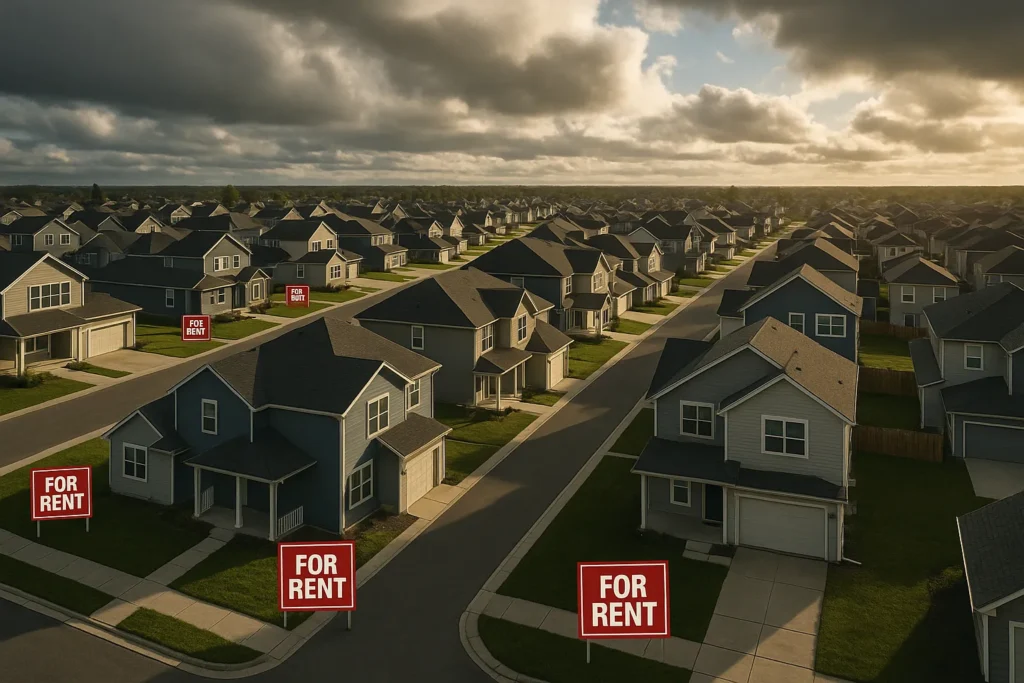
Key Takeaways
- I’ve been watching the same video clip circulate in three different Facebook groups this week.
- But here’s the critical context the doom narrative omits: supply grew faster than demand.
- Professional STR operators, those running multiple properties with dynamic pricing tools, professional photography, and systematized guest communication, are holding occupancy rates around 60%.
- Some markets are genuinely difficult right now.
I’ve been watching the same video clip circulate in three different Facebook groups this week. A man in a baseball cap, standing in what looks like a vacation rental kitchen, shaking his head. “The STR market is done,” he says. “Completely oversaturated. Get out while you can.”
The comments below: hundreds of panicked hosts agreeing. Dozens more sharing horror stories from Phoenix. Austin. Scottsdale.
I spent the past week pulling apart the actual data behind these claims. What I found is a story more complicated, and more interesting, than either the doom-scrollers or the cheerleaders want you to believe.
Where the “Oversaturation” Narrative Comes From
The panic has a specific origin point. In mid-2023, a real estate consultant named Nick Gerli posted a viral thread citing data from AllTheRooms showing revenue-per-listing in Phoenix had dropped nearly 47% comparing May 2022 to May 2023. Austin showed similarly dramatic declines. The posts spread widely, and the phrase “Airbnb bust” entered the short-term rental conversation like a splinter that never quite came out.
The thing is: those numbers were disputed almost immediately.
AirDNA’s chief economist, Jamie Lane, pushed back publicly. His firm’s data showed declines of 3% to 10% nationally, not 47%. An ABC15 investigation in Phoenix dug into the methodology. The AllTheRooms figures, analysts noted, compared a single month at the absolute peak of post-pandemic travel demand to that same month the following year, when supply had grown substantially. It also tracked Airbnb listings only, without deduplicating across platforms like VRBO. Mark Stapp, a real estate professor at Arizona State, told ABC15 he “sincerely doubted” the 40% figures reflected actual market conditions.
That doesn’t mean the pain wasn’t real. It was. But the 50% revenue collapse became a narrative shorthand that outlasted the nuance that should have accompanied it.
What the Data Actually Shows About Short Term Rental Market Saturation
Let’s look at what we actually know.
Occupancy did decline in 31 of the top 50 US short-term rental markets. The national average occupancy rate, which spiked above 60% during the pandemic travel boom, has normalized back toward the mid-50s. The US market now holds 1,709,603 active short-term rental properties. Demand growth, which ran at 15.8% in 2021, has decelerated to a projected 5.5% in 2026.
Those are real shifts. But here’s the critical context the doom narrative omits: supply grew faster than demand. Supply expanded at nearly 20% annually at its peak. The market wasn’t just losing travelers, it was adding listings at a pace that would have pressured occupancy no matter what.
When you have more plates and the same amount of food, everyone gets a smaller serving. That’s not necessarily a crisis. It’s math.
For deeper context on where the market stands today, our own analysis in The State of Short-Term Rentals in 2026 breaks down exactly which segments are winning and which are getting squeezed.
The Markets Nobody Is Talking About
Here’s what the “Airbnb is dead” crowd consistently gets wrong: they’re describing a national average and applying it universally.
Secondary and rural markets grew 13.76% year-over-year. Suburban areas posted 8.1% growth. While Phoenix and Austin were grabbing headlines, smaller markets, think drive-to destinations, mountain towns, lake communities, secondary cities, were quietly outperforming.
New Orleans and Las Vegas, driven by year-round event calendars and deep tourism infrastructure, have continued to show demand fundamentals that top-50-market averages mask. Markets with major catalysts ahead are performing differently still. Philadelphia, Jersey City, and Dallas are projected to see RevPAR (revenue per available rental) growth of 5.5% to 6.3% in 2026, largely driven by FIFA World Cup 2026 demand.
The geography of short-term rental saturation is highly localized. A market that’s overbuilt in one city can be undersupplied thirty miles away. Treating “Airbnb is oversaturated” as a national verdict is like saying “the restaurant business is dying” because midtown Manhattan is competitive.
The Supply Flood Is Slowing
One of the most underreported developments in the STR market right now: the supply wave is receding.
AirDNA’s 2026 Outlook Report, published in December 2025, projects supply growth of just 4.6%, a fraction of the 20% peak expansion rates that defined 2021 and 2022. That’s a meaningful structural shift. The flood of new listings that created the pressure on occupancy rates is slowing to a trickle.
At the same time, regulatory pressure is acting as a natural supply limiter. As we covered in STR Regulations Are Tightening Everywhere, cities across the country are implementing stricter permitting, registration requirements, and compliance frameworks that are effectively removing non-compliant listings from the market. Tighter rules don’t just create headaches, they thin the competitive field for operators who have their houses in order.
AirDNA CEO Rohit Bezewada said publicly in December that 2026 is “opening meaningful opportunities for both new and experienced operators”, calling it the best year to invest in short-term rentals since 2021.
The Real Divide: Professional Operators vs. Casual Hosts
This is the part of the story I find most compelling.
Professional STR operators, those running multiple properties with dynamic pricing tools, professional photography, and systematized guest communication, are holding occupancy rates around 60%. Casual hosts, the “set it and forget it” crowd who listed a spare room or second home during the pandemic and haven’t updated their approach since, are averaging closer to 54%.
That six-point gap sounds modest. But at scale, with average daily rates in many markets running $150 to $250 per night, the difference between 54% and 60% occupancy across a full year is thousands of dollars per property. The gap is also widening, not narrowing.
Professional operators are investing in pricing software, direct booking channels, and guest experience infrastructure. They’re treating compliance as a competitive moat, if regulations thin the casual host supply, they capture that demand. They’re diversifying across markets rather than concentrating in a single city.
The short-term rental market isn’t dying. It’s professionalizing. And the hosts who recognized that shift early are doing fine.
What Smart Hosts Are Doing Right Now
The investigative picture that emerges from all of this isn’t a crash story. It’s a maturation story.
The operators performing well in 2026 share a few common practices. They’ve moved to dynamic pricing, manual price-setting is simply not competitive anymore against operators using tools that adjust rates in real time based on local demand signals. They’ve invested in their listings: professional photos, detailed descriptions, strong review management. And they’ve paid attention to geography, either choosing markets with strong event demand and tourism infrastructure, or pivoting toward secondary and rural markets where competition is still thin.
The StaySTRA Analyzer is one of the tools smart investors are using to cut through the noise, pulling actual market-level data on occupancy, ADR, and revenue trends before committing to a market, not after.
The operators struggling in 2026 are largely those who entered during the pandemic, set a static price, and expected the returns to keep compounding indefinitely. That model worked for about eighteen months. It doesn’t anymore.
The Real Story
Here’s the honest verdict after a week of digging.
Short term rental market saturation is real, in specific markets, in specific property types, for specific operator profiles. The top 50 US markets saw occupancy decline in 31 of them. That’s not nothing.
But the national narrative of an Airbnb collapse doesn’t hold up. Secondary markets are growing. Supply growth is decelerating. Regulatory pressure is removing the marginal hosts who drive down quality and price. Professional operators are widening their advantage over casual hosts. And the overall market, measured in nights booked, continues to grow, just at a more sustainable pace than the pandemic boom suggested was normal.
The Facebook clip guy in the baseball cap isn’t entirely wrong. Some markets are genuinely difficult right now. But “get out while you can” is terrible advice when what the data actually suggests is: know your market, run your operation professionally, and stop extrapolating from someone else’s bad experience in Phoenix.
We do our best to keep our reporting accurate and up to date, but situations evolve and we are only human. Always verify current details directly with local officials and sources before making decisions.
Know Your Market Before You Move
Our free StaySTRA Analyzer pulls real market data so you can see what properties are actually earning in your target area, occupancy rates, average daily rates, and revenue projections grounded in actual booking data, not viral Twitter threads.
Frequently Asked Questions
Who is Loretta on the StaySTRA blog?
Loretta is a beloved voice on the StaySTRA blog who shares stories, advice, and commentary about the short-term rental industry with her signature Southern charm. Her posts blend humor with practical hosting insights, making complex industry topics approachable and entertaining. She has become a favorite among the StaySTRA community for her candid storytelling.
What topics does Loretta cover on StaySTRA?
Loretta writes about everything from wild guest stories and hosting mishaps to tax strategies and industry news. She is known for her reader mailbag columns, humorous takes on hosting challenges, and ability to make even dry regulatory topics engaging. Her Southern style brings warmth and personality to the short-term rental conversation.
What is AirDNA and how do STR investors use it?
AirDNA is a data analytics platform that provides short-term rental market data including average daily rates, occupancy rates, revenue estimates, and supply trends for virtually any market in the United States. Investors use AirDNA to evaluate potential markets, underwrite specific properties, and track competitive performance. Subscription plans start at around $20 per month for a single market.
What are the Airbnb rules in Austin, Texas?
Austin distinguishes between Type 1 (owner-occupied) and Type 2 (non-owner-occupied) STR licenses. Type 2 licenses are no longer being issued in most residential zones, making existing licenses valuable. All operators must obtain a license, collect hotel occupancy taxes, post the license number on listings, and comply with occupancy and noise restrictions.
Is Austin still a good market for short-term rentals?
Austin remains strong for STRs due to its robust event calendar (SXSW, ACL, F1), tech sector business travel, and tourism appeal. However, restrictive regulations on non-owner-occupied properties have limited new supply, which benefits existing permitted operators. Investors should focus on Type 1 properties or look at surrounding areas with fewer restrictions.