

Key Takeaways
- The greater Orlando metro area has over 53,000 active short-term rentals across five major submarkets, making it one of the largest STR concentrations in the United States.
- Kissimmee leads in revenue at $3,539 per month with a $250 ADR, while Winter Park leads in occupancy at 71% with a much lower $168 ADR.
- The Disney corridor (Kissimmee and Davenport) accounts for roughly 41,000 listings, nearly 78% of metro supply, and 37.8% of Kissimmee listings are five-bedroom homes or larger.
- Epic Universe opened in May 2025 and drove a 12% jump in STR demand, though ADR dipped 3% as the massive supply absorbed the surge.
- Davenport offers the lowest entry point at $339,474 typical home value with $3,047 monthly STR revenue, giving it the tightest price-to-revenue ratio in the metro.
The greater Orlando metro has 53,000 active short-term rentals and they earned an average of $250 per night in the Disney corridor last year, $202 per night in urban Orlando, and $168 per night in Winter Park. Those are not rounding errors. They represent three entirely different businesses operating under the same “Orlando vacation rental” umbrella.
Think of it like walking through a department store. The ground floor sells designer handbags at full markup, the second floor moves mid-range clothing at steady volume, and the basement clears discount items fast. All three are profitable. But you would never evaluate the handbag counter using the basement’s metrics. The same logic applies to Orlando’s STR zones, and I have spent the last two weeks pulling apart the numbers to show you exactly where each zone stands in early 2026.
StaySTRA data tracks five cities across the Orlando metro, and the performance gaps between them tell you more about where to invest than any single “Orlando average” ever could.
How Big Is This Market, Really?
Let me put a number on it that surprises most people.
StaySTRA’s proprietary data shows 53,060 active short-term rental listings across the five cities that make up greater Orlando: Kissimmee (31,888), Orlando proper (9,661), Davenport (9,372), Clermont (1,922), and Winter Park (217). That is not a typo. Over fifty-three thousand vacation rentals competing for bookings in one metro area.
For context, 75.3 million people visited Orlando in 2024 according to Visit Orlando’s official data, generating $93 billion in economic impact. Then Universal opened Epic Universe in May 2025, nearly doubling the resort’s footprint to 750 acres. Orange County tourist tax collections broke records in five consecutive months after that opening.
Demand is not Orlando’s problem. Supply distribution is.
The Three Zones That Actually Matter
I could slice the Orlando metro a dozen different ways, but after forty years of looking at market data, I have found that three zones tell the story clearly. Let me walk you through each one, starting with the biggest.
Zone 1: The Disney Corridor (Kissimmee and Davenport)
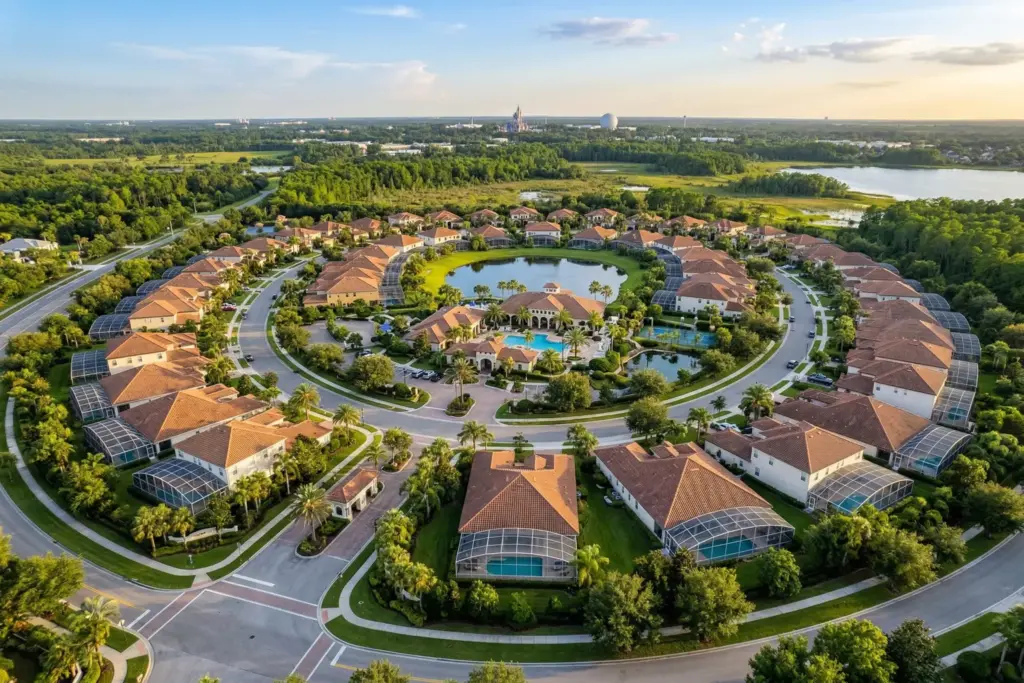
This is the engine room. Kissimmee and Davenport together account for 41,260 active listings, roughly 78% of the entire metro’s supply. These are the large vacation homes with private pools that families book for their Disney trips. In Kissimmee alone, 37.8% of all listings have five or more bedrooms. That is 13,943 big houses fighting for the same family-of-eight booking.
Here is the performance picture from StaySTRA data.
| Metric | Kissimmee | Davenport |
|---|---|---|
| Active Listings | 31,888 | 9,372 |
| LTM Average Daily Rate | $250 | $228 |
| LTM Occupancy | 61.3% | 60.0% |
| LTM Monthly Revenue | $3,539 | $3,047 |
| Typical Home Value | $356,106 | $339,474 |
| Pool Availability | 72.3% | N/A |
Now, don’t let those occupancy numbers discourage you. Sixty-one percent across 31,888 listings is actually strong when you understand the seasonal swing. Kissimmee peaked at 77.4% occupancy in March 2025 with $4,714 in monthly revenue and bottomed at 43.3% in September 2024 with just $2,343. That is a $2,371 monthly gap between peak and trough, which means your cash flow planning matters as much as your nightly rate.
Davenport is the quiet performer here. It earns less per month than Kissimmee, but the entry price is $17,000 lower on a typical home. For investors focused on the ratio of purchase price to monthly revenue, Davenport is the tightest deal in the metro right now.
Zone 2: The I-Drive and Theme Park Corridor (Orlando Proper)
Orlando’s 9,661 listings look nothing like the Disney corridor. This zone includes the International Drive tourist strip, the Universal area, and the neighborhoods ringing the convention center. The property mix skews heavily toward condos and smaller units. Only 929 listings (6.9%) have five or more bedrooms. Compare that to Kissimmee’s 37.8% and you are looking at a completely different business model.
StaySTRA data shows Orlando proper earning $2,772 per month at a $202 ADR with 64.5% occupancy. Lower ADR, higher occupancy. That is the trade-off.
The I-Drive zone benefits from something the Disney corridor does not: year-round convention and business travel. The Orange County Convention Center hosts major events that fill nearby STRs on weekdays when family-oriented Kissimmee properties sit empty. Orlando’s September occupancy held at 50%, while Kissimmee dropped to 43.3%. Seven percentage points does not sound like much, but spread across a full year, that steadier booking pattern means fewer dead weeks.
Epic Universe is already reshaping this zone. STR demand in Metro Orlando jumped 12% after the May 2025 opening, and bookings were pacing 15% ahead of the prior year through the summer. But here is the number that should catch your attention: ADR actually fell 3% despite the demand surge. The sheer volume of available supply absorbed the new visitors without pushing prices up. That tells you the I-Drive corridor is a volume game, not a pricing game.
Zone 3: Urban Orlando and Winter Park
This one surprises people.
Winter Park, with just 217 active listings, has a StaySTRA market score of 77.76, the highest of any city in the metro. Its occupancy runs at 71%, nearly ten percentage points above Kissimmee. The ADR is just $168 per night, which is the lowest in the metro, but the consistency makes up for it.
I keep a piece of Pueblo pottery on my desk that my daughter bought me from a Winter Park antique shop years ago. Nice town. But what makes it interesting for STR investors is not the charm. It is the booking pattern.
Winter Park and the broader urban Orlando zone attract a different guest entirely. Business travelers, wedding attendees, Rollins College parents, medical patients visiting the nearby hospitals. These guests book shorter stays but they book year-round. The 71% occupancy is not driven by one big March peak and a September valley. It spreads more evenly across the calendar.
The catch? Typical home values in Winter Park run $453,291, nearly $100,000 more than Kissimmee and $114,000 more than Davenport. The revenue does not scale with the purchase price. At $2,298 monthly revenue on a $453,000 home, the gross yield math is significantly weaker than the Disney corridor.
The Full Metro Comparison
Let me lay the whole picture out in one place. I find tables like this settle more arguments than paragraphs ever could.
| City | Listings | ADR | Occupancy | Monthly Rev | Home Value | Market Score |
|---|---|---|---|---|---|---|
| Kissimmee | 31,888 | $250 | 61.3% | $3,539 | $356,106 | 67.15 |
| Davenport | 9,372 | $228 | 60.0% | $3,047 | $339,474 | 64.69 |
| Orlando | 9,661 | $202 | 64.5% | $2,772 | $367,867 | 66.47 |
| Clermont | 1,922 | $196 | 61.1% | $2,665 | $425,524 | 62.96 |
| Winter Park | 217 | $168 | 71.0% | $2,298 | $453,291 | 77.76 |
See it? The highest-revenue market (Kissimmee) and the highest-occupancy market (Winter Park) are not the same place. That is the single most important insight in the entire Orlando STR dataset. What you optimize for determines where you should buy.
Where the Seasonal Money Actually Flows
Stay with me here, because this part is worth understanding if you are planning cash flow for an Orlando rental.
I pulled the monthly revenue data from StaySTRA for Kissimmee and Orlando proper, and the seasonal curves tell very different stories.
Kissimmee monthly revenue (2024-2025):
- March (peak): $4,714 at 77.4% occupancy
- July (summer peak): $4,427 at 74.2% occupancy
- June 2025: $4,004 at 66.7% occupancy
- February: $3,975 at 75% occupancy
- December (holidays): $3,436 at 51.6% occupancy
- September (trough): $2,343 at 43.3% occupancy
Kissimmee’s revenue swings 101% from trough to peak. That is like running two different businesses depending on the month.
Orlando proper monthly revenue (2024-2025):
- March (peak): $3,590 at 75.9% occupancy
- June 2025: $3,236 at 70% occupancy
- February: $3,192 at 76.9% occupancy
- January: $2,739 at 63.6% occupancy
- September (trough): $2,018 at 50% occupancy
Orlando’s swing is 78% from trough to peak. Still significant, but meaningfully flatter than the Disney corridor. If predictable monthly income matters more to you than chasing the highest possible peak, the I-Drive and urban zones offer a smoother ride.
The Epic Universe Effect on 2026 Numbers
Universal’s Epic Universe opened May 22, 2025, and the data is already visible in the numbers. According to the Orlando Sentinel, Orange County tourist tax collections hit $355.1 million through the first 11 months of fiscal year 2024-25, already within striking distance of the prior full-year record of $359.4 million. August 2025 collections alone jumped 11% year over year.
For STR hosts, the impact has been real but uneven. Demand jumped 12% and bookings were pacing 15% ahead, but ADR dipped 3%. The Orlando Economic Partnership projects the park will generate $1 billion in additional tax revenue and nearly 18,000 direct jobs. The demand pipeline is not slowing down.
But here is what I think matters most for STR investors. Epic Universe is stretching average stays from two or three days to four or five days. Longer stays mean fewer turnovers, lower cleaning costs, and better net margins. If your property is set up for families doing a week-long multi-park trip, you are positioned to capture that extended-stay revenue more effectively than a hotel room.
What This Means for Investors in 2026
After sifting through the data from all five markets, here is where I land.
If you want the highest gross revenue, Kissimmee is still the answer. The $3,539 monthly average with a $250 ADR is hard to beat, and the $356,106 entry price gives you a reasonable gross yield. But you need to plan for a brutal September and October. Build a reserve fund or find a way to market to off-season guests (think locals using pools for birthday parties, sports tournament families, corporate retreat groups).
If you want the best entry-price-to-revenue ratio, look at Davenport. At $339,474 typical home value generating $3,047 per month, the math is compelling. Less competition than Kissimmee’s 31,888 listings. Fewer headlines, fewer investors looking there. That can be an advantage.
If you want occupancy consistency and lower management headaches, urban Orlando and Winter Park are worth the higher entry price. The 71% occupancy in Winter Park with its diverse guest base means fewer gaps in your calendar. Fewer frantic adjustments between peak and off-season pricing. The trade-off is real: lower ADR, higher purchase price, smaller checks each month. But the steadiness has its own value, especially if this is your first property or you are managing from out of state.
One thing I would not do: buy in Clermont expecting Disney spillover to carry the numbers. At $425,524 for a typical home producing $2,665 per month, the yield is the weakest in the metro. Clermont has other things going for it as a place to live, but the STR math does not pencil the way the other zones do.
We do our best to keep our data accurate and up to date, but markets move fast and we are only human. Always verify current figures directly with local sources before making investment decisions.
Frequently Asked Questions
What is a good occupancy rate for an Airbnb in Orlando?
The metro-wide average ranges from 60% to 65%, but location matters enormously. Winter Park averages 71% occupancy due to its year-round business and event traffic, while Kissimmee averages 61.3% with sharp seasonal swings between a 77% peak in March and 43% trough in September. A well-managed property in any Orlando zone should target at least 65% annual occupancy.
How much do Orlando Airbnb hosts earn per month?
Monthly revenue varies significantly by zone. Kissimmee hosts average $3,539 per month, Davenport hosts average $3,047, Orlando proper averages $2,772, and Winter Park averages $2,298. These are market-wide averages from StaySTRA data. Top-performing properties in the Disney corridor can earn $4,700 or more during peak months.
Is Kissimmee or Orlando better for a vacation rental investment?
It depends on your strategy. Kissimmee offers higher revenue ($3,539/mo) and lower home prices ($356,106) but extreme seasonality and intense competition from 31,888 listings. Orlando proper offers steadier occupancy (64.5%) and convention-driven demand but lower monthly revenue ($2,772). Kissimmee is better for maximizing gross income while Orlando is better for booking consistency.
How has Epic Universe affected Orlando short-term rental demand?
Since Epic Universe opened in May 2025, STR demand in Metro Orlando increased 12% and bookings paced 15% ahead of the prior year. However, average daily rates dipped 3% because the large existing supply absorbed the new visitors. The biggest benefit has been longer stays, with average visits extending from two or three days to four or five days.
What is the average daily rate for a vacation rental in Orlando in 2026?
Average daily rates vary by zone. The Disney corridor (Kissimmee) averages $250 per night, Davenport averages $228, Orlando proper averages $202, and Winter Park averages $168. Larger properties with pools in the Disney corridor regularly command $300 or more per night during peak season months like March and July.
Run the Numbers for Orlando
Want to see how these numbers play out for a specific property? Our free Orlando Airbnb Calculator pulls real market data so you can estimate revenue, occupancy, and expenses. For Kissimmee properties, use our Kissimmee Airbnb Calculator instead.
For a deeper look at the market including active rental counts, average daily rates, and neighborhood-level data, check out our Orlando market profile, Kissimmee market profile, or Davenport market profile.
Stay in the Loop
Markets shift. Data changes. New opportunities emerge. Join the StaySTRA Insider newsletter and we will keep you updated on the numbers that matter.
Become a StaySTRA Insider
Join free — get our newsletter + 1 free property analysis/month.
No spam. Unsubscribe anytime. Free membership includes property analyses and market insights.