
Key Takeaways
- Panama City Beach enters Q4 2026 with occupancy up 19.9% year-over-year, one of the strongest recovery trajectories in the state.
- Orlando/Kissimmee holds Florida’s top market score at 95.64, driven by 62,000+ active listings and consistent year-round theme-park demand.
- The 30A corridor (Santa Rosa/Rosemary Beach) commands the highest average daily rate in Florida at $477 and the highest monthly revenue at $6,357.
- Jacksonville/St. Augustine ranks second statewide on market score (89.82) with the most accessible entry prices among Florida’s top performers.
- Florida’s state preemption law protects STR operators from local bans in most municipalities, but a DBPR license ($170-$180/yr) is required statewide and county tourist development taxes apply in all but five counties (Source).
Panama City Beach entered Q4 2026 with occupancy up 19.9% year-over-year. Think of that figure the way you would think of a tide gauge reading: it is not just measuring the current level, it is telling you the water is rising fast. That kind of sustained demand acceleration, held through the shoulder season, is exactly the signal long-term investors look for.
In 40 years of working with market data, I have learned to distrust headlines that treat a state as a single number. Florida has more active STR listings than any other state, and more internal diversity to match. A beach house in Destin and a townhouse outside Disney World are both “Florida Airbnbs.” The similarity ends there. Different demand drivers, different seasonal curves, different permit landscapes, and very different investor profiles fit each one.
StaySTRA data covers 35 distinct Florida submarkets. What follows is a market-by-market breakdown of where the numbers actually point investors heading into the spring 2027 buying season. I will cover eight markets: the Destin/30A Emerald Coast corridor, Orlando/Kissimmee, Miami/Fort Lauderdale, Tampa/St. Pete, Naples/Fort Myers, Jacksonville/St. Augustine, Key West, and Panama City Beach.
If you want to run current projections for any of these markets against a specific property, the StaySTRA Analyzer will give you a live revenue estimate. But first, let me walk you through what the headline data actually shows.
Why Florida Is the STR Megastate
Florida accounts for a larger share of total U.S. STR listings than any other state. StaySTRA tracks over 35 active Florida submarkets, and that count does not include the dozens of smaller beach towns and lake communities that feed into the larger regional picture. The practical meaning for investors is twofold: supply is competitive, but demand is also broader and more resilient than most markets in the country.
Florida also benefits from a state preemption framework that most investors do not fully appreciate. Under Florida statute F.S. 509.032(7)(b), local governments are prohibited from enacting ordinances that ban STRs outright or regulate the duration or frequency of rentals. That legal architecture removes a category of regulatory risk that haunts investors in New York, California, and Massachusetts. You still need permits (more on that below), but the baseline risk of waking up to a ban is structurally lower in Florida than almost anywhere else in the country.
With that context in place, here is how the markets stack up.
Florida STR Market Comparison (2026)
The table below summarizes headline metrics for each market covered. Occupancy and ADR figures reflect September 2026 trailing data (StaySTRA). Market score reflects composite scoring on a 0-100 scale, combining revenue growth, rental demand, investability, regulation environment, and seasonality stability. Listing count reflects active platform listings.
| Market | Avg Occupancy | Avg ADR | Market Score | Active Listings |
|---|---|---|---|---|
| Orlando/Kissimmee | 50.2% | $212 | 95.64 | 62,600+ |
| Jacksonville/St. Augustine | 51.4% | $217 | 89.82 | 13,500+ |
| 30A / Santa Rosa Beach | 51.3% | $477 | 62.67 | 19,600+ |
| Panama City Beach | 55.6% | $287 | 61.35 | 18,700+ |
| Destin/Fort Walton Beach | 58.0% | $347 | 59.18 | 11,500+ |
| Sarasota | N/A | N/A | 64.77 | 22,100+ |
| Fort Lauderdale | N/A | N/A | 57.79 | 24,000+ |
| Tampa | 51.8% | $147 | 55.93 | 11,300+ |
| Miami | 51.3% | $196 | 55.04 | 31,300+ |
| Key West | 39.5% | $426 | 56.97 | 9,000+ |
| Naples/Fort Myers | 35.9% | $254 | 42.24 | 10,200+ |
Source: StaySTRA data. Occupancy and ADR: trailing September 2026. Market scores: composite as of mid-2026. Sarasota and Fort Lauderdale occupancy/ADR pending current-period refresh.
Orlando/Kissimmee: The Depth Market
With more than 62,000 active listings and a market score of 95.64, Orlando is not just the largest STR market in Florida. It is the highest-scoring STR market in the entire state. That number surprises people who assume the biggest market must be the most crowded. Stay with me here: market score is not a measure of competition level. It is a composite of revenue growth trajectory, rental demand durability, investment entry conditions, regulation environment, and how predictably the market performs across all four seasons.
Orlando scores extraordinarily high on all three controllable factors. Revenue growth hit 7.1% year-over-year through September 2026. Occupancy reached 50.2%, up 5.8% from the same period last year. ADR came in at $212. None of those numbers are Florida’s most dramatic, but the consistency across 62,000 listings is remarkable. Theme parks are a demand generator that does not require a weather window.
The investor case for Orlando is built around volume, stability, and lower entry prices relative to coastal markets. The trade-off is that competition is real. With 62,000 listings, quality differentiation matters more here than anywhere else in Florida. A well-located, well-reviewed property in Kissimmee or the Disney corridor will outperform the market average significantly. A generic listing in an oversupplied zone will not.
Permit note: You need both a state DBPR license and either an Orange County or Osceola County vacation rental registration depending on your property location. Orange and Osceola have different operational rules. Verify your county before closing.
Live data for the Orlando market is on the StaySTRA Orlando location page.
Jacksonville/St. Augustine: Florida’s Best Value Market
If you asked me to point to one market where I think investors are systematically underpricing the opportunity, I would point to Jacksonville. The market score is 89.82, second only to Orlando in all of Florida. Revenue jumped 14.8% year-over-year through September 2026. Occupancy sits at 51.4%, up 7.3% from last year. ADR is $217.
Think of Jacksonville the way you would think of a stock trading at a discount to its peers with better fundamentals. The market has roughly 13,500 listings, which is large enough to give you comparable data and competition you can study, but small enough that a well-positioned property does not get lost in the noise the way it might in Orlando or Miami.
The Jacksonville/St. Augustine metro combines the infrastructure of a major port city with the heritage tourism draw of St. Augustine, the oldest city in the continental United States. That two-driver combination produces a more balanced occupancy curve than pure beach markets, which is why the seasonality component of Jacksonville’s market score is among Florida’s strongest.
Entry prices are also the most accessible among Florida’s top-performing markets. That combination of high market score, strong revenue growth, and lower acquisition cost is where the data-driven investor case is clearest.
Current market data is on the StaySTRA Jacksonville location page.
Destin/30A Emerald Coast: Florida’s Premium Tier
The Emerald Coast corridor is really two adjacent markets sharing one stretch of the Florida Panhandle: Destin/Fort Walton Beach to the west, and the 30A corridor (Santa Rosa Beach, Seaside, Watercolor, Rosemary Beach) to the east. Both are premium-tier markets. The data distinguishes them meaningfully.
Destin/Fort Walton Beach leads the Florida markets covered here on occupancy at 58.0%, with a 14.6% year-over-year improvement entering Q4 2026. ADR sits at $347 and monthly revenue averaged $5,453. RevPAR for Destin in the peak summer window was second only to 30A among Florida markets in the data.
The 30A corridor shows a different profile. Occupancy is 51.3%, but that figure comes with the highest ADR in Florida at $477 and the highest average monthly revenue in Florida at $6,357. Year-over-year occupancy growth on 30A reached 20.8%, the largest single-market occupancy improvement among the markets covered here entering this period.
What the lower market scores on both Destin (59.18) and 30A (62.67) are telling you is this: the seasonality component pulls the composite down significantly. Both markets run peak performance in summer and measurably lower in winter. That seasonality is real and investors need to plan around it. But within season, the demand and rate performance here is as strong as anywhere in the country.
If your financing requires year-round revenue consistency, the Panhandle beach markets will stress-test that assumption. If you can operate with a summer peak and shoulder-season cash flow structure, the ADR ceiling here is legitimately exceptional.
Explore live market data at the StaySTRA Destin location page. For current revenue projections on 30A properties, the StaySTRA Analyzer will show you exactly where the numbers land today.
Panama City Beach: The Comeback Story
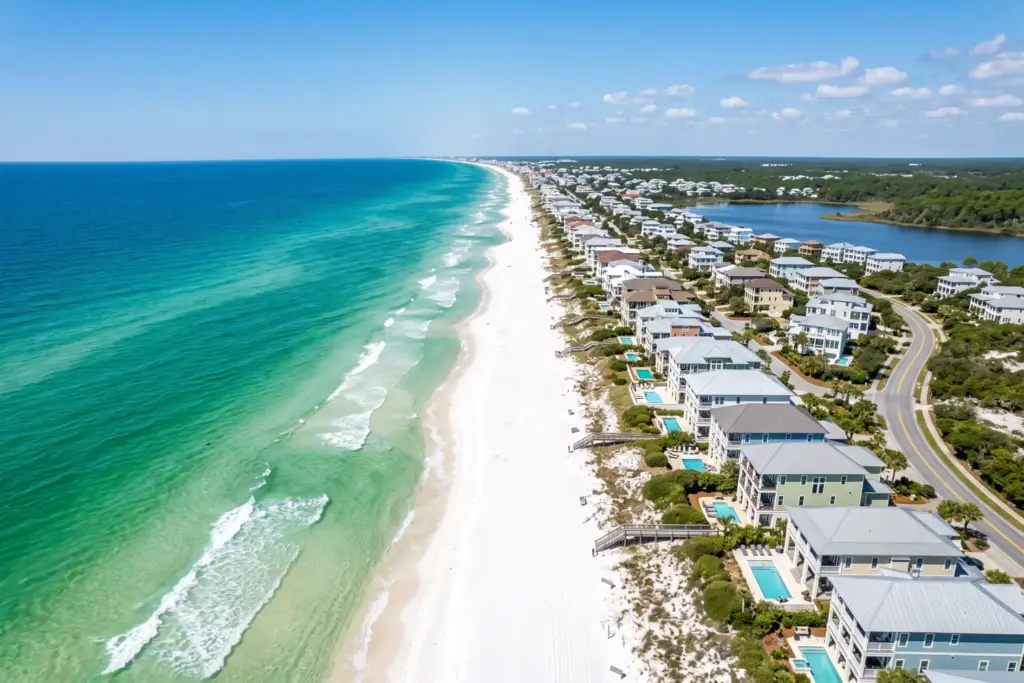
Panama City Beach is the data story of Q4 2026 in Florida. Occupancy hit 55.6% in September, up 19.9% year-over-year. Monthly revenue reached $4,425, up 17.8% from a year ago. ADR climbed to $287, a 7.9% increase. Market score sits at 61.35.
Don’t let that market score be the number that stops you from reading further. The seasonality drag that limits the composite is real, but the underlying demand recovery here is one of the most consistent in the state. Panama City Beach is a working beach town: large families, spring break crowds, and summer vacationers. That breadth of demand is actually a stabilizing factor over time, even if it concentrates into a narrower seasonal window than year-round markets.
The 30A corridor commands a higher ADR, but Panama City Beach offers a more accessible entry price and a similar-size listing pool (18,700+ vs. 19,600+ on 30A) that gives you better comparable data and more competition you can study and outperform.
For investors who want Panhandle beach exposure without paying 30A prices, Panama City Beach is worth a serious look. The recovery trajectory heading into Q4 is clear.
See current data on the StaySTRA Panama City Beach location page.
Miami/Fort Lauderdale: The Premium Urban Market
Miami is Florida’s most globally recognized STR market and also one of the most complex. The city has 31,300+ active listings, one of the largest single urban STR pools in the country. ADR sits at $196 with occupancy at 51.3%. Revenue averaged $2,834 per month through September 2026, with ADR growing 10.2% year-over-year.
The market score of 55.04 reflects one genuine constraint: Miami Beach has pre-2011 grandfathered restrictions that allow additional regulation on short-term rentals in certain neighborhoods. If you are considering a Miami Beach property specifically, verify the zoning and permit status before closing. Properties in unincorporated Miami-Dade and other Miami neighborhoods operate under the standard Florida preemption framework.
Fort Lauderdale adds another 24,000 listings to the broader market, with RevPAR growing 10.1% year-over-year. Combined, the Miami/Fort Lauderdale metro represents a massive, highly liquid STR market where competition is intense and quality differentiation drives outsized results. World Cup 2026 drove ADR gains across Miami that have partially sustained into the shoulder season.
The investor case for Miami is not primarily about finding undervalued markets. It is about finding specific properties within a well-established demand pool where you can compete on quality, location, or unique positioning.
Live market data: StaySTRA Miami location page and StaySTRA Fort Lauderdale location page.
Tampa/St. Pete: The Year-Round Urban Market
Tampa runs different numbers than most Florida markets, and the difference is worth understanding clearly. Occupancy is 51.8%, up 5.9% year-over-year. ADR is $147, the lowest among Florida markets covered here. Monthly revenue averaged $2,124. Market score: 55.93.
Think of Tampa ADR the way you might think of an economy airline: lower ticket price, higher load factor. The revenue case is built on volume and consistency, not premium pricing. Tampa’s rental demand score within the composite is 82.09, which is actually quite strong. The ADR suppression comes from a large supply of budget-tier listings pulling the average down, not from weak demand overall.
St. Petersburg offers a higher price point within the same metro. ADR there runs at $220, occupancy at 47.3%, and monthly revenue averaged $2,937. St. Pete benefits from its walkable arts district and waterfront character, which supports a meaningful premium over the broader Tampa base.
Tampa/St. Pete is a strong market for investors who prioritize lower acquisition cost, year-round demand, and consistent cash flow over peak-season rate maximization. The seasonality score in Tampa’s market composite is 78.82, confirming that this market does not crater in winter the way coastal beach markets do.
More Tampa data is at the StaySTRA Tampa location page.
Key West: The Constraint Play
Key West has the second-highest ADR in Florida at $426 and monthly revenue of $4,942. Occupancy runs at 39.5%, which looks low until you understand why. Key West has the most constrained listing supply in the state: roughly 9,000 listings across an island where buildable land has been effectively exhausted for decades. Occupancy is lower because the island’s regulations and geography physically cap the number of units available, not because demand is soft.
The market score of 56.97 reflects strong revenue and ADR scores offset by lower rental demand and regulation complexity. Monroe County and the City of Key West have their own registration requirements layered on top of state licensing, and property availability is genuinely limited.
Investors who buy into Key West are buying into a supply-constrained luxury market. Entry prices are among the highest in Florida. The upside: supply cannot catch up with you. Nobody is building new STR inventory on an island roughly 4 miles long and 1.5 miles wide (Source). The downside: the lower occupancy rate means your revenue depends more heavily on rate than on nights booked, which amplifies the impact of pricing and listing quality on your results.
Data and details: StaySTRA Key West location page.
Naples/Fort Myers: The Winter Seasonal Market
Naples is one of the few Florida markets where the seasonality story runs backward from the Panhandle. Winter is the peak: snowbirds, retirees, and Gulf Coast sun-seekers drive November through April demand. September occupancy sits at 35.9%, but it is growing (up 15.5% year-over-year) as shoulder-season demand builds. ADR is $254 and monthly revenue averaged $2,592 in the September trailing period.
The market score of 42.24 reflects the genuine challenge: a short winter peak window requires significant revenue concentration in four to five months to justify year-round carrying costs. For the right investor profile, someone who intends to use the property personally during summer and monetize it during the snowbird season, Naples works well. For investors who need year-round revenue to service debt, the seasonality concentration creates real risk.
Fort Myers (Cape Coral area) within the broader Southwest Florida corridor offers a lower entry price with similar demand characteristics and a multi-year recovery trajectory following 2022 hurricane activity.
Current data: StaySTRA Naples location page and StaySTRA Fort Myers location page.
Florida STR Permits and Compliance in 2026
Before placing an offer on any Florida STR property, understand the three-layer permit requirement.
State level: Florida requires a DBPR vacation rental license for any property rented more than three times per year for periods under 30 days. Fees run $170-$180 per year. This is non-negotiable statewide.
County level: All but five counties levy a Tourist Development Tax (TDT) (Source). The state adds 6% sales tax on short-term rentals, and county TDT adds another 2-6% in most counties (Source). Booking platforms typically handle collection, but confirm with a local tax professional.
Municipal level: Most Florida municipalities cannot ban STRs under the preemption framework, but they can regulate operational elements: noise, parking, occupancy limits, and safety inspections. Miami Beach is the major exception with grandfathered pre-2011 restrictions. Always verify zoning and permit requirements at the specific address level, not just the general market.
For a detailed breakdown of Florida’s preemption framework, the Florida STR Laws 2026 investor guide covers the statute history and what it means market by market.
Decision Framework: Which Florida Market Fits Your Investor Profile
Not every Florida market is the right fit for every buyer. Here is a plain-English framework based on the data.
Highest market score and year-round stability: Orlando/Kissimmee (score 95.64). Theme-park demand is weather-independent. The trade-off is competition at scale. Quality and location matter more here than anywhere else in the state.
Best combination of value and performance: Jacksonville/St. Augustine (score 89.82). Revenue growing 14.8% YoY, accessible entry price, strong seasonality score. This is the market where the numbers say opportunity has not yet been fully priced in.
Highest ADR ceiling, seasonal concentration accepted: 30A/Santa Rosa Beach. ADR $477, revenue $6,357/mo. Premium entry cost, shorter high-revenue window, but the ceiling on per-night revenue is exceptional.
Beach market with recovery momentum and accessible entry: Panama City Beach. Occupancy up 19.9% YoY, revenue up 17.8% YoY. Not as premium as 30A but performing faster on a recovery basis.
Year-round demand without beach seasonality: Tampa or Jacksonville. Both have strong rental demand scores, consistent occupancy curves, and lower acquisition costs.
Supply-constrained luxury market: Key West. Entry is expensive, supply cannot grow, revenue per night is among the highest in Florida. Low occupancy means quality execution matters more than average.
Personal use in summer, snowbird income in winter: Naples/Fort Myers. Snowbird season is a real demand driver. Confirm your debt service can handle off-peak months before winter bookings arrive.
The StaySTRA Analyzer lets you run projections for any Florida market against a specific property address or price point. If you are narrowing down between two markets, running the numbers side-by-side is the clearest way to see which one actually pencils for your situation.
For broader context on how Florida compares to other top STR states, see the Best States to Buy an Airbnb in 2026 guide, which ranks Florida alongside Tennessee, South Carolina, and the other top investor destinations.
Frequently Asked Questions
What is the best Airbnb market in Florida for new investors in 2026?
For first-time investors, Jacksonville/St. Augustine offers the strongest combination of market score (89.82), accessible entry prices, and strong revenue growth (14.8% year-over-year). Orlando/Kissimmee is also strong but requires more capital to compete in a 62,000-listing pool. Jacksonville gives you a top-performing market at a more manageable starting point.
Which Florida Airbnb market has the highest average daily rate (ADR)?
The 30A corridor (Santa Rosa Beach, Rosemary Beach) leads Florida with an average daily rate of $477, ahead of Key West at $426 and Destin at $347. The 30A premium reflects the area’s luxury beach home inventory, which pulls the market average significantly above other Florida beach destinations.
Do I need a permit to run an Airbnb in Florida?
Yes. Florida requires a DBPR vacation rental license for any property rented more than three times per year for periods under 30 days. Fees run $170-$180 annually. You will also owe state sales tax (6%) plus county Tourist Development Tax (2-6% in most counties) (Source). Most municipalities cannot ban STRs under Florida’s preemption law, but many regulate operational rules like noise and parking. Always verify requirements at the specific address before closing.
What Florida market had the strongest STR occupancy recovery entering Q4 2026?
Panama City Beach posted year-over-year occupancy growth of 19.9%, with revenue up 17.8% in the same period. The 30A corridor showed even stronger occupancy growth at 20.8%, on a similar-size listing base. On a broad recovery basis, Panama City Beach is the clearest story entering Q4 2026.
Is Florida a good state for short-term rental investing?
By most measures, yes. Florida has the largest STR listing pool of any state, 35+ distinct submarkets, strong year-round tourism demand, and a state preemption law that provides more regulatory stability than most states. The challenges are real: seasonality in beach markets, supply competition in major markets, and rising insurance costs for coastal properties. But the data shows consistent occupancy gains and ADR growth across the state entering Q4 2026, which is a positive sign for long-term investors.
We do our best to keep our data accurate and up to date, but markets move fast and we are only human. Always verify current figures directly with local sources before making investment decisions.
Ready to run the numbers on a specific Florida property? The StaySTRA Analyzer gives you a revenue estimate based on real market data, so you can go into any Florida market with data behind your decision.
Browse all 35+ Florida city market profiles at the Florida STR Market Overview page, where you can drill into occupancy, ADR, and revenue data for any Florida city we track.
Become a StaySTRA Insider
Join free — get our newsletter + 1 free property analysis/month.
No spam. Unsubscribe anytime. Free membership includes property analyses and market insights.