
Key Takeaways
- Arizona’s state preemption law (ARS 9-500.39) prevents cities from banning short-term rentals outright, making it one of the strongest investor-protection states in the country for STR capital.
- Sedona leads all Arizona markets on average daily rate ($330) and RevPAR ($208), driven by destination scarcity and guests who specifically choose Sedona over anywhere else.
- Phoenix/Scottsdale posts the highest occupancy in the state at 63%, anchored by snowbird demand from November through April and a year-round events calendar that keeps the market moving.
- Flagstaff delivers genuine four-season revenue with $256 ADR, pulling demand from Arizona Snowbowl, Grand Canyon visitors, and Northern Arizona University’s academic calendar.
- Arizona’s diverse market mix (resort, mountain, university, lake) lets investors match a property type to their cash-flow priorities rather than chasing one dominant market.
Arizona’s five major STR markets averaged 57% occupancy and a $239 average daily rate across the last twelve months, with RevPAR ranging from $100 in the Lake Havasu corridor to $208 in Sedona. I keep a cup of black coffee on my desk in Santa Fe while I work through state-level data like this, and Arizona is one of those states that always repays careful attention. The numbers hold up for a reason that starts with geography and ends with a statute most out-of-state investors haven’t read yet.
That statute is Arizona’s short-term rental preemption law, codified in ARS 9-500.39. It is the first thing any investor evaluating Arizona should understand, because it changes the risk calculation entirely. Cities in Arizona cannot ban short-term rentals. They can regulate them, require permits, and enforce occupancy standards, but they cannot put you out of business. In a regulatory environment where cities from Austin to Portland have used zoning to effectively eliminate STR investment, that protection is not a minor footnote. It is a structural advantage.
What follows is a market-by-market breakdown of five of the Arizona STR markets StaySTRA tracks in its database, with data from November 2025 through September 2026 (October 2026 for Tucson), ranked by RevPAR. I’ll cover what each market produces, what drives its demand, and what every investor needs to know before buying.
Arizona’s STR Regulatory Landscape in 2026
Short-term rental investing in Arizona starts with that preemption foundation. Under ARS 9-500.39, originally passed in 2016 and reinforced by HB 2672, Arizona municipalities cannot prohibit STRs. Arizona HB 2429, a 2026 bill that would have limited overnight occupancy to two adults per sleeping area plus up to two additional persons, passed the House but was held in the Senate and did not become law (Source). These are operational guardrails, not barriers to entry.
The practical result is that Arizona’s most popular STR cities regulate through permit systems rather than prohibition. Scottsdale requires a $250 annual permit, $500,000 in liability insurance, and a maximum of six adults per property. Flagstaff charges $250 per year as of July 1, 2026 (Source). Sedona requires a city short-term rental permit even for owners who rent one day per year, and the city states that no Arizona city or town is currently permitted to cap the number of short-term rentals (Source). These are known, stable costs of doing business.
The Sun Belt demand story is well established but worth articulating for investors evaluating Arizona for the first time. November through April is peak season across most of the state, driven by snowbirds from the Upper Midwest and Canada, Cactus League spring training (which draws over 200,000 fans in March across 10 stadiums in the Phoenix metro, per the Cactus League), golf resort demand, and dry weather that makes Arizona genuinely comfortable when most of the country is frozen. Flagstaff extends its peak demand into summer through Grand Canyon proximity. Tucson gets its own spike from the University of Arizona. Lake Havasu runs a summer-dominant pattern tied to water recreation on the Colorado River.
Top Arizona STR Markets: 2026 Data Overview
| Market | Avg Occupancy | Avg ADR | RevPAR | Avg Monthly Revenue |
|---|---|---|---|---|
| Sedona | 57% | $330 | $208 | $5,216 |
| Phoenix/Scottsdale | 63% | $235 | $180 | $4,128 |
| Flagstaff | 55% | $256 | $134 | $3,930 |
| Lake Havasu/Kingman | 51% | $214 | $100 | $2,887 |
| Tucson | 61% | $160 | $109 | $2,709 |
Source: StaySTRA database, average of monthly data from November 2025 through September 2026 (October 2026 for Tucson); RevPAR covers November 2025 through May or June 2026. Data represents averages across all tracked submarkets within each market.
Sedona: Arizona’s Premium Destination Market
Sedona is the outlier in this dataset, and the kind of outlier worth examining carefully. At $330 average daily rate and $208 RevPAR, it leads all Arizona markets on the two metrics that matter most for revenue-per-available-night. The 57% occupancy figure is lower than Phoenix/Scottsdale or Tucson, but that number tells an incomplete story. Think of RevPAR like a batting average in baseball: it tells you how efficiently a market converts available nights into revenue, accounting for both how full properties are and how much each booked night earns. Sedona’s $208 RevPAR beats every other Arizona market because its ADR premium more than compensates for the occupancy gap.
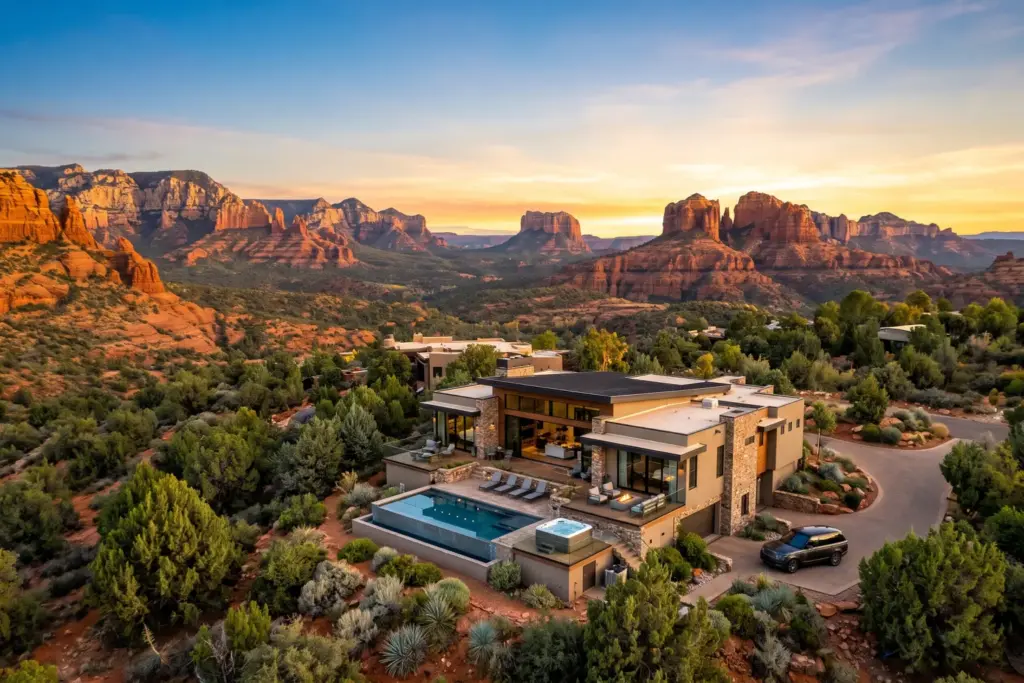
The Sedona demand story is about red rock scenery, spiritual and wellness tourism, hiking, and an aesthetic that simply does not exist anywhere else in Arizona. Guests are not choosing Sedona because it is convenient or affordable. They are choosing it because they specifically want Sedona. That destination loyalty is the engine behind $330 ADR. It is the same dynamic you see in Nantucket or Carmel: when a destination has genuine visual and experiential distinctiveness, the market will pay for it.
At $5,216 average monthly revenue, a well-managed Sedona property produces the highest gross income of any Arizona market in this dataset. At current averages, annual gross revenue runs above $62,000 before expenses.
The regulatory picture requires careful due diligence before purchase. The City of Sedona states that no Arizona city or town is currently permitted to cap the number of short-term rentals, and a Sedona permit expires one year from the date it became active (Source). If you are buying a property with an active permit already in place, your position under state law is solid. The full Sedona data and market analysis are available at Sedona AZ Short-Term Rental Market 2026.
Phoenix/Scottsdale: Arizona’s Volume Market
The Phoenix/Scottsdale metro is the largest STR ecosystem in Arizona by any measure. StaySTRA tracks 32 geographic submarkets across this metro, and the aggregate numbers reflect a market that runs on volume and consistency rather than pure rate premium. At 63% average occupancy, Phoenix/Scottsdale is the most consistently occupied of Arizona’s major markets. The $235 average daily rate is strong for an urban metro, and the $4,128 average monthly revenue puts a typical Scottsdale property solidly above what most U.S. STR markets produce.
Think of Scottsdale’s demand stack like a layered cake. The base is year-round leisure demand drawn to golf (more than 185 courses in Phoenix and its neighboring communities, per Visit Phoenix), spas, resorts, and warm weather. The middle layer is snowbirds, who push November through April to peak levels. The top layer is event-driven demand: the Barrett-Jackson car auction in January, Cactus League spring training in March, music festivals, and corporate retreats. Each layer compounds on the others during peak season, which is why the first quarter of the calendar year consistently produces the highest revenue figures in this market.
The honest challenge in Phoenix/Scottsdale is entry cost. Home values run well above the national average, which affects how the DSCR math works for many buyers. The $4,128 monthly revenue figure, taken against the acquisition cost of a typical Scottsdale property, requires careful modeling. For investors with the capital to enter, StaySTRA’s location data and market breakdown are at staystra.com/location/arizona/scottsdale/, and the deep market analysis is at Scottsdale STR Market 2026.
Scottsdale’s current permit requirements are well-established: $250 annual fee, $500,000 in liability insurance, and a six-adult occupancy limit under the city’s Ordinance No. 4566 (Source). For a market of this size and profile, these are among the most predictable operating conditions in Arizona.
Flagstaff: The Four-Season Investment Case
Flagstaff sits at 7,000 feet elevation. It gets actual snow, actual ski season, and a summer that runs 20 degrees cooler than Phoenix. For STR investors, that translates into a demand stack that works across all four seasons rather than depending heavily on one. StaySTRA tracks one submarket here, and the aggregate data shows 55% occupancy, $256 ADR, and $3,930 average monthly revenue over the last twelve months.
Four distinct demand drivers feed Flagstaff’s calendar. Arizona Snowbowl operates from roughly November through April, anchoring ski-season demand (Source). Grand Canyon National Park draws over four million visitors annually, and Flagstaff is the last major town before the South Rim, making it a natural gateway for overnight stays. Northern Arizona University enrolled 27,183 students in fall 2025 and generates graduation weekends, game days, and move-in periods that spike demand on specific dates (Source). Route 66 tourism adds a cultural layer, particularly visible in summer when the centennial-era highway draws its own enthusiasts.
The practical implication is a relatively tight ADR band across the year compared to Scottsdale’s pronounced peaks and troughs. Don’t let that consistency suggest underperformance. Investors who prefer predictable monthly cash flow over explosive peaks find that Flagstaff’s four-season pattern has real portfolio value. Full market data is at Flagstaff AZ Short-Term Rental Market 2026.
Tucson: The University and Value Market
Tucson surprises investors who look at the $160 ADR and move on without examining the occupancy line. Stay with me here: at 61% average occupancy, Tucson is the second most consistently occupied market in this dataset. That means Tucson properties are regularly booked even if each booked night generates less revenue than a comparable night in Scottsdale or Sedona. For investors entering at a lower price point, that occupancy performance is the investment case.
The University of Arizona (over 47,000 enrolled students) drives a demand calendar that includes football, basketball, graduation weekends, parents weekends, and homecoming. The Tucson Gem and Mineral Show in February brings tens of thousands of collectors and dealers annually and is one of the most reliable demand events in any Arizona market. Winters are mild enough to draw snowbirds at lower price points than Scottsdale.
At $2,709 average monthly revenue and 61% occupancy, Tucson is Arizona’s most accessible entry-level market. For investors buying a first STR property where DSCR math needs to work carefully, Tucson’s combination of lower acquisition costs relative to Scottsdale and consistent occupancy tells a sensible story. The month-by-month demand curve and neighborhood-level data are available through the StaySTRA Analyzer.
Lake Havasu/Kingman: The Summer Water Market
This is a summer-dominant market built around Lake Havasu, the Colorado River, and outdoor recreation that peaks when the water is warm. At 51% average occupancy and $214 ADR, the annual averages understate what summer months look like for properties in this market.
The $2,887 average monthly revenue reflects that seasonal concentration. Summer demand from the Phoenix metro (a three-hour drive) and from visitors drawn to the relocated London Bridge, boat rentals, and water recreation drives peak months significantly above the annual average. Lake Havasu rewards investors who price aggressively for summer and manage shoulder-season expectations accordingly.
What this market offers that the others in this list do not is relatively low acquisition cost combined with strong summer demand from a large, proximate feeder market. For investors comfortable with seasonal cash flow patterns, the actual market performance during peak months looks better than the annual average suggests. The StaySTRA Analyzer shows the seasonal distribution for individual markets so you can build realistic projections before you commit.
Matching the Market to Your Goals
Arizona’s diversity is both its appeal and its analytical challenge. The right market for your investment depends on what you are optimizing for.
If you want the highest revenue-per-available-night with a premium property, Sedona is the answer. The ADR premium is real, the destination appeal is durable, and supply constraints protect existing operators. Entry costs are high and permit due diligence is essential, but the revenue case is the strongest in the state.
If you want volume and consistency in Arizona’s most recognized resort market, Scottsdale remains the flagship. Snowbird demand is structural and recurring, the events calendar adds predictable peaks, and the regulatory framework is well-established and workable.
If you want four-season balance without extreme volatility, Flagstaff delivers. Lower entry costs than Scottsdale or Sedona and a diverse demand stack make this a solid mid-tier option that holds up year-round.
If you want cash-flow accessibility and consistent occupancy at a lower purchase price, Tucson’s university-driven demand calendar and 61% average occupancy make the numbers work for many first-time buyers.
Lake Havasu/Kingman rewards investors who understand seasonal cash flow and can price aggressively for summer water recreation demand from the Phoenix feeder market.
All five markets sit inside Arizona’s preemption protection. That is the foundation. For investors evaluating the broader Sun Belt, the companion guides for Colorado STR markets and Texas STR markets cover the same framework applied to those states. The StaySTRA Best Airbnb Markets 2026 guide aggregates the national picture. The StaySTRA Arizona location page lists the 71 Arizona markets StaySTRA tracks, with market data for each.
Frequently Asked Questions
What is the best Arizona market for STR beginners?
Tucson is the most accessible entry point for first-time STR investors in Arizona. Lower property acquisition costs, 61% average occupancy, and demand anchored by the University of Arizona academic calendar create a more predictable cash flow environment than Scottsdale or Sedona. The permit process is straightforward and state preemption protects your ability to operate. For investors with more capital, Scottsdale is the premium volume market, while Sedona offers the highest rate potential in the state.
Can Arizona cities ban short-term rentals?
No. Arizona’s preemption statute (ARS 9-500.39, reinforced by HB 2672) prohibits municipalities from banning STRs outright. Cities can require permits, charge fees, set occupancy limits, and enforce noise and safety rules. Arizona HB 2429, a 2026 bill that would have limited overnight occupancy to two adults per sleeping area plus up to two additional persons, passed the House but was held in the Senate and did not become law (Source). The fundamental right to operate remains state-protected, which distinguishes Arizona from states without preemption laws.
What are the STR permit rules in Sedona?
Sedona requires a city short-term rental permit even for owners who rent one day per year, and the city states that no Arizona city or town is currently permitted to cap the number of short-term rentals (Source). If you are buying a property that already has an active STR permit in place, your position under state law is solid. A Sedona permit expires one year from the date it became active, so confirm a property’s permit status with the City of Sedona directly before closing.
What taxes apply to Arizona Airbnb income?
Arizona STR operators pay state and local transaction privilege taxes (TPT), which function similarly to a sales or occupancy tax. Combined rates vary by city; in Sedona, for example, the combined short-term rental rate is 13.325% in Yavapai County and 13.90% in Coconino County (Source). Platforms like Airbnb collect and remit TPT on behalf of hosts in Arizona for most transactions, which simplifies compliance for most operators. STR income is also reported as ordinary income on federal returns. For properties used personally and rented, the 14-day rule can affect deductibility. Consult a tax professional familiar with STR investing for your specific situation before purchase.
Can I manage an Arizona STR property from out of state?
Yes, and many Arizona STR investors do exactly that. Scottsdale, Sedona, and Flagstaff all have established professional property management infrastructure. Remote management with a local co-host or property manager typically costs 20 to 30 percent of gross revenue in Arizona markets. For investors who prefer self-managing, smart lock access control, noise monitoring devices, and digital guidebook tools handle most day-to-day operations without requiring on-site presence. The StaySTRA Analyzer can help you model management costs against market revenue estimates before you commit to a property.
How does Arizona’s seasonality affect STR investment returns?
Arizona has pronounced seasonality across most of its STR markets. Scottsdale and the Phoenix metro see peak occupancy and ADR from November through April, with summer months producing significantly lower revenue. Sedona’s pattern is similar but softened by consistent demand from Grand Canyon proximity. Flagstaff is the most balanced of the major markets, with ski season in winter and Grand Canyon and NAU demand in summer keeping revenue relatively consistent year-round. Investors buying on annual average metrics need to stress-test their projections against the summer trough, particularly in Scottsdale. The StaySTRA Analyzer shows the seasonal distribution for individual markets so you can build realistic projections.
We do our best to keep our data accurate and up to date, but markets move fast and we are only human. Always verify current figures directly with local sources before making investment decisions.
Run the Numbers on Your Arizona Property
The five markets above give you the landscape. The StaySTRA Analyzer takes you from landscape to specific property analysis, running your target address against current market benchmarks to give you occupancy projections, revenue estimates, and competitive positioning.
Run your Arizona property through the StaySTRA Analyzer
Become a StaySTRA Insider
Join free — get our newsletter + 1 free property analysis/month.
No spam. Unsubscribe anytime. Free membership includes property analyses and market insights.