
Key Takeaways
- Texas has no statewide short-term rental preemption law, so each city sets its own STR rules; cities in the three markets featured here (Port Aransas, Fredericksburg, San Antonio) have all maintained permissive or well-defined STR frameworks.
- Port Aransas leads Texas coastal markets with a $372 average daily rate and $5,088 average monthly revenue (StaySTRA data).
- Fredericksburg holds 46% average occupancy and $4,861 in average monthly revenue, making it the Hill Country’s most consistent STR performer.
- San Antonio earns the highest rental demand score among the three featured markets (59.2 out of 100), driven by year-round convention and leisure demand with over 5,700 active listings.
- Texas offers more than 240 trackable STR markets across coastal, Hill Country, and urban profiles; the three markets here represent the strongest data-supported entry points for Q4 2026 acquisitions.
Port Aransas averages $372 a night for a short-term rental. That figure, pulled from StaySTRA’s tracking of the Texas Gulf Coast, is not a peak-week outlier. It is the average of every month from March 2021 through February 2026, including the slower shoulder months when the beach crowds thin and the fog rolls in off the Gulf. That data point, combined with the practical permissive regulatory track records of the three markets in this guide, is what makes Texas one of the most compelling state-level conversations in STR investing as we head into Q4 2026 planning season.
I have spent 40 years watching data tell stories that headlines miss. After tracking STR markets from my desk in Santa Fe, the pattern I keep seeing is that investors spend enormous energy on yield projections and almost none on regulatory risk. In Texas, the regulatory story is city-specific rather than state-wide, which means where you buy matters as much as what the state-level data shows. The three markets in this guide all have well-defined STR frameworks with years of operator history.
This guide covers three markets in depth: Port Aransas on the Gulf Coast, Fredericksburg in the Hill Country, and San Antonio as the urban anchor. A five-market comparison table at the end gives broader state context. For a full view of Texas STR data across all tracked markets, the StaySTRA Texas location hub is the place to start.
Why Texas Regulation Is a City-by-City Question in 2026
Before the numbers, the legal picture matters. Texas has no statewide law that stops cities from banning short-term rentals. Rules are set city by city, and they range from light registration to outright prohibitions: Grapevine, for example, expressly forbids STRs in residential zoning districts. Some states have taken the decision away from local governments. Idaho bars any county or city ordinance with the practical effect of prohibiting STRs, Indiana has a state STR statute, and Florida law says a local ordinance may not prohibit vacation rentals. Texas is not on that list (you can see the full rundown in the StaySTRA preemption laws guide). So in Texas, the city you buy in matters as much as the market data.
Think of it like this: the regulatory layer in Texas is a local setting you can research and verify before you buy, not an unknown that shifts with state politics. For the three markets in this guide, that research lands in a favorable place. Port Aransas, Fredericksburg, and San Antonio all have years of established STR operating history, defined permit paths, and no active prohibition proposals. That predictability is what makes them the data-supported entry points for this guide.
Texas STR investing still carries local complexity. San Antonio raised its non-owner-occupied STR permit fee by 122 percent in 2026. Some Hill Country municipalities have parking and occupancy limits. The right approach is to verify the city ordinance and any pending changes before you underwrite a DSCR loan, and to check back at acquisition time since local rules can shift. Texas investors evaluating other states for comparison will find the best states to buy an Airbnb in 2026 guide useful for the full regulatory ranking.
Port Aransas: The Texas Gulf Coast Market Built for STR Investors
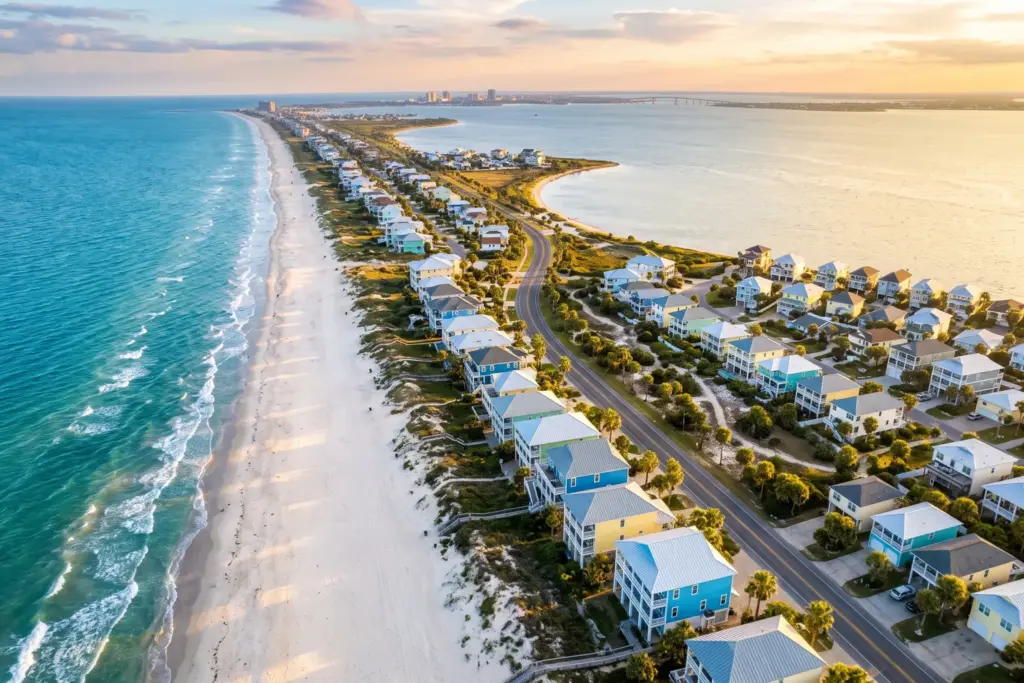
Port Aransas sits on Mustang Island, connected to the Texas mainland by a ferry crossing and a bridge at Corpus Christi. What makes it relevant to an investor rather than just a tourist is the demand structure. StaySTRA data shows approximately 2,399 active listings in the Port Aransas market as of February 2026, and the platform tracks these headline numbers (monthly averages, March 2021 through February 2026):
- Average occupancy: 39%
- Average daily rate (ADR): $372
- RevPAR: $167
- Average monthly revenue: $5,088
- Rental demand score: 34.2 / 100
- Active listings: ~2,399
Stay with me on the occupancy number. Thirty-nine percent is a five-year monthly average, which means it reflects the off-season months when the Gulf Coast slows considerably. The revenue figure of $5,088 per month on average reflects that seasonal curve. The investor play in a coastal market like Port Aransas is not year-round consistency. It is peak-season concentration. Spring break, summer, and Gulf holiday weekends drive the bulk of annual revenue, and Port Aransas is built to capture them.
The ADR of $372 is one of the highest among all Texas markets with full data in the StaySTRA system. Think of ADR like the sticker price on a car: it is what each occupied night is worth on average, regardless of how many nights that is in a given year. A high ADR in a seasonal market means the math can still work even with modest off-peak occupancy, because the nights that do book are generating strong revenue.
Port Aransas also benefits from a structural constraint that helps investors: the island has limited land for new development. Supply growth is naturally capped by geography in ways that inland markets cannot replicate. Demand from the San Antonio corridor, about three hours away by car, and the Houston corridor, about four, provides a consistent feeder audience that renews every summer.
A practical note: Corpus Christi, just across the causeway, imposed a moratorium on new Type 1 STR permits running through November 17, 2026 (Source). That does not affect Port Aransas directly, but it illustrates why buying in a market with stable permitting matters. Port Aransas has an established STR ecosystem with clear local rules in place.
To run current revenue projections for Port Aransas properties, the StaySTRA Analyzer lets you input specific property parameters and see market-calibrated estimates based on active comparables.
Fredericksburg: The Hill Country Market That Works Year-Round
Fredericksburg is a different kind of STR market entirely. Where Port Aransas is seasonal, Fredericksburg is remarkably steady across the calendar. The Hill Country wine trail draws visitors every weekend of the year. Antique shops, German heritage festivals, and the proximity to Enchanted Rock bring a diverse visitor profile that does not compress into a single peak window. StaySTRA data for Fredericksburg (monthly averages, March 2021 through February 2026; listings as of February 2026):
- Average occupancy: 46%
- Average daily rate (ADR): $313
- RevPAR: $160
- Average monthly revenue: $4,861
- Rental demand score: 41.9 / 100
- Active listings: ~2,202
A 46% occupancy rate in a market with 2,202 active listings tells you something important: guests are finding and booking Fredericksburg properties consistently, not just during peak events. That is the hallmark of a demand profile that is broad rather than spike-driven. The average monthly revenue of $4,861 reflects that steadiness across all twelve months, not just the busy ones.
The Hill Country market is also shaped by its property type mix. Most STR supply in Fredericksburg leans toward cottages, farmhouses, vineyard properties, and converted historic buildings. These are not interchangeable with a coastal condo. The investor who buys a well-positioned Hill Country property with outdoor space and wine-country views is selling an experience, not just a bed. That experience supports the $313 ADR the data shows, and it holds that rate more consistently than a purely seasonal market can.
Don’t let the 2,202 listing count intimidate you. Supply in Fredericksburg is constrained by the same forces that make the town attractive: its historic character, limited commercial development zones, and small-town scale. A market where supply growth is structurally slow tends to be one where existing inventory holds its value, because new competition cannot flood in the same way it can in an unconstrained suburban market.
The towns in the Fredericksburg area have historically been accommodating to STR investors because tourism is central to the local economy. The regulatory risk here was never high.
The full Fredericksburg market data, including how seasonal patterns move across the year, is available for property-specific analysis through the StaySTRA Analyzer.
San Antonio: The Urban Market With This Guide’s Highest Rental Demand Score
San Antonio operates differently from the other two markets in this guide. Where Port Aransas and Fredericksburg are leisure-driven, San Antonio runs on a hybrid demand base: leisure, convention, military, medical, and corporate travel layer together into a profile that smooths out the peaks and valleys that purely seasonal markets experience. StaySTRA data for San Antonio (monthly averages, March 2024 through February 2026; listings as of February 2026):
- Average occupancy: 46%
- Average daily rate (ADR): $193
- RevPAR: $88
- Average monthly revenue: $2,686
- Rental demand score: 59.2 / 100
- Active listings: ~5,712
San Antonio’s rental demand score of 59.2 out of 100 is the highest among the three featured markets. The score is the rental demand component of StaySTRA’s market grade, from a late-2025 snapshot. The lower ADR compared to Port Aransas and Fredericksburg is expected in an urban market: more inventory, more competition with hotels, and a broader range of property types keep the average down. But RevPAR of $88 on a consistent 46% average occupancy tells a story of a market that books steadily all twelve months.
Think of urban STR markets like a diversified bond portfolio compared to a concentrated equity position. The coastal and Hill Country markets can produce bigger peaks, but they carry more volatility. The investor who buys in San Antonio is trading those spikes for predictability, and for some capital profiles, especially those using DSCR financing where steady income matters for loan performance, that trade is worth making.
San Antonio is the largest of the three featured markets by listing count, with over 5,700 active properties as of February 2026. Size means competition, but it also means demand is well-established and guests are comfortable booking there. The Riverwalk, the Alamo, and the steady stream of conventions at the Henry B. Gonzalez Convention Center drive demand that does not disappear when a single event ends.
A practical regulatory note: the city raised its non-owner-occupied STR permit fee by 122 percent in 2026. That is a real cost increase for investors who do not live on-site, and it should be factored into acquisition underwriting. It does not change the investment case fundamentally, but it changes the operating cost line. Factor it in from day one rather than as a surprise at renewal.
For properties near the Riverwalk, the Pearl district, or the King William neighborhood, the StaySTRA Analyzer generates property-specific revenue estimates based on comparable active listings in each zone.
Five Texas STR Markets Compared by Rental Demand Score
The table below compares five Texas markets by StaySTRA’s rental demand score, the rental demand component of its market grade. The Texas location hub links to individual market pages for all 240-plus tracked Texas markets.
| Market | Type | Rental Demand Score | Avg Occupancy | Avg ADR |
|---|---|---|---|---|
| San Antonio | Urban | 59.2 / 100 | 46% | $193 |
| South Padre Island | Coastal | 58.7 / 100 | N/A | N/A |
| Austin | Urban | 55.5 / 100 | 56% | $262 |
| Wimberley | Hill Country | 42.8 / 100 | 48% | $280 |
| Fredericksburg | Hill Country | 41.9 / 100 | 46% | $313 |
Source: StaySTRA market data. Scores are the rental demand component of StaySTRA’s market grade, from late-2025 snapshots. Occupancy and ADR are monthly averages from March 2021 through February 2026 (San Antonio: March 2024 through February 2026). South Padre Island is not covered in the dataset behind the occupancy and ADR columns, so those cells show N/A.
Port Aransas, the featured coastal market in this guide, carries a rental demand score of 34.2. Its lower score reflects the seasonal concentration of its demand profile. But its $372 average daily rate is the highest of any Texas coastal market with full revenue data in the StaySTRA system, which is why it earns the coastal section here over South Padre Island. When your platform does not have full data on a market, that is useful information in itself.
Austin earns a strong rental demand score, but its regulatory environment deserves careful attention before acquisition. The city requires all STR listings to display a valid city license number on Airbnb and Vrbo, enforced at the platform level since July 2026. New non-owner-occupied licenses face scrutiny. Austin’s fundamentals are strong (56% average occupancy, $262 ADR), but investors should budget time and cost for the permitting process before closing. The Florida comparison guide is worth reading if you are considering a cross-state analysis of urban market dynamics and regulatory environments.
How to Use This Data in Your Acquisition Process
These numbers are market averages. They tell you what the distribution of performance looks like across all property types and locations within each market. The actual performance of a specific property depends on its proximity to demand drivers, its amenities, its size, and how it is managed and priced.
The investor who reads these averages and then uses them to build a property-specific pro forma is doing it right. The investor who uses them to skip the property-level analysis is taking a shortcut that markets penalize eventually. A good starting framework for the full acquisition process is the StaySTRA guide to buying an Airbnb property in 2026, which walks through how to use market data to set realistic income assumptions before you make an offer.
Frequently Asked Questions
Can Texas cities ban Airbnb or short-term rentals in 2026?
Yes, in some cases. Texas has no statewide STR preemption law, so cities set their own rules. Grapevine, for example, expressly forbids STRs in residential zoning districts. The three markets featured in this guide (Port Aransas, Fredericksburg, San Antonio) all have established permit frameworks and years of operational history without active ban proposals. But city rules change, and the right practice before any acquisition is to verify the current ordinance and any pending changes for the specific city you are buying in.
Which Texas Airbnb market has the best occupancy rate?
Among the five markets in the table above, Austin leads with a 56% average occupancy rate. Fredericksburg, San Antonio, and Wimberley all show 46 to 48% average occupancy. Port Aransas runs lower at a 39% average because of its coastal seasonal pattern, though its peak-season months push significantly higher. Occupancy varies by property type, location within a market, and how a property is priced and managed. The StaySTRA Analyzer can narrow these averages to comparable properties in a specific area.
Is Fredericksburg Texas a good Airbnb investment in 2026?
StaySTRA data supports Fredericksburg as one of Texas’s more consistent STR markets. Its 46% average occupancy is driven by year-round wine-country and heritage tourism rather than a single seasonal peak. The $313 average ADR and $4,861 average monthly revenue reflect a market where well-positioned properties can generate meaningful income across twelve months. The Hill Country regulatory environment has historically been accommodating to STR operators.
What is the average daily rate for Airbnb in Port Aransas?
StaySTRA data shows a $372 average daily rate across all tracked property types in Port Aransas. This is one of the highest ADRs among Texas coastal markets with full revenue data. The rate reflects the Gulf Coast premium that spring break, summer, and holiday weekend demand places on island properties. Average monthly revenue across all tracked periods is $5,088, with significant seasonal variation between peak and off-peak months.
How does the StaySTRA Analyzer help Texas STR investors?
The StaySTRA Analyzer takes a specific property address and parameters and generates a revenue estimate calibrated to comparable active listings in that market. Rather than relying on the market averages in this guide, which blend all property types and locations, the Analyzer narrows the projection to what properties similar to yours are actually earning. For Texas markets where the supply mix varies widely (Gulf Coast beach houses, Hill Country cottages, San Antonio urban condos), that property-level analysis is where broad market data becomes a useful investment decision.
We do our best to keep our data accurate and up to date, but markets move fast and we are only human. Always verify current figures directly with local sources before making investment decisions.
Ready to run the numbers on your Texas target? The StaySTRA Analyzer gives you property-level revenue estimates for Port Aransas, Fredericksburg, San Antonio, and every other Texas market we track. Put in your address and see what comparable properties are earning right now.
Become a StaySTRA Insider
Join free — get our newsletter + 1 free property analysis/month.
No spam. Unsubscribe anytime. Free membership includes property analyses and market insights.