

Key Takeaways
- Kansas City’s Ordinance 250965, passed in November 2025, created a $50 “Major Event STR Permit” valid May 3 through July 31, 2026, specifically for the FIFA World Cup.
- The Major Event permit costs 75% less than the city’s standard $200 annual STR registration and expires automatically after the tournament window closes.
- All applicants must pass a property inspection, obtain a tax clearance letter, and remit Kansas City’s 7.5% Transient Guest Tax, $3/night Occupancy Fee, and 1% Earnings Tax independently (platforms do not withhold these).
- The application deadline for the Major Event permit is 5 p.m. on Friday, May 5, 2026, through the CompassKC portal.
- No other FIFA 2026 host city has created a temporary, event-specific STR permit track, making Kansas City’s approach a potential regulatory template for future major events.
Kansas City’s $50 Major Event STR Permit opens its operating window on May 3, 2026, and if you are a property owner who hasn’t applied yet, you have roughly ten days before the application deadline closes on May 5. Yes, the application deadline falls two days after the operating window opens. I’ve read a lot of ordinances, and that scheduling decision is a new one for me.
The permit itself exists because of Ordinance 250965, which the Kansas City Council passed in November 2025. It created something no other American city has built for the 2026 FIFA World Cup: a temporary, low-cost STR permit track designed to unlock housing stock during a defined event window without forcing property owners into the city’s year-round licensing system. The regular annual STR registration costs $200. This one costs $50 and vanishes on July 31.
For a city that already ranks among the strongest STR investment markets in the FIFA host city lineup, the ordinance is worth understanding in detail. Here is what it actually requires.
What Ordinance 250965 Created
The ordinance introduced a new designation within Kansas City’s existing STR regulatory framework: the Major Event Short-Term Rental Permit. Under this mechanism, the city’s Neighborhood Services Director can designate a “special event period” of up to 90 days when existing hotels and registered STRs are not likely to meet visitor demand.
For the FIFA World Cup, that designated period runs May 3 through July 31, 2026. The permit is non-renewable. Once July 31 passes, the registration expires and the property must either convert to the standard $200 annual STR registration (if eligible) or stop operating as a short-term rental entirely.
The cost differential is significant. The Major Event permit is $50. The annual registration is $200. That’s a 75% discount for a permit with a 90-day shelf life. For property owners who want to test the STR waters during the World Cup without committing to year-round hosting, the math is straightforward.
Applications opened December 15, 2025, and the city has received over 800 applications as of late April 2026, with nearly half approved and registrations issued. The city projects 700 to 1,000 total permitted STRs will be operating during the tournament window.
Who Qualifies for the Major Event Permit
The Major Event permit doesn’t create a regulatory free-for-all. All of Kansas City’s existing STR eligibility rules still apply. That means the distinction between Resident and Non-Resident short-term rentals matters just as much for the $50 permit as it does for the $200 annual registration.
Resident Short-Term Rentals (where the registrant lives in the property) have the simpler path. The property must be the registrant’s primary residence. The owner must occupy the home at least 270 days per year. Each person is limited to one primary residence registration. These are allowed in most zoning districts across the city.
Non-Resident Short-Term Rentals face tighter restrictions. Properties in residentially zoned areas are prohibited from operating as non-resident STRs unless they were grandfathered in before June 2023. For properties with fewer than three units, there cannot be another short-term rental within 1,000 feet. For buildings with three or more units, a maximum of 12.5% of the building can be used for STRs. And properties that received city incentives like tax abatements are ineligible entirely.
Picture this: you own a duplex in a residential neighborhood near Arrowhead Stadium. You’re thinking the World Cup traffic makes this a perfect time to list one unit on Airbnb. Under the ordinance, unless that duplex was operating as a non-resident STR before June 2023, you’re likely ineligible for the non-resident category. You could still qualify for the resident category if the property is your primary home and you occupy it 270 days per year.
The eligibility rules are not suggestions. Kansas City has been clear that enforcement will be active during the tournament window.
Sponsored — OfferMarket
Buy Your First STR With Long-Term Rental Financing
Flexible, long-term financing for short-term rental buyers. Rates from 5.75%. Instant online quote, no credit pull.
Explore RTL Financing Options →Affiliate disclosure: StaySTRA may earn a referral fee.
What the Permit Requires
Getting the $50 permit is not just a matter of paying the fee and listing your property. The application process through the CompassKC portal requires several compliance steps.
Documentation requirements:
- Valid identification
- Proof of ownership or written landlord consent (renters can apply with landlord permission)
- Tax clearance letter from the city
- Safety and legal compliance certifications
Property inspection: The city schedules an inspection before approving the permit. This is not a paper exercise. An inspector visits the property to verify safety and habitability standards.
Business registration: All STR operators must register with the Kansas City Business License Office using Form RD-100. This is a one-time registration, but it’s a prerequisite for the permit.
Tax Obligations (The Part People Miss)
Here is where compliance gets real. Kansas City imposes three separate tax obligations on STR operators, and booking platforms like Airbnb and VRBO do not withhold or remit any of them on your behalf. Hosts are responsible for collecting and filing directly with the city.
| Tax | Rate | Filing |
|---|---|---|
| Transient Guest Tax | 7.5% of gross receipts | Quarterly (Form RD-306) |
| Occupancy Fee | $3 per rental night | Quarterly (Form RD-306) |
| Earnings Tax | 1% of net profits | Annually (Form RD-108) |
That tax structure is straightforward on paper, but the quarterly filing requirement catches first-time hosts off guard. If you start hosting on May 3, your first quarterly filing covers through June 30. Miss it, and you’re dealing with penalties on top of the taxes owed. For anyone new to STR hosting who grabbed a Major Event permit to try it out during the World Cup, these quarterly filings are the compliance obligation most likely to slip through the cracks.
How to Apply (and the May 5 Deadline)
The application is submitted through the CompassKC portal on the city’s website. The deadline for Major Event permit applications is 5 p.m. on Friday, May 5, 2026.
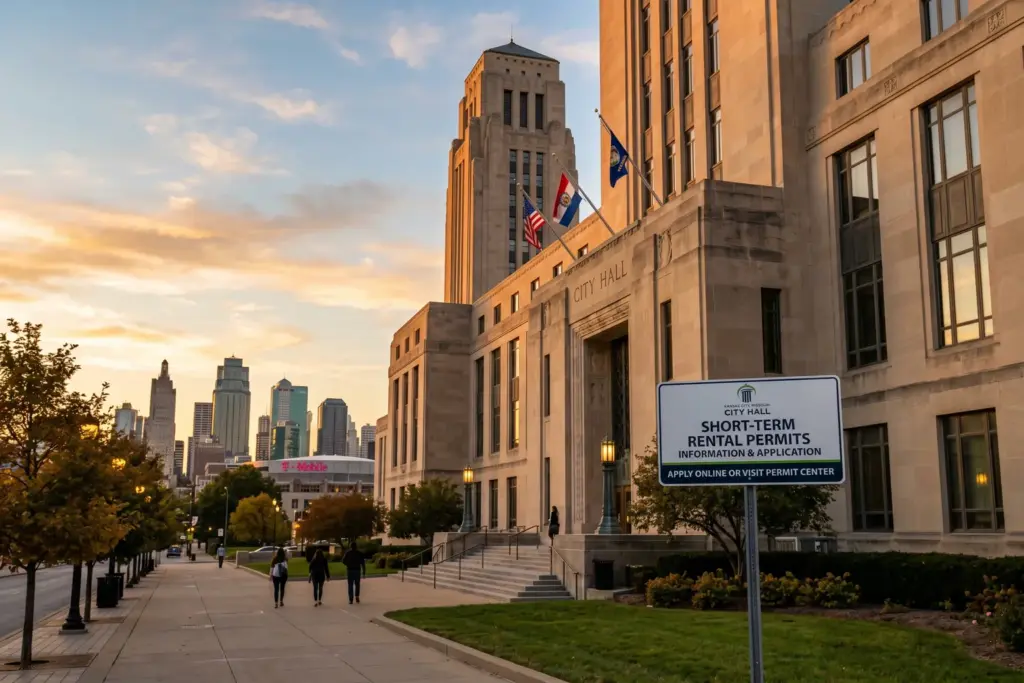
The city’s STR office can be reached at 816-513-1120 or [email protected]. Walk-in help is available at City Hall, 414 E. 12th Street, 1st Floor.
One practical note: Assistant Director Nia Webster asked applicants to “give the city staff grace” in processing the volume of applications. With over 800 submissions and an inspection requirement for each one, the processing timeline is not instantaneous. If you’re applying close to the May 5 deadline, build in time for the inspection to be scheduled and completed before May 3.
What Happens When the Permit Expires
On August 1, 2026, every Major Event permit becomes invalid. There is no renewal option, no extension, and no grace period. Hosts who want to continue operating after July 31 must apply for the standard $200 annual STR registration, which carries its own eligibility requirements (including the residential zoning restrictions for non-resident STRs).
Most temporary hosts won’t convert. Industry projections suggest the majority of Major Event permit holders will simply stop hosting and return their properties to long-term rental use or personal occupancy. The realistic expectation is that between 200 and 600 units exit the STR market simultaneously at the end of July, depending on how many total permits are issued.
For the city’s broader housing market, the impact is expected to be modest. Kansas City has approximately 99,600 renter-occupied households within city limits, vacancy rates of 6 to 7% metro-wide, and annual rent growth around 3%. A few hundred temporary STR units rotating back to long-term use won’t move those numbers meaningfully.
Kansas City as an STR Investment Market
The Major Event permit is a regulatory tool, but for investors watching Kansas City, the underlying market fundamentals are what matter long-term.
StaySTRA data shows Kansas City currently has 1,892 active STR listings with a $195 average daily rate and 70% current occupancy. The last twelve months averaged $2,493 in monthly revenue per listing. The median home value sits at $245,199, with a median sale price of $261,000.
Those numbers become more interesting in context. In StaySTRA’s analysis of all 11 FIFA 2026 host cities, Kansas City ranked first in DSCR (debt service coverage ratio) at 1.39, assuming 75% LTV and a 7.5% interest rate. Only four of the eleven host cities cleared the 1.0 DSCR threshold at all. Kansas City cleared it by a wider margin than any other market.
The entry price is the differentiator. At a $245,000 median home value, Kansas City offers an STR investment entry point that markets like San Francisco (0.45 DSCR), Boston, and New York simply cannot match. For investors considering a DSCR loan structure, Kansas City’s numbers make the underwriting conversation significantly easier.
The World Cup itself is a bonus. Dynamic pricing data shows Kansas City STR rates for World Cup dates are running 264% above normal, and 25.2 million annual visitors already support a year-round demand base.
Sponsored — OfferMarket
Buy Your First STR With Long-Term Rental Financing
Flexible, long-term financing for short-term rental buyers. Rates from 5.75%. Instant online quote, no credit pull.
Explore RTL Financing Options →Affiliate disclosure: StaySTRA may earn a referral fee.
Why No Other City Did This
What makes Ordinance 250965 genuinely novel is not the $50 price tag. It’s the regulatory architecture. Kansas City built a parallel permit track that runs alongside the existing annual system, serves a defined event window, and auto-expires without requiring any affirmative action from the city to revoke it.
No other FIFA 2026 host city created anything comparable. Houston requires a $275 annual STR registration with no event-specific alternative. Miami requires both a Certificate of Use and a Business Tax Receipt through its standard permitting process. New York City and Boston both explicitly rejected loosening their STR rules for the World Cup. Philadelphia requires a zoning permit before you can even apply for an STR license.
The closest parallel to Kansas City’s approach is actually Parkville, Missouri, a suburb just north of the city. Parkville temporarily lifted its own STR permit cap ahead of the World Cup, approving seven new applications. But Parkville modified an existing cap rather than creating a new permit category.
The Kansas City model is a potential template. Imagine a city hosting the Super Bowl, a major political convention, or the Olympics. Instead of either leaving existing rules in place and accepting that housing demand will outstrip legal supply, or permanently loosening restrictions, a city could create a temporary event permit with a defined window, lower cost, and automatic expiration. Kansas City proved the concept. Other cities are watching.
The Enforcement Question
The ordinance has teeth. Operating a short-term rental in Kansas City without a valid registration carries fines of $200 to $1,000 per violation. Each day of unauthorized operation counts as a separate violation. Over a 90-day World Cup window, an unlicensed operator could theoretically face $90,000 in cumulative fines at the maximum rate.
City staff have indicated they will actively monitor compliance during the tournament, particularly given that Kansas City approved 23-hour liquor sales for the World Cup period. The combination of increased tourism, extended bar hours, and first-time STR hosts creates an enforcement environment the city is clearly preparing for.
This article provides general information and should not be construed as legal advice. Consult a qualified attorney in your jurisdiction for advice specific to your situation.
Frequently Asked Questions
How much does a Kansas City World Cup STR permit cost?
The Major Event STR Permit costs $50 and is valid from May 3 through July 31, 2026. This is 75% less than the standard $200 annual STR registration. Applications are submitted through the CompassKC portal.
What is the deadline to apply for a Kansas City World Cup STR permit?
The application deadline for the Major Event STR Permit is 5 p.m. on Friday, May 5, 2026. Applications submitted after this deadline will not be accepted for the World Cup window. The standard $200 annual registration remains available year-round.
Can I rent a non-owner-occupied property as an STR during the Kansas City World Cup?
Only if the property is in a commercially zoned area or was grandfathered in as a non-resident STR before June 2023. Non-resident STRs are prohibited in residentially zoned areas. Properties with fewer than three units must also be at least 1,000 feet from any other STR.
Does Airbnb collect Kansas City STR taxes for hosts?
No. Kansas City requires hosts to collect and remit the 7.5% Transient Guest Tax, $3/night Occupancy Fee, and 1% Earnings Tax directly. Platforms like Airbnb and VRBO do not withhold these taxes. Hosts file quarterly using Form RD-306 and annually using Form RD-108.
What happens to the Major Event STR permit after July 31, 2026?
The permit expires automatically on July 31, 2026, with no option for renewal or extension. Hosts who want to continue operating must apply for the standard $200 annual STR registration and meet all eligibility requirements, including zoning restrictions for non-resident properties.
We do our best to keep our regulatory guides accurate and up to date, but ordinances change and we are only human. Always verify current requirements directly with your local municipality before making business decisions.
What This Means for Your Next Move
Kansas City’s Ordinance 250965 is a regulatory experiment. The city bet that creating a temporary, low-cost permit track would be better than watching illegal listings multiply during the World Cup, and better than permanently expanding its STR footprint. Whether the bet pays off depends on compliance rates, enforcement execution, and whether the 700-plus hosts who applied actually deliver a quality guest experience.
For investors looking at Kansas City beyond the World Cup window, the fundamentals speak for themselves. A 1.39 DSCR, a $245,000 median home price, and 25.2 million annual visitors make Kansas City one of the strongest STR investment markets in the country, tournament or not.
Run the numbers for Kansas City yourself with the StaySTRA Analyzer, or explore the full Kansas City STR market data to see how the city stacks up against other markets you’re watching.
Become a StaySTRA Insider
Join free — get our newsletter + 1 free property analysis/month.
No spam. Unsubscribe anytime. Free membership includes property analyses and market insights.