

Key Takeaways
- Let me show you a number that my coffee did not survive this morning.
- The Important Catch: What Airbnb Allows Before we go further, I want to be precise about something, because this is an area where I see a lot of well-intentioned hosts accidentally put their accounts at risk.
- That number jumped to 33.4% for 2026, according to industry survey data from The Host Report.
- The 33% of hosts planning to invest in marketing in 2026 understand this.
Let me show you a number that my coffee did not survive this morning.
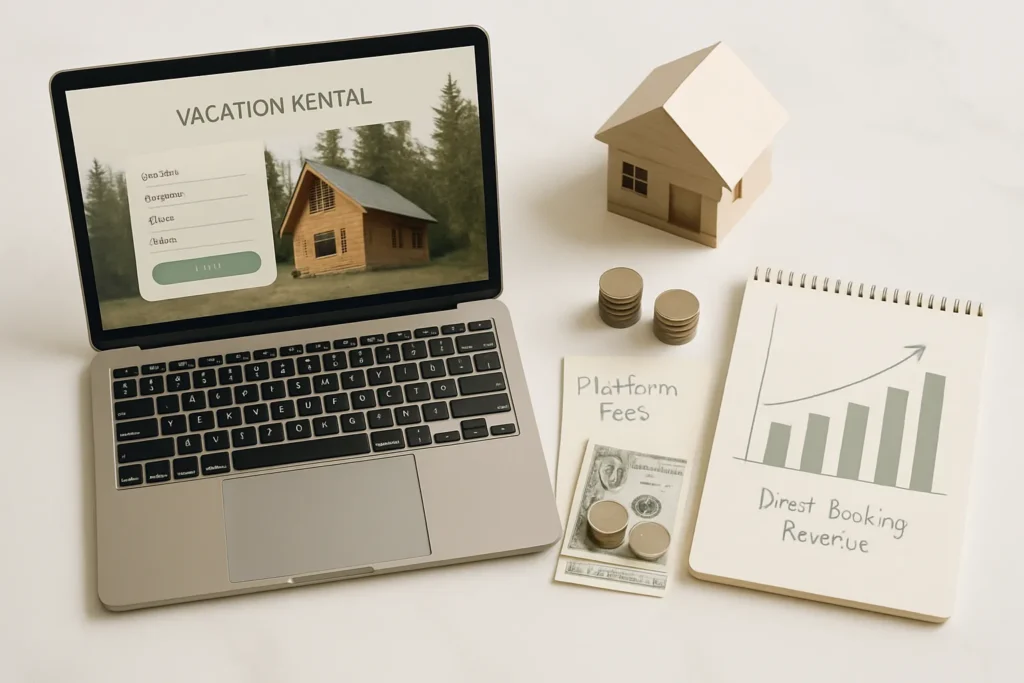
On a $1,000 vacation rental booking, Airbnb currently takes $155 in host fees before the money ever reaches you. That is the 15.5% host-only fee that rolled out fully at the end of 2025. Run that booking through your own direct website with a standard payment processor, and you keep roughly $971 of that same $1,000.
The difference is $126 per booking. Multiply that by 50 bookings a year and you are looking at $6,300 left on the table annually. For a host with 100 bookings, the figure climbs to $12,600.
Now, I am not here to tell you to abandon Airbnb. I have spent four decades looking at market data, and the numbers are clear: OTA platforms are extraordinarily effective at putting guests in front of your property. What the data also shows, however, is that a growing number of experienced operators are using that discovery power strategically, then routing repeat guests and organic traffic through a direct booking channel where the math works in their favor.
Let me walk you through the fee structure, the behavioral research behind this strategy, and what it actually takes to build a direct booking channel that works.
The Fee Comparison, by Platform
Think of OTA fees like a toll road. You get to use a well-maintained highway with a lot of traffic, but you pay every time you pass through the gate. The question is whether you need to pay that toll on every single trip, or whether some of your travelers can take a different route.
Here is how the current fee structure looks across the major platforms, based on OTA commission rate data compiled in late 2025:
| Platform | Host Fee / Commission | Notes | Net on $1,000 Booking |
|---|---|---|---|
| Airbnb | 15.5% | Host-only model; guests see no separate service fee | $845 |
| VRBO | ~11% | 8% commission + 3% payment processing | $890 |
| Booking.com | 10–25% | Varies by property type, location, cancellation policy | $750–$900 |
| Direct Booking | 2–3% | Payment processing only (e.g., Stripe, Square) | $970–$980 |
That direct booking column is the one that tends to get hosts’ attention. A property generating $60,000 in annual revenue through Airbnb alone is effectively paying $9,300 in platform fees every year. Some of that cost is absolutely worth it, because Airbnb delivers traffic you could not generate on your own. But not all of it has to be.
If you are not yet familiar with how Airbnb’s fee model changed at the end of 2025, our earlier breakdown of Airbnb’s 15.5% host fee and the math behind it covers the transition in detail.
The Billboard Effect: Why This Strategy Works
Here is the behavioral insight that underpins everything I am about to describe.
Research from Cornell University, cited in Cloudbeds’ analysis of the billboard effect, found that 30% of guests who ultimately book directly with a property first discovered it on an OTA. Guests use platforms like Airbnb the same way they once used hotel booking sites: as a search engine and validation tool. They find the property, read the reviews, confirm it looks legitimate, and then go searching for a better price or a more direct relationship.
Now don’t let this number intimidate you. It does not mean 30% of your Airbnb guests are out there trying to go around you. Many guests never think to look further. But a meaningful portion do, and when they land on a well-built direct booking page, they convert.
The same research found that direct bookers plan their trips significantly further in advance, an average of 102 days compared to 41 days for OTA guests. These are planners. They are doing research. They are exactly the kind of traveler who will find a well-optimized website or a well-written blog post about your destination.
The Important Catch: What Airbnb Allows
Before we go further, I want to be precise about something, because this is an area where I see a lot of well-intentioned hosts accidentally put their accounts at risk.
Airbnb updated its off-platform policy in May 2025, and the rules are now strictly enforced using AI monitoring of host messages. Here is what you cannot do through the Airbnb platform:
- Share your email address, phone number, or personal website URL with guests via Airbnb messaging
- Ask guests to contact you outside of Airbnb
- Solicit guests to book with you directly or through another platform
- Request that guests register on an external website to access the property
The penalty for violations can be account suspension. Airbnb is serious about this, and the AI enforcement means even a well-meaning message like “visit my website for local tips” can trigger a review.
What this means is that your direct booking strategy has to work entirely on the inbound side. You cannot reach through Airbnb to pull guests toward you. Instead, you build the infrastructure so that guests who are already searching for you — the 30% looking to verify and compare — can find your direct booking channel organically.
See the full breakdown of Airbnb’s May 2025 off-platform policy for the exact language on what is and is not permitted.
The Three-Channel Approach
The most resilient STR operations I have studied in the data do not choose between platforms. They treat each channel as serving a different function in the booking funnel.
| Channel | Primary Role | Best For | Net Revenue (per $1,000) |
|---|---|---|---|
| Airbnb | Discovery + social proof | New guests, first-time travelers to your area | $845 |
| VRBO | Discovery + family market | Longer stays, families, domestic travelers | $890 |
| Direct booking site | Margin + repeat guests | Return guests, organic search traffic, referrals | $970–$980 |
Airbnb for discovery. VRBO for the family-travel segment. Your own website for the margin and the relationship. This is not a radical idea. It is the same model that hotel chains have used for years, and the data shows it works for independent STR operators too.
A Florida-based property manager who shifted to this model reduced OTA-only bookings by 52% and grew total revenue by 21% over eight months, according to case study data from a 2025 STR marketing analysis. That kind of result does not happen overnight, but it demonstrates what a deliberate channel strategy can produce.
Building the Direct Booking Channel: What the Data Says Works
Let me walk through the strategies that the data consistently supports, in order of ROI from strongest to weakest.
1. Email Marketing for Return Guests
This is the most underutilized channel in short-term rentals, and the numbers are striking. Email and SMS marketing campaigns to past guests deliver up to 44 times return on investment, with a cost per booking of less than $5. Compare that to Facebook or Google advertising, where a single booking costs $60 to $120 to acquire.
The challenge under Airbnb’s current policy is that you cannot collect guest email addresses through the Airbnb platform. This means email marketing only works for guests who have already found your direct booking site, signed up for a newsletter, or booked directly. It is a long-term play, but once your list has 200 to 300 past guests, a single email offering a return-booking discount can fill gaps in your calendar in 24 hours.
Automated post-stay emails — set up once, running indefinitely — are the most efficient way to start. A simple message thanking the guest for staying, offering a 10% direct-booking discount for their next visit, and linking to your booking page is enough to generate meaningful return traffic.
2. SEO and Organic Search
Think of SEO like planting a garden. The work happens now; the harvest comes later. A well-optimized direct booking website for a property in Nashville can rank for search terms like “vacation rental Nashville” or “cabin rental near Nashville with hot tub.” These searches happen every day from travelers who are not starting on Airbnb at all.
For 2026, the shift toward marketing investment among STR hosts is dramatic. Just 4.6% of operators cited marketing as a key investment area in 2025. That number jumped to 33.4% for 2026, according to industry survey data from The Host Report. The hosts who start building SEO foundations now will have a meaningful advantage as that competition increases.
The basics of a bookable direct website include local area content (guides, attraction lists, seasonal recommendations), a clear booking flow, and schema markup so Google can display your property in vacation rental search results. Most PMS-provided websites lack the technical foundation for competitive SEO ranking, which is why custom builds or platforms designed for direct bookings tend to outperform them.
3. Organic Social Media
Short-form video on Instagram Reels and TikTok has become a legitimate discovery channel for vacation rentals. A well-shot 30-second video of your property at peak season, shared consistently, can generate direct booking inquiries without any ad spend. This channel works particularly well for properties with a strong visual identity: a coastal cabin, a mountain retreat, a historic home with distinctive character.
The key is consistency over time, not viral moments. Three to four posts per week over six months builds an audience that, when planning a trip, thinks of your property by name before opening Airbnb.
4. Metasearch Advertising
Google Vacation Rentals and TripAdvisor allow you to list your direct booking page alongside OTA results in search. When a traveler searches “vacation rental Austin TX” on Google, metasearch results appear at the top with a calendar, price comparison, and direct link. This is the one paid channel where direct booking ROI clearly outperforms other ad formats, because the guest is already in purchase intent mode.
For more on pricing strategies that work across all these channels, our guide to effective short-term rental pricing strategies covers the data behind rate-setting decisions in detail.
What Does This Cost to Set Up?
A direct booking infrastructure is not free, but it is not expensive either.
| Component | Monthly Cost Range | Notes |
|---|---|---|
| Direct booking website (PMS or custom) | $50–$200/month | Lodgify, Hospitable, Ownerrez, or similar platforms |
| Email marketing platform | $0–$30/month | Mailchimp free tier works up to 500 contacts |
| Payment processing | 2–3% per transaction | Stripe standard rate; no monthly fee |
| Channel manager (syncs calendars) | $20–$50/month | Prevents double-bookings across all platforms |
| Total | ~$100–$280/month | Break-even at 1–3 additional direct bookings/month |
At a monthly cost of $150 to $280, you need roughly two additional direct bookings per month to cover the infrastructure cost. Every booking after that is pure margin recovery. For a host currently generating $50,000 annually through OTAs and paying $7,500 in platform fees, capturing even 20% of that through direct channels returns approximately $1,300 in annual savings while also reducing the structural risk of a single platform’s policy changes.
For a deeper look at how to manage the operational side of your rental business as you scale across multiple channels, our guide on short-term rental property management covers the systems that hold it all together.
What the Numbers Look Like in Real Markets
To give this some grounding in actual market data, here is what StaySTRA’s proprietary data shows for last-twelve-month performance in three popular STR markets as of early 2026:
| Market | LTM Monthly Revenue (Avg) | Average Daily Rate | Occupancy Rate |
|---|---|---|---|
| Nashville, TN | $5,023 | $301/night | 61.3% |
| Scottsdale, AZ | $4,195 | $297/night | 68.4% |
| Austin, TX | $2,794 | $225/night | 57.7% |
A Nashville host generating $5,023 per month — $60,276 annually — pays approximately $9,300 in Airbnb host fees on that revenue. Moving 25% of bookings to a direct channel would recover roughly $2,300 per year in fees, while also building a database of guests who are more likely to return because the relationship is more direct and the experience feels more personal.
StaySTRA’s proprietary data shows these are the real numbers operators across these markets are working with. The fee math is the same regardless of market; the opportunity is proportional to revenue.
A Measured Assessment
I want to be honest with you about what direct bookings are and are not.
They are not a replacement for OTA platforms. Airbnb and VRBO bring extraordinary reach, trust signals, and booking infrastructure that would cost far more to replicate independently. Any host who abandons them entirely in favor of direct bookings is taking on significant vacancy risk.
What direct bookings are is a margin-recovery and relationship-building layer that sits on top of your OTA presence. You use OTAs to grow. You use direct channels to keep more of what you earn and to build a loyal guest base that is not dependent on any single platform’s algorithm or fee structure.
The 33% of hosts planning to invest in marketing in 2026 understand this. They are not abandoning Airbnb. They are building the infrastructure that makes their businesses more resilient, more profitable, and less vulnerable to the next fee change.
We do our best to keep our data accurate and up to date, but markets move fast and we are only human. Always verify current figures directly with local sources before making investment decisions.
Run the Numbers for Your Market
Want to see how direct booking math plays out for a specific property in your market? Our free StaySTRA Analyzer pulls real market data so you can estimate revenue, occupancy, and expenses — and see what a shift in channel mix would mean for your bottom line.
Frequently Asked Questions
What is a direct booking for vacation rentals?
A direct booking happens when a guest reserves your property through your own website or communication channel rather than through Airbnb, Vrbo, or another platform. Direct bookings save hosts 3% to 16% in platform fees per reservation. Building a direct booking channel requires your own website with booking functionality, payment processing, and marketing.
How do I start getting direct bookings for my rental?
Build a simple website using tools like Lodgify, Hospitable Direct, or WordPress with a booking plugin. Collect guest email addresses and encourage repeat bookings with loyalty discounts. Offer a 5% to 10% savings versus OTA prices to incentivize direct reservations. Business cards in your property and follow-up emails after checkout are effective low-cost tactics.
Do I need a permit to operate a short-term rental?
Most cities and counties require some form of permit, license, or registration to operate a short-term rental legally. Requirements vary significantly by jurisdiction, so check your local government website or contact your city clerk before listing your property. Operating without required permits can result in fines ranging from several hundred to several thousand dollars per violation.
How do I find the STR regulations for my area?
Start by searching your city or county government website for short-term rental or vacation rental ordinances. Many municipalities have a dedicated STR registration page with application forms and requirements. You can also contact your local planning department directly or consult with a real estate attorney who practices in your area.
What is the short-term rental tax loophole?
The STR tax loophole allows property owners who materially participate in managing their short-term rental to deduct losses against active income like W-2 wages. This works because rentals with an average guest stay of seven days or fewer are not classified as passive rental activities under IRS rules. It is one of the most powerful tax strategies available to real estate investors.
Stay in the Loop
Markets shift. Data changes. New opportunities emerge. Join the StaySTRA Insider newsletter and we will keep you updated on the numbers that matter.
Become a StaySTRA Insider
Join free — get our newsletter + 1 free property analysis/month.
No spam. Unsubscribe anytime. Free membership includes property analyses and market insights.