

Key Takeaways
- Woodstock leads the Catskills with a $305 average daily rate and 60% occupancy across 264 active listings, the strongest occupancy figure in the region according to StaySTRA data.
- Hunter commands the highest ADR at $389/night but runs at 26.7% occupancy, reflecting its concentrated ski-season demand profile rather than year-round strength.
- Livingston Manor in Sullivan County offers the most investor-accessible entry point: $314 ADR, 43.3% occupancy, minimal local regulation, and lower acquisition costs than Greene County mountain towns.
- The Catskills regulatory landscape spans three counties and dozens of townships, from Woodstock’s hard permit cap to Windham’s no-permit-required environment, making due diligence location-specific.
- New York’s statewide 4% STR sales tax has been fully operational since March 2025, applying to every Catskills booking regardless of county or township rules.
Woodstock’s short-term rental market is running at $305 per night with 60% occupancy across 264 active listings, the strongest occupancy rate StaySTRA tracks in the Catskills region. Think of occupancy rate like a hotel’s room utilization stat: 60% means six out of every ten available nights are booked and generating revenue. For a market that sits 90 to 120 minutes from 20 million metro New York residents, that kind of utilization isn’t an accident. It’s the product of four-season demand that very few Northeast markets can match.
I’ve spent decades watching data tell stories that the headlines miss. In Santa Fe, I keep a small framed map of New York State on my office wall, right between two pieces of Pueblo pottery. For years, the Catskills showed up on that map as an afterthought, sandwiched between the Adirondacks to the north and the Hudson Valley wine country to the southeast. The data tells a different story now.
This article covers what StaySTRA data shows for the Catskills STR market in 2026: four distinct submarkets, a seasonal demand curve that rewards patient capital, a regulatory landscape that varies dramatically by township, and a comparison to the Hudson Valley market published here last week. If you are evaluating a Northeast STR investment and haven’t looked at the Catskills seriously, the numbers deserve your attention.
Why 20 Million NYC Metro Residents Make the Catskills Work
The single strongest tailwind for any Catskills STR investment isn’t the foliage or the skiing. It’s geography. The drive from Midtown Manhattan to Woodstock runs about 110 minutes under normal traffic conditions. To Hunter or Windham, closer to two hours. To Livingston Manor in Sullivan County’s western reach, about two hours as well.
That 90-to-120-minute window is the sweet spot for weekend escape demand. Close enough for a Friday-night departure after work. Far enough to feel genuinely removed from the city. The Catskills sit squarely in that band, and they sit there exclusively for the New York City metro area, a consumer base of roughly 20 million people who skew toward urban professionals with disposable income and limited time.
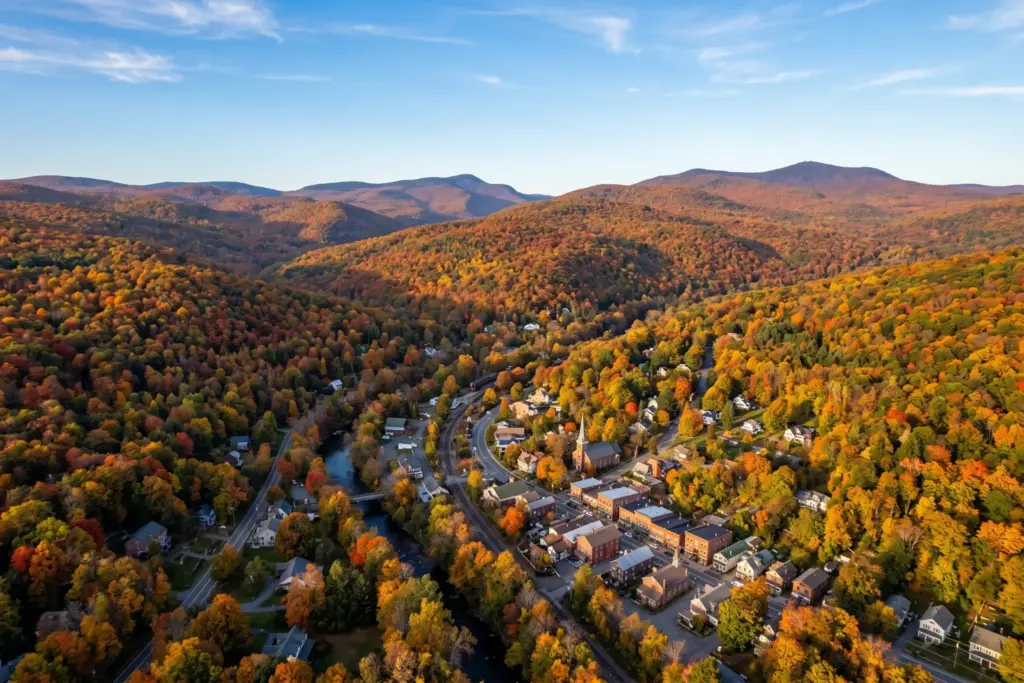
Four-season demand is the second structural advantage. The Catskills aren’t a single-season market like the Jersey Shore or a two-season market like many Adirondacks destinations. Fall foliage runs September through November and drives some of the highest ADRs of the year. Hunter Mountain and Windham Mountain provide legitimate ski terrain December through March. Hiking, swimming, and farm-to-table tourism carry spring and summer. And Woodstock’s arts-and-culture identity generates demand independent of season or weather.
Supply has grown, but not uniformly. The Catskills added new listings across all four submarkets between 2024 and 2026, but township-level permit caps in places like Woodstock have put a hard ceiling on investor-owned units. That supply constraint is a feature for existing permit holders, not a bug.
StaySTRA Market Data: Four Submarkets, Four Different Stories
The Catskills is not one market. It’s a cluster of distinct communities spread across Greene, Ulster, and Sullivan counties, each with different demand profiles, price points, and regulatory environments. Here is what StaySTRA data shows for the four submarkets that matter most to investors.
Woodstock and the Ulster County Arts Corridor
StaySTRA tracks Woodstock at $305 ADR, 60% occupancy, and 264 active listings. Annualized, that rate and occupancy combination produces an estimated gross revenue of approximately $66,800 per year for a well-positioned listing. That is the highest revenue potential in the Catskills by our data.
Woodstock’s demand driver is cultural, not just recreational. The town’s identity, built around the 1969 festival, the Woodstock Film Festival, and a dense arts community, generates consistent demand from a creative-class visitor who books repeatedly and at premium prices. Properties with design character, such as converted barns, architect-renovated farmhouses, and mid-century modern retreats, command ADR premiums well above the market average.
The trade-off is supply. Woodstock capped STR permits at 285 total, and the non-owner-occupied permit waitlist has been full for over a year. Investors buying today should assume they are acquiring an operating permit along with the property, not applying for a new one. StaySTRA’s Woodstock location page has current market detail for underwriting.
Sponsored — Beeline
Finance Your Next STR With a DSCR Loan
Qualify on property cash flow, not W-2 income. Beeline specializes in fast DSCR closings for STR investors. No personal income verification required.
Check Your DSCR Eligibility →Affiliate disclosure: StaySTRA may earn a referral fee.
Hunter and Windham: The Ski Mountain Market (Greene County)
Hunter runs at $389 ADR, the highest in the Catskills by our data, but at only 26.7% occupancy across 398 active listings. Don’t let that occupancy number stop you before you understand what’s behind it. Hunter is a ski market, and a concentrated one. Occupancy spikes dramatically December through March, then softens sharply in the shoulder seasons. A 26.7% annual average reflects that asymmetry, not a weak market in general.
Windham tells a similar story at $263 ADR and 43% occupancy, generating approximately $36,144 in estimated annual revenue based on StaySTRA’s $3,012 monthly average figure. Windham’s lower ADR compared to Hunter reflects a more accessible entry point and a longer shoulder season. Windham Mountain has been expanding its summer operations with mountain biking and hiking infrastructure, which is beginning to push shoulder-season occupancy upward in a measurable way.
Neither Hunter nor Windham currently requires a town-level STR permit. Greene County requires occupancy tax registration, and New York State’s 4% STR sales tax applies statewide, but the local regulatory burden is light relative to Woodstock. StaySTRA’s Hunter data page is the starting point for property-level underwriting in Greene County’s mountain towns.
Livingston Manor and the Sullivan County Corridor
Livingston Manor sits in Sullivan County’s western reach, adjacent to the Beaverkill River and what has quietly become one of the most talked-about rural culinary and arts scenes in the Northeast. A wave of farm-to-table restaurants, artisan creameries, and craft distilleries has been driving consistent urban visitor demand from New York City since roughly 2020.
StaySTRA shows Livingston Manor at $314 ADR and 43.3% occupancy across 178 active listings. Annual estimated gross revenue runs approximately $49,700, placing it between Windham’s lower-end and Woodstock’s top-end performance. Sullivan County’s STR regulatory environment is among the least restrictive in the Catskills region: unincorporated areas generally require no local permit, making this one of the more investor-accessible entry points in the whole cluster.
Property acquisition costs in Sullivan County also run lower than in Ulster or Greene counties, which affects the DSCR math significantly for leveraged buyers.
Sponsored — Beeline
Finance Your Next STR With a DSCR Loan
Qualify on property cash flow, not W-2 income. Beeline specializes in fast DSCR closings for STR investors. No personal income verification required.
Check Your DSCR Eligibility →Affiliate disclosure: StaySTRA may earn a referral fee.
The Seasonal Demand Curve
Think of the Catskills seasonal demand curve like a restaurant with four distinct meal services. Each service has different volume and pricing, and you need to understand all four before you model annual revenue with any accuracy.
Fall (September through November) is peak. October is the single highest-occupancy month across the Catskills for most submarkets, with foliage driving bookings from late September through early November. ADRs reach their annual highs during Columbus Day weekend, when properties routinely command 40 to 60 percent above their standard nightly rate. Woodstock and the Ulster County arts corridor see the longest peak window because cultural demand extends the season past peak foliage.
Winter (December through March) is the ski market’s primary season. Hunter and Windham see their occupancy spike sharply, with peak-weekend ADRs reaching their annual highs. Properties near the lifts command the clearest premiums. The ski season is also the easiest to model because it tracks directly to lift-open weekends.
Spring (March through May) is the shoulder. The ski season winds down before hiking and outdoor demand picks up fully. Experienced operators use this window for deep cleaning, maintenance, and capital improvements. Pricing during spring should be set at the floor necessary to move inventory, not held at fall rates.
Summer (June through September) has been the growth story of the last three years. Hiking, swimming in Catskill swimming holes, kayaking, and agritourism demand has made summer a reliable second peak across the region. Woodstock and Sullivan County benefit most from summer demand due to their cultural and culinary infrastructure, which generates traffic independent of specific outdoor recreation conditions.
Property Type Performance
Across the Catskills, cabin and cottage properties consistently outperform standard homes on a per-night basis. The premium for a purpose-built or design-renovated cabin typically runs 30 to 40 percent above a comparable standard home. Guests paying $350 to $450 per night in this market are selecting for experience: a hot tub, a wood-burning fireplace, exposed beams, a soaking tub with a mountain view. They are not selecting for a three-bedroom colonial with a two-car garage.
Farmhouse properties have become the fastest-growing segment in the Sullivan County corridor. The farm-stay experience, including access to working farm elements, vegetable gardens, or simply the aesthetic of a rural working property, drives both ADR and repeat bookings. Livingston Manor is the epicenter of this trend in the Catskills.
Standard homes perform adequately but compete more directly on price. In markets like Hunter, where ADRs run high overall, a well-located standard home can still generate strong revenue. In Woodstock, a standard home without distinctive character competes against a deeper pool of design-forward inventory.
The Regulatory Patchwork: What Investors Need to Know
The Catskills regulatory landscape is arguably the most complex due-diligence question in any Catskills STR investment. Unlike a market such as Miami, where rules are consistent across the city, the Catskills spans three counties and dozens of incorporated villages and townships, each with authority to set its own rules. Stay with me here, because this section matters a lot for anyone doing serious underwriting.
Woodstock (Ulster County): Permit required. Annual fee: $50 for owner-occupied plus $25 per additional bedroom; $250 per year for non-owner-occupied. A 285-permit hard cap is currently full, with a waitlist for investment properties. Buyers should confirm permit transferability before closing.
Hunter and Windham (Greene County): No town-level permit currently required. Greene County occupancy tax registration is mandatory. New York State’s 4% STR sales tax applies. The Village of Catskill, a separate community within Greene County, enacted its own village permit requirement.
Livingston Manor and unincorporated Sullivan County: Sullivan County has the least restrictive STR environment in the Catskills region. Many unincorporated areas require no local permit, though Sullivan County imposes a 5% occupancy tax and state tax applies.
Ulster County broadly: All hosts must register with the Ulster County Department of Finance and collect approximately 4% occupancy tax, regardless of township-level rules.
New York State: Governor Hochul’s statewide 4% STR remittance framework has been fully operational since March 2025 across all 62 New York counties. Major platforms collect and remit this tax automatically. New York’s statewide STR registry rollout is also underway, with platforms required to delist unregistered properties in participating counties.
For investors running DSCR loan scenarios, our STR Financing Guide 2026 covers how lenders handle the Catskills permit and regulatory question in underwriting. It’s worth reading before you apply.
Sponsored — Beeline
Finance Your Next STR With a DSCR Loan
Qualify on property cash flow, not W-2 income. Beeline specializes in fast DSCR closings for STR investors. No personal income verification required.
Check Your DSCR Eligibility →Affiliate disclosure: StaySTRA may earn a referral fee.
Catskills vs. Hudson Valley: The NYC Metro Cluster Thesis
If you read our Hudson Valley NY STR market analysis published last week, you’ve already seen the adjacent market data. The two regions function as a cluster for NYC metro leisure demand, and understanding how they differ tells you where to deploy capital based on your investor profile.
The Hudson Valley, anchored by towns like Rhinebeck, Kingston, and Beacon, skews toward cultural and agritourism demand with lower average ADRs than the Catskills mountain towns. Hudson Valley properties tend to run more consistent year-round occupancy. They also trade at higher acquisition prices in the most desirable corridors.
The Catskills offer a wider ADR range: from Windham’s $263 to Hunter’s $389. The mountain premium is real. The ski-season concentration risk is also real. Investors who want peak-season ADR upside with multi-season occupancy stability should study Woodstock’s data most carefully, since it combines cultural demand, outdoor recreation, and the highest occupancy rate in the cluster.
For a broader view of New York STR markets across both clusters, StaySTRA’s New York overview page tracks data across 180 cities statewide. The Best Airbnb Markets hub puts the full national picture in context alongside both NYC metro leisure markets.
Supply and Market Entry Outlook
The Catskills saw meaningful new listing growth between 2024 and 2026 in the markets without permit caps. Hunter grew to 398 active listings. Livingston Manor remains the smallest tracked market at 178 listings, which means individual new properties face less direct competition and have more ability to differentiate on design and amenities.
Woodstock’s supply is essentially frozen by the permit cap. 264 active listings is a ceiling, not a floor. In a market where supply cannot grow, revenue performance for existing permit-holding properties should be more defensible over time.
Entry prices vary significantly. Sullivan County farmhouses and rural properties can still be acquired in the $350,000 to $600,000 range in many areas. Greene County mountain properties near the ski lifts run higher. Woodstock’s premium and permit scarcity push prices toward the upper range for properties that come with a transferable permit.
For investors running DSCR loan scenarios, use the StaySTRA New York Analyzer to pull current revenue projections for specific addresses. It’s the fastest way to stress-test a purchase price against actual submarket data before you make an offer.
Frequently Asked Questions
What is the average revenue for a short-term rental in the Catskills in 2026?
Revenue varies significantly by submarket. StaySTRA data shows Woodstock at the high end with an estimated $66,800 annual gross revenue based on $305 ADR and 60% occupancy. Livingston Manor in Sullivan County runs approximately $49,700 annually at $314 ADR and 43.3% occupancy. Windham averages $3,012 per month in gross revenue, or roughly $36,144 annually. Hunter’s $389 ADR is the highest in the region, but 26.7% occupancy produces lower annual totals. Actual performance depends on property type, listing quality, and seasonal availability.
Do you need a permit to operate a short-term rental in the Catskills?
It depends entirely on which township you are in. Woodstock requires an annual permit with a hard cap of 285 total, currently full for non-owner-occupied listings. Windham and Hunter in Greene County do not currently require a town-level STR permit. Livingston Manor and unincorporated Sullivan County areas generally require no local permit. All operators statewide must collect New York’s 4% STR sales tax, and county occupancy taxes apply regardless of township rules.
Is the Catskills a year-round STR market or a seasonal one?
The Catskills is genuinely four-season, which is one of its core investment advantages. Fall foliage (October through early November) drives peak occupancy and ADRs. Winter serves the ski market at Hunter and Windham. Summer hiking, swimming, and agritourism demand has grown substantially since 2020. Spring is the softest quarter. Markets like Woodstock and Livingston Manor have the most consistent year-round demand due to their cultural and culinary draw independent of outdoor recreation conditions.
How does the Catskills compare to Hudson Valley for STR investing?
The two regions anchor the NYC metro leisure STR cluster but serve different investor profiles. Hudson Valley generally runs lower ADRs with more consistent year-round occupancy. The Catskills offer higher peak ADRs in mountain towns, particularly Hunter at $389 and Woodstock at $305, with more seasonal concentration. Sullivan County offers the most accessible Catskills entry price point. Both markets are tracked across StaySTRA’s New York data.
What property type performs best in the Catskills STR market?
Cabins and design-forward rural retreats consistently command 30 to 40 percent ADR premiums over standard homes in the same submarket. Farmhouse properties in Sullivan County have been the fastest-growing premium segment, driven by agritourism and farm-stay demand from NYC visitors. Standard homes perform adequately in high-ADR markets like Hunter but face more price competition. Properties with outdoor amenities (fire pit, hot tub, mountain views) and distinctive interior character generate both higher ADRs and stronger repeat booking rates.
Ready to run the numbers on a specific Catskills property? The StaySTRA New York Analyzer generates revenue projections by address using market data across 180 New York cities. It’s free and takes about two minutes.
Sponsored — Beeline
Finance Your Next STR With a DSCR Loan
Qualify on property cash flow, not W-2 income. Beeline specializes in fast DSCR closings for STR investors. No personal income verification required.
Check Your DSCR Eligibility →Affiliate disclosure: StaySTRA may earn a referral fee.
Become a StaySTRA Insider
Join free — get our newsletter + 1 free property analysis/month.
No spam. Unsubscribe anytime. Free membership includes property analyses and market insights.
We do our best to keep our data accurate and up to date, but markets move fast and we are only human. Always verify current figures directly with local sources before making investment decisions.