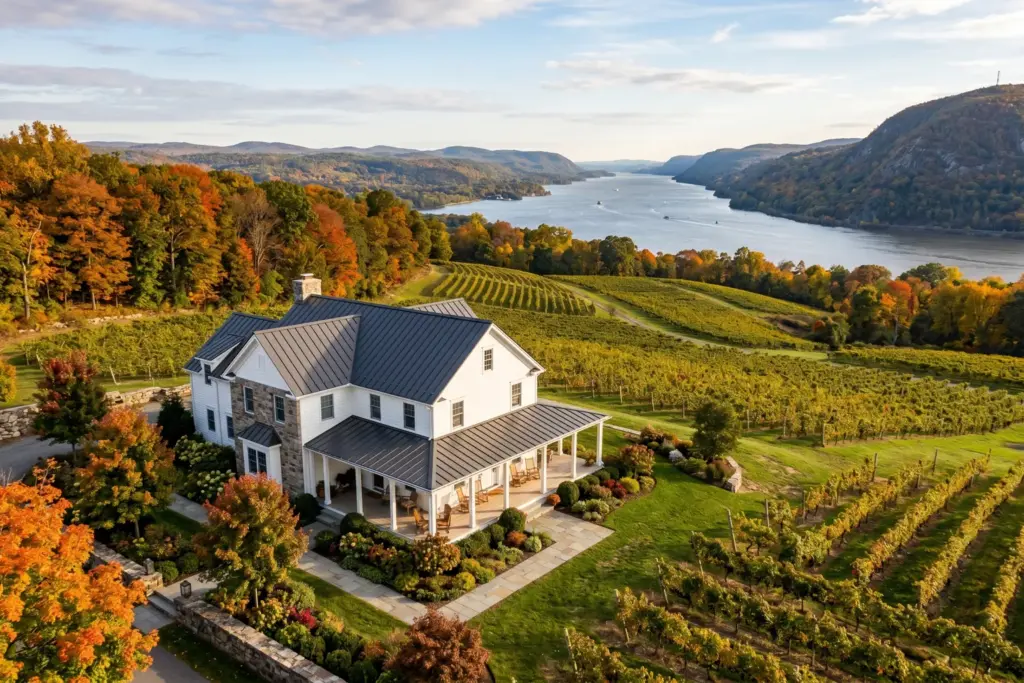
Key Takeaways
- StaySTRA data shows Hudson Valley STR properties average approximately $40,500 in annual gross revenue, with August peak monthly revenue of $4,694 at 62% occupancy and $288 ADR across the region’s core submarkets.
- Kingston delivers the region’s strongest occupancy at 65.4% with a $244 ADR; Woodstock commands a 25% rate premium at $305 ADR with 60% occupancy and 264 active listings.
- The regulatory landscape varies sharply by town: Kingston’s non-owner-occupied permit cap is full, Woodstock’s investment-property waitlist is long, and Hudson City limits STR stays to 60 days per year.
- New York’s statewide 4% STR sales tax (effective March 2025) applies to all Hudson Valley bookings, with Airbnb and VRBO collecting and remitting automatically for platform bookings.
- DSCR loan math works well for Hudson Valley properties priced under roughly $550,000; the numbers tighten significantly at price points common in Rhinebeck and Woodstock.
The median Hudson Valley short-term rental property generated approximately $40,500 in gross revenue over the past 12 months, according to StaySTRA market data, with peak-month August delivering $4,694 at 62% occupancy and $288 per night. Those numbers put this market well ahead of most rural Upstate New York destinations, and they make one thing unmistakably clear: being 90 minutes from Manhattan is not a footnote in the revenue story. It is the headline.
From my desk in Santa Fe, I have been tracking the Hudson Valley data all spring. This is a cultural tourism market, not a wilderness market. Think of it this way: the Adirondacks attract visitors who want to disconnect; the Hudson Valley attracts visitors who want to engage with art, wine, food, and history on a curated long weekend. That distinction shapes the demand curve in ways the data confirms, including a shoulder season that holds meaningfully stronger than most comparable Upstate markets.
Hudson Valley STR Market Data: 2026 Snapshot
StaySTRA tracks four core Hudson Valley markets. Here is where each stands as of mid-2026, reflecting market activity through late 2025.
| Market | ADR | Occupancy | Active Listings | Peak Month Revenue |
|---|---|---|---|---|
| Kingston (Ulster Co.) | $244 | 65.4% | 330 | $4,694 (Aug) |
| Saugerties (Ulster Co.) | $302 | 52.4% | 512 | $4,694 (Aug) |
| Woodstock (Ulster Co.) | $305 | 60% | 264 | $4,694 (Aug) |
| Hudson (Columbia Co.) | $263 | 43%* | est. 120-150 | $4,387 (Aug) |
*Hudson City’s 60-day annual rental cap substantially restricts effective utilization; its occupancy rate is not directly comparable to uncapped markets.
The regional average daily rate across these four markets runs roughly $278 per night. That is a meaningful premium over most Finger Lakes markets and well above the majority of rural Upstate New York destinations, reflecting the NYC proximity effect. Guests willing to pay $300 per night in Woodstock are almost always driving from New York City or Connecticut, and those travelers carry less price sensitivity than typical rural leisure visitors.
Sponsored — Beeline
Finance Your Next STR With a DSCR Loan
Qualify on property cash flow, not W-2 income. Beeline specializes in fast DSCR closings for STR investors. No personal income verification required.
Check Your DSCR Eligibility →Affiliate disclosure: StaySTRA may earn a referral fee.
Seasonal Profile: When Does Hudson Valley Peak?
The StaySTRA monthly data tells a more nuanced story than the typical “summer peaks in August” narrative. Don’t let that scare you when you see January’s 38% occupancy sitting in the same table as August’s 62%. The range is narrower than most mountain markets, and the floor is higher than most people expect.
| Month | Occupancy | ADR | Est. Monthly Revenue |
|---|---|---|---|
| January | 38% | $267 | $2,974 |
| February | 46% | $273 | $3,092 |
| March | 39% | $230 | $2,645 |
| April | 48% | $226 | $2,733 |
| May | 51% | $244 | $2,854 |
| June | 53% | $269 | $3,564 |
| July | 60% | $280 | $4,386 |
| August | 62% | $288 | $4,694 |
| September | 48% | $256 | $3,295 |
| October | 52% | $269 | $3,851 |
| November | 44% | $256 | $3,151 |
| December | 46% | $270 | $3,271 |
Peak season runs June through August, averaging around 58% occupancy. October is the year’s third-best month at $3,851, driven by fall foliage demand. The shoulder (November through April, excluding February’s slight bump) averages roughly 42% occupancy. That sustained demand from NYC weekend travelers means the Hudson Valley does not experience the deep winter valleys common in pure ski markets or the summer-only patterns of many Catskills properties. Annual revenue of $40,510 sums out across all twelve months.
Submarket Breakdown: Four Different Stories
Do not let regional averages flatten what is a varied landscape. Buying in the wrong submarket for your strategy is a real risk in the Hudson Valley.
Kingston: High Occupancy, Accessible Entry
Kingston runs the highest utilization of any market in this dataset at 65.4% occupancy. The $244 ADR is the region’s lowest, reflecting a broader guest demographic and value positioning relative to Woodstock and Saugerties. That combination of moderate rate and high occupancy produces reliable annual returns, and Kingston’s relatively accessible property prices make the DSCR financing math work more cleanly than in premium ZIP codes.
Woodstock and Saugerties: Rate Premium Markets
Woodstock at $305 ADR and Saugerties at $302 run the region’s highest nightly rates. Woodstock’s name recognition is a genuine booking driver: guests actively search for it as a destination, creating pricing power beyond what pure location would support. Saugerties, with 512 active listings, is the deepest market in the region by supply volume, signaling sustained investor interest and a less restricted permitting path than Woodstock. Both markets reward operators who invest in property quality and presentation.
Hudson: Premium Demand, Regulatory Ceiling
Hudson is the most analytically interesting submarket here. The city’s Warren Street arts district and rising culinary scene attract high-income visitors from New York City who would support above-regional ADR. But Hudson City’s 60-day annual rental cap means you are operating a part-time STR regardless of market demand. The StaySTRA data shows $263 ADR and 43% occupancy, but those numbers are constrained by ordinance, not by visitor interest. Investors should underwrite Hudson on a capped-revenue basis and monitor whether the council extends the limit to 120 days, as was under consideration in early 2026.
The contrast with our Adirondacks STR market analysis is useful: the Adirondacks offer wilderness demand with a generally more permissive rural regulatory environment across most towns, while the Hudson Valley offers cultural-tourism demand with more municipal variation. Both reward investors who verify local rules before closing.
Sponsored — Beeline
Finance Your Next STR With a DSCR Loan
Qualify on property cash flow, not W-2 income. Beeline specializes in fast DSCR closings for STR investors. No personal income verification required.
Check Your DSCR Eligibility →Affiliate disclosure: StaySTRA may earn a referral fee.
The Regulatory Patchwork: State Rules and Local Variation
The Hudson Valley operates under two regulatory layers: a statewide tax framework that applies across all 62 New York counties, and a highly variable local ordinance structure that differs by municipality.
New York State 4% Sales Tax
Governor Hochul signed the statewide STR sales tax expansion in December 2024, effective March 25, 2025. Every short-term rental booking in New York State is now subject to the 4% state sales tax. Airbnb and VRBO collect and remit automatically for platform bookings. Add Ulster County and Columbia County local occupancy taxes and total guest-paid taxes in most Hudson Valley markets land between 7% and 8.875%. Hosts managing direct bookings remain personally responsible for collection and remittance.
Kingston: Permit Cap Is Full
Kingston limits non-owner-occupied STR permits to approximately 106 citywide (roughly 1% of housing stock), and that cap is currently full. New investors cannot obtain a whole-property STR permit unless purchasing from a permit holder in a transfer, or they plan to operate an owner-occupied rental with primary residence on-site. Owner-occupied STRs face no cap. Fines run $1,000 per day for a first offense, up to $7,500 per day for repeat violations.
Woodstock: Investment Waitlist
Woodstock requires registration with fees tiered by ownership type: $250 to $350 per year for owner-occupied properties, $450 per year for non-owner-occupied rentals. The investment-property permit cap is full with a waitlist. Woodstock updated its fee structure in January 2025.
Hudson: The 60-Day Rule
Hudson City allows STRs only for primary residents who occupy the property at least 50 days per year, with a hard limit of 60 rental days annually. A proposal to extend this to 120 days was under council consideration as of early 2026. Hudson also imposes a local 4% lodging tax layered on top of state sales tax. Do not underwrite a Hudson property as a full-time STR operation under the current ordinance.
Saugerties and Dutchess County
Saugerties requires town registration but operates with a more permissive posture than Kingston or Woodstock. Towns in Dutchess County, including the broader Rhinebeck area, range from simple registration requirements to still-developing frameworks. Investors seeking uncapped non-owner-occupied access should research Saugerties, Red Hook, Millbrook, and Greene County towns as alternatives to the most restricted Ulster County municipalities.
Sponsored — Beeline
Finance Your Next STR With a DSCR Loan
Qualify on property cash flow, not W-2 income. Beeline specializes in fast DSCR closings for STR investors. No personal income verification required.
Check Your DSCR Eligibility →Affiliate disclosure: StaySTRA may earn a referral fee.
Investment Thesis: Does the DSCR Math Work?
Stay with me here, because this is where the Hudson Valley gets genuinely complicated from a financing standpoint. Think of the DSCR calculation like a balance scale: monthly rental income on one side, monthly debt service on the other. Most DSCR lenders want income running at least 20-25% heavier before they close the loan.
A $450,000 property in Kingston or well-located Saugerties, purchased with 25% down, carries a loan of $337,500. At approximately 7.25% on a 30-year DSCR note, monthly debt service runs roughly $2,303. Against StaySTRA’s $3,376 average monthly gross revenue, the DSCR ratio is approximately 1.47. Most lenders require 1.20 or better. The math clears with room at that price point.
Move to $650,000, a realistic price for a well-positioned Woodstock or Rhinebeck property, and the calculation changes. A $487,500 loan at 7.25% runs about $3,326 per month. Monthly gross revenue of $3,376 produces a DSCR of roughly 1.02. That falls short of the 1.20-1.25 most lenders require. Closing at that price point demands a larger down payment to reduce the loan balance, or a property with documented above-median revenue performance.
The Hudson Valley DSCR sweet spot is roughly $400,000 to $550,000 for median-performing properties. Premium Woodstock and Rhinebeck properties that genuinely achieve $300-plus ADR with 60%+ occupancy can work on DSCR terms, but the underwriting must use actual documented performance data, not regional averages. Our STR DSCR financing guide covers the full underwriting mechanics, including how lenders calculate qualifying income and what documentation to prepare.
One broader context worth noting: our coastal versus mountain STR market comparison found that cultural-tourism markets like the Hudson Valley tend to hold ADR premiums more durably than pure outdoor-recreation markets, because the visitor mix skews toward higher-income urban travelers with lower price sensitivity. The $278 regional average ADR in the StaySTRA data reflects that premium clearly. For the right property at the right price, the Hudson Valley investment case is solid. The regulatory environment just means the municipal homework is not optional.
Sponsored — Beeline
Finance Your Next STR With a DSCR Loan
Qualify on property cash flow, not W-2 income. Beeline specializes in fast DSCR closings for STR investors. No personal income verification required.
Check Your DSCR Eligibility →Affiliate disclosure: StaySTRA may earn a referral fee.
We do our best to keep our data accurate and up to date, but markets move fast and we are only human. Always verify current figures directly with local sources before making investment decisions.
Frequently Asked Questions
What is the average daily rate for short-term rentals in the Hudson Valley in 2026?
StaySTRA data across the four core tracked markets shows average daily rates ranging from $244 (Kingston) to $305 (Woodstock), with a regional average around $278 per night. Woodstock and Saugerties command a clear premium over Kingston, reflecting their stronger cultural brand identity and higher-income visitor base. Hudson City averages $263 but is constrained by a 60-day annual rental cap that limits effective supply and utilization.
How much annual revenue does a Hudson Valley Airbnb property generate?
StaySTRA data puts median annual gross revenue around $40,500 for Hudson Valley short-term rental properties. August is the strongest month at $4,694, and October (fall foliage) is the year’s third-best month at $3,851. Properties in Woodstock and the broader Rhinebeck area that command $300-plus ADR with strong occupancy can generate significantly more than the regional median.
Can investors buy short-term rental properties in Kingston or Woodstock?
It is complicated in both towns. Kingston’s non-owner-occupied STR permit cap is full at approximately 106 permits citywide. Woodstock’s investment-property waitlist is also at capacity. Owner-occupied STRs have more accessible registration paths in both municipalities. Investors seeking uncapped non-owner-occupied access should research Saugerties, Red Hook, and towns in Dutchess and Greene counties before settling on a target municipality.
Does the New York state 4% sales tax apply to Hudson Valley short-term rentals?
Yes. New York’s statewide 4% sales tax on short-term rentals took effect March 25, 2025, and applies to all 62 counties including Ulster, Dutchess, Columbia, and Greene. Adding local county and municipality taxes, guests typically pay 7% to 8.875% total. Airbnb and VRBO collect and remit automatically for platform-booked stays; hosts managing direct bookings are personally responsible for collection and remittance.
How does the Hudson Valley STR market compare to the Adirondacks?
The two markets draw different visitor profiles. The Adirondacks attract wilderness and outdoor recreation visitors with a stronger summer concentration. The Hudson Valley captures a cultural tourism audience with a broader seasonal spread due to year-round arts, wine trail, and agri-tourism attractions. Hudson Valley ADR runs slightly higher in the core markets, reflecting the NYC proximity premium and cultural brand strength. See our Adirondacks market analysis for a full comparison of the two markets for Upstate New York investors.
Run Your Hudson Valley Analysis
The StaySTRA Analyzer runs revenue projections, occupancy models, and DSCR scenarios for Hudson Valley properties at the submarket level. If you are evaluating a specific Kingston, Saugerties, Woodstock, or Hudson address, the Analyzer gives you data specific to that market rather than regional averages.
Run a free analysis at the StaySTRA Analyzer.
For New York state STR market data across all 180 tracked cities, visit the New York STR location page.
Become a StaySTRA Insider
Join free — get our newsletter + 1 free property analysis/month.
No spam. Unsubscribe anytime. Free membership includes property analyses and market insights.