

Key Takeaways
- StaySTRA data tracks the White Mountains NH region at $237 average daily rate and 44% average annual occupancy, with peak revenue reaching $5,076 in August and $4,338 in February across 5,600-plus active listings.
- The dual-season structure (winter ski, summer hiking and fall foliage) produces two distinct revenue peaks, giving White Mountains investors a meaningful yield advantage over single-season mountain markets.
- Entry prices average $487,000 in the White Mountains corridor, roughly one-third of Stowe VT condo median values, and Stowe has effectively closed its door to new short-term rental registrations in residential zones as of May 2026.
- New Hampshire imposes an 8.5% state rooms and meals tax on STR stays under 185 days (RSA 78-A), with local zoning control but a favorable 2023 New Hampshire Supreme Court precedent that protected non-owner-occupied rentals in the White Mountains corridor.
- The market draws East Coast buyers priced out of Vermont ski towns, investors seeking a drive-to destination reachable from Boston and New York, and DSCR borrowers attracted to a lower entry price relative to competing Northeast mountain markets.
StaySTRA data shows the White Mountains of New Hampshire generating an average daily rate of $237 and annual average occupancy of 44 percent across 5,600-plus active listings in Carroll and Grafton counties. By itself, 44 percent sounds uninspiring. Think of it the way you would think about a restaurant’s table-turn rate: the number only tells you part of the story until you look at when those tables are full. In the White Mountains, February hits 57 percent occupancy at $311 average nightly rate and $4,338 in average monthly revenue. Then August hits 67 percent occupancy and $5,076. That is a market with two separate revenue engines, not one, and that distinction matters more than most investors realize when they are first sizing up Northeast mountain markets.
This article covers what the StaySTRA data shows for the White Mountains STR market in 2026, including the monthly revenue breakdown, how Carroll County (North Conway and the eastern ski corridor) compares to Grafton County (Lincoln, Franconia, and the Kancamagus Highway), and what the dual-season dynamic means for investors evaluating New Hampshire against pricier alternatives like Stowe. If you are coming here from the Vermont ski market conversation, the regulatory section is worth reading carefully.
A Mountain Market with Two Revenue Engines
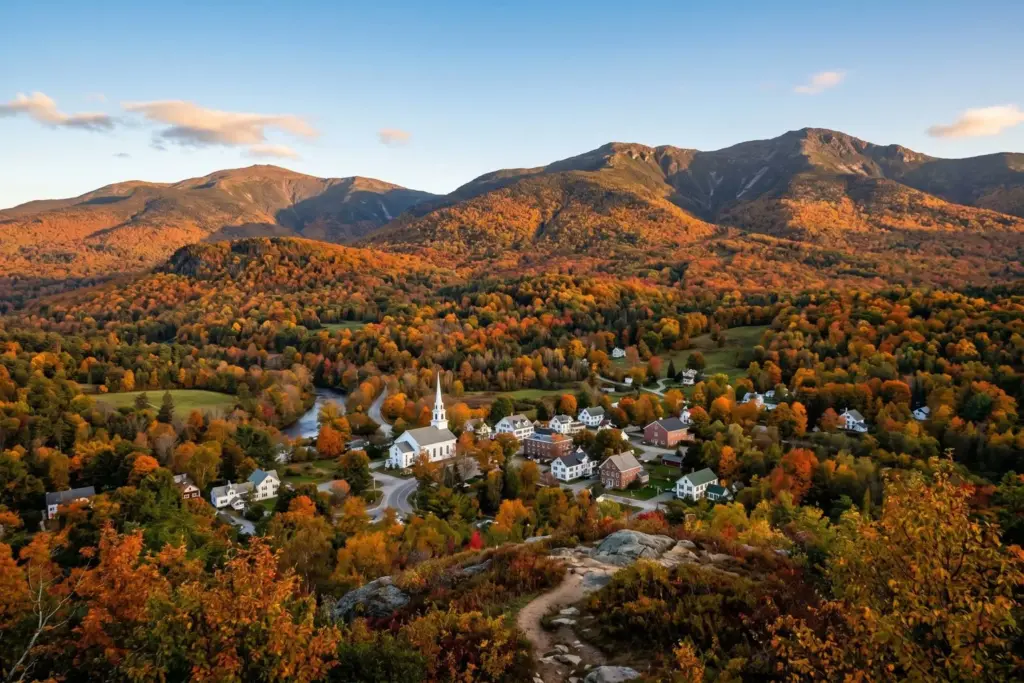
The White Mountains of New Hampshire sit in the northern half of the state, anchored by the White Mountain National Forest, which draws roughly six million visitors per year. For reference, that puts it above both Yosemite and Yellowstone in annual visitation, and the reason is straightforward: the proximity to population. Boston is about two hours south. New York City is four to five hours. The visitor base is not flying in from around the country; it is driving up from one of the densest population corridors in the United States, which creates remarkably stable underlying demand.
The region divides into two county-level sub-markets that investors should understand separately. Carroll County runs along the eastern White Mountains corridor, centered on North Conway and its surrounding villages of Jackson, Bartlett, and Glen. This is where Attitash Mountain Resort and Wildcat Mountain draw winter ski traffic, and where outlet shopping, Mount Washington, and family attractions keep summer and shoulder-season visitors coming. Grafton County covers the western approach, including Lincoln (home to Loon Mountain Resort), Franconia (Cannon Mountain), and Waterville Valley Resort. The Kancamagus Highway, one of the most celebrated fall foliage drives in New England, runs directly through this section of the region. Both counties show near-identical metrics in StaySTRA data, which suggests investors should treat the White Mountains as a unified destination brand rather than competing sub-markets.
What StaySTRA Data Shows for the White Mountains in 2026
StaySTRA data for the White Mountains region, updated through April 2026, shows the following market profile across 5,600-plus active listings:
- Average daily rate: $237
- Annual average occupancy: 44 percent
- RevPAR: $62 (down 4.7 percent year-over-year)
- 2025 average monthly revenue: $3,635 (approximately $43,620 annual gross)
- Top operator by listing count: Vacasa (230 listings)
- Typical home value: $486,974
The monthly breakdown is where the dual-season story becomes concrete. Stay with me here, because these numbers tell a more interesting story than the annual average suggests:
| Month | Occupancy | ADR | Avg Revenue |
|---|---|---|---|
| January | 44% | $298 | $3,512 |
| February | 57% | $311 | $4,338 |
| March | 35% | $274 | $2,803 |
| April | 30% | $222 | $1,987 |
| May | 40% | $229 | $1,918 |
| June | 52% | $256 | $2,955 |
| July | 64% | $276 | $4,654 |
| August | 67% | $276 | $5,076 |
| September | 41% | $251 | $2,891 |
| October | 47% | $263 | $3,438 |
| November | 32% | $248 | $2,306 |
| December | 46% | $291 | ~$3,400 |
Source: StaySTRA White Mountains data, updated April 2026. Data reflects Carroll County market metrics representative of the broader White Mountains region.
The two peaks stand out immediately: February (ski season) at $4,338 and August (summer hiking season) at $5,076. What also stands out is mud season, the three-month stretch from March through May when snow has melted but summer crowds have not arrived. Occupancy in that window runs 30 to 40 percent and monthly revenue drops to the $1,900 to $2,800 range. This is the structural risk in a White Mountains investment, and buyers who underwrite it accurately will not be surprised.
October deserves a mention. At 47 percent occupancy and $3,438 average revenue, it outperforms late summer and rivals January. Leaf-peeping in the White Mountains is a genuine demand driver with staying power, and the data supports it.
Sponsored — Beeline
Finance Your Next STR With a DSCR Loan
Qualify on property cash flow, not W-2 income. Beeline specializes in fast DSCR closings for STR investors. No personal income verification required.
Check Your DSCR Eligibility →Affiliate disclosure: StaySTRA may earn a referral fee.
Carroll County vs. Grafton County: Two Micro-Markets
StaySTRA tracks 5,600-plus listings in the Carroll County market and 5,500-plus entire-place listings in the Lincoln-area Grafton County market. Both show nearly identical ADR and occupancy patterns, which tells you guests are not choosing between the eastern and western approaches based on price. They are choosing based on which resort or trail system they want to access.
The bedroom distribution in Grafton County skews toward larger properties: three-bedroom units are the most common listing type (1,754 out of roughly 5,500 total units), followed closely by one-bedroom (1,220) and two-bedroom (1,255) units, with 929 four-bedroom and 509 five-bedroom properties. This is a market built around family and group travel. Investors buying a studio here are going against the grain of what guests actually book.
Carroll County has an additional regulatory tailwind. The New Hampshire Supreme Court’s 2023 decision in Town of Conway v. Kudrick held that non-owner-occupied short-term rentals are permitted in the Town of Conway’s residential districts, clarifying that non-owner-occupied STR operation is not a zoning violation under ordinances with similar language. It is not a blanket statewide green light, but it is meaningful precedent for the market’s most active zip codes.
The Dual-Season Yield Advantage
In a pure ski market, one revenue peak carries almost the entire annual gross, which means any disruption to that window (a warm winter, low snowfall) hits the income statement hard. The White Mountains does not have that concentration risk.
Think of it like a business that serves both a morning rush and an afternoon rush. A coffee shop that only serves breakfast has to make its numbers before 11 AM every day. A cafe with both breakfast and lunch service gets two shots at it. The White Mountains gets February (ski season peak at $4,338 average) and then August (summer peak at $5,076 average), plus a meaningful October shoulder at $3,438. That is roughly five months of the year at above-average revenue, compared to two or three months in a classic single-season ski market.
The peak-to-trough ADR spread runs from $222 in April to $311 in February, a 40 percent range. For context, a pure ski market typically sees ADR collapse more dramatically in the off-season because there is no competing demand driver. The White Mountains’ summer hiking and fall foliage demand put a floor under off-peak rates that you will not find in a market that relies entirely on snow.
Investors comparing dual-season mountain markets to leisure markets will find familiar dynamics. Our analyses of Traverse City, Michigan and Door County, Wisconsin show similar two-peak structures driven by summer recreation paired with a secondary shoulder season. The White Mountains version is simply operating at a higher ADR point because of the ski season winter premium.
How the White Mountains Compares to Other Northeast Mountain Markets
The comparison that comes up most in investor conversations is Stowe, Vermont. Stowe is the benchmark Northeast ski market: world-class resort, charming village, genuine year-round rental demand. Comparable sources show Stowe commanding average daily rates around $478, roughly twice the White Mountains’ $237. Annual gross revenues in Stowe run approximately $65,000 to $70,000 for well-positioned properties, versus the White Mountains’ $43,620 estimated annual gross.
That revenue gap is real. But so is the entry price gap. Median condo prices in Stowe currently run around $770,000, with single-family homes above $1.7 million. In the White Mountains, the typical property value is $487,000. At Stowe’s revenue figures on a $770,000 condo entry, gross yield runs about 8.8 percent before expenses. At White Mountains revenue on a $487,000 entry, gross yield runs about 9 percent before expenses. The yield math is actually comparable on a percentage basis, even though the absolute revenue numbers favor Stowe.
The regulatory picture tips the comparison further toward New Hampshire in 2026. Stowe stopped accepting new short-term rental registrations in residential zones as of May 2026, and STR rights no longer transfer to a new buyer upon sale unless the new owner qualifies as a primary resident. For an investor purchasing a Stowe property today, that is a fundamental change to the operating conditions. The White Mountains does not have an equivalent restriction in its primary STR markets.
For investors who want the full picture across Northeast leisure and mountain markets, the StaySTRA Best Airbnb Markets guide covers data-backed rankings across the regions. And if you are thinking about financing a purchase at this price point, the STR Financing Guide covers how DSCR loans work for markets like this one.
Sponsored — Beeline
Finance Your Next STR With a DSCR Loan
Qualify on property cash flow, not W-2 income. Beeline specializes in fast DSCR closings for STR investors. No personal income verification required.
Check Your DSCR Eligibility →Affiliate disclosure: StaySTRA may earn a referral fee.
The New Hampshire Regulatory Environment
New Hampshire applies its Rooms and Meals Tax (RSA 78-A) to short-term rentals, defined as stays of fewer than 185 consecutive days. The current rate is 8.5 percent, applied to the rental price including cleaning fees. A proposal to raise the rate to 9 percent was deemed inexpedient to legislate by the New Hampshire Legislature in February 2026, so the 8.5 percent rate remains in place. Airbnb and VRBO collect and remit this tax automatically for platform bookings, so most hosts do not manage it manually.
New Hampshire does not have a statewide STR preemption law, which means local municipalities retain authority to regulate rentals through zoning. In practice, this has produced a patchwork: some White Mountains towns have minimal STR oversight, while others have permit requirements or density limits. The important context is that New Hampshire’s overall regulatory climate is considerably lighter than what you encounter in Massachusetts (where Boston’s permit compliance rate runs around 40 percent), Connecticut, or New York.
Don’t let the absence of state preemption worry you without that context. New Hampshire is not pursuing the aggressive municipal crackdowns seen in coastal Massachusetts or upstate New York. The state’s property rights tradition creates real friction against sweeping local bans. That said, always verify the specific town ordinance before purchasing. The favorable statewide climate does not override individual municipal rules, and towns do vary.
Who Is the White Mountains Buyer in 2026
In my four decades of research work, I have learned to look at who is actually showing up in a market before trying to explain why the numbers look the way they do. From my desk in Santa Fe, the White Mountains buyer profile in 2026 is specific enough to be genuinely useful.
The most active buyer segment is the East Coast investor who has been priced out of the Vermont ski market, either by entry prices stretching to $800,000-plus or by the new registration restrictions that have closed Stowe and several other Vermont towns to non-resident STR operators. These buyers know the White Mountains personally (they have been driving up from Boston for years) and they are motivated by the combination of lower entry price, comparable yield math, and a regulatory environment that still welcomes the investor-owned vacation rental model.
The second segment is the DSCR borrower evaluating mountain markets. At $487,000 typical entry and roughly $43,600 in annual gross revenue, the numbers are workable for a DSCR product depending on leverage and rate assumptions. The StaySTRA Analyzer lets you run property-level numbers in the White Mountains before you make an offer.
The third segment is the buyer who wants year-round personal use without committing to a single-season market. The White Mountains’ two-peak calendar, drive-to distance from Boston and New York, and range of property sizes give this buyer flexibility that purely seasonal ski markets cannot offer.
We do our best to keep our data accurate and up to date, but markets move fast and we are only human. Always verify current figures directly with local sources before making investment decisions.
Frequently Asked Questions
What is the average daily rate for short-term rentals in the White Mountains of New Hampshire?
StaySTRA data shows an average daily rate of $237 across the White Mountains region, covering Carroll County (North Conway, Jackson, Bartlett) and the Lincoln area of Grafton County. ADR varies by season, from $222 in April to $311 in February (ski season peak). Summer rates run $256 to $276 depending on month, with August commanding the highest occupancy at 67 percent despite a slightly lower nightly rate than the winter peak.
Is the White Mountains short-term rental market a good investment in 2026?
StaySTRA rates the White Mountains market at 64 out of 100 (grade C), with strong investability (88 out of 100) and regulation scores (73 out of 100), offset by seasonality risk from the mud season trough in March through May. At a typical entry price of $487,000 and roughly $43,620 in estimated annual gross revenue, gross yield runs approximately 9 percent before expenses. The dual-season demand structure provides more income stability than single-season ski markets, and New Hampshire’s regulatory environment is relatively permissive compared to Vermont and Massachusetts peers.
What are the short-term rental regulations in New Hampshire’s White Mountains?
New Hampshire applies an 8.5 percent state rooms and meals tax (RSA 78-A) to STR stays under 185 days, currently collected and remitted by platforms like Airbnb and VRBO. There is no statewide STR preemption law, so local towns control zoning and permitting. A 2023 New Hampshire Supreme Court ruling (Town of Conway v. Kudrick) confirmed that non-owner-occupied STRs are permitted in residential districts under the Conway zoning ordinance, providing favorable precedent for the Carroll County market. Regulations vary by town, so investors should verify the specific ordinance for any property they consider.
How does the White Mountains compare to Stowe, Vermont for STR investing?
Stowe commands roughly twice the average daily rate (approximately $478 vs. $237) and 50 to 60 percent higher annual gross revenue. However, Stowe entry prices are 1.5 to 3.5 times higher depending on property type, putting gross yields on a comparable basis when calculated as a percentage. The decisive factor in 2026 is access: Stowe stopped accepting new STR registrations in residential zones as of May 2026 and eliminated the ability to transfer STR rights upon sale. White Mountains properties do not face equivalent restrictions, making New Hampshire the more accessible market for new STR investors in the region.
When is the best season for White Mountains short-term rental revenue?
August is the highest-revenue month at $5,076 average monthly revenue (67 percent occupancy), followed by February at $4,338 (57 percent occupancy, highest ADR at $311). October is a meaningful shoulder peak at $3,438 (47 percent occupancy) driven by fall foliage demand. The weakest months are April and May (mud season), when occupancy drops to 30 to 40 percent and monthly revenue falls to $1,900 to $2,000. Investors should budget for this three-month trough in their underwriting.
Run the White Mountains Numbers on Your Property
StaySTRA tracks 5,600-plus active listings across the White Mountains region of New Hampshire. If you are evaluating a specific property in North Conway, Lincoln, Franconia, or the surrounding communities, the StaySTRA Analyzer lets you pull current market data for your specific location, bedroom count, and seasonal assumptions before you make an offer.
Become a StaySTRA Insider
Join free — get our newsletter + 1 free property analysis/month.
No spam. Unsubscribe anytime. Free membership includes property analyses and market insights.