

Key Takeaways
- Sister Bay, Door County’s top sub-market, averaged 96.8% occupancy in July with a $469 average daily rate and $9,855 in gross monthly revenue, according to StaySTRA data.
- Across the three StaySTRA-tracked Door County sub-markets, active entire-place listings total approximately 875, with Sturgeon Bay accounting for over half of supply at 505 listings.
- Summer (June-September) represents 57-58% of annual gross revenue in every Door County sub-market, and October holds strong at 64% occupancy in Sister Bay due to fall foliage and winery harvest demand.
- At current average revenue levels, a Sister Bay property supports a roughly $541,000 acquisition at 1.25x DSCR; Egg Harbor pencils at approximately $420,000 and Sturgeon Bay at $350,000.
- Wisconsin’s state-level framework (Wis. Stat. § 66.1019) is among the more permissive in the Midwest, though Door County municipalities require tourist rooming house licensing and local registration.
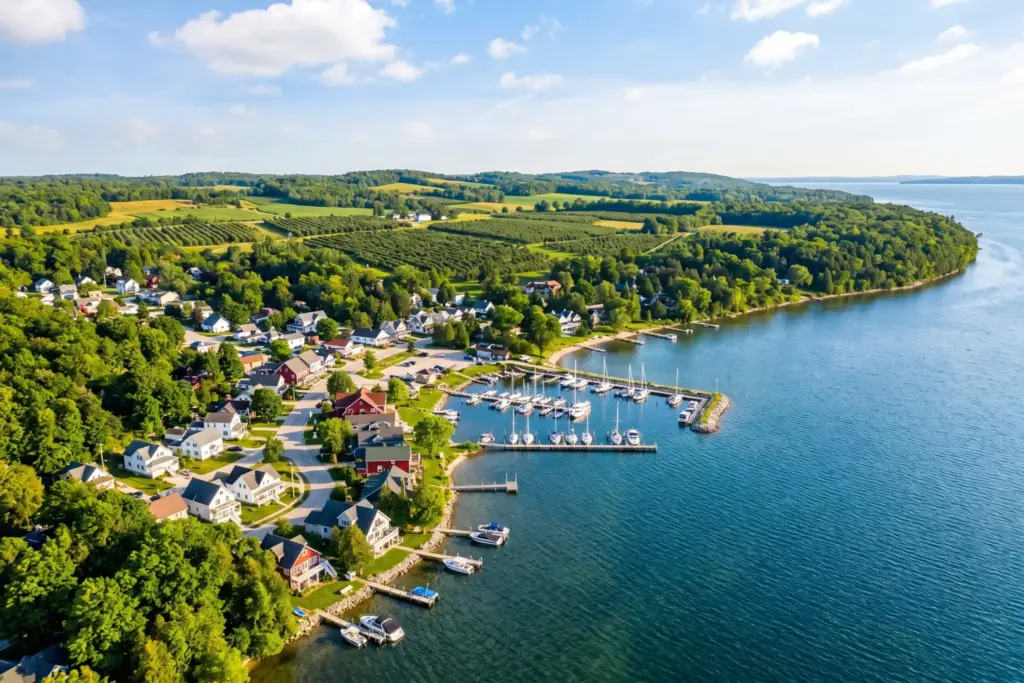
Sister Bay, Wisconsin logged 96.8% occupancy in July with a $469 average daily rate, generating $9,855 in gross monthly revenue per property. StaySTRA data places this among the strongest single-month occupancy readings we track for Great Lakes vacation rental sub-markets. Think of the Door County summer peak like a concert hall that sells out four consecutive weekends in a row: the house is absolutely full, and the pricing reflects it. The real investor question is whether that run of sold-out weekends is long enough to carry the rest of the year.
That is the central question for Door County, and StaySTRA data gives a more nuanced answer than the “it’s too seasonal” warning that gets repeated in investor forums. Let’s look at what the numbers actually show.
The Door County STR Market: What StaySTRA Data Shows
StaySTRA tracks three Door County sub-markets at the property level: Sister Bay, Egg Harbor, and Sturgeon Bay. Together they account for roughly 875 active entire-place listings and represent the full range of investment options available on the peninsula, from the high-ADR village character of Sister Bay to the more accessible price points of Sturgeon Bay. The peninsula’s other well-known micromarkets (Ephraim, Fish Creek, and Baileys Harbor) share the same demand pool but are not currently tracked as separate sub-markets in our database.
Here is the last-twelve-months picture for each:
| Sub-Market | Active Listings | Avg ADR | LTM Occupancy | Avg Monthly Revenue | Est. Annual Gross |
|---|---|---|---|---|---|
| Sister Bay | 183 | $418 | 58.3% | $5,722 | ~$68,664 |
| Egg Harbor | 187 | $351 | 54.2% | $4,419 | ~$53,028 |
| Sturgeon Bay | 505 | $296 | 53.6% | $3,708 | ~$44,496 |
Sturgeon Bay is doing the heavy supply lifting here, with 505 listings versus about 185 each for Sister Bay and Egg Harbor. It is also the most accessible entry point for investors, and the lower ADR reflects both that accessibility and the fact that Sturgeon Bay functions as both a tourism hub and a working small city, which puts more utilitarian lodging into the mix alongside vacation rentals.
The ADR spread across these three markets tells a meaningful story. Sister Bay commands a 41% premium over Sturgeon Bay. On an annual basis, that premium translates to roughly $24,000 in additional estimated gross revenue. Choosing where on the peninsula you buy is not purely a lifestyle decision. It is a return decision, and one with real implications for your DSCR calculation.
For context, Traverse City MI (another Great Lakes leisure market covered in our Sprint 3 Great Lakes data series) posted 21% year-over-year listing growth as investors discovered it. Door County’s three tracked sub-markets show no comparable oversupply pressure, which helps explain the strong occupancy figures above.
Sponsored — Beeline
Finance Your Next STR With a DSCR Loan
Qualify on property cash flow, not W-2 income. Beeline specializes in fast DSCR closings for STR investors. No personal income verification required.
Check Your DSCR Eligibility →Affiliate disclosure: StaySTRA may earn a referral fee.
The Seasonality Question: Does a 4-Month Peak Carry the Year?
Forty years working with data taught me that the scariest-looking numbers often look different once you break them down by component. The seasonality concern in Door County is real, but it is less extreme than investors typically expect.
Stay with me here, because this part matters for your underwriting. Here is the month-by-month breakdown for Sister Bay, which illustrates the seasonal pattern most clearly:
| Month | Sister Bay ADR | Occupancy | Monthly Gross Revenue |
|---|---|---|---|
| January | $350 | 17.6% | $1,455 |
| February | $350 | 21.4% | $1,836 |
| March | $350 | 23.3% | $2,141 |
| April | $407 | 23.3% | $2,833 |
| May | $425 | 41.9% | $4,840 |
| June | $494 | 71.4% | $8,339 |
| July | $469 | 96.8% | $9,855 |
| August | $479 | 90.5% | $9,681 |
| September | $427 | 66.7% | $6,708 |
| October | $446 | 64.3% | $6,888 |
| November | $360 | 33.3% | $2,953 |
| December | $363 | 30.8% | $2,763 |
Two things stand out from this table. First, June through September produces roughly $34,583 in gross revenue for a Sister Bay property, or about 57% of the annual total from monthly data. That four-month window does carry the year, just as the bear case suggests. Second, and more important for investors who feared a complete post-Labor Day cliff, October holds up at 64.3% occupancy and $6,888 in gross revenue. Door County’s fall foliage season, apple orchards, and winery harvest weekends create a genuine October shoulder that many pure-beach markets simply cannot match.
The genuinely soft window is January through April. A Sister Bay property averages between $1,455 and $2,833 per month in that stretch. That covers carrying costs in most underwriting scenarios, but it is not what you are buying the property for. You are buying it for the summer run, with October as a meaningful bonus month.
Don’t let the winter numbers unsettle you without full context. The same operator averaging $9,855 in July is still clearing $6,888 in October. That is a functional business with a compressed high season, not a four-month hobby.
Sub-Market Breakdown: Where on the Peninsula to Buy
Door County’s peninsula stretches roughly 70 miles from the base at Sturgeon Bay to the tip near Northport, and where you buy matters as much as the market-level averages suggest.
Sister Bay is the premium play. At $418 ADR, 58.3% annual occupancy, and July running within three percentage points of full capacity, a well-positioned 3-bedroom property here can exceed $70,000 in annual gross in a strong year. The limitation is entry cost. Waterfront inventory in Sister Bay trades at a meaningful premium to the county median, and premium listings can reach well above the $480,000 county median price.
Egg Harbor offers a middle path. Its $351 ADR and 54.2% occupancy generate roughly $53,000 in estimated annual gross, and properties here are generally more accessible than Sister Bay. The summer peak is nearly as strong (July at 93.6% occupancy, $7,959 gross), but the October shoulder is softer ($5,563 versus Sister Bay’s $6,888). For an investor willing to accept a modestly lower peak ADR in exchange for a more accessible entry price, Egg Harbor is worth a close look.
Sturgeon Bay is the volume market and the most accessible entry point on the peninsula. With 505 active listings, it is larger than Sister Bay and Egg Harbor combined, which moderates individual operator leverage on occupancy. The $296 ADR reflects both the supply depth and the mixed demand character in Sturgeon Bay, which serves leisure visitors alongside travelers with non-leisure purposes. Peak July performance is still solid (91.7% occupancy, $7,043 gross), but the ADR ceiling is lower. DSCR math here works best on properties acquired below the county median.
DSCR Math: At What Price Does Door County Cash Flow?
Think of DSCR underwriting like a bridge load rating: the income your property generates has to hold the weight of the debt you put on it, with meaningful clearance to spare. At 1.25x DSCR, a common lender threshold, your net operating income must be 25% higher than your annual debt service. Here is how that plays out across Door County’s sub-markets, using a 38% operating expense ratio and a 7.5% DSCR loan rate on a 30-year amortization at 75% loan-to-value. The 38% expense assumption covers property management, platform fees, cleaning, insurance, utilities, and routine maintenance.
Sister Bay (~$68,664 estimated annual gross): Net Operating Income approximately $42,572. Maximum annual debt service at 1.25x DSCR: approximately $34,058. Maximum supportable loan: approximately $406,000. Maximum acquisition price at 75% LTV: approximately $541,000.
Egg Harbor (~$53,028 estimated annual gross): NOI approximately $32,877. Maximum debt service: approximately $26,302. Maximum loan: approximately $314,000. Maximum acquisition price: approximately $420,000.
Sturgeon Bay (~$44,496 estimated annual gross): NOI approximately $27,588. Maximum debt service: approximately $22,070. Maximum loan: approximately $263,000. Maximum acquisition price: approximately $350,000.
Door County’s median home price was approximately $480,000 as of late 2025. That median sits right at the edge of DSCR feasibility for Sister Bay averages and above the DSCR threshold for Egg Harbor and Sturgeon Bay at standard income calculations. This is an important signal: Door County is not a straightforward set-it-and-forget-it DSCR market the way some lower-cost leisure markets are. It rewards investors who buy selectively: below-median prices, above-average locations, or waterfront properties with demonstrated ADR premium potential.
For a broader look at how Door County compares to other high-seasonality leisure markets on DSCR criteria, see our analysis of the Best STR Markets for DSCR Borrowers in 2026. For context on markets where supply constraints protect investor returns, see our piece on STR markets where supply cannot keep up with demand.
Regulatory Environment: Wisconsin’s Permissive Framework
Wisconsin is among the more STR-friendly states in the Midwest, and that matters for long-term underwriting confidence. State statute § 66.1019 prevents municipalities from banning rentals of seven consecutive days or longer, establishing a floor of operator protection that states like New York or Hawaii cannot claim. That framework was reinforced in 2025 when a Wisconsin appellate court struck down an overly restrictive local ordinance as preempted by state law.
At the state level, operators renting more than 10 nights per year must obtain a Wisconsin DATCP tourist rooming house license, which requires a one-time $300 inspection fee and a $110 annual renewal. Airbnb remits Wisconsin’s 5% state sales tax automatically on behalf of most hosts. Door County adds a 5.5% local room tax (remitted by the platforms for most bookings).
Individual Door County municipalities each require their own permit or registration, with occupancy, noise, and parking standards enforced locally. None of the three StaySTRA-tracked sub-markets currently imposes hard permit caps or owner-occupancy conditions as of 2026. Local rules do update as the peninsula grows more popular, and keeping direct contact with your specific municipality is wise. But Door County sits in a significantly more permissive regulatory tier than most comparable coastal leisure markets, and Wisconsin’s state preemption posture makes sweeping local restrictions legally vulnerable.
Property Type: What Outperforms in Door County
Door County’s demand drivers (cherry orchards, wineries, five state parks, sailing on Green Bay and Lake Michigan, and fall foliage) favor experiential properties over transactional ones. Waterfront cabins and cottages with private outdoor space command the strongest ADR premiums above sub-market averages. A lakefront property in Sister Bay or a cottage with dock access will run substantially above the $418 sub-market mean.
Village cottages in walkable Sister Bay or Fish Creek earn strong repeat booking rates and a premium for proximity to restaurants, galleries, and the water. Sturgeon Bay accommodations positioned as full-house family rentals with multiple bedrooms serve the volume play: lower ADR, but larger parties and longer average stays that lift occupancy through softer shoulder months.
Properties near Door County’s state parks (Peninsula, Potawatomi, Newport, Rock Island, and Whitefish Dunes) benefit from proximity to outdoor demand that extends usability into late fall, supporting the strong October occupancy numbers visible in the monthly data above.
We do our best to keep our data accurate and up to date, but markets move fast and we are only human. Always verify current figures directly with local sources before making investment decisions.
Frequently Asked Questions
Is Door County Wisconsin a good short-term rental investment in 2026?
Door County can be a solid STR investment for buyers who price their acquisition carefully. Sister Bay properties performing at sub-market averages support acquisition prices up to approximately $541,000 at 1.25x DSCR. The market rewards waterfront and well-located village properties with premium ADR. Investors should plan for a genuinely seasonal revenue profile, with 57-58% of estimated annual gross concentrated in June through September, and a meaningful October shoulder from fall tourism demand.
How seasonal is Door County for short-term rentals?
Summer (June-September) accounts for approximately 57% of annual gross revenue in Sister Bay and Egg Harbor, and about 56% in Sturgeon Bay. October is a meaningful shoulder month, with Sister Bay averaging $6,888 in gross revenue and 64.3% occupancy due to fall foliage and winery harvest season. The softest months are January through March, when occupancy dips to the 18-23% range across all tracked sub-markets.
What is the average daily rate for Door County Airbnb properties?
Average daily rates vary by sub-market. Sister Bay averages $418 ADR on a last-twelve-months basis, with a June peak of $494. Egg Harbor averages $351 LTM with a June peak of $424. Sturgeon Bay averages $296 LTM. Peak July ADR ranges from $315 in Sturgeon Bay to $469 in Sister Bay, reflecting the intensity of summer demand across the peninsula.
What permits does a Door County short-term rental require?
Wisconsin requires a DATCP tourist rooming house license for anyone renting more than 10 nights per year: a $300 one-time inspection fee and $110 annual renewal. Door County municipalities add their own registration requirements and enforce occupancy, noise, and parking standards. Wisconsin’s state preemption law (§ 66.1019) protects operators from outright local bans on rentals of seven consecutive days or longer. Always verify current requirements with your specific municipality before listing.
What is the estimated annual gross revenue for a Door County STR?
Estimated annual gross revenue based on StaySTRA LTM data ranges from approximately $44,496 in Sturgeon Bay to $53,028 in Egg Harbor and $68,664 in Sister Bay. These are market averages. Waterfront and premium-location properties often significantly exceed these figures, while below-average properties in higher-supply areas will track below them.
Run Your Numbers Before the Summer Season Books Up
The seasonality concern is real, but so is the revenue. Sister Bay running at 97% occupancy in July while Egg Harbor clears $6,779 in June tells you this market captures peak demand at full intensity. Whether the math works for your acquisition depends on purchase price, property type, and how deliberately you manage the October shoulder season.
Use the StaySTRA Wisconsin Airbnb calculator to run your specific property against Door County sub-market benchmarks. Browse the full Wisconsin STR market overview to see how Door County compares to other markets in the state for your portfolio strategy.
Sponsored — Beeline
Finance Your Next STR With a DSCR Loan
Qualify on property cash flow, not W-2 income. Beeline specializes in fast DSCR closings for STR investors. No personal income verification required.
Check Your DSCR Eligibility →Affiliate disclosure: StaySTRA may earn a referral fee.
Become a StaySTRA Insider
Join free — get our newsletter + 1 free property analysis/month.
No spam. Unsubscribe anytime. Free membership includes property analyses and market insights.