Key Takeaways
- Hosts using dynamic pricing tools earn 15 to 36 percent more revenue than those with static rates, according to a 2025 study of 541 listings across 34 countries.
- Airbnb Superhosts earn roughly 50 to 60 percent more total revenue than standard hosts, driven primarily by higher occupancy rather than higher nightly rates.
- Multi-platform hosts listing on Airbnb, VRBO, and direct booking channels earn 15 to 25 percent more than single-platform operators.
- Response time under one hour correlates with 25 percent higher booking conversion rates, and conversion rate is now the top ranking factor in Airbnb search algorithm.
- The gap between $100K hosts and $40K hosts is not luck or location. It is systems, consistency, and the decision to treat a rental property like a real business.
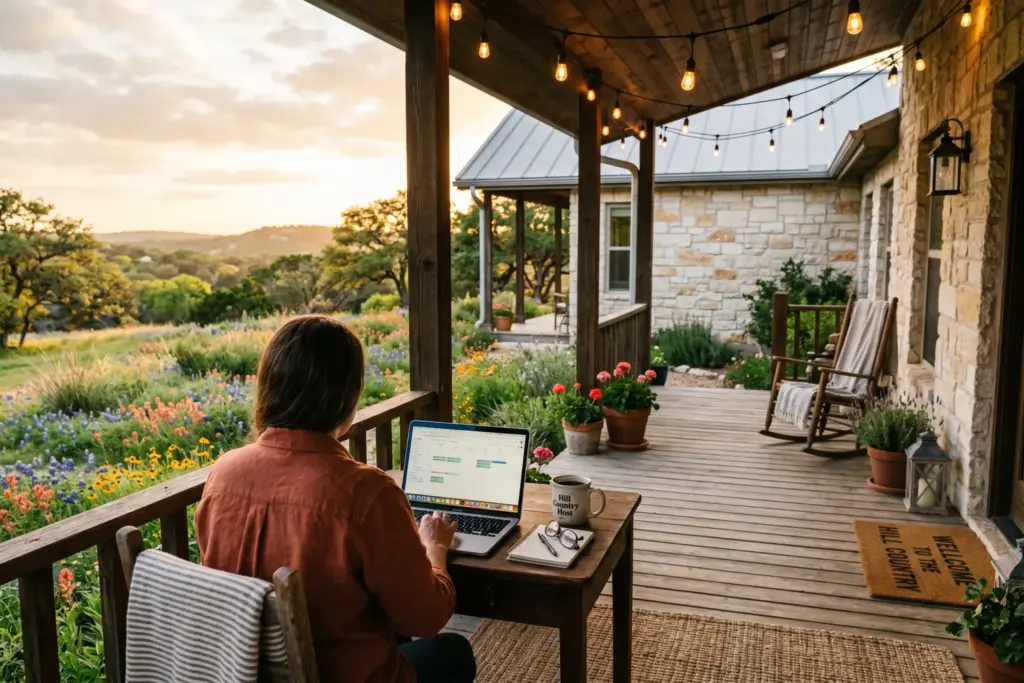
On a Tuesday morning in April, somewhere in the Hill Country west of Austin, a host named Daniela checks her phone before her first cup of coffee. She adjusts tonight’s rate by twelve dollars (a local music festival just added a second headliner), responds to a guest inquiry that came in at 2 a.m., and flags a maintenance request for her handyman. By 7:15, she is done. Así empieza el día, she told me once. That is how the day starts.
Two hundred miles east, another host with a similar three-bedroom property in the same price range is doing none of those things. His rate has not changed since January. His last guest message sat unanswered for nine hours. He does not know that a festival is happening forty minutes from his front door.
Both hosts own comparable properties. Both started around the same time. One will gross over $100,000 this year. The other will land closer to $40,000 and wonder what went wrong.
I have been writing about STR hosts for a while now, and the pattern I keep seeing is not about who got lucky with a great location or who has the fanciest property. The hosts pulling in top-tier revenue share a specific set of habits, and those habits are surprisingly consistent across markets, property types, and experience levels. This article is about what those habits actually look like in practice.
The Revenue Gap Is Not About the Property
We covered what hosts are actually earning in 2026 earlier this month, and the numbers vary wildly. But the variance does not map neatly onto property quality or market strength. Two hosts in the same city, with the same bedroom count, can have a two-to-one revenue gap. Airbnb’s own Q1 2026 earnings report shows the platform generated $2.7 billion in revenue with nights booked up 9 percent year over year. The pie is getting bigger. The question is who is getting a larger slice and why.
According to an analysis by AirROI, Superhosts earn roughly 50 to 60 percent more total annual revenue than standard hosts. But here is the part most people miss: Superhosts actually charge less per night. The revenue advantage comes almost entirely from higher occupancy. They are booked more often because they do more things right, more consistently.
At the very top of the earnings ladder, the picture shifts. AirROI found that among the top 10 percent of earners, the gap between Superhosts and non-Superhosts nearly disappears. The highest-revenue hosts are not relying on a badge. They have built systems that work regardless of status labels.
Habit 1: They Never Set a Rate and Forget It
The single biggest operational difference between high-revenue and average-revenue hosts is pricing behavior. A 2025 study by Your.Rentals tracking 541 vacation rental listings across 34 countries found that hosts using dynamic pricing tools earned 36 percent more revenue on average compared to those using static pricing. Beyond Pricing’s industry benchmark puts the range at 20 to 40 percent annual revenue improvement, depending on market competitiveness and property type.
Let’s call her Rosa. She manages two properties in a Gulf Coast beach market. “I used to set my summer rate at $250 and my winter rate at $180 and that was it,” she told me. “When I switched to PriceLabs, my annual revenue went from about $52,000 to $71,000 on the same property. I did not change a single piece of furniture.”
The top hosts I talk to check their pricing tool dashboards weekly at minimum. They override the algorithm when they spot a local event, a weather pattern, or a gap weekend that the tool has not caught yet. They understand that pricing is not something you set in January and revisit in June. Es un trabajo de todos los días (it is an everyday job), as one host in San Antonio put it.
Sponsored — Beeline
Finance Your Next STR With a DSCR Loan
Qualify on property cash flow, not W-2 income. Beeline specializes in fast DSCR closings for STR investors. No personal income verification required.
Check Your DSCR Eligibility →Affiliate disclosure: StaySTRA may earn a referral fee.
Habit 2: They Respond Like the Booking Depends on It (Because It Does)
Airbnb’s April 2026 Terms of Service update confirmed what top hosts already knew: conversion rate is now the platform’s primary ranking signal. That means the ratio of people who view your listing to people who actually book determines how often you show up in search results.
Response time is one of the biggest conversion levers hosts can control. Properties where hosts respond within one hour see 25 percent higher conversion rates than those with slower response times. Airbnb’s algorithm also factors in consistency. A host who responds quickly at 2 p.m. but goes silent after 10 p.m. gets penalized compared to a host with round-the-clock availability.
A host I spoke with in the Smoky Mountains, let’s call him James, runs four cabins grossing a combined $190,000 a year. He uses Hospitable to automate his initial guest messages. “I have templates for every scenario,” he said. “Check-in instructions, local recommendations, the Wi-Fi password reminder, the checkout nudge. But I also jump in personally when someone has a specific question. The automation buys me time to be human when it matters.”
James’s average response time is under eight minutes. He does not think of that as a vanity metric. He thinks of it as the reason his listings consistently appear on the first page of search results in his market.
Habit 3: They Refresh Their Listings Like Storefronts
Walking through a neighborhood in Austin last fall, I passed a restaurant that had not updated its window display in months. The menu was sun-bleached. The hours were wrong. I did not go inside. Airbnb listings work the same way.
Professional photography has been shown to increase bookings by up to 40 percent and support nightly rates 26 percent higher than listings with amateur photos. But the top hosts do not just invest in photos once. They update them seasonally, or at minimum every 12 to 18 months. When they add a new amenity (a hot tub, a fire pit, upgraded bedding), new photos go up within a week.
Daniela, the Hill Country host, reshuffles her photo order every quarter. “In December, I lead with the fireplace and the wool throws,” she explained. “In April, it is the patio and the wildflowers. Same house, different story.” She also rewrites her listing description twice a year and updates her guidebook with seasonal restaurant recommendations.
Airbnb’s algorithm rewards this behavior. Listings that are updated regularly signal an active, engaged host, which translates to better search placement. Hosts who update their calendar and listing details at least every 30 days consistently outperform those who let their listings sit untouched.
Habit 4: They Are Not on Just One Platform
The average host lists exclusively on Airbnb. The top-earning hosts almost never do.
Multi-platform operators listing on Airbnb, VRBO, and at least one additional channel (Booking.com, Furnished Finder, or a direct booking website) earn 15 to 25 percent more revenue than single-platform hosts. VRBO in particular draws a different guest demographic: people booking larger properties for longer stays. Booking.com brings international travelers who may never search Airbnb.
Direct bookings are where the math gets especially interesting. Airbnb’s host-only fee sits at 15.5 percent. VRBO charges around 5 percent on software-connected accounts. Direct bookings through your own site cost roughly 2.9 percent in payment processing. On a $50,000-a-year property, the difference between 15.5 percent and 2.9 percent is $6,300 in fees that stay in your pocket.
Rosa runs her two Gulf Coast properties on Airbnb, VRBO, and a simple direct booking site built with Lodgify. “About 22 percent of my bookings come direct now,” she said. “Those are my favorite bookings. No service fees, I own the guest relationship, and I can offer return-guest discounts that keep people coming back año tras año (year after year).”
A channel manager keeps calendars synced across platforms and prevents double bookings. For hosts running more than one property, this is not optional. It is infrastructure. We covered how the Airbnb Co-Host Network works in 2026, and co-hosting is another way multi-property hosts expand without burning out.
Habit 5: They Treat Reviews Like a Revenue Strategy
Airbnb’s algorithm now reads review text and uses specific mentions (like “spotless kitchen” or “fast Wi-Fi”) as relevance signals when matching listings to guest searches. A listing with consistent reviews praising cleanliness will rank higher for guests who prioritize cleanliness in their search filters.
The top hosts respond to every review within 24 hours, including the negative ones. But more importantly, they actively shape the review experience. James sends a message the morning after check-in asking if everything is perfect. “If something is wrong, I want to fix it before it becomes a bad review,” he said. “A leaky faucet on night one is a maintenance issue. A leaky faucet that is still leaking on checkout day is a one-star review.”
Guest Favorites, Airbnb’s recognition for listings rated 4.9 or above, now outweighs Superhost status for search ranking purposes. That shift, which Airbnb implemented in its 2026 algorithm update, means that the quality of your recent reviews matters more than your cumulative track record. Hosts who had a rough quarter cannot coast on past performance. The algorithm recalibrates constantly.
Habit 6: They Schedule Maintenance Before Guests Find the Problem
Daniela has a spreadsheet. Every appliance, every HVAC filter, every mattress in her property has a replacement or service date. “I replace the mattress toppers every 18 months whether they need it or not,” she said. “I deep-clean the dryer vent every six months. I repaint the front door every spring. Guests notice freshness even when they cannot name exactly what feels different.”
Preventive maintenance is one of those habits that does not show up in any Airbnb dashboard, but it compounds over time. The hosts who gross $100,000 or more spend intentionally on upkeep during their slow seasons. They are not waiting for a guest to report a broken drawer pull or a stained couch cushion. They are walking the property monthly with a checklist.
The financial logic is straightforward. A $200 preventive repair costs far less than a $200 refund plus a bad review plus the lost future bookings that bad review causes. Top hosts budget 8 to 12 percent of gross revenue for maintenance and capital improvements. Average hosts budget reactively, which usually means they spend more in the long run.
Sponsored — Beeline
Finance Your Next STR With a DSCR Loan
Qualify on property cash flow, not W-2 income. Beeline specializes in fast DSCR closings for STR investors. No personal income verification required.
Check Your DSCR Eligibility →Affiliate disclosure: StaySTRA may earn a referral fee.
The Mindset That Ties It All Together
Every high-earning host I have talked to over the past year says some version of the same thing: “I stopped thinking of this as a side hustle and started thinking of it as a business.”
That shift sounds simple, but it changes everything. A side-hustle host checks Airbnb when they remember. A business-owner host has a Monday morning routine: review the week’s bookings, check pricing against local events, respond to pending inquiries, scan reviews from the previous week, and verify the cleaning schedule. It takes 30 minutes. It is not glamorous. But it is the 30 minutes that separates the top tier from everyone else.
Rosa put it this way: “My friends ask me how I make so much more than them on Airbnb. I tell them the truth. I work at it every single day for about 30 minutes. They work at it once a month for three hours in a panic when bookings are slow. The total time is about the same. The results are completely different.”
For hosts considering scaling to a second property, understanding the financial mechanics of STR-specific lending is part of that business mindset. Our STR Financing Guide for 2026 breaks down how DSCR loans work and which markets currently make the numbers work for investors.
Where You Stand in the Market
The habits outlined here are not secrets. They are documented, measurable, and available to anyone willing to put in the consistent effort. The real question is whether your current revenue reflects your property’s actual potential, or whether operational gaps are leaving money on the table.
StaySTRA’s free market analyzer lets you run your market numbers to see if your current performance is above or below the market median. Knowing where you stand is the first step toward closing the gap.
We do our best to keep our content accurate and up to date, but things change and we are only human. Always verify details directly with local sources before making decisions.
Frequently Asked Questions
How do I make more money on Airbnb in 2026?
The highest-impact changes are switching from static to dynamic pricing (which increases revenue 15 to 36 percent on average), responding to guest inquiries within one hour, listing on multiple platforms beyond just Airbnb, and updating your listing photos and description at least twice a year. These operational habits consistently separate top-earning hosts from average performers.
How much more do Airbnb Superhosts earn compared to regular hosts?
On average, Superhosts earn 50 to 60 percent more total annual revenue than standard hosts, driven primarily by higher occupancy rates rather than higher nightly prices. However, among the top 10 percent of earners, the Superhost advantage nearly disappears because the highest performers have built systems that work independently of any badge or status.
Is dynamic pricing really worth it for a single Airbnb property?
Yes. A 2025 study of 541 listings across 34 countries found that hosts switching from static to dynamic pricing earned 36 percent more revenue on average. Even for a single property grossing $50,000 a year, that is an additional $10,000 to $18,000 in annual revenue from a tool that costs $20 to $60 per month.
What does a successful Airbnb host’s daily routine look like?
Top-earning hosts spend about 30 minutes each morning checking their pricing dashboard, responding to guest messages, reviewing upcoming bookings, scanning recent reviews, and verifying their cleaning and maintenance schedules. The consistency of this routine, not the total time spent, is what drives the revenue difference between high performers and average hosts.
Should I list my STR on platforms other than Airbnb?
Multi-platform hosts consistently earn 15 to 25 percent more than single-platform operators. VRBO attracts people booking longer stays, Booking.com brings international travelers, and direct booking websites reduce your fee burden from 15.5 percent to roughly 2.9 percent. A channel manager keeps calendars synced across platforms and prevents double bookings.
Ready to see where your property’s revenue stacks up against the market? Run your numbers through StaySTRA’s free analyzer and find out whether you are leaving money on the table.
Become a StaySTRA Insider
Join free — get our newsletter + 1 free property analysis/month.
No spam. Unsubscribe anytime. Free membership includes property analyses and market insights.