

Key Takeaways
- University town STR hosts who build pricing strategies around the academic calendar can see ADR premiums of 50% to 100% during graduation weekends and football Saturdays.
- Graduation weekends often book three to six months in advance, far earlier than typical leisure travel, giving strategic hosts a revenue planning advantage.
- StaySTRA data shows Ann Arbor STR hosts hitting a September peak ADR of $374, compared to a January low of $183, a swing driven almost entirely by the University of Michigan calendar.
- College towns like Athens, GA and College Station, TX carry unique operational challenges (noise ordinances, parking limits, party-house rules) that require hosts to manage guest profiles carefully.
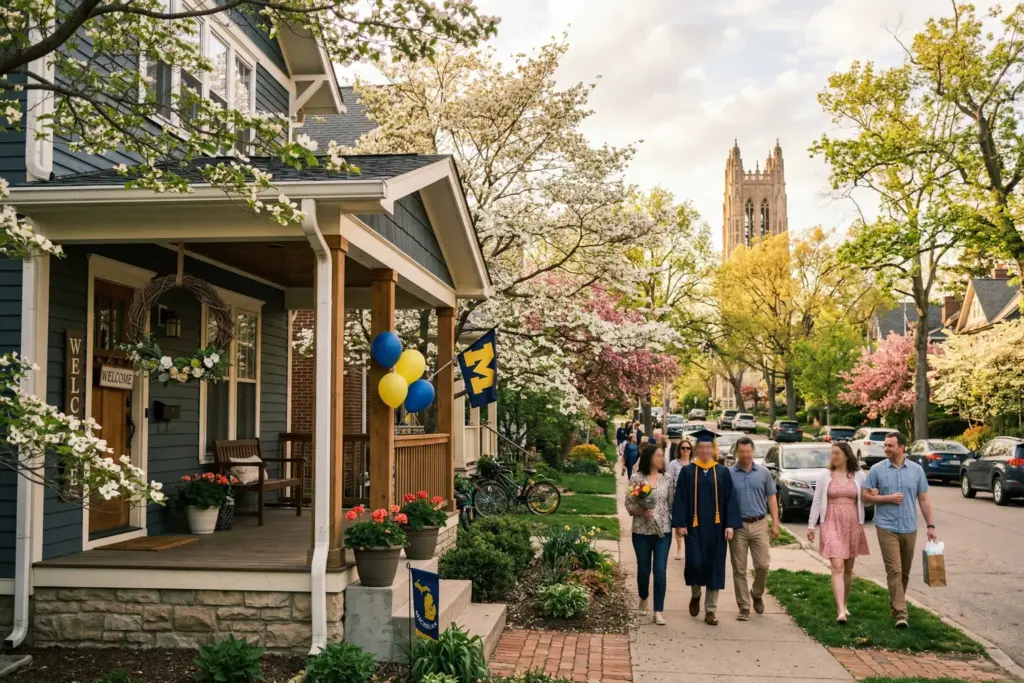
On a warm Saturday morning in Ann Arbor, Michigan, the smell of grilled bratwurst already hangs in the air by 8 a.m. The sidewalks around State Street fill with maize and blue, families spill out of rental houses with coffee in hand, and somewhere near the Big House a marching band is warming up. For the next six hours, this college town of 124,000 people will swell to nearly twice its size.
And for a specific group of STR hosts, this is payday.
Not the accidental kind. Not the “I listed my spare room and got lucky” kind. The hosts who thrive in university markets have done something that sets them apart from hosts in beach towns or mountain retreats: they have built their entire revenue year around a calendar that someone else publishes. The university academic calendar. Football schedules. Graduation dates. Parents’ weekends. Move-in days. Cada fecha es una oportunidad (every date is an opportunity), and the best operators in these markets treat it exactly that way.
Walking through neighborhoods near campuses in Ann Arbor, Athens, and College Station, I could not help but notice how different the hosting rhythm feels here. This is not the lazy seasonality of a beach town. This is a market that spikes hard, goes quiet, spikes again, and rewards the hosts who understand the pattern.
The Numbers Behind the Calendar
University town STR markets move to a beat that most investors never consider. StaySTRA data for Ann Arbor tells the story clearly: the average daily rate across 856 active listings sits at $229 to $244 on a typical month. But in September, when Michigan’s football season opens and families arrive for the first home game, that ADR jumps to $374. That is a 54% premium over the annual average. By January, after the academic calendar goes quiet and bowl season ends, the ADR drops to $183.
The swing from peak to trough is $191 per night. No external shock causes it. No hurricane season, no ski conditions report. Just the university calendar doing what it does every single year.
In Athens, Georgia, where 1,176 STR listings compete for attention in a city built around the University of Georgia, the current ADR sits at $189. During football Saturdays at Sanford Stadium, hosts who price strategically report nightly rates between $400 and $1,000 depending on the matchup. A rivalry game against Florida or Auburn can push a 3-bedroom rental past the $800 mark for a single night.
Then there is College Station, Texas, where Texas A&M’s 878 active STR listings serve a market with 300,000 annual visitors. The baseline ADR here is $199. But the pricing delta during football weekends is staggering. Local hotels that charge $39 on a regular Tuesday have been documented charging $219 on game day. STR hosts see similar multipliers. The 71.5% of College Station properties booked one to three months ahead suggests that savvy guests (and savvy hosts) are planning well in advance.
Meet the Hosts Who Built a Calendar Business
Let’s call her Rosa. (Names throughout this piece are composites drawn from host interviews and forum discussions across multiple university markets. These are representative profiles, not single individuals.)
Rosa runs a 4-bedroom house two blocks from Kyle Field in College Station. She bought it in 2021 for $285,000. Her strategy from day one was simple: the Aggie football schedule IS her business plan. She blocks seven home-game weekends a year at $450 to $650 per night with a three-night minimum. Those 21 nights alone generate roughly $11,000 to $13,000 in revenue. Graduation weekend in May adds another $1,800 to $2,400. Parents’ weekend and Ring Day (a tradition unique to A&M) fill in more premium dates.
“The rest of the year, I price competitively,” Rosa’s approach reflects. “I am not trying to compete with hotels on random Tuesday stays. Mi negocio vive y muere por el calendario (my business lives and dies by the calendar).”
In Ann Arbor, a host we will call David takes a different approach to the same calendar principle. David owns two properties near the University of Michigan campus. He uses dynamic pricing software to set cascading minimum stays: five nights when bookings open six months ahead of a football Saturday, then dropping to three nights at the 45-day mark, then two nights in the final two weeks if gaps remain. This strategy, recommended by platforms like PriceLabs for recurring-event markets, lets David capture the families who want a full long weekend first (at premium rates), then fill remaining inventory as the date approaches.
David’s September revenue averages $4,900 per property per month, according to the pattern StaySTRA data reflects for Ann Arbor’s September peak. His January revenue drops to around $2,100. He plans for that. “If you are surprised by a slow January in a Big Ten town,” he says, “you did not do your homework.”
Down in Athens, a host we will call Janelle converted her grandmother’s bungalow near downtown into a game-day rental in 2019. Athens has grown from 468 STR listings in 2016 to 1,176 today, and Janelle has watched the competition intensify. Her edge is local knowledge. She includes a printed guide with tailored restaurant recommendations, parking instructions (critical in Athens, where game-day parking is notoriously limited), and a walking map to Sanford Stadium.
“Half the guest experience in a college town is not the house. It is the information,” Janelle’s approach reflects. “Families coming for graduation have never been here. They need someone who knows the town.”
Graduation Season Is the Quiet Giant
Football gets the attention, but graduation season (May and June in most university markets) is the revenue event that many hosts underestimate. Here is why it deserves its own strategy.
Graduation weekends book earlier than almost any other event type. While a typical leisure weekend might book two to four weeks ahead, graduation stays often lock in three to six months in advance. Parents and extended relatives begin searching the moment ceremony dates are announced, sometimes in the fall semester before a spring graduation.
The guest profile is also different. Football weekends attract groups of friends, alumni tailgaters, and younger travelers. Graduation weekends bring multi-generational groups: parents, grandparents, siblings, sometimes aunts and uncles. They want more bedrooms. They want full kitchens. They care about accessibility, about parking for multiple cars, about quiet neighborhoods where abuelos (grandparents) can rest between events.
This means larger properties command an outsized premium during graduation. A 4- or 5-bedroom listing near campus that might earn $250 per night on a standard weekend can push past $500 during commencement. In Ann Arbor, the University of Michigan commencement has historically produced some of the largest Airbnb guest surges in the city’s history, rivaling even the biggest football Saturdays.
For hosts, the tactical move is clear: set graduation weekend pricing and minimum stays early (by January for a May ceremony), list the specific event in your property description so search algorithms surface your listing for “graduation weekend stay” queries, and communicate checkout timing clearly. Graduation ceremonies often run Saturday morning. Families want to check out Sunday, not Saturday. Build that into your calendar.
The Full Event Calendar and Which Dates Command the Highest ADR
University town hosts who treat this as a genuine calendar business typically rank their annual events by revenue potential. Based on research across multiple markets, here is the general hierarchy:
Tier 1 (highest ADR, earliest bookings): Rivalry football games, graduation weekends. These can command 2x to 3x the baseline ADR and book three to six months out.
Tier 2 (strong ADR, moderate lead time): Regular-season football home games, parents’ weekends, homecoming. These typically command 1.5x to 2x baseline and book one to three months ahead.
Tier 3 (solid fills, shorter lead time): Move-in weekend (August), academic conferences, alumni reunion weekends, basketball tournament weekends. ADR premiums of 20% to 50% are common, with bookings often within 30 days.
Tier 4 (baseline or slightly above): Regular weekends during the academic year, summer months (except graduation). These fill at standard rates and keep the lights on between spikes.
The key insight is that a host who only optimizes for football is leaving money on the table. The full calendar, including the smaller events, is what separates a $27,000-per-year property from a $36,000-per-year property in the same market.
Operational Challenges Unique to University Markets
University town hosting is not just about pricing the spikes. It comes with operational realities that beach and mountain hosts rarely face.
Noise ordinances are stricter. College towns have spent years battling party houses, and local governments have tightened noise rules accordingly. In many university markets, noise complaints trigger faster enforcement action than in resort towns. Hosts need noise monitoring devices, clear quiet-hours policies, and the willingness to enforce them.
Parking is a genuine operational issue. On football Saturdays and graduation weekends, city parking infrastructure gets overwhelmed. Athens and Ann Arbor both have aggressive towing and ticketing during events. Smart hosts provide detailed parking guides, secure off-street spots when possible, and set clear expectations before arrival.
Guest profiles shift dramatically. A Friday-night football group may be four college friends in their 20s. A graduation weekend booking may be a grandmother, two parents, and three siblings. The same property needs to serve both, which means flexible staging (removing fragile items before football season, adding extra towels and kitchen supplies before graduation).
STR permit requirements vary widely. College Station requires a permit and inspection for all STR properties, plus collection of a 7% hotel occupancy tax. Athens has its own registration framework. Ann Arbor’s regulations have evolved as the city balances resident concerns with the economic reality that game-day and graduation visitors pump millions into local businesses. Hosts must stay current with local rules, because university towns tend to update them more frequently than other markets.
Compared to how urban markets perform nationally, university towns occupy a unique middle ground: they carry the occupancy stability of urban markets during the academic year with the ADR spike potential of resort markets during events.
Is This Strategy Right for You?
University town STR investing is not for everyone. If you need consistent, month-over-month cash flow with minimal variance, a college town will frustrate you. The seasonality is real. January through March in a Big Ten or SEC town can feel painfully slow.
But if you are comfortable with a lumpy revenue curve, if you enjoy the predictability of a calendar you can plan around years in advance, and if you are willing to learn the specific rhythms of a university community, this is a market segment that rewards homework.
The hosts who win here share a few traits: they price aggressively during events and competitively during quiet periods. They know the university calendar better than most students. They invest in guest communication and local knowledge. And they think of their STR not as a passive investment but as a small hospitality business timed to a very specific clock.
Es una disciplina, no un accidente (it is a discipline, not an accident). The hosts making $35,000 to $50,000 per year in college towns with $25,000 to $30,000 baselines are not lucky. They studied the calendar. They built a system. And graduation season, which starts in just a few weeks, is where many of them make their strongest margin of the entire spring.
We do our best to keep our content accurate and up to date, but things change and we are only human. Always verify details directly with local sources before making decisions.
Frequently Asked Questions
How far in advance do graduation weekend Airbnb bookings typically happen in college towns?
Graduation weekend bookings in university markets typically happen three to six months in advance, significantly earlier than standard leisure travel. Parents and extended relatives begin searching as soon as ceremony dates are announced, often in the fall semester preceding a spring graduation. Hosts should set their graduation pricing and minimum-stay requirements by January for May ceremonies.
What is the average ADR premium during football weekends in university STR markets?
Football weekends in major university towns typically produce an ADR premium of 50% to 100% above baseline rates. Rivalry games can push premiums even higher, to 2x or 3x the normal nightly rate. StaySTRA data shows Ann Arbor’s September peak ADR at $374 compared to an annual average in the $229 to $244 range, a direct result of the Michigan football calendar.
Which university events generate the highest STR revenue beyond football?
Graduation weekends are the highest-revenue non-football events, often matching or exceeding regular-season game revenue. Parents’ weekends, homecoming, and move-in weekends also generate strong premiums. Academic conferences and alumni reunions produce moderate lifts. Hosts who optimize pricing across the full academic calendar can earn 20% to 30% more annually than those who only focus on football.
What are the biggest operational challenges of hosting in a college town?
The three biggest challenges are noise enforcement (college towns have stricter ordinances due to party-house history), parking logistics (game days and graduation overwhelm city infrastructure), and guest profile variance (the same property serves young alumni groups and multi-generational graduation visitors). Successful hosts use noise monitoring, provide detailed parking guides, and adapt their property staging to different event types.
Is a college town STR a good investment for first-time buyers?
College towns can be strong STR investments because of their predictable, calendar-driven demand and relatively affordable home prices compared to resort markets. College Station’s typical home prices and Athens’ median sale price of $321,000 are accessible entry points. The tradeoff is seasonal revenue variance, with January through March often being slow. Buyers who plan for that seasonality and price strategically around events can build a profitable calendar business.
Run the Numbers for Your University Market
If you are considering an STR purchase in a university town, or if you already host near a campus and want to see how your numbers compare, the StaySTRA Analyzer pulls real-time ADR, occupancy, and revenue data for markets across the country. Plug in Ann Arbor, Athens, College Station, or any college town you are evaluating and see what the data actually shows before you make a move.
Sponsored — OfferMarket
Buy Your First STR With Long-Term Rental Financing
Flexible, long-term financing for short-term rental buyers. Rates from 5.75%. Instant online quote, no credit pull.
Explore RTL Financing Options →Affiliate disclosure: StaySTRA may earn a referral fee.
Become a StaySTRA Insider
Join free — get our newsletter + 1 free property analysis/month.
No spam. Unsubscribe anytime. Free membership includes property analyses and market insights.