

Key Takeaways
- Summit County, Utah recorded 18 STR complaint calls in the first two months of its new hotline, with noise (7) and trash (5) as the top categories.
- The county has roughly 2,000 short-term rentals in unincorporated areas alone, meaning the 18-complaint figure represents less than 1% of active properties generating a reported issue.
- Of 653 unlicensed operators contacted in October 2025, only 113 obtained permits, revealing a significant compliance gap that complaint data alone cannot capture.
- Complaint-driven enforcement is emerging as the default model in mountain resort markets, but the data suggests most violations go unreported.
- Nationally, STR enforcement is shifting from paper regulations to active mechanisms: Houston began delisting unpermitted listings April 1, Clark County hit a federal injunction, and Provincetown is capping ownership.
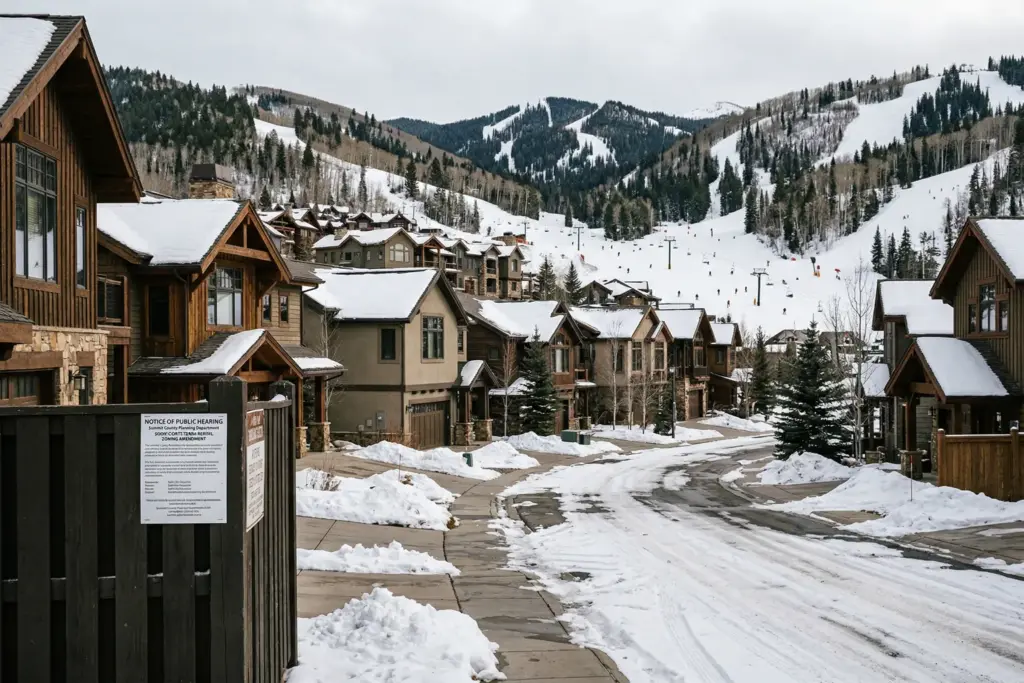
Summit County, Utah, home to Park City and some of the most expensive short-term rental inventory in the Mountain West, recorded exactly 18 complaint calls through its new STR hotline in January and February of 2026. That is the first public enforcement data to come out of one of the country’s most STR-saturated resort markets. And the number raises a question that nobody in county government seems eager to answer: is 18 a sign that the system is working, or proof that almost nobody is using it?
The hotline launched in January. It was pitched as a tool for owners, neighbors, and renters to report problems ranging from noise to unpermitted listings. Two months in, the county released the breakdown. Seven of the 18 calls were noise complaints. Five were about trash. Four flagged unpermitted short-term rentals. One was a parking issue. One was categorized as “other.”
StaySTRA data shows Park City alone has 4,085 active short-term rental listings, with an average daily rate of $986 and a last-twelve-month occupancy rate of 39%. The average property pulls in $10,415 per month. During peak ski season in February, occupancy hits 57% and revenue climbs to $13,157. This is not a small-time vacation rental market. It is a billion-dollar hospitality economy operating inside residential neighborhoods.
So 18 complaints. From a county where Deputy County Manager Janna Young estimates roughly 2,000 short-term rentals operate in the unincorporated areas alone. That is a complaint rate of less than 1%.
What the Complaint Breakdown Actually Reveals
The seven noise complaints are not surprising. Noise is the universal STR grievance, the thing neighbors notice at 11 p.m. on a Saturday when a group of ski tourists is still celebrating on the deck. It is also the easiest complaint to file and the hardest to substantiate after the fact.
The five trash complaints are more interesting. Trash violations are visible, persistent, and documentable. A neighbor does not need to be awake at midnight to notice overflowing bins on a Tuesday morning. Trash complaints suggest ongoing operational failures, not one-time party incidents.
The four reports of unpermitted STRs are the most significant data point in the set. These are not complaints about behavior. They are complaints about legality. Someone took the time to report a property they believed was operating without a license. In a county that contacted 653 unlicensed operators last October and got only 113 of them to actually obtain permits, four unpermitted-STR reports in two months is almost certainly a fraction of the real number.
Young told the county council that staff are “working with the code enforcement official assigned to this to better understand what data we have, and if it’s time to meet again as an internal working group to look at additional regulations.” Translation: the county is still figuring out what the data means, too.
The Compliance Gap Nobody Talks About
Here is where the story gets uncomfortable for both regulators and operators.
Last October, Summit County staff used new licensing software to identify and contact 653 operators running unlicensed short-term rentals in unincorporated areas. Of those 653, only 448 even responded. Of the 448 who responded, 113 obtained permits. Several told the county they had already pulled their properties off the short-term rental market entirely.
Do the math. The county identified 653 unlicensed operators. Roughly 200 never responded at all. Only 113 got licensed. That means hundreds of operators are either still running unlicensed, ignoring enforcement outreach, or operating in a gray zone where nobody is checking.
The 18-complaint figure looks different in that context. It is not a measure of how many problems exist. It is a measure of how many problems someone picked up the phone to report. And in a resort community where most STR neighbors are themselves seasonal residents or second-home owners who may not even be in town during peak rental periods, the gap between reported complaints and actual violations could be enormous.
How Mountain Markets Differ from Urban Enforcement
Compare Summit County’s experience to what is happening in Houston. On April 1, 2026, Houston began notifying Airbnb and Vrbo to remove listings that do not display valid registration numbers. Both platforms are systematically delisting unregistered properties. When a listing gets pulled, the owner loses all bookings, all reviews, and cannot relist until providing proof of city registration.
That is proactive enforcement. The city is not waiting for complaints. It is running software against platform listings and pulling the ones that do not match permits on file.
In Clark County, Nevada, the enforcement approach hit a different wall entirely. A federal court issued an injunction blocking the county from enforcing its STR fines, creating legal uncertainty for hosts and regulators alike. The county tried to move aggressively, and the courts pumped the brakes.
And in Provincetown, Massachusetts, the town is considering capping STR ownership at three units per person, a structural approach that sidesteps the complaint-and-enforcement cycle entirely by limiting who can participate in the market.
Summit County’s complaint hotline sits somewhere between these models. It is not proactive like Houston. It is not structural like Provincetown. It is reactive. It depends on residents picking up the phone. And in a mountain resort county where 38.3% of all homes are classified as vacant and more than half the housing stock in Park City proper sits empty most of the year, there may not be enough year-round residents to generate the complaint volume that would trigger meaningful enforcement action.
What This Means for STR Hosts and Investors
If you operate a short-term rental in Summit County or any mountain resort market with complaint-driven enforcement, the 18-complaint data contains a practical lesson.
Low complaint volume does not mean low risk. It means enforcement has not caught up yet. Councilmember Roger Armstrong has already signaled that the county may reconvene its internal working group to draft new STR regulations, noting that “nightly rentals take housing off the market” and function like boutique hotels. That language suggests tighter rules are coming regardless of the complaint numbers.
The compliance math is also worth understanding. If you are one of the operators who received a letter last October and did not respond, you are on a list. The county knows who you are. The fact that they have not knocked on your door yet does not mean they will not. The licensing software that identified 653 unlicensed properties is still running.
For compliant operators in Park City, the good news is that the market fundamentals remain strong. At nearly $1,000 in average daily rate and monthly revenue above $10,000, the economics support professional operation. But the regulatory environment is evolving. Hosts who respond quickly to complaints, maintain proper licensing, and manage their properties like businesses (not absentee investments) will be the ones who survive whatever regulations the working group produces.
What to Do If You Receive a Complaint
Summit County’s system requires the responsible agent for a property to respond within 60 minutes of receiving a complaint call. That clock starts when the hotline contacts you, not when the neighbor called in.
Three things to know about the enforcement structure:
The first contact is a notice, a communication offering you the opportunity to resolve the issue. If the problem continues, you get a warning. If it continues after that, you get a violation, which typically comes with a citation from the Sheriff’s Office.
The practical advice: designate a local responsible agent who can actually respond in under an hour. If your property manager is based in Salt Lake City and you are listed in the Snyderville Basin, a 60-minute response window is tight. Have a plan. Have a local contact. Have your guest communication templates ready for noise, parking, and trash issues before you need them.
The Bigger Picture: Data Is Finally Emerging
Summit County’s 18-complaint report is notable not because the number is large or small, but because the number exists at all. For years, cities and counties have passed STR regulations with no mechanism to track whether they are being followed. Enforcement was an afterthought. The permit existed on paper. The complaint process was “call the police non-emergency line.”
That era is ending. Houston is using platform-level delisting. Clark County tried fines and got blocked by a federal court. Provincetown is restructuring ownership limits. And Summit County, Utah is counting phone calls and trying to figure out what 18 means.
The honest answer is that 18 complaints in two months from a county with thousands of active rentals almost certainly understates the problem. Research on STR complaint hotlines nationally suggests that reporting rates are low across the board, particularly in resort and vacation markets where the people most affected by STR noise and parking are themselves transient.
But the data is a start. And in STR enforcement, having data (even imperfect data) is what separates cities that are actually enforcing their rules from cities that just have rules on paper.
We do our best to keep our reporting accurate and up to date, but situations evolve and we are only human. Always verify current details directly with local officials and sources before making decisions.
Frequently Asked Questions
How many STR complaints did Summit County Utah receive in 2026?
Summit County recorded 18 complaint calls through its new STR hotline in January and February 2026. The breakdown was seven noise complaints, five trash complaints, four reports of unpermitted rentals, one parking issue, and one categorized as “other.”
How does Summit County enforce short-term rental regulations?
Summit County uses a complaint-driven enforcement model with a dedicated hotline. When a complaint is filed, the responsible agent for the property must respond within 60 minutes. Enforcement follows a three-tier system: notice, warning, then violation with a Sheriff’s Office citation.
How many short-term rentals are in Summit County Utah?
The county estimates roughly 2,000 short-term rentals in unincorporated Summit County alone. StaySTRA data shows 4,085 active listings in Park City. Summit County has more short-term rentals than any other county in Utah.
What happens if a short-term rental host gets a complaint in Summit County?
The hotline contacts the property’s responsible agent, who has 60 minutes to respond with a resolution. The first complaint results in a notice. Continued problems lead to a warning, then a formal violation issued alongside a Sheriff’s Office citation.
Are complaint hotlines effective for enforcing STR rules?
Early data suggests complaint hotlines capture only a fraction of actual violations. Summit County’s 18 complaints from a market with thousands of active rentals represents a sub-1% complaint rate, which likely reflects underreporting rather than high compliance. Proactive enforcement models like Houston’s platform-level delisting tend to produce faster compliance results.
Run your own numbers on any STR market in Utah with the StaySTRA Analyzer, or explore current market data for Park City and every Utah market we track.
Become a StaySTRA Insider
Join free — get our newsletter + 1 free property analysis/month.
No spam. Unsubscribe anytime. Free membership includes property analyses and market insights.
Sponsored — OfferMarket
Buy Your First STR With Long-Term Rental Financing
Flexible, long-term financing for short-term rental buyers. Rates from 5.75%. Instant online quote, no credit pull.
Explore RTL Financing Options →Affiliate disclosure: StaySTRA may earn a referral fee.