
Key Takeaways
- Short-term rental guests are legally classified as invitees, which means you owe them the highest duty of care under premises liability law, including an obligation to inspect your property and correct or warn of dangerous conditions.
- Airbnb’s AirCover provides up to $1 million per stay in host liability protection, but in the United States it may be underwritten by a non-admitted insurer that may not be subject to your state’s insurance laws, it does not cover off-platform bookings, and it excludes intentional acts, communicable disease, and punitive damage claims.
- Florida and Texas use modified comparative negligence with a 50 or 51 percent fault bar, while Tennessee uses modified comparative fault, meaning a guest who was 50 percent or more at fault for their own injury recovers nothing.
- Operating your STR through an LLC creates a liability shield between a guest’s lawsuit and your personal assets, but only when properly maintained. A poorly documented LLC with comingled finances can be pierced by a court.
- The most common STR guest injury scenarios (stairs, pools, uneven flooring, outdoor furniture) are preventable through documented inspection routines and inexpensive physical upgrades.
Here is a fact that tends to get skipped over in the general conversation about STR risk management: a guest who is injured at your property can sue you personally, even if you have an LLC, even if you have AirCover, and even if the guest was doing something you told them not to do. The legal machinery that makes this possible has nothing to do with Airbnb’s terms of service. It is called premises liability law, and it predates Airbnb by about a century.
I have read more than my share of STR insurance policies and legal guides that conflate two completely separate things: the law (premises liability) and the financial product (insurance). They are related, but they are not the same. The law determines whether you owe a guest compensation after an injury. The insurance determines whether you personally have to write the check. Understanding both, separately, is how you actually manage this risk rather than just hoping for the best.
This article is about the legal framework. If you want the insurance product breakdown (AirCover vs. Steadily vs. Proper Insurance), that is covered in our companion article on STR host liability insurance beyond AirCover. What follows here is the law: what a court is actually asking when a guest files suit, what standards apply in the states STR investors favor most, and what practical steps reduce your exposure before anyone calls an attorney.
This article provides general information and should not be construed as legal advice. Consult a qualified attorney in your jurisdiction for advice specific to your situation.
The Legal Category That Controls Everything: Premises Liability
Premises liability is the body of law that decides who is responsible when someone is injured on another person’s property. Every state has it. The basic framework is older than the automobile. And it applies to your vacation rental whether the guest found you on Airbnb, VRBO, a direct booking site, or a friend of a friend who Venmo’d you the nightly rate.
The law starts by asking a simple question: what category did this person fall into when they were on your property? Courts use three traditional categories, each carrying a different level of responsibility for the property owner.
The three categories are trespassers (people who had no legal right to be on the property), licensees (people who had permission but were not invited for a commercial purpose, like a social guest), and invitees (people who entered for a business purpose, with the owner’s invitation). STR guests fall squarely into the invitee category. They paid to be there. They came at your explicit invitation. This matters enormously, because invitees receive the highest duty of care under the law.
As an invitee’s host, you do not just have to avoid deliberately hurting them. You have an affirmative obligation to inspect your property for hidden hazards and either repair those hazards or warn guests about them. If a guest trips on a loose stair tread that you did not know about but should have discovered during a reasonable inspection, that is on you. Courts in Florida, Texas, Tennessee, and virtually every other state apply this standard to STR hosts.
What Negligence Actually Requires
When a guest files a premises liability claim, their attorney is building a case around four elements. All four have to be present for the claim to succeed. This is not a technicality that lets negligent hosts off the hook. It is a framework that tells you exactly where your exposure lives and where it does not.
Duty. Did you owe the injured person a legal duty of care? For a paying STR guest, this is never in dispute. You owed them the invitee-level duty described above.
Breach. Did you fail to meet that duty? This is where most defenses live. A host who conducts documented regular inspections, fixes known hazards promptly, and provides adequate warnings is in a much stronger position than one who has no inspection records and left a broken pool gate unrepaired for months.
Causation. Did your breach actually cause the injury? A guest can be injured at your property in ways that have nothing to do with any hazard you created or allowed to persist. Causation is a real legal requirement, not a formality.
Damages. Did the person actually suffer a legally recognizable harm? Fright without injury is generally not enough. A hospital bill, lost wages, and pain and suffering are what personal injury attorneys are adding up when they evaluate whether a case is worth filing.
How the Three Investor-Favorite States Handle This
The legal principles above are consistent across states. The difference in how states treat the guest’s own contribution to the accident is where investor-relevant distinctions actually appear.
Florida
Florida is a modified comparative negligence state, following a 2023 change in the law (HB 837, codified at Florida Statutes Section 768.81). Under the current rule, a plaintiff whose share of fault exceeds 50 percent cannot recover anything. If a guest was partially responsible for their injury but their fault was 40 percent and yours was 60 percent, they recover 60 percent of their damages. If their fault was 55 percent, they recover nothing.
Florida also has a specific procedural rule for slip-and-fall cases on transitory foreign substances in a business establishment, found at Florida Statutes Section 768.0755 (Source). Under that statute, a plaintiff must show that the property owner had actual or constructive knowledge of the condition. This is a meaningful protection for hosts who maintain inspection logs and turnaround checklists. A hazard the host could not have reasonably discovered is not automatically the host’s legal problem.
Texas
Texas uses a modified comparative fault scheme under Texas Civil Practice and Remedies Code Section 33.001. A guest whose percentage of responsibility exceeds 50 percent cannot recover anything. If a guest is 50 percent or less at fault for the accident, they can still recover, but their award is reduced by their percentage of fault.
Texas courts treat premises liability as a “special form of negligence,” meaning the analysis focuses closely on the specific condition of the property, what the owner knew about it, and whether the danger was open and obvious. The open-and-obvious doctrine is a meaningful defense in Texas: if a hazard was clearly visible and an ordinary person would have recognized the danger, the host’s duty to warn may be diminished. This does not eliminate liability for creating dangerous conditions, but it matters in pool deck and stair cases where guests sometimes argue they did not realize a risk that any reasonable person would have spotted.
Tennessee
Tennessee uses modified comparative fault, a standard the state’s Supreme Court adopted in McIntyre v. Balentine (Tenn. 1992), when it rejected the pure form (Source). Under that rule, a plaintiff whose own negligence was 50 percent or more of the total cannot recover anything. Their recovery is otherwise reduced by their percentage of fault. A guest who was 40 percent responsible for their own injury can still collect 60 percent of their damages from you.
This matters for STR investors concentrated in Tennessee’s high-volume markets like Nashville, the Smoky Mountains, and Gatlinburg. A guest who stumbled at 2 a.m. on a deck they had been warned about can still present a viable claim if they were less than half at fault for the incident.
The Contributory Negligence States Worth Knowing
A small group of states use pure contributory negligence, which is as host-friendly as premises liability gets. Under that rule, a plaintiff who was any percent responsible for their own injury cannot recover at all. The states still using this standard include Alabama, Maryland, North Carolina, Virginia, and Washington, D.C. (yes, D.C. is in this category too, which surprises most people).
If you are evaluating markets partly on legal risk, those states present a different liability profile than Tennessee. This does not mean you should ignore safety at an Airbnb in Asheville because North Carolina uses contributory negligence. It means the legal baseline for a successful guest claim is higher, which is a data point worth knowing.
What AirCover Actually Does (and Does Not Do)
Airbnb’s AirCover for Hosts includes host liability protection of up to $1 million per stay for bodily injury or property damage to guests and third parties. That coverage, when it applies, should respond to the typical guest slip-and-fall at a property that was booked through Airbnb and fulfilled through Airbnb.
Three things hosts consistently miss about AirCover:
It may not be state-regulated insurance. AirCover’s Host Liability Insurance is an insurance program, and in the United States coverage is provided under policies issued by Illinois Union Insurance Company, Generali US Branch or Assicurazioni Generali Spa. In certain instances it is underwritten by a non-admitted insurer, so it may not be subject to your state’s insurance laws and regulations and is not protected by the insolvency guaranty fund (Source).
It only covers Airbnb-booked stays. If you have any direct bookings, VRBO bookings, or Booking.com bookings at your property, AirCover does nothing for injuries to those guests. A host managing bookings across multiple platforms has liability exposure on every non-Airbnb booking that AirCover does not touch.
Key exclusions apply. AirCover excludes intentional acts, assault and battery, communicable disease, punitive damages, and other categories that can appear in real STR claims. Hosts with six or more listings face an additional issue: since March 1, 2025, if a host has 6 or more active Airbnb listings at the time of loss, AirCover’s liability insurance may require contribution from the host’s other applicable insurance or apply as excess coverage, depending on that other policy’s language (Source).
This is not an argument against relying on AirCover. For a typical single-property host doing all business through Airbnb, AirCover is genuine coverage for most scenarios. It is an argument for understanding exactly what you have, so you know where the gaps are. For a full breakdown of how AirCover compares with purpose-built STR policies, see our detailed comparison of STR host liability insurance options.
The Four Injury Scenarios That Drive Most STR Claims
Picture this: you get a call from a guest who twisted an ankle on the stairs. It happens more often than most hosts realize, and the reason is usually not neglect. It is a combination of unfamiliar space, low lighting, and a step riser that is slightly inconsistent with the others. The guest was paying attention. The property was generally well-maintained. And yet here you are, staring at a potential liability claim.
These four scenarios account for a disproportionate share of STR guest injury claims:
Stairs and step changes. Uneven risers, inadequate lighting, missing handrails, and transitions between floor heights are the most common sources of STR slip-and-fall injuries. Many STR properties, especially historic homes or cabins with custom construction, have stairs that do not meet current building codes. A documented inspection that checks handrail stability, lighting levels, and step uniformity before each checkout period goes a long way toward showing you exercised reasonable care.
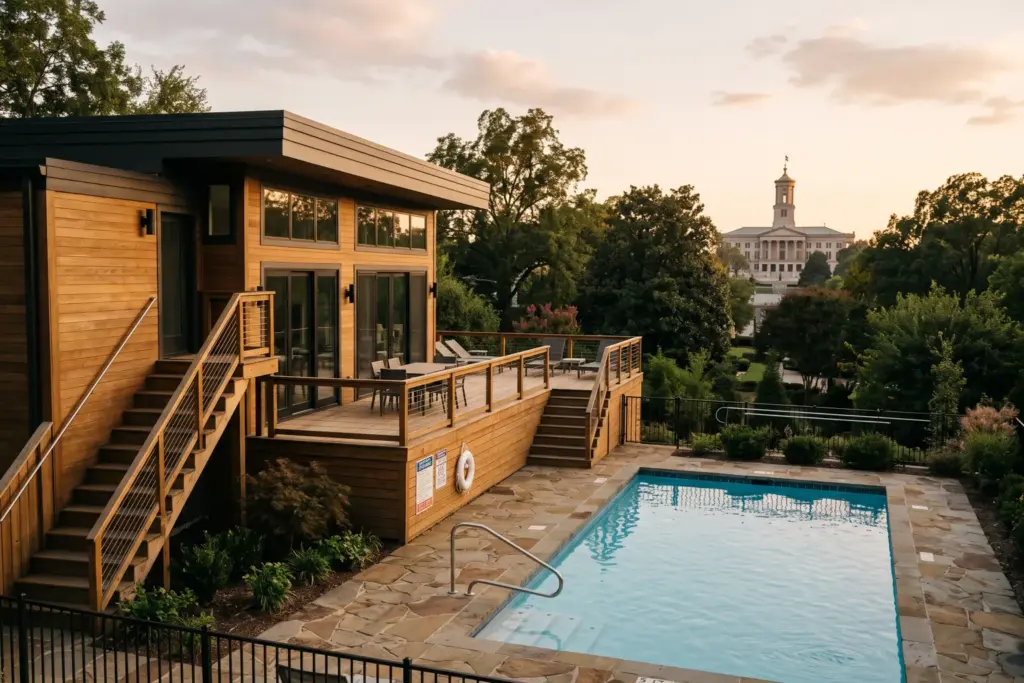
Pools and hot tubs. Wet surfaces are always a hazard, but the legal exposure around pools involves more than just slipping. Pool depth markers that are faded, broken pool gates that do not latch, missing or inadequate fencing, and the absence of a rescue hook can all be argued as evidence of a breach of the host’s duty. Florida enforces pool safety requirements under Chapter 515 of the Florida Statutes. Texas and Tennessee have their own frameworks. A pool that does not comply with local safety codes is a documented duty breach sitting in your backyard.
Outdoor furniture and decks. Weather-damaged furniture, railings with hidden rot, and deck boards that have loosened over seasons are easy to miss on a visual walkthrough and expensive to miss in a lawsuit. Outdoor furniture should be inspected at the start of each booking season and after major weather events. Deck railings should be physically tested for stability, not just looked at.
Flooring transitions and rugs. Loose area rugs on smooth floors, unanchored transitions between flooring types, and surfaces that become slippery when wet are routine findings in STR injury claims. These are also some of the least expensive hazards to address: non-slip rug pads, transition strips, and anti-slip bath mats are under ten dollars each and eliminate categories of risk entirely.
The LLC Question: Does It Actually Protect You?
Operating your STR through an LLC creates a liability barrier between a guest’s lawsuit and your personal assets, in theory. In practice, the protection depends on how the LLC is structured and maintained.
When an LLC is properly maintained (a separate bank account, no comingling of personal and business funds, adherence to the operating agreement, appropriate capitalization), courts generally respect the entity’s liability shield. A guest who wins a judgment against your LLC can reach the LLC’s assets. They cannot reach your personal home, your personal savings, or your other properties that sit in separate entities.
When an LLC is poorly maintained, a court can apply “piercing the corporate veil” and hold the owner personally liable anyway. The specific tests vary by state, but the common thread is that courts look to see whether the LLC was genuinely functioning as a separate entity or was just a name on paper. A single-member LLC that uses the same bank account as the owner, never held a meeting, and has no operating agreement is a thinner shield than it looks.
The other thing an LLC does not do is make a premises liability claim disappear. If a guest is injured at your property and brings a valid claim, the LLC determines who pays (the entity rather than you personally), but it does not determine whether the claim is valid. You still need appropriate insurance coverage behind the LLC.
For a detailed walkthrough of LLC formation, S-Corp elections, and how Series LLCs protect multi-property portfolios, our guide on STR business entity structure covers the full picture.
Practical Risk Reduction: What Courts Look For
When a premises liability case goes to trial or is evaluated in settlement negotiations, one of the most important questions is what documentation the host has. Attorneys on both sides are looking for evidence of your inspection and maintenance practices. Here is what actually matters:
Inspection logs. A written record of property inspections, with dates and what was checked, is evidence that you took your duty of care seriously. It does not have to be elaborate. A checklist that covers stairs, railings, pool gates, lighting, and high-traffic surfaces, completed and dated before each guest arrival, creates a paper trail that goes directly to the “breach” element of a negligence claim.
Maintenance records. Written records of repairs and when they were completed matter. A repair that was flagged, promptly completed, and documented looks very different in litigation than a repair that was flagged, never completed, and resulted in an injury six months later.
Warning communications. If your property has a known condition that presents some risk (a steep staircase, a pool with a specific depth, a firepit with a recommended perimeter), a written note in your welcome book and the same information in your digital house guide creates a documented warning. The key word is documented. An oral warning that cannot be verified never happened, in the eyes of a court.
Building code compliance. Local building codes set a baseline for what a “reasonably safe” property looks like. A property that fails to meet those baselines on the specific condition that caused the injury faces a difficult argument that it exercised reasonable care. Code compliance does not guarantee you will never face a claim. It does significantly improve your position when one is filed.
What Happens After a Guest Reports an Injury
The practical steps you take in the first 24 to 48 hours after a guest reports an injury can have real consequences for how any subsequent claim proceeds.
First, document everything about the property’s condition at the time of the incident. Photographs, timestamps, and written notes are all useful. If the condition that allegedly caused the injury is something that could change (a wet floor, a loose rug, weather conditions on a deck), document it immediately.
Second, do not make admissions of liability in your communications with the guest. This is not about being cold or adversarial. It is about the fact that an expression like “I’m so sorry, I should have fixed that” can be used as an admission in litigation. Express concern for the guest’s wellbeing, offer to cooperate on documentation they need, and involve your insurance carrier immediately.
Third, notify your insurance carrier (and Airbnb, if the booking was through that platform) as soon as you are aware of an injury. Insurance policies contain notice requirements. Late notice can complicate coverage, and there is no benefit to delay.
Fourth, preserve any evidence relevant to the incident. Do not repair the condition that allegedly caused the injury before it has been photographed and documented. The obligation to preserve evidence exists from the moment you have reason to anticipate litigation.
Frequently Asked Questions
Can a guest sue me personally for an injury at my Airbnb?
Yes. A guest who is injured at your STR property can file a premises liability lawsuit naming you personally, your LLC, or both. If your property is held in an LLC that is properly maintained, the lawsuit should be directed at the entity rather than you individually, and any judgment should be limited to the entity’s assets. If the LLC’s liability shield is pierced due to comingled finances or missing documentation, personal assets can be at risk. Operating through a properly maintained LLC and carrying adequate liability insurance are both important parts of the protection stack.
Does my LLC fully protect me from guest injury claims?
An LLC limits your personal exposure, but it does not make claims disappear and it is not impenetrable. Courts can pierce the corporate veil when an LLC is not genuinely maintained as a separate entity. Beyond the veil-piercing issue, an LLC protects your personal assets but does not pay the claim itself. You still need liability insurance behind the LLC. The right answer is both: a properly maintained LLC and appropriate STR insurance coverage.
What does AirCover actually cover for host liability?
Airbnb’s AirCover for Hosts includes up to $1 million per Airbnb stay for bodily injury or property damage claims by guests and third parties. In the United States it may be underwritten by a non-admitted insurer that may not be subject to your state’s insurance laws, it only applies to bookings made and fulfilled through Airbnb, and it excludes intentional acts, communicable disease, punitive damages, and several other categories. For hosts with 6 or more active Airbnb listings at the time of loss, AirCover’s liability insurance may require contribution from the host’s other insurance or apply as excess coverage (Source). AirCover is real protection for the most common guest injury scenarios on Airbnb-booked stays, but it is not a complete solution if you take any direct or multi-platform bookings.
Does it matter which state my STR is in for liability purposes?
Yes, the state matters significantly for how guest fault is treated. Florida and Texas use modified comparative negligence, which bars recovery when a guest’s own fault exceeds 50 percent (Source). Tennessee uses modified comparative fault, where a guest who was 50 percent or more responsible for the accident recovers nothing and a guest below that line has the award reduced proportionally (Source). States like North Carolina, Virginia, Alabama, and Maryland use contributory negligence, where any fault by the guest bars recovery entirely. These rules affect the realistic exposure from a given claim, not just the theoretical maximum.
What documentation should I keep to protect myself from guest injury claims?
Dated inspection logs showing what was checked before each guest arrival, maintenance records showing when and how repairs were completed, written warnings in your welcome book and digital house guide for any known conditions, and documentation of building code compliance for safety-relevant systems (stairs, pool fencing, railings) are all useful. This documentation goes directly to the “breach” element of a negligence claim. A host who can show they conducted reasonable inspections and addressed known hazards is in a meaningfully better legal position than one who cannot.
What should I do immediately after a guest reports being injured at my STR?
Document the property’s condition immediately with photographs and timestamped notes. Do not admit fault or make statements about the property’s condition that could be used as admissions in litigation. Express concern for the guest’s wellbeing and cooperate on documentation they need. Notify your insurance carrier and Airbnb (if applicable) as soon as possible, since insurance policies have notice requirements. Preserve all evidence related to the guest’s stay and do not repair the condition in question until it has been fully documented.
We do our best to keep our regulatory guides accurate and up to date, but ordinances change and we are only human. Always verify current requirements directly with your local municipality and consult a qualified attorney before making business decisions.
Use the StaySTRA Analyzer to Evaluate Your Market’s Full Risk Profile
Legal exposure is one dimension of STR risk. Market fundamentals, regulatory environment, and revenue data are the others. The StaySTRA Analyzer pulls together market occupancy, ADR, and competitive data for markets across the country so you can evaluate whether a given market’s return justifies its full risk profile before you buy.
Become a StaySTRA Insider
Join free — get our newsletter + 1 free property analysis/month.
No spam. Unsubscribe anytime. Free membership includes property analyses and market insights.