Key Takeaways
- Metro Nashville issued a formal removal order on September 9, 2026 for a 5-bedroom East Nashville STR that had been denied a permit in 2022 and cited for code violations in 2024.
- Seven days after the removal order, Vrbo still showed the listing as active and bookable. Airbnb had removed the listing after WKRN questioned it. Two platforms, same order, different outcomes.
- Nashville has no ordinance requiring platforms to act within any defined window after a city removal order. Austin mandates 10 days by law; Clark County, Nevada now blocks payment processing outright for unlicensed properties.
- The gap between Metro’s removal order authority and actual platform compliance creates a live booking window where a denied, ordered-removed property continues generating revenue.
- For investors tracking Nashville STR compliance risk in 2026, this case is a concrete illustration of the enforcement gap that allows unlicensed operators to persist even after the city acts.
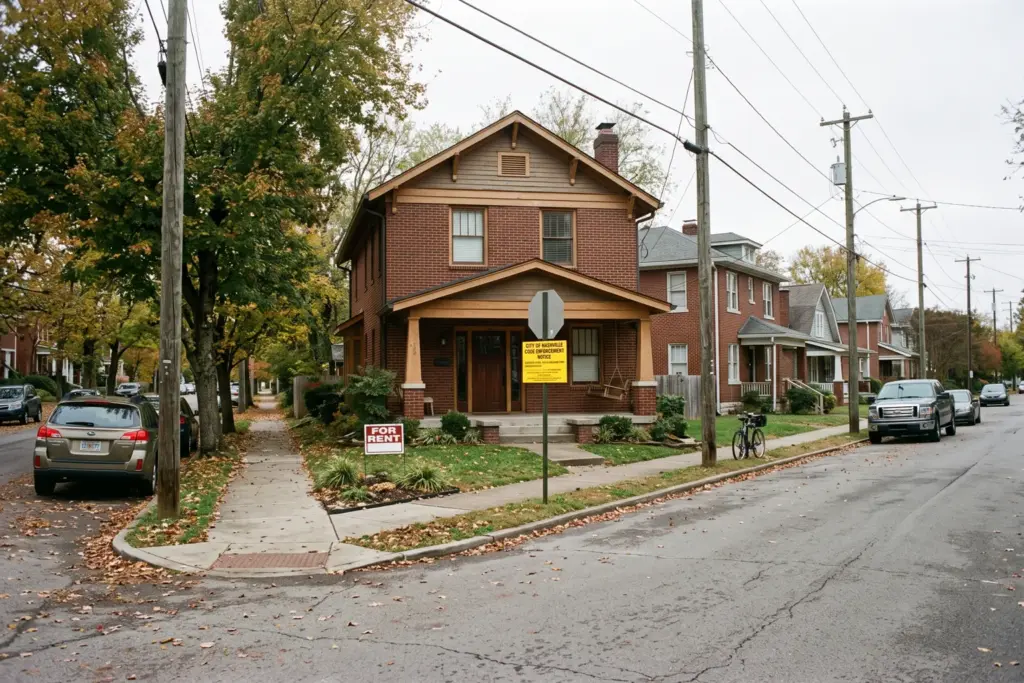
The listing was hard to miss. A five-bedroom house on Lischey Avenue in East Nashville, sleeping 12, appraised by the county at $889,600, available on both Airbnb and Vrbo (WKRN). The photos were polished. The availability calendar was open.
Metro Nashville had a different view of the property. City records show the permit was denied in 2022. Code violations were documented in 2024. On September 9, 2026, Metro issued a formal removal order.
Six days later, the property was still accepting bookings.
On both platforms. Airbnb removed the listing only after WKRN News 2 questioned it (WKRN). Vrbo had not. The East Nashville house with the denied permit and the documented violations was still on the market, still available for guests, still generating revenue from a property whose owner the city had ordered to remove its listings.
That split result is what this story is about. Not the property itself. The gap between what a city can order and what platforms are required to do about it, and how quickly.
What the Nashville STR Ordinance Actually Says
Metro Nashville has had a short-term rental permit structure in place for several years. Non-owner-occupied STRs, known locally as NOOSTRs, require a city permit to operate legally. The permitting process involves zoning eligibility, code compliance review, and documentation requirements administered by Metro Codes.
Starting in 2022, Metro stopped issuing new NOOSTR permits in residential zones across much of Davidson County. Properties that already held permits could continue operating under existing approvals. New applications in those zones were denied. The East Nashville property on Lischey Avenue applied and was turned down.
On paper, Metro’s enforcement path for non-compliant operators is well-defined. Complaint reports or city-initiated listing scans can trigger an inspection. If an address is operating without a valid permit, the city can issue citation notices, and escalating penalties follow. Under Metro’s framework, the fine is $50 per day, with each day of operation without a permit a separate offense (Metro Nashville BL2020-187). At the far end of the escalation path sit permit revocations and Environmental Court prosecution.
Data from NASTRA, the Nashville Short Term Rental Association, indicates Metro Nashville had approximately 4,800 active NOOSTR permits heading into 2026. The number of Nashville listings on Airbnb and Vrbo is substantially higher. As NASTRA’s own materials acknowledge, the number of STR listings appearing online appears to be far higher than the number of permits the city has issued, with a potentially large number of properties operating without licenses.
What Nashville’s ordinance does not include is a provision that tells platforms what they must do, and in how many days, when Metro issues a removal order. That absence is the mechanism gap this case exposed.
Documents Show: The Split-Platform Outcome
Reporting by Strisker’s Jas Albatana, published in the September 14-17 weekly STR briefing and confirmed in follow-up daily notes on September 17, documented what happened after Metro’s September 9 order to remove the listings.
By September 16, seven days after the order, Airbnb had removed the listing. Vrbo had not. The Lischey Avenue property remained active and bookable on Vrbo at least through that date.
Two platforms hosted the same ordered-removed listing. One removed it within a week, after a reporter asked. The other had not. The window during which the property continued accepting bookings on Vrbo was at least seven days from Metro’s order date.
The reason that window exists is structural. Nashville’s STR ordinance does not include a provision requiring platforms to remove listings within any defined timeframe after receiving a city removal order. There is no 10-day compliance window codified in Nashville law. There is no payment-blocking mechanism. There is no fine schedule for platforms that fail to delist after a city order. Metro can issue the removal order. What it cannot do is enforce a platform-specific deadline with legal teeth.
The platforms themselves have not filled this gap through voluntary policy. Airbnb states it may suspend or remove listings that fail to meet quality standards or cause severe neighborhood disturbances, but no publicly stated universal timeline for responding to government removal orders exists in Airbnb’s public policy documentation. Vrbo’s public policy language is similarly general: it will remove listings that do not comply with their guidelines or any applicable law. No timeline is attached to either commitment.
The result is that platform compliance in Nashville depends on each platform’s internal processes, not a city-imposed deadline. When Airbnb and Vrbo move at different speeds, a property can disappear from one platform and persist on the other. That is exactly what happened on Lischey Avenue in September 2026.
How Other Cities Have Closed This Gap
Nashville’s enforcement architecture is not unusual for a city that adopted its STR ordinance before the platform-enforcement era caught up. But two comparison markets show what a stronger framework looks like in practice.
Austin, Texas. Effective July 1, 2026, Austin’s STR platform enforcement law codified three specific obligations for platforms. They must require users to display a valid city license number in any Austin STR advertisement. When the city sends a delist notice for an unlicensed or revoked property, the platform must remove the listing within 10 days. Platforms cannot collect fees to facilitate bookings for unlicensed Austin properties. The 10-day removal window is not a platform courtesy. It is city law with fine authority behind it.
The scale of the compliance problem that framework addresses is instructive. As of April 2026, Austin had approximately 2,750 active STR licenses and had identified roughly 2,785 unlicensed addresses operating in the city. Nearly a 1:1 ratio of licensed to unlicensed inventory. The enforcement gap between what cities formally permit and what platforms actually host is not a Nashville-specific condition. It is the national baseline.
Clark County, Nevada. On September 2, 2026, Clark County implemented what may be the most aggressive platform enforcement tool in the country. As this site covered in September, the Clark County ordinance passed 5-0 on August 18 moved beyond removal orders to outright payment blocking: platforms must verify valid county licenses, display licensing information on listings, and refuse reservations for unlicensed properties (FOX5 Las Vegas). Platforms that process reservations or payments for unlicensed Clark County STRs face fines starting at $500, escalating with each subsequent violation. (See: Clark County Just Made Airbnb and Vrbo Responsible for Unlicensed Listings.)
Clark County’s ordinance faces a federal preliminary injunction that continues to challenge parts of the county’s licensing scheme. The legal battle is ongoing. But the direction of travel is clear: cities that want to close the enforcement gap between issuing removal orders and achieving actual platform compliance are moving toward mandating platform action on defined timelines, with financial penalties for platform non-compliance.
Nashville is not there yet.
The Ownership Layer Adds Another Wrinkle
The Lischey Avenue property also surfaces a question that goes beyond platform compliance timelines. Documents show the former owner of the property, Nurbek Ulmasov, died on November 9, 2025. A quitclaim deed was signed approximately 18 days before his death. The property continued operating on Airbnb and Vrbo through at least September 2026, nearly a year after the ownership transfer.
Under Nashville’s permit rules, NOOSTR permits do not transfer with a property sale. A new owner must apply for a new permit. Under the 2022 residential-zone moratorium, a new NOOSTR application for the Lischey Avenue address would almost certainly be denied. Yet the listing persisted, accepting bookings on two platforms six days after Metro’s September removal order, and on Vrbo a full week after.
That combination — permit denied in 2022, violations documented in 2024, post-death ownership transfer, active bookings seven days after a removal order — is not a story about one isolated actor slipping through a crack. It is a story about what happens when enforcement depends on platform cooperation that no ordinance compels on any specific timeline.
What Nashville Investors Need to Understand About Compliance Risk
For investors evaluating Nashville as a market in 2026, the Lischey Avenue case is a data point with two distinct implications depending on which side of the compliance line you sit.
From one angle, the case shows the enforcement gap is real but not permanent. Metro Nashville does issue removal orders. Airbnb did remove the listing within a week, after a reporter asked. Vrbo’s delay was measured in days, not months. The window exists, but it is narrowing as platforms develop internal compliance infrastructure in response to growing city pressure nationally.
From the other angle, that same gap means permitted operators are competing against unlicensed properties that can continue generating bookings and collecting revenue while waiting on platform compliance after a removal order. That keeps supply artificially elevated in the permitted market and distorts the competitive floor that enforcement is supposed to create.
The most consistent approach among experienced Nashville investors is to focus on owner-occupied STR permits (OOSTRs), which carry far lower regulatory risk than the NOOSTR category that has been effectively frozen since 2022. NOOSTR due diligence now requires permit verification against Metro’s public dashboard before any transaction closes. Metro’s STRP Dashboard at data.nashville.gov tracks active permits, denied applications, and enforcement actions by address.
StaySTRA data covers Nashville market fundamentals for investors evaluating the market. The Nashville live market page tracks current occupancy, ADR, and competitive context. Regulatory compliance risk is a layer that market data cannot capture alone, and the Lischey Avenue removal order illustrates why permit verification has become a standard due diligence step in Nashville acquisitions.
The Broader Pattern: Enforcement Reality vs. Enforcement on Paper
Nashville’s enforcement gap is not an outlier. It is the default condition for most US cities that adopted STR ordinances before building the platform-directed enforcement infrastructure to back them up.
As this site documented earlier in 2026, STR laws are multiplying across America. Which cities are actually making them stick is a different question entirely. Compliance rates in the first year of a new STR ordinance typically run between 30% and 50%. More than half the inventory the ordinance is designed to regulate is out of compliance at the one-year mark. (See: STR Laws Are Multiplying Across America. Here’s Which Cities Are Actually Making Them Stick.)
Metro Nashville’s residential-zone NOOSTR moratorium has been in place since 2022. The gap between the approximately 4,800 permitted operators and total Nashville online inventory has had four years to widen. The September 9 removal order for the Lischey Avenue property is the most visible recent data point from that gap. It is not the only one. It is the one that was reported.
The question for Nashville — and for every market watching how this plays out — is whether Metro moves toward an Austin or Clark County model: platform-directed enforcement with defined timelines and financial penalties. Without that infrastructure, the city can issue orders. Platforms can choose how quickly to act on them. And a denied, ordered-removed property can continue booking guests in the meantime.
Frequently Asked Questions
Can a Nashville STR keep accepting bookings after Metro issues a removal order?
Based on the Lischey Avenue case documented in September 2026, yes, at least for several days. Nashville’s ordinance does not include a provision requiring platforms to remove a listing within any defined timeframe after receiving a city removal order. Airbnb removed the listing within a week in this case, after WKRN questioned it; Vrbo had not acted at least seven days after the order. Without a legally mandated compliance window, removal timing depends on each platform’s internal processes.
What makes Nashville’s enforcement different from Austin or Clark County?
Austin’s STR ordinance, effective July 1, 2026, requires platforms to remove listings within 10 days of receiving a city delist notice and prohibits platforms from collecting fees for bookings on unlicensed properties. Clark County, Nevada requires platforms to block payment processing for unlicensed STRs entirely, with fines for non-compliance. Nashville has no equivalent platform-directed enforcement mechanism with a mandated compliance timeline or financial penalties for platform non-compliance.
Do Nashville STR permit rules transfer when a property changes ownership?
No. Nashville’s non-owner-occupied STR permits do not transfer with a property sale. A new owner must apply for a new permit. Under the 2022 residential-zone moratorium, new NOOSTR applications in most of Davidson County’s residential areas would be denied. The Lischey Avenue case documented continued operation after a post-death ownership transfer via quitclaim deed, despite the non-transferable permit status and the outstanding removal order.
What is the safest permit category for Nashville STR investors in 2026?
Owner-occupied STR permits (OOSTRs) carry substantially lower regulatory risk than NOOSTRs. The NOOSTR category has been effectively frozen in residential zones since 2022, meaning new approvals are not being issued in most of Davidson County. OOSTR permits, which allow owner-occupants to rent their home or a room while away, remain available and do not carry the same exposure to the moratorium. Due diligence on any Nashville STR purchase should include permit status verification against Metro’s STRP Dashboard before closing.
How many unlicensed STRs are operating in Nashville?
The exact number is not captured in any publicly accessible, current dataset. Metro Nashville had approximately 4,800 active NOOSTR permits heading into 2026, but total Nashville listings on Airbnb and Vrbo significantly exceed that number. Industry observers including NASTRA have noted that online inventory appears substantially higher than permitted inventory. Metro’s STRP Dashboard at data.nashville.gov tracks active permits and denied applications for investors who want to verify specific addresses before acquiring a property.
Nashville STR investors tracking compliance risk can run permit status checks through Metro’s public dashboard before any acquisition. The StaySTRA Analyzer covers Nashville market fundamentals including occupancy, ADR, and competitive context — the market data layer that tells you whether Nashville pencils before the compliance due diligence tells you whether a specific property is clean.
Become a StaySTRA Insider
Join free — get our newsletter + 1 free property analysis/month.
No spam. Unsubscribe anytime. Free membership includes property analyses and market insights.
We do our best to keep our reporting accurate and up to date, but situations evolve and we are only human. Always verify current details directly with local officials and sources before making decisions.