

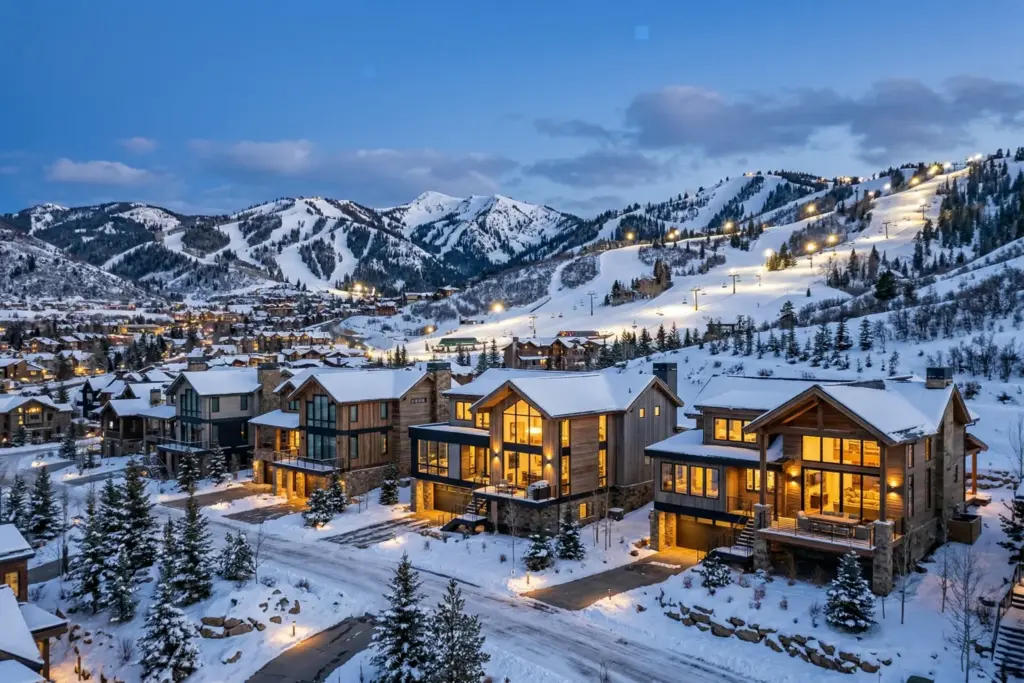
Key Takeaways
- Park City’s 4,085 active STR listings generate a median monthly revenue of $7,394, with top performers (90th percentile) pulling in $22,885 per month. The market-wide average daily rate sits at $986, one of the highest in any U.S. ski market.
- Seasonality is the defining feature: ski season (December through March) delivers roughly 52% of annual revenue, while shoulder months (April, May, October) see occupancy dip below 33%. Investors who cannot weather the off-season will struggle.
- Park City caps nightly rentals at 182 nights per year, requires a one-night vacancy between bookings, and only permits STRs in designated zones. These constraints protect existing operators but make new market entry harder.
- The Sundance Film Festival left Park City after 2026, removing an estimated $196 million annual economic impact. January revenue will likely decline for rental operators going forward.
- Compared to Breckenridge ($393 ADR, 62.5% occupancy), Park City runs at more than double the nightly rate but lower occupancy (roughly 39% annually). Park City is a higher-ADR, lower-volume play.
Park City’s average daily rate hit $986 in February 2026, putting it in a pricing tier that most STR markets in the country simply cannot touch. StaySTRA data across 4,085 active listings shows a market where the nightly rate for a typical rental costs more than what many hosts in mid-tier cities earn in a week. That number deserves context, though, because it only tells half the story.
The other half is occupancy, and at roughly 39% market-wide, Park City sits well below the national average for comparable resort markets. Think of it like a high-end restaurant that charges three figures per plate but only fills half its tables. The revenue per plate is spectacular. The question is whether enough diners walk through the door.
I have been watching mountain resort STR markets for the better part of four decades, and Park City stands apart from every other ski town I have analyzed. The combination of extreme pricing power, hard regulatory caps, and a seismic shift in the event calendar (goodbye, Sundance) makes this one of the most nuanced investment decisions in the 2026 STR landscape. Let me walk you through the numbers.
Park City STR Market Data at a Glance
StaySTRA tracks 4,085 active short-term rental listings in Park City as of early 2026. That is roughly one listing for every two permanent residents in a city of 8,254 people. Supply has expanded 36% since 2021, when the market had 3,114 active listings.
Here are the core metrics:
- Average Daily Rate (ADR): $986
- Occupancy Rate: 39% (market-wide, February 2026)
- RevPAR: $372
- Average Monthly Revenue: $10,415
- Median Monthly Revenue: $7,394
- Average Booking Lead Time: 103.5 days
- Average Length of Stay: 6.4 nights
The revenue distribution tells you a lot about this market. The bottom quartile of listings earns $3,521 per month. The median sits at $7,394. The 75th percentile climbs to $13,104, and the top 10% of performers pull in $22,885 monthly. That spread, roughly 6.5x between the 25th and 90th percentiles, is wider than what I see in most markets. It means property quality, location within town, and management sophistication matter enormously here.
The 103-day average booking lead time also stands out. Guests are planning Park City trips more than three months in advance, which tells you this is a destination market, not an impulse-booking one. If you are used to managing a property where bookings roll in a week or two ahead, Park City operates on a different rhythm entirely.
Seasonality Is the Whole Ballgame
Don’t let that $10,415 monthly average lull you into thinking the revenue flows evenly. It does not. Not even close. Park City has one of the most pronounced seasonal swings of any STR market in the country, and understanding that swing is the difference between a profitable investment and a painful one.
Here is the month-by-month breakdown from StaySTRA data:
| Month | Occupancy | ADR | Monthly Revenue |
|---|---|---|---|
| January | 52% | $810 | $12,710 |
| February | 57% | $816 | $13,157 |
| March | 58% | $689 | $12,871 |
| April | 33% | $482 | $5,508 |
| May | 30% | $398 | $4,584 |
| June | 39% | $446 | $6,230 |
| July | 44% | $477 | $7,302 |
| August | 43% | $436 | $6,871 |
| September | 38% | $411 | $5,621 |
| October | 32% | $410 | $4,714 |
| November | 33% | $455 | $4,772 |
| December | 43% | $770 | $10,019 |
The ski season core (December through March) generates approximately $48,757 in revenue across those four months. The full twelve-month total comes to roughly $94,359. That means ski season alone accounts for about 52% of annual revenue, packed into one-third of the calendar.
February and March lead in occupancy (57% and 58% respectively), while January and February command the highest ADRs ($810 and $816). December is the transition month where rates spike to $770 but occupancy lags at 43% as the season ramps up.
Stay with me on the shoulder months, because this is where the investment math gets uncomfortable. April through November averages roughly $5,700 per month. If your carrying costs (mortgage, HOA, property management, utilities, insurance) run $6,000 to $8,000 monthly, you are losing money for eight months of the year and counting on ski season to dig you out. That is the question every Park City STR investor needs to answer honestly.
The Sundance Factor (and Its Disappearance)
For more than 40 years, the Sundance Film Festival turned late January into the single most profitable week of the year for Park City rental operators. The 2026 festival (January 22 through February 1) was the last one held in Park City before the event moves to Boulder, Colorado in 2027.
The numbers tell the story of what is leaving. The 2025 Sundance Film Festival generated $196 million in total economic impact, an all-time high, with more than 85,000 in-person attendees. Lodging alone accounted for $38.7 million in spending during the 10-day event. Recreation and entertainment contributed $37.9 million. Meals and dining added $37.4 million.
During Sundance, STR operators routinely charged three to five times their normal nightly rates. Some property owners reported that a single Sundance week covered their entire annual mortgage payment. That revenue concentrated in late January will not be replaced automatically.
To be clear, I am not forecasting a collapse in January bookings. Park City still has world-class skiing, and January is still ski season. But $38.7 million in lodging spend does not vanish without consequences. The January revenue figure ($12,710 in the current data) likely includes Sundance-inflated rates from the 2026 festival. Investors should model future Januaries closer to a typical ski month, which based on the December and March numbers would put it somewhere in the $10,000 to $11,000 range for the median operator. That is a meaningful haircut.
Regulations in Park City and Summit County
Park City’s regulatory framework for short-term rentals is strict by design, and that strictness is actually what protects the investment thesis for operators already in the market.
Here are the rules that matter for investors:
Nightly Rental License required. Park City defines a nightly rental as lodging for fewer than 30 consecutive days. Every operator must obtain a Nightly Rental License, which requires proof of ownership, a floor plan, a parking plan, state and local tax registration, a building inspection, and a designated local contact person. The application process typically takes 15 to 30 days.
Zoning restrictions. STRs are only allowed in designated zones. Resort-oriented areas, Old Town, and Canyons Village are the primary zones where nightly rentals are permitted. Neighborhoods like Prospector are zoned to prohibit nightly rentals entirely. If you are buying a property for STR use, confirming the zoning designation before closing is not optional.
182-night annual cap. Properties may be rented for no more than 182 nights per year. At the current occupancy rates (35% to 39% annually, which translates to roughly 128 to 142 booked nights), most operators are not bumping up against this ceiling. But top performers in ski season absolutely could, and the cap limits your upside.
One-night vacancy between bookings. Operators must leave at least one night vacant between guest stays. This rule directly reduces your bookable inventory, particularly during high-demand periods when back-to-back bookings would otherwise be standard.
Occupancy limits. No more than eight related guests or four unrelated guests may occupy a rental at any given time.
In unincorporated Summit County (outside Park City limits), a separate county-level license is required. The county has its own regulations around occupancy limits and requires a local property manager. Utah does not have statewide STR preemption, meaning each municipality and county maintains full control over how short-term rentals are regulated. This is the opposite of states like Idaho and Indiana, which recently passed preemption laws blocking local STR restrictions.
Park City vs. Breckenridge. The Mountain Market Comparison
If you are considering a ski-town STR investment, Breckenridge, Colorado is the most natural comparison point for Park City. Both are premier ski destinations with constrained supply, strong tourism economies, and regulatory frameworks designed to limit STR growth. The numbers, though, paint two very different pictures.
| Metric | Park City, UT | Breckenridge, CO |
|---|---|---|
| Active Listings | 4,085 | 5,008 |
| ADR | $986 | $393 |
| Occupancy (LTM) | ~39% | 62.5% |
| Monthly Revenue (Avg) | $10,415 | $5,346 |
| Peak Month Revenue | $13,157 (Feb) | $11,116 (Feb) |
| Typical Home Value | ~$1.52M | ~$1.17M |
Park City generates nearly double the monthly revenue of Breckenridge ($10,415 vs. $5,346) despite significantly lower occupancy. The entire difference comes down to rate. Park City’s $986 ADR is 2.5 times Breckenridge’s $393. Guests in Park City pay dramatically more per night, but there are fewer of them.
For a detailed breakdown of Breckenridge’s market dynamics, licensing zones, and HOA restrictions, see our Breckenridge STR Market 2026 analysis.
Which market is “better” depends entirely on your investment style. Breckenridge offers more consistent occupancy and lower entry costs, making it a more predictable cash flow play. Park City offers higher revenue ceilings but demands tolerance for empty calendars during shoulder months and higher purchase prices. Breckenridge also carries its own regulatory complexity, with a four-zone licensing system where two zones (Downtown and Residential) have active waitlists of 160 or more applicants.
If I am being cold-eyed about it (and that is what you pay me for), Park City’s revenue-per-listing advantage erodes quickly once you factor in the higher cost basis. A $1.5 million Park City property generating $94,000 annually yields 6.3% gross. A $1.17 million Breckenridge property generating $64,000 yields 5.5%. The gap narrows to less than a percentage point, and Breckenridge fills more consistently.
The Investment Thesis. Who Should Buy Here
Park City works as an STR investment for a specific type of buyer. It does not work for everyone.
The case for investing:
- Supply constraints protect pricing power. Zoning restrictions, the 182-night cap, and the one-night vacancy rule all limit how much competition can enter the market. The 36% supply growth since 2021 is meaningful, but the regulatory ceiling prevents a true flood.
- Premium demand is durable. Park City is home to two world-class ski resorts (Park City Mountain and Deer Valley), a billion-dollar real estate market, and a destination identity that extends well beyond skiing. The guests who book here are high-income travelers willing to pay $800-plus per night.
- Revenue upside at the top is enormous. The 90th percentile earner pulls in $22,885 per month. That is $274,620 annualized. If you can operate at that level, the returns on even a $1.5 million property become compelling.
- Personal use offset. Many Park City STR investors use their properties personally during off-peak months, which changes the math from pure return-on-investment to a hybrid lifestyle play.
The case for caution:
- Sundance is gone. The loss of $196 million in annual economic impact (with $38.7 million in lodging spend alone) will pressure January revenue going forward. The full effect will become visible in January 2027 data.
- Occupancy is low by national standards. At 39% market-wide, Park City sits well below resort peers like Breckenridge (62.5%) and even South Lake Tahoe (50%). Low occupancy amplifies your exposure to carrying costs during slow months.
- Entry prices are high. With typical home values around $1.52 million (and median sale prices pushing well above $2 million for properties with STR potential), the capital required to enter this market is substantial. The gross yield does not compensate for the risk as cleanly as lower-cost resort markets.
- Shoulder-season losses are real. Five months of the year (April, May, September, October, November) average below $5,500 in monthly revenue. If your carrying costs exceed that, you are subsidizing the property from personal funds during the off-season.
What the Data Tells You About Timing
If you are planning to acquire a Park City STR, timing your purchase matters more here than in most markets. Sellers are most motivated after ski season ends and the shoulder months reveal how thin off-peak revenue really is. April through June is historically when listing prices soften (slightly) and seller urgency increases.
The post-Sundance era also creates a specific opportunity. Some operators who purchased properties primarily for Sundance-week revenue may find the economics no longer pencil out. Over the next 12 to 18 months, watch for a small wave of properties coming to market from owners who can no longer justify the carry.
For operators already in the market, the strategic move is to invest in summer programming. Park City’s summer occupancy (39% to 44% in June through August) has room to grow. Mountain biking, hiking, cultural events, and proximity to the Wasatch mountains make the summer product genuinely appealing. The operators who build a four-season booking strategy will be best positioned to absorb the Sundance loss.
Run your own numbers for a specific Park City property using the StaySTRA Park City Airbnb Calculator.
We do our best to keep our data accurate and up to date, but markets move fast and we are only human. Always verify current figures directly with local sources before making investment decisions.
Frequently Asked Questions
What is the average Airbnb revenue in Park City, Utah in 2026?
StaySTRA data shows the average monthly revenue for a Park City STR is $10,415, with a median of $7,394 per month. Top-performing properties (90th percentile) earn $22,885 monthly. Annual revenue for a typical listing runs roughly $89,000 to $125,000 depending on property quality and management.
How many nights per year can you rent a short-term rental in Park City?
Park City limits nightly rentals to 182 nights per year. Operators must also leave one vacant night between guest stays, which further reduces the number of bookable nights. At current occupancy levels (roughly 128 to 142 booked nights annually), most operators are below this cap.
How does the Sundance Film Festival leaving Park City affect STR revenue?
The 2026 Sundance Film Festival was the last one held in Park City before the event moves to Boulder, Colorado in 2027. The festival generated $196 million in total economic impact in 2025, with $38.7 million in lodging spend. January revenue for STR operators will likely decline once Sundance demand is removed, though Park City ski season will continue to drive winter bookings.
Is Park City or Breckenridge a better STR investment?
Park City offers higher nightly rates ($986 ADR vs. $393) and higher monthly revenue ($10,415 vs. $5,346), but Breckenridge fills more consistently (62.5% occupancy vs. 39%). Breckenridge also has lower entry costs ($1.17M typical home vs. $1.52M). The gross yield difference is less than one percentage point. Breckenridge suits investors who want predictable cash flow, while Park City rewards those who can tolerate seasonal volatility.
What zones in Park City allow short-term rentals?
Park City only permits nightly rentals in designated zones. Resort-oriented areas, Old Town, and Canyons Village are the primary zones where STRs are allowed. Neighborhoods like Prospector are zoned to prohibit nightly rentals entirely. Investors should verify zoning through the city’s interactive zoning map before purchasing any property for STR use.
Run the Numbers for Park City
Every property in Park City tells a different revenue story depending on its zone, size, proximity to the slopes, and management quality. Before making an investment decision, plug your target property into the StaySTRA Park City Airbnb Calculator to see projected revenue, occupancy, and comparable listings with real booking data. For the full market dashboard with current metrics, visit the Park City STR market page.
Become a StaySTRA Insider
Join free — get our newsletter + 1 free property analysis/month.
No spam. Unsubscribe anytime. Free membership includes property analyses and market insights.