

Key Takeaways
- StaySTRA tracks 5,384 active short-term rental listings in New Orleans with a $472 average daily rate, 43% occupancy, and $5,557 average monthly revenue as of early 2026.
- New Orleans requires STR operators to live on-site at their primary residence, limits permits to one per square block, and bans most rentals in the French Quarter and Garden District.
- Mardi Gras and Jazz Fest drive the city’s revenue peaks, with March generating $5,772 in average monthly revenue at 64% occupancy, nearly double the August trough.
- The city removed over 1,000 unlicensed listings in August 2025, and a new platform accountability law requires Airbnb and Vrbo to verify permits before allowing bookings.
- Median New Orleans home values sit at $236,136, making entry costs accessible, but navigating the lottery permit system and seasonal revenue swings requires careful planning.
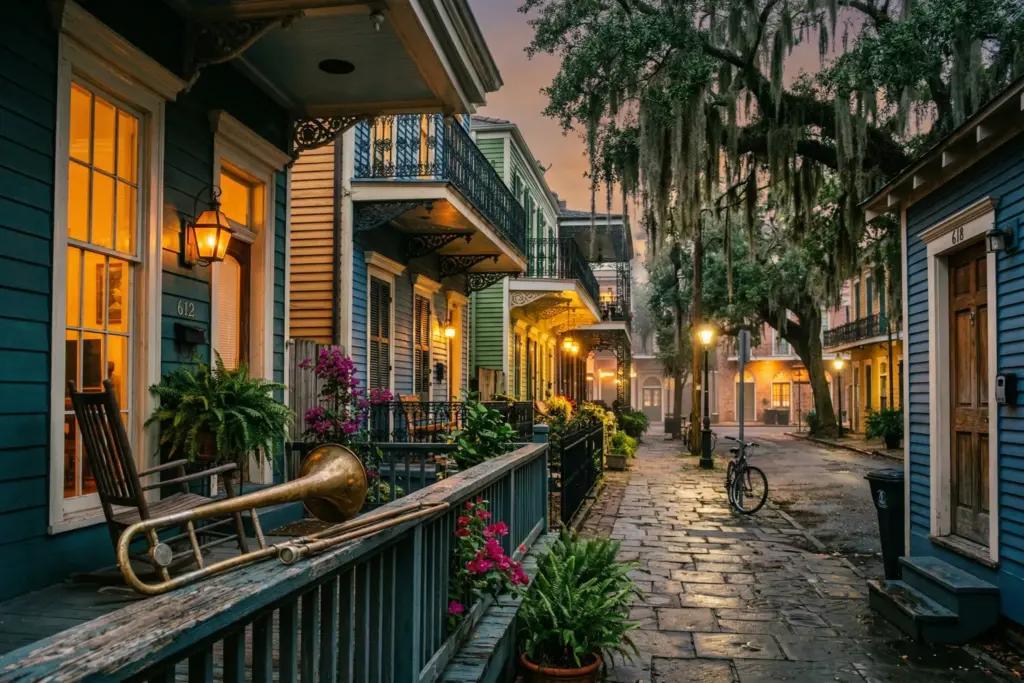
On a warm February evening in the Tremé, the oldest African American neighborhood in the country, you can hear a brass band warming up three blocks away. The sound floats through shotgun houses and over wrought-iron balconies, past front porches where neighbors wave at people they have known for decades. Down the street, a couple from Chicago rolls a suitcase toward a freshly painted double with a digital lockbox on the door. Both of these scenes are happening on the same block. And in New Orleans, that proximity is the whole story.
This city lives and breathes tourism. Roughly 20 million visitors come through each year, drawn by the food, the music, the architecture, and a cultural identity that exists nowhere else in America. Short-term rentals are woven into that fabric. But so is the tension between what visitors need and what residents can afford. Bienvenidos a Nueva Orleans, welcome to a market that rewards investors who understand not just the numbers, but the place.
Here is what the data actually shows.
New Orleans STR Market Data: The Numbers Behind the Music
StaySTRA data tracks 5,384 active short-term rental listings across New Orleans as of February 2026. The average daily rate sits at $472, occupancy at 43%, and RevPAR (revenue per available room) at $199. The average listing generates $5,557 per month in gross revenue.
Those top-line numbers tell one story. The distribution tells a richer one.
The median New Orleans STR brings in $3,767 per month, which works out to roughly $45,200 annually. That is a meaningful number for someone who owns the property outright. At the 75th percentile, monthly revenue jumps to $7,151 (about $85,800 per year). And the top 10% of listings are pulling in $12,145 per month, clearing six figures annually with room to spare.
But the bottom quartile? Those properties earn $1,947 per month at a 25% occupancy rate. In a city where permit compliance, insurance, and maintenance carry real costs, that margin can evaporate quickly.
Walking through those numbers, I keep coming back to the same thought: New Orleans is a market that pays generously if you operate well, and punishes you quietly if you do not.
Seasonality: When the City Comes Alive (and When It Doesn’t)
New Orleans is one of the most event-driven STR markets in the country, and the seasonal swings prove it.
March is king. StaySTRA data shows average monthly revenue of $5,772 at 64% occupancy during the peak Mardi Gras and early spring window. February follows at $5,429 and 55% occupancy, and April, when Jazz Fest brings 400,000 to 500,000 attendees to the Fair Grounds, averages $5,479 at 61% occupancy.
During Mardi Gras week itself, hotel occupancy across the city’s roughly 26,000 rooms hits 90%, and STRs run near capacity. Checking Airbnb during Fat Tuesday week reveals fewer than 150 available units across the entire city. That kind of compression is something most markets never experience.
Then there is August. Average monthly revenue drops to $3,823 at 47% occupancy. The heat is brutal, hurricane season looms, and visitors stay home. The gap between March and August is roughly $2,000 per month, a swing that investors need to plan around rather than be surprised by.
Other demand drivers beyond the big two include the Sugar Bowl (typically late December or early January), NFL Saints games, Essence Festival in July, and French Quarter Festival in April. Each creates a localized spike, but none rivals Mardi Gras or Jazz Fest for sustained multi-week pricing power.
The practical takeaway: about 55% to 60% of your annual New Orleans STR revenue concentrates in the five months from November through March. If your financial model cannot absorb a slow summer, this is not the right market for you.
Regulations: The Most Complex STR Rulebook in America
I have written about STR regulations in dozens of cities at this point. New Orleans is, without exaggeration, the most layered and contested regulatory environment I have encountered. Es complicado, as we say. It is complicated.
Short-term rentals were illegal in New Orleans until April 2017, when the city adopted its first permitting framework. Since then, the rules have been rewritten twice (2019 and 2023), challenged in federal court three separate times, and remain the subject of an active Airbnb lawsuit filed in February 2025.
The Two Permit Types
New Orleans issues two categories of STR licenses:
Non-Commercial STR Permits apply to residential zones. The operator must live on the property as their primary residence. You can rent out part of your home (spare rooms, a guest house, a converted half of a double) but you must physically live there. Each owner gets one permit. Only one permit is allowed per city square (a four-block area), and when multiple people apply, a lottery determines who gets the license. The 2026 lottery application window ran from March 8 through March 14, with the drawing on April 14. Annual fee: $500.
Commercial STR Permits apply to properties in non-residential zones (commercial corridors, mixed-use areas). These allow up to five guest bedrooms and ten guests per property, with the requirement that fewer than 25% of units in the building are licensed for short-term use. Annual fee: $1,000.
Where You Cannot Operate
The French Quarter is effectively off-limits. The city prohibits STRs throughout most of the Vieux Carré, with one narrow exception: the Vieux Carré Entertainment (VCE) district, which covers six blocks of Bourbon Street between Iberville and Orleans Streets. If you are picturing a quiet residential rental in the heart of the Quarter, that door is closed.
The Garden District carries similar restrictions. And across all residential neighborhoods, corporate entities are prohibited from holding STR permits, though the Fifth Circuit Court of Appeals recently struck down that particular provision as discriminatory against business entities that own homes.
The Platform Accountability Law
Starting in June 2025, New Orleans requires Airbnb, Vrbo, and other platforms to verify that every listing has a valid city-issued permit before allowing bookings. Platforms must also submit monthly data reports and delist any unpermitted properties. This is one of the strongest platform enforcement mechanisms in the country.
The results showed up fast. In August 2025, the city removed over 1,000 unlicensed listings from Airbnb alone. Total STR inventory dropped roughly 20% from early 2025 levels. Before that enforcement push, roughly 7,000 listings were active on Airbnb, but only about 2,500 held valid permits (approximately 1,350 in residential areas).
What Is Still Uncertain
Airbnb filed a federal lawsuit in February 2025 arguing the regulations violate property rights and that platforms should not be forced into enforcement roles. The case is ongoing. If the city prevails, the current framework solidifies. If Airbnb prevails, the City Council has signaled it may pursue a total STR ban rather than loosening restrictions.
At the state level, Louisiana does not have a preemption law protecting STR operators from local regulation. Bills SB 104 and HB 109 would prohibit local STR bans and expand lodging tax collection, but as of early 2026, neither has received a floor vote. The legislature convenes April 14, and Airbnb has two lobbyists working the issue.
The Investment Math: Entry Costs and Revenue Potential
One thing that sets New Orleans apart from other top-tier STR markets is the entry cost. The typical New Orleans home value sits at $236,136, with a median sale price of $287,250. Compare that to Miami ($586,000), Nashville ($440,000), or Key West (over $1 million), and the math looks different from the start.
A median-performing STR generating $45,200 annually against a $287,000 purchase price produces a gross yield of roughly 15.7% before expenses. Even after accounting for management, insurance, maintenance, taxes, and the seasonal revenue dip, that ratio is more favorable than most comparable markets.
But the yield only matters if you can get a permit. The lottery system, owner-occupancy requirement, and one-per-block cap mean you cannot simply buy a property and expect to operate it as a short-term rental. The permit is the bottleneck, not the property.
For the StaySTRA Airbnb Calculator for New Orleans, plug in your target property’s specifics to see revenue projections, comparable rental data, and ROI estimates based on actual booking data from the market.
A Market That Has Been Tightening for Years
The trend lines in New Orleans tell a story of a market consolidating around serious, permitted operators.
Active listings peaked at 6,296 in 2023. By 2024, the count had fallen to roughly 5,024 as the city’s regulatory enforcement intensified. The current 5,384 represents a slight recovery, but the trajectory is clear: the days of easy, unregulated Airbnb hosting in New Orleans are over.
Occupancy has followed its own path. In 2021, New Orleans STRs averaged 67.4% occupancy. By 2025, that number had dropped to roughly 44%. The ADR moved in the opposite direction, climbing from $257 in 2021 to $472 in early 2026. Fewer listings, lower occupancy, higher nightly rates. The market has traded volume for pricing power.
That pattern favors well-positioned properties. If you are operating a permitted, professionally managed listing in a desirable neighborhood (Marigny, Bywater, Mid-City, Uptown), you are likely capturing a larger share of a smaller pie. If you are trying to sneak an unlicensed listing past the platform verification system, the window for that is closing fast.
The Human Story: Who Hosts Here and What They Are Navigating
The data tells you what the market looks like. It does not tell you what it feels like to host in a city where the conversation about short-term rentals carries real weight.
The people I think about most are the ones who bought doubles in the Bywater or the Marigny ten years ago, lived in one half, and started renting the other half on Airbnb to cover the mortgage. That was the original promise of home-sharing in New Orleans: a way for working residents to stay in their neighborhoods as property taxes climbed and insurance costs spiked after Katrina.
Some of those hosts are still there. They know their guests’ names. They leave handwritten notes about where to get the best po’boys. They walk the thin line between hospitality and privacy, sharing their home with strangers because the economics of living in New Orleans demand creative solutions.
But the community cost has been real. In neighborhoods like the Tremé, Central City, St. Roch, and Hollygrove, roughly 24,000 residents were displaced over a three-and-a-half-year period according to local housing data. The city currently needs approximately 44,000 additional affordable rental units. More than 31,000 households spend over half their income on rent. Average one-bedroom rent in New Orleans has reached $1,838, climbing to $2,262 in the French Quarter and Warehouse District.
Comunidad (community) is not an abstraction here. It is the second line that needs enough neighbors to carry the parade. It is the Mardi Gras Indian who needs a neighborhood where they can practice their craft and pass it down.
In November 2024, New Orleans voters approved a charter amendment establishing a Housing Trust Fund, dedicating at least 2% of the city’s general fund (roughly $17 million starting in 2026) to affordable housing. It is a start. Whether it is enough to offset the pressures that tourism-driven economies create remains an open question.
What This Means for Investors in 2026
New Orleans rewards investors who treat it as a place, not just a portfolio line item. Here is the honest assessment:
The case for investing: Accessible entry costs ($236K typical home value), strong peak-season revenue ($5,772/month in March), a cultural tourism engine that never stops drawing visitors, and a tightening supply that benefits permitted operators. The platform verification system is essentially a moat around licensed hosts.
The case for caution: The permit system is genuinely restrictive. Owner-occupancy means you cannot run this remotely as a pure investment property in residential zones. The lawsuit outcome could reshape the entire framework. Summer revenue drops significantly. And the community dynamics require a host who is willing to be a neighbor, not just a landlord.
The investors who tend to succeed in New Orleans are the ones who live there, or who partner with someone who does. They understand that the Bywater feels different from Lakeview, that Mid-City guests want a different experience than French Quarter visitors, and that the regulatory landscape demands ongoing attention.
Where some see restriction, others see protection. The city’s tight permitting means your competition is capped. If you hold one of those permits, you have something that new entrants cannot easily replicate.
We do our best to keep our content accurate and up to date, but things change and we are only human. Always verify details directly with local sources before making decisions.
Frequently Asked Questions
What is the average Airbnb revenue in New Orleans in 2026?
StaySTRA data shows the average New Orleans short-term rental generates $5,557 per month in gross revenue as of early 2026. The median listing earns $3,767 per month (roughly $45,200 annually), while top-performing properties at the 75th percentile bring in $7,151 monthly. Revenue peaks in March during Mardi Gras season and drops to around $3,823 in August.
Can you operate a short-term rental in the French Quarter?
Short-term rentals are banned throughout most of the French Quarter. The only exception is the Vieux Carré Entertainment (VCE) district, which covers six blocks of Bourbon Street between Iberville and Orleans Streets. Outside that narrow corridor, STR permits are not available in the Quarter.
Do you have to live in your New Orleans Airbnb property?
For non-commercial STR permits in residential zones, yes. New Orleans requires the operator to live on the property as their primary residence. This owner-occupancy requirement is one of the strictest in the country. Commercial permits in non-residential zones do not carry the same residency mandate, but those properties must be in commercially zoned areas.
How does the New Orleans STR lottery system work?
Because residential zones only allow one STR permit per city square (a four-block area), the city runs a lottery when multiple applicants compete for the same zone. The 2026 application window ran from March 8 through March 14, with the lottery drawing on April 14. Applicants must meet all eligibility requirements before entering.
What are the best months for short-term rental revenue in New Orleans?
March is the highest-revenue month, averaging $5,772 at 64% occupancy, driven by Mardi Gras and the start of spring tourism. February ($5,429, 55% occupancy) and April ($5,479, 61% occupancy, boosted by Jazz Fest) round out the peak season. About 55% to 60% of annual revenue concentrates between November and March.
Run the Numbers for New Orleans
New Orleans is one of those cities where the investment case lives in the details. The StaySTRA Airbnb Calculator lets you plug in a specific property address and see projected revenue, occupancy, comparable listings, and ROI based on real booking data from the New Orleans market. Start with the numbers before you fall in love with the neighborhood.
For the full New Orleans market dashboard, including monthly trends, revenue distribution, and listing data, visit the StaySTRA New Orleans market page.
Become a StaySTRA Insider
Join free — get our newsletter + 1 free property analysis/month.
No spam. Unsubscribe anytime. Free membership includes property analyses and market insights.