

Key Takeaways
- Waterfront STR properties on the Lake Champlain Islands (Vermont side) averaged $319 per night in 2025, outpacing the Burlington urban market ($238 ADR) by 34% and ranking among the highest ADRs for inland lake markets in the Northeast.
- Burlington, VT leads Vermont’s STR market with approximately 50% occupancy and $3,280 in average monthly host revenue, but a primary residence requirement significantly limits the off-site investor buy box.
- Lake Champlain is a summer-first market, with July generating peak monthly revenues of nearly $6,000 on the islands; Stowe ski proximity (roughly 45 minutes from Burlington) supports winter demand for urban properties but does not transform island properties into year-round performers.
- The New York side of the lake (Clinton and Essex counties) offers lower entry prices and lighter regulations than Vermont, but thinner market depth and fewer comparable data points for underwriting.
- Supply on the Lake Champlain Islands grew 48% recently in a 37-listing micro-market, signaling early investor discovery before the market matures.
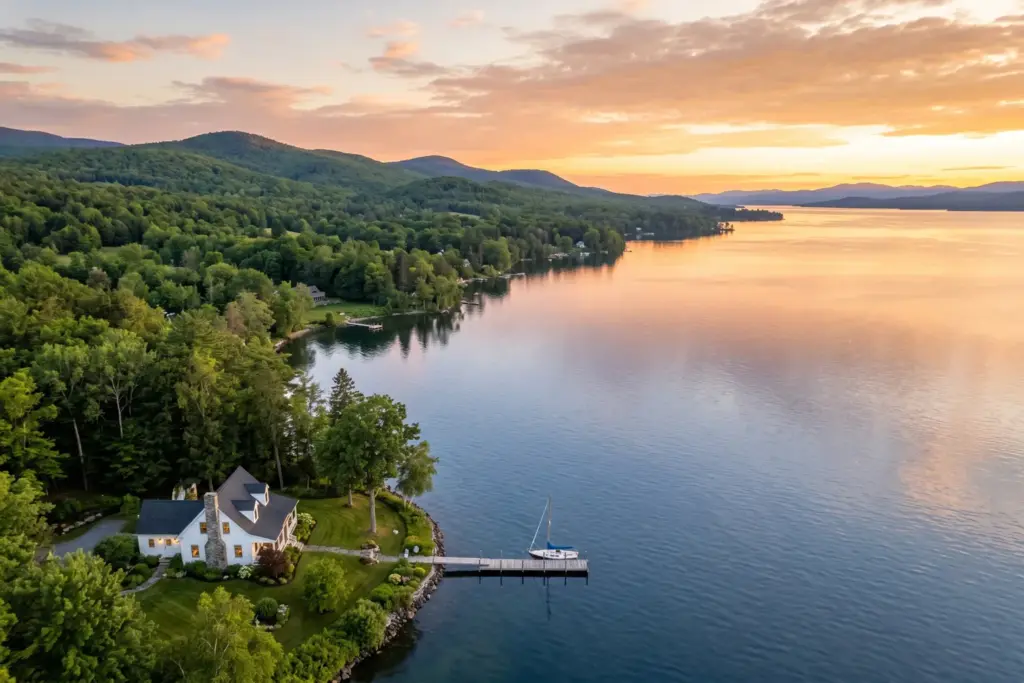
Waterfront STR properties on the Lake Champlain Islands averaged $319 per night in 2025. That is not a coastal market number. That is not a Stowe number. That is a lake market number, from a stretch of Vermont and New York that most STR data platforms have barely touched. It tells you something important before we go any further: Lake Champlain prices like a premium Northeast destination, not a second-tier inland alternative.
I have spent a lot of time at my desk here in Santa Fe looking at lake market data from across the country. Lake Tahoe, Lake Michigan, the Finger Lakes. What makes Lake Champlain analytically interesting is what I think of as the “two-menu problem.” Investors are choosing between two very different menus on the same lake: the Vermont side, which has stronger urban demand infrastructure but tighter regulations, and the New York side, which offers more regulatory freedom but less market depth. Both menus have real appeal. Neither is obviously right for every investor. Let me show you the numbers.
Sponsored — Beeline
Finance Your Next STR With a DSCR Loan
Qualify on property cash flow, not W-2 income. Beeline specializes in fast DSCR closings for STR investors. No personal income verification required.
Check Your DSCR Eligibility →Affiliate disclosure: StaySTRA may earn a referral fee.
The Market in Context: Why Lake Champlain Is Different
Lake Champlain stretches 120 miles from Whitehall, New York to the Canadian border, with the Vermont shoreline to the east and the New York Adirondack foothills to the west. Burlington anchors the market on the Vermont side; Plattsburgh serves as the gateway on the New York side. The lake is the sixth largest in the United States and, unlike most inland lakes, sits within reach of genuine four-season infrastructure: skiing at Stowe and Sugarbush to the east, Whiteface Mountain near Lake Placid to the west, spectacular fall foliage in October, and summer water access from late May through September.
This is also the first time StaySTRA has covered this market. It is the last major uncovered inland lake in the Northeast corridor. The data picture, when you piece it together, is one of a market that rewards patient capital and punishes lazy seasonality math.
Vermont Side: Burlington and the Islands
The Vermont side of Lake Champlain divides cleanly into two sub-markets. Burlington, the state’s largest city, anchors the urban segment with approximately 322 active STR listings, an average daily rate of $238, and roughly 50% occupancy. That works out to average monthly host revenue of about $3,280 and annual revenue in the $39,000 range. Burlington leads Vermont’s STR market in both depth and occupancy stability.
Think of Burlington’s occupancy rate like a seat in a university lecture hall: it fills up reliably because there are always reasons to be there, not just in summer. The University of Vermont, a busy medical center, Stowe proximity, and a walkable downtown create year-round demand that pure leisure markets do not have. That is a meaningful floor for any cash flow analysis.
| Metric | Burlington VT (Urban) | Lake Champlain Islands (VT) |
|---|---|---|
| Average Daily Rate | $238 | $319 |
| Annual Occupancy | ~50% | ~39% |
| Monthly Revenue (avg) | $3,280 | $1,939 |
| Peak Monthly Revenue | $4,500-$5,500 (est.) | $5,992 (July) |
| Active Listings | ~322 | ~37 |
| RevPAR | ~$119 | $136 |
| Primary Residence Restriction | Yes | No (unincorporated towns) |
The island segment is a different animal. North Hero, Grand Isle, and South Hero sit in Lake Champlain itself, connected to the Vermont mainland by bridges, and they function as a pure leisure destination. The 37 active listings there averaged $319 per night with a RevPAR of $136. Annual revenue averaged $23,269, which sounds modest until you look at the July number: $5,992 in a single month at 53% occupancy. Summer is doing most of the work, and doing it well.
Island supply grew 48% recently. In a 37-listing market, that represents a handful of new properties. But it signals investor discovery. Early movers are arriving before this micro-market becomes well-known, and in STR investing, being in the second wave rather than the fifth is where the math still holds.
Sponsored — Beeline
Finance Your Next STR With a DSCR Loan
Qualify on property cash flow, not W-2 income. Beeline specializes in fast DSCR closings for STR investors. No personal income verification required.
Check Your DSCR Eligibility →Affiliate disclosure: StaySTRA may earn a referral fee.
New York Side: Clinton and Essex Counties
The New York side of Lake Champlain is thinner in data and thinner in listings, but it carries two advantages that some investors find compelling: lighter regulation and lower acquisition costs.
Essex County and Clinton County, New York do not have Burlington’s primary residence requirement. New York State moved in 2025 to require county-level STR registries (effective September 2025) and directed platforms to collect the 4% state sales tax directly, but individual counties in the Adirondack North Country have largely avoided the restrictive local ordinances that complicate Burlington deals. Plattsburgh functions more as a gateway than a destination, but the waterfront communities south of Plattsburgh (Willsboro Point, Essex, Westport) offer genuine lakefront appeal at price points below Vermont.
The tradeoff is real. Fewer active listings means less comparable performance data to underwrite against. The market is less liquid, both for rentals and for future sale. Treat the NY side as a value-relative opportunity rather than a data-rich market. That distinction matters when you are putting a loan application together.
The Seasonality Deep Dive
Stay with me here, because the seasonal math is where Lake Champlain investors make or lose their underwriting case.
The lake’s primary revenue window is late June through Labor Day. July is the apex: island properties produced $5,992 in monthly revenue on average, with occupancy at 53%. August performs similarly. Fall foliage (October) creates a secondary shoulder with above-average ADR, as leaf-peeper demand from the Boston-to-Montreal corridor fills properties at premium rates.
| Season | Period | Island Occupancy (est.) | Island ADR Range (est.) | Notes |
|---|---|---|---|---|
| Peak Summer | July-August | 53-65% | $350-$500+ | Highest volume; waterfront premium active |
| Early Summer Shoulder | June | 40-50% | $280-$350 | Building to peak; strong weekend demand |
| Fall Foliage Shoulder | Late Sept-Oct | 35-45% | $300-$400 | Premium ADR; shorter stays |
| Off-Peak | November-March | 15-30% | $250-$319 | Ski proximity helps Burlington; islands slow |
Annual occupancy on the islands runs at 39.4%, meaning roughly 60% of nights go unbooked across the year. If you are modeling cash flow at 70% occupancy, the real data will break your spreadsheet. Don’t let that number scare you out of the market. It means you size your cash reserves for six slow months and plan your financing to match a seasonal income profile.
The Ski Proximity Question
Investors regularly ask: are Lake Champlain STR owners dual beneficiaries of ski proximity, or is this a summer-only market that happens to be near mountains?
The honest answer depends entirely on which side of the lake and which property type. Burlington urban properties benefit meaningfully from ski proximity. Stowe Mountain Resort is about 45 minutes from Burlington, and Sugarbush is not much farther. Burlington hosts see genuine winter weekend demand from ski visitors who prefer a city base over a mountain-town rental. The city’s year-round demand base (university, medical center, business travel) combines with ski-season weekends to keep Burlington occupancy above 40% even in winter.
Island properties are a different story. A North Hero cottage is charming in July. In January, it is cold, isolated, and difficult to justify for a ski visitor who would rather stay in Stowe or base in Burlington. Island properties should be modeled as summer-primary with a fall foliage bonus, full stop. Ski proximity is not a meaningful revenue driver for waterfront island properties.
On the New York side, Whiteface Mountain and Lake Placid are approximately 90 minutes from Plattsburgh, which is too far for convenient ski-base positioning. The NY side is even more firmly a summer market.
Sponsored — Beeline
Finance Your Next STR With a DSCR Loan
Qualify on property cash flow, not W-2 income. Beeline specializes in fast DSCR closings for STR investors. No personal income verification required.
Check Your DSCR Eligibility →Affiliate disclosure: StaySTRA may earn a referral fee.
Regulatory Landscape: Two States, Two Approaches
The regulatory difference between Vermont and New York is material for investors and deserves direct treatment.
Burlington, Vermont has the most restrictive framework on the lake. The city requires hosts to live on the same lot or in the same building as the STR. Narrow exceptions exist: seasonal homes qualify, and buildings with two or more units where the host occupies a qualifying unit may be eligible. But the intent is to limit investor-owned, owner-absent rentals in residential zones. Total tax burden in Burlington is 9%: 7% goes to the Burlington Housing Trust Fund and 2% to the general fund. Annual registration is required, one per host, and whole-unit STRs must pass inspection.
For investors considering Burlington, this is not news to bury in a footnote. It is the central fact of the market. An off-site investor buying a Burlington condo purely for STR income faces genuine legal friction. The buy box narrows to seasonal properties, qualifying multi-unit buildings, or accepting that you may need to occupy the property part of the year.
Vermont’s island communities (North Hero, Grand Isle, South Hero) operate under town-level oversight without Burlington’s primary residence rules. The investor entry point on the islands is cleaner from a regulatory standpoint, which partly explains the recent supply growth there.
New York’s Clinton and Essex counties moved to a county registry model in fall 2025, in line with the state’s push for local oversight. But the counties have not layered on the primary-residence restrictions that define Burlington. New York State platforms now collect the 4% state sales tax directly. Local occupancy taxes vary by municipality but tend to be modest. For investors who want a lighter-touch regulatory environment on the same lake, the NY side offers that.
How Lake Champlain Compares to Regional Markets
StaySTRA has covered three comparable Sprint 3 markets recently: Stowe Vermont, the Adirondacks New York, and the White Mountains New Hampshire. Lake Champlain sits in an interesting position relative to each.
Stowe is the premium four-season play in the Vermont universe, with ski-first economics and a village ecosystem that commands higher entry prices and higher ADR during ski season. Stowe outperforms Lake Champlain in winter revenue. Lake Champlain outperforms Stowe on summer waterfront premium for island properties. They serve different investor profiles: Stowe suits the investor who wants ski-season income as the anchor; Lake Champlain suits the investor who wants summer water access as the anchor.
The Adirondacks, on the New York side, is a wilderness-and-lake market with broader geographic footprint and a lower ADR ceiling than Lake Champlain waterfront. The Adirondacks market is deeper in listings and has more transaction history. Lake Champlain, especially the islands, is thinner and less mature. Mature markets give you better data; thinner markets give you earlier-mover pricing advantages if you underwrite carefully.
The White Mountains of New Hampshire compete for the same Boston-to-Quebec leisure traveler but are mountain-centric rather than lake-centric. They are not direct substitutes for Lake Champlain. Think of them as serving adjacent demand pools that occasionally overlap.
If you are financing with a DSCR loan, understanding where your property fits on this spectrum matters for income documentation. The StaySTRA DSCR Financing Guide covers how lenders underwrite seasonal lake and mountain markets, and what income evidence looks like when revenue is concentrated in a three-month peak window.
The Buy Box: What the Numbers Point Toward
Sponsored — Beeline
Finance Your Next STR With a DSCR Loan
Qualify on property cash flow, not W-2 income. Beeline specializes in fast DSCR closings for STR investors. No personal income verification required.
Check Your DSCR Eligibility →Affiliate disclosure: StaySTRA may earn a referral fee.
For investors building a Lake Champlain thesis, here is how the buy box stacks up based on available market data:
| Property Type | Location | Entry Price (est.) | Annual Revenue (est.) | Key Risk |
|---|---|---|---|---|
| Waterfront cottage (3BR+) | VT Islands | $500,000+ | $23,000-$40,000 | Seasonal vacancy; no ski floor |
| Urban condo (1-2BR) | Burlington VT | $200,000-$400,000 | $28,000-$40,000 | Primary residence restriction |
| Waterfront home (3-4BR) | NY side | $300,000-$600,000 | Limited comp data | Thin market; less liquidity |
The strongest DSCR case on the lake right now is the island waterfront cottage, for one specific reason: the ADR premium ($319+ average, waterfront peak $400-$500+) combined with summer demand compression gives lenders a defensible income story. The challenge is seasonal concentration. Lenders will want 12 months of actual income history or, for new purchases, conservative seasonal adjustment assumptions. Run your specific address through the StaySTRA Analyzer before you commit to an offer price.
Frequently Asked Questions
What is the average daily rate for short-term rentals on Lake Champlain?
Waterfront properties on the Lake Champlain Islands (Vermont side) averaged $319 per night in 2025. Burlington urban STRs averaged $238 per night. New York side properties vary, but generally track below Vermont island pricing given lower demand density. Premium waterfront properties with private beaches or boat docks reach $400 to $500 per night during July and August peak season.
Can I buy a short-term rental in Burlington, Vermont as an off-site investor?
Burlington’s STR ordinance includes a primary residence requirement for most properties, meaning you generally must live on the same lot or in the same building as your rental. Exceptions exist for seasonal properties and some multi-unit buildings. Off-site investors should review Burlington’s Chapter 18 ordinance and consult local legal counsel before purchasing. The Lake Champlain Islands (North Hero, Grand Isle, South Hero) do not have Burlington’s primary residence restriction and represent a cleaner off-site investor option on the Vermont side of the lake.
Is Lake Champlain a year-round STR market or seasonal?
Lake Champlain is primarily a seasonal market with summer (June through August) generating the majority of annual revenue. Fall foliage in October creates a secondary shoulder season with above-average ADR. Island properties see significant vacancy from November through April. Burlington urban properties benefit from Stowe ski proximity and year-round city demand, which provides a more stable occupancy floor even in winter months, typically above 40%.
How does the Vermont side compare to the New York side for STR investing?
Vermont offers more market depth, better data, and a stronger urban demand anchor in Burlington, but carries more regulatory complexity, including Burlington’s primary residence requirement. New York’s Clinton and Essex counties have lighter regulations and lower entry prices, but thinner listing density and less transaction data for underwriting purposes. Both sides can support an investment strategy depending on your risk profile, financing approach, and target revenue model.
What are the tax obligations for Lake Champlain STR hosts?
Burlington, Vermont hosts pay a 9% local tax (7% to the Burlington Housing Trust Fund, 2% to general funds) plus Vermont’s state rooms and meals tax. Island properties in unincorporated Vermont towns pay state tax without Burlington’s local layer. New York side hosts pay 4% state sales tax, which platforms collect directly since March 2025, plus applicable local occupancy taxes which vary by municipality. Both states require registration under their respective county or state STR registry frameworks.
Run Your Lake Champlain Numbers
The data in this article gives you the market frame. Whether a specific property pencils out depends on its exact location, bedroom count, waterfront access, and acquisition price. Run the specific address through the StaySTRA Analyzer for a property-level projection before you make an offer.
If you are financing with a DSCR loan, the StaySTRA DSCR Financing Guide covers how lenders treat seasonal lake market income, what qualifying rent calculations look like, and which lenders are actively closing on Northeast lake properties in 2026.
Become a StaySTRA Insider
Join free — get our newsletter + 1 free property analysis/month.
No spam. Unsubscribe anytime. Free membership includes property analyses and market insights.
We do our best to keep our data accurate and up to date, but markets move fast and we are only human. Always verify current figures directly with local sources before making investment decisions.