

Key Takeaways
- Hoboken has roughly 300 Airbnb listings available for World Cup weekends in June 2026, and the city has no formal short-term rental ordinance on the books.
- City council members are drafting regulations that would ban STRs in rent-controlled apartments and impose hotel taxes on platforms like Airbnb and Vrbo.
- Nearby Kearny, NJ expanded its STR ban to multifamily homes in February 2026, while Union City, Weehawken, and West New York already prohibit short-term rentals entirely.
- StaySTRA data for the Jersey City metro shows an average daily rate of $251.69 and 72.4% occupancy, numbers that could climb sharply during World Cup match weeks.
- New Jersey expects over 1.2 million visitors for the tournament, with MetLife Stadium hosting eight games including the final on July 19.
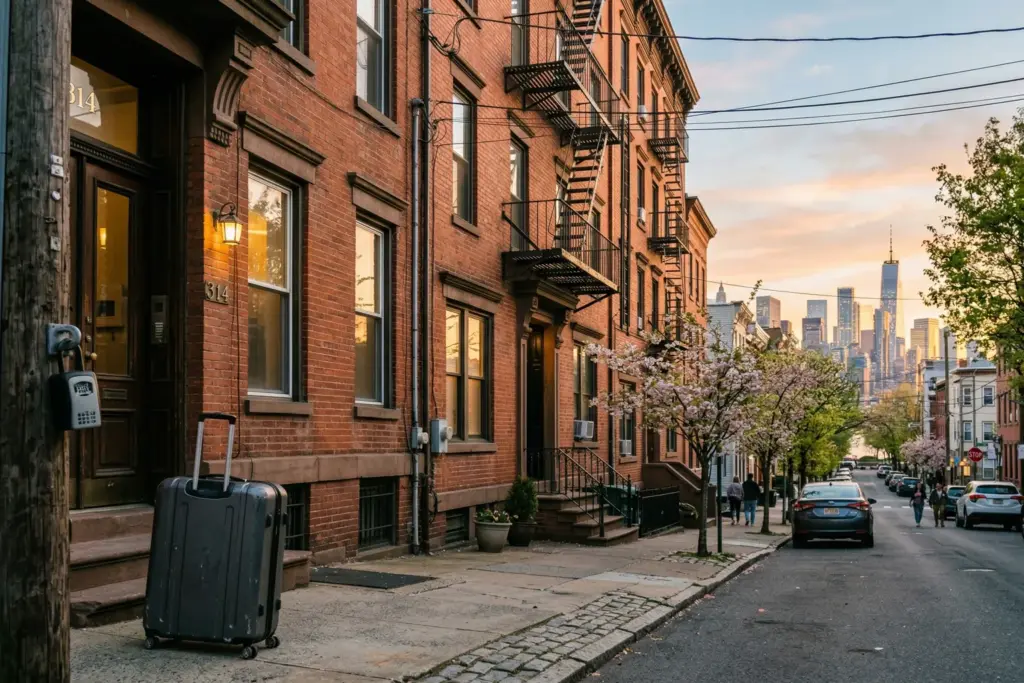
On a warm Friday evening in early April, the hallway of a six-story walkup on Washington Street in Hoboken smelled like someone else’s cologne. A rolling suitcase bumped against the stairwell walls. Two men in matching Brazil jerseys fumbled with a lockbox on the third floor.
Down the hall, a woman who has lived in the building for nine years watched through her peephole. “Vecinos nuevos cada fin de semana,” she told me later. New neighbors every weekend. She asked me not to use her name because her lease is up in August and she does not want to give her landlord a reason.
This is the sound of Hoboken in the spring of 2026. With the FIFA World Cup arriving at MetLife Stadium in East Rutherford this June, the small, dense city across the Hudson from Manhattan is living through a transformation that nobody voted for and everybody has an opinion about.
A City Without Rules for Short-Term Rentals
Hoboken is 1.25 square miles. About 60,000 people live here, and roughly 66% of them are renters. The average apartment goes for $4,560 a month. The vacancy rate sits at 9.63%. It is, by almost every measure, a tight housing market where every unit matters.
And right now, there are no formal rules governing short-term rentals.
“We don’t regulate it. So there’s no real clear rules,” Councilman Joe Quintero told CBS New York. He put it more bluntly to Gothamist: “The reality is that these short-term rentals are going to happen and so what we want to do is take this market out of the gray zone.”
That gray zone has been Hoboken’s default for years. While New York City cracked down with Local Law 18 (requiring hosts to register and be present during stays), and while neighboring New Jersey towns built their own walls, Hoboken simply never wrote the rules. No permit system. No registration. No cap on the number of nights a unit can be rented. If you own a condo or your lease does not explicitly prohibit it, you can list your place on Airbnb tonight.
The World Cup changed the math on that silence.
Eight Games, 1.2 Million Visitors, and 300 Listings
MetLife Stadium will host eight FIFA World Cup matches between June 13 and July 19, 2026. The lineup includes heavyweight group-stage games (Brazil vs. Morocco, France vs. Senegal, Ecuador vs. Germany, Panama vs. England), a Round of 32 match, a Round of 16 match, and the final itself on July 19. The stadium holds over 82,000 fans. New Jersey officials project more than 1.2 million visitors statewide during the monthlong tournament.
As of April 2026, roughly 300 homes in Hoboken are listed on Airbnb for weekends in June. CBS New York reported a 500% increase in bookings in New Jersey towns near MetLife Stadium for the final weekend alone. Airbnb says about 75% of available listings in the New Jersey area are priced under $500 per night, though premium properties are pushing well past that. Hotels in the region are quoting $200 to $8,500 per night for match days.
StaySTRA data for the Jersey City metro (Hoboken’s immediate neighbor across the same transit lines) tells the baseline story: an average daily rate of $251.69, occupancy at 72.4%, and average monthly revenue of $3,227 across 2,287 active listings. Those numbers reflect a normal market. What is coming in June and July is not a normal market.
For hosts weighing whether to enter this market, StaySTRA’s free Airbnb calculator can project what a specific property might earn during event periods like the World Cup.
The People Who Live There
Walking through Hoboken’s residential blocks in the weeks before the tournament, I kept hearing the same worry from different people. Not anger, exactly. Something quieter. La inquietud, maybe. The unease of watching your building become something else.
Let’s call her Maria. She lives on Washington Street and has been in her apartment for nine years. Her neighbor’s unit has been listed on Airbnb since February. “He moved in with his girlfriend in Jersey City and just turned it into a hotel room,” she told me. The building has thin walls. She hears the lockbox click open on Thursday evenings. She hears the suitcase wheels on Sunday mornings. She does not know who is sleeping fifteen feet from her kitchen.
Cheryl Fallick, an affordable housing advocate with the Hoboken Fair Housing Association, framed it in starker terms. “We have a serious problem with displacement in Hoboken,” she told Gothamist. “These so-called guardrails don’t change the reality that people don’t want strangers cycling through their buildings.”
That word, “strangers,” came up in almost every conversation I had with long-term renters. It is not about xenophobia or hostility toward soccer fans. It is about the texture of daily life in a building where you know your neighbors, where you hold the door, where somebody watches your cat when you visit your mom in Bayonne. When that apartment down the hall becomes a revolving door, something changes that no tax revenue can replace.
The Hosts Who Are Making the Bet
On the other side of the equation are the property owners doing the math. And the math is compelling.
Bobby Roufaeal, who manages short-term rentals in New Jersey, told Fortune that a luxury rental in the state could bring in $240,000 between June 11 and July 19. That is an extreme case. But even modest projections suggest a two-bedroom Hoboken apartment that normally rents for $4,500 a month could clear $8,000 to $12,000 in a single month of World Cup bookings.
Airbnb is fueling the supply side with a $750 cash bonus for first-time hosts in World Cup cities who complete a reservation by the end of July. Deloitte projects that hosts in the New York/New Jersey metro will earn an average of $5,700 each across the tournament period.
Let’s call him Daniel. He owns a Hoboken condo and asked to remain anonymous because his HOA has not taken a formal position on short-term rentals. He described his decision to list as “guilt money.” He is renting out his unit for six weeks while he stays with his parents in Montclair. “I know it changes things for the building,” he said. “But the tournament is going to happen whether I list or not. Alguien lo va a hacer.” Someone is going to do it.
That fatalism is its own kind of honesty. When the incentive is this large and the rules are this absent, individual restraint becomes a losing strategy. The people who hold back simply watch their neighbors collect the money.
What the Council Is Trying to Do
Hoboken’s city council is not standing still, but it is moving carefully. Councilman Paul Presinzano told Patch that “we have had some preliminary discussions” but that “there are many issues the committee want to address before rolling out patchwork legislation.” Mayor Emily Jabbour has deferred STR policy questions to Quintero and the council.
The emerging framework, according to Gothamist, would borrow from Jersey City’s approach: require owner permits, explicitly prohibit rent-controlled apartments from being used as short-term rentals, and impose a hotel-style tax on Airbnb, Vrbo, and similar platforms. New Jersey already levies state taxes on STRs (6.625% sales tax plus a 5% state occupancy fee), and municipalities can add up to 3% more, bringing the combined rate to as high as 14.625%.
The question is timing. The World Cup starts June 13. April legislation has maybe eight weeks to become enforceable policy. Council members I spoke with off the record acknowledged that whatever passes will likely take effect after the tournament’s peak, making these regulations more of a long-term framework than a World Cup intervention.
For investors monitoring how cities respond to event-driven STR surges, this pattern is worth studying. We recently covered what happens when cities move to ban Airbnb, and the Hoboken story is the chapter just before that one: the scramble to write rules while the market is already running.
The Neighbors Who Already Said No
Hoboken is not operating in a vacuum. Just a few miles away, the towns surrounding MetLife Stadium have taken the opposite approach.
Kearny expanded its STR ban to multifamily homes on February 24, 2026, adding to an existing prohibition on single-family short-term rentals. The penalties are serious: up to $750 and 10 days in jail for a first offense, escalating to $2,000 and 30 days for repeat violations. The ordinance cited concerns about “increased traffic, noise, high occupant turnover and increased density.”
Union City, Weehawken, and West New York already prohibit short-term rentals outright. Secaucus (the town immediately adjacent to MetLife Stadium) is imposing strict limits. Even Guttenberg, a tiny municipality along the Hudson, requires that STRs operate only in owner-occupied buildings with a cap of two units per owner.
The result is a patchwork that pushes demand toward the places with the fewest restrictions. Right now, that place is Hoboken.
This is a pattern we have seen across every World Cup host region. Cities that regulate early push STR activity into neighboring jurisdictions that have not. The demand does not disappear. It migrates. Hoboken is living proof.
The Bigger Pattern
Every World Cup host city is wrestling with some version of this story. Boston is fighting off Airbnb’s lobbying for a special event exemption. Dallas hosts are tripling their rates. Miami’s STR market is pivoting entirely around match-week pricing.
But Hoboken’s version is uniquely compressed. This is not a sprawling metro where STR growth can spread across suburbs and exurbs. This is 1.25 square miles of six-story walkups, corner bodegas, and PATH trains. When 300 apartments become short-term rentals in a city this small, everybody feels it. Your building feels it. Your hallway feels it.
The tension is not between good people and bad people. It is between two legitimate needs that occupy the same physical space. Long-term renters need stability, predictability, the comfort of knowing who lives next door. Property owners need the freedom to maximize the value of what they own. Neither side is wrong. But in a city where two-thirds of residents are renters, the question of whose need comes first is not academic. It is deeply personal.
Comunidad is not just a Spanish word for community. It is a way of describing what happens when people share walls, share stairwells, share the thin line between private life and public noise. What Hoboken is negotiating right now is whether that comunidad can survive a six-week gold rush.
Sponsored — OfferMarket
Buy Your First STR With Long-Term Rental Financing
Flexible, long-term financing for short-term rental buyers. Rates from 5.75%. Instant online quote, no credit pull.
Explore RTL Financing Options →Affiliate disclosure: StaySTRA may earn a referral fee.
We do our best to keep our content accurate and up to date, but things change and we are only human. Always verify details directly with local sources before making decisions.
Frequently Asked Questions
Does Hoboken NJ allow Airbnb and short-term rentals?
As of April 2026, Hoboken has no formal ordinance regulating short-term rentals. Property owners can list units on Airbnb, Vrbo, and similar platforms without a permit or registration. The city council is actively working on new legislation that would require permits and prohibit STRs in rent-controlled apartments.
How many World Cup games will be played at MetLife Stadium in 2026?
MetLife Stadium in East Rutherford, New Jersey will host eight FIFA World Cup 2026 matches. These include five group-stage games featuring teams like Brazil, France, Germany, and England, plus a Round of 32 match, a Round of 16 match, and the World Cup Final on July 19, 2026.
What taxes apply to short-term rentals in Hoboken NJ?
Short-term rentals in Hoboken are subject to New Jersey’s state sales tax (6.625%), a state occupancy fee (5%), and a potential municipal occupancy tax (up to 3%). The combined tax rate can reach 14.625%. The city council is also considering an additional hotel-style tax on STR platforms.
How much can Airbnb hosts earn in Hoboken during the World Cup?
Deloitte projects that hosts in the New York/New Jersey metro will earn an average of $5,700 each across the tournament. About 75% of NJ listings are priced under $500 per night. A typical two-bedroom Hoboken apartment could earn significantly more than its $4,560 monthly rent during peak match weeks in June and July 2026.
Which New Jersey towns have banned short-term rentals ahead of the World Cup?
Several NJ municipalities near MetLife Stadium have restricted or banned STRs. Kearny expanded its ban to multifamily homes in February 2026. Union City, Weehawken, and West New York prohibit short-term rentals outright. Secaucus is imposing strict limits. These bans are pushing rental demand toward cities like Hoboken that have not yet regulated.
Wondering what a short-term rental could earn in the New York/New Jersey metro? Run a free analysis on the StaySTRA Airbnb Calculator to see projected revenue for any address, or explore the Jersey City STR market data for the latest performance benchmarks.
Become a StaySTRA Insider
Join free — get our newsletter + 1 free property analysis/month.
No spam. Unsubscribe anytime. Free membership includes property analyses and market insights.