

Key Takeaways
- StaySTRA tracks 8,940 active short-term rentals in Gulf Shores and 7,514 in neighboring Orange Beach, forming a combined corridor of over 16,400 listings along Alabama’s Gulf Coast.
- Gulf Shores STRs average $305 per night (LTM) with 61.3% occupancy and $4,606 in monthly revenue. Orange Beach runs higher at $357 ADR and $5,405 monthly revenue.
- Seasonality is extreme: June revenue in Gulf Shores tops $9,800 per month while January drops to $1,374, concentrating roughly 60% of annual income into a 14-week summer window.
- Gulf Shores requires a $500 business license, safety inspections, and $1 million in liability insurance. Alabama lacks a settled statewide STR preemption law, meaning local regulations could tighten without state protection.
- Compared to Destin ($348 ADR, $5,488/mo) and Panama City Beach ($276 ADR, $3,803/mo), Gulf Shores sits in the middle on revenue but offers lower entry costs at a $442,911 median home value.
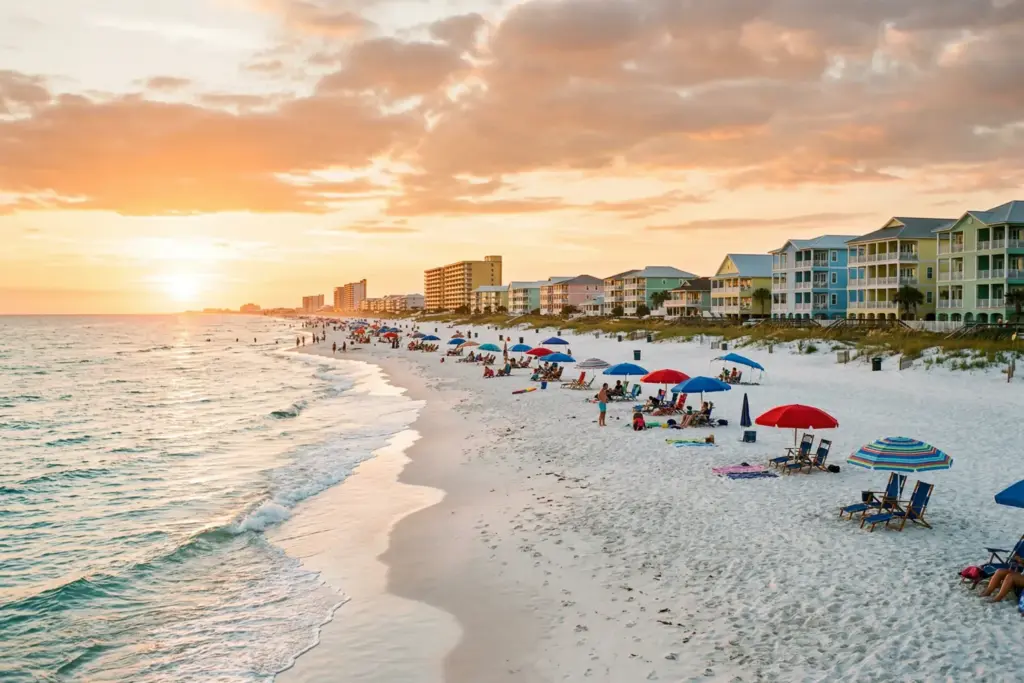
On a warm Friday evening in late May, the bridge into Gulf Shores starts to back up. Pickup trucks with kayaks strapped to the roof. Minivans packed tight with coolers, boogie boards, and three generations of one family heading south together. You can see the anticipation through the windshields. Ya casi llegamos, the kids in the back seat are probably hearing from their abuelas. We’re almost there.
This is what Gulf Shores has always been. Not a glamorous resort destination. Not a spring break party strip. A place where people from Birmingham, Atlanta, Memphis, and Jackson have been coming back to the same stretch of white sand for decades. And for a growing number of short-term rental investors, that loyalty is the entire thesis.
StaySTRA data tells the story in numbers. Gulf Shores currently has 8,940 active short-term rental listings, and neighboring Orange Beach adds another 7,514. Together, this corridor along Alabama’s Baldwin County coast forms one of the largest vacation rental markets in the Southeast, with over 16,400 properties competing for roughly 8 million annual visitors.
But the numbers only tell you what is happening. To understand why this market works the way it does, you have to understand the people who built it.
Gulf Shores STR Market Data: Revenue, Occupancy, and What the Numbers Actually Say
StaySTRA tracks Gulf Shores at a last-twelve-months ADR of $305 and an occupancy rate of 61.3%. That translates to $4,606 in average monthly revenue per listing. For a beach market drawing 8 million visitors annually, those numbers might look modest at first glance. They are not.
The story is in the seasonality. Gulf Shores is a summer market in the truest sense. June revenue hits $9,833 per listing with 92.9% occupancy and a $408 nightly rate. July follows closely at $9,336 with 90.3% occupancy. These two months alone can generate nearly $19,200 in revenue, which is more than four months of winter combined.
Here is the full monthly breakdown from StaySTRA data:
| Month | ADR | Occupancy | Monthly Revenue |
|---|---|---|---|
| June | $408 | 92.9% | $9,833 |
| July | $386 | 90.3% | $9,336 |
| May | $370 | 69.0% | $6,649 |
| March | $300 | 64.5% | $4,865 |
| April | $303 | 56.7% | $4,453 |
| October | $274 | 58.1% | $4,161 |
| August | $322 | 56.5% | $4,952 |
| September | $276 | 53.3% | $3,782 |
| February | $247 | 53.6% | $2,415 |
| November | $258 | 30.0% | $2,164 |
| December | $253 | 22.6% | $1,618 |
| January | $253 | 25.0% | $1,374 |
That peak-to-trough swing is dramatic. June revenue ($9,833) is more than seven times January revenue ($1,374). Investors who underwrite Gulf Shores properties using annualized averages without stress-testing the winter months are setting themselves up for cash flow surprises. Your mortgage, insurance, and HOA fees do not take December off.
Orange Beach: The Other Half of Alabama’s Coastal Corridor
You cannot talk about Gulf Shores without talking about Orange Beach. The two cities share a coastline, a tourism board, and an audience. But the STR economics are different enough to matter.
StaySTRA data shows Orange Beach running a $357 LTM ADR with 63.3% occupancy and $5,405 in average monthly revenue. That is $800 per month more than Gulf Shores, driven primarily by a higher concentration of larger, newer properties along the beachfront.
Orange Beach’s monthly data tells a similar seasonal story but at a higher price point:
| Month | ADR | Occupancy | Monthly Revenue |
|---|---|---|---|
| June | $506 | 92.3% | $12,124 |
| July | $457 | 90.3% | $11,021 |
| May | $438 | 73.9% | $8,418 |
| March | $355 | 64.5% | $5,466 |
| October | $325 | 61.3% | $5,064 |
| January | $303 | 25.8% | $1,510 |
Orange Beach peaks at $12,124 in June. That is a number that gets investors’ attention. But the winter trough is just as real: January drops to $1,510 despite a higher nightly rate, because occupancy craters to 25.8%.
The combined corridor gives investors optionality. Gulf Shores offers lower entry costs (median home value $442,911 versus roughly $705,000 in Orange Beach) and stronger value positioning for budget-conscious guests. Orange Beach commands premium rates and attracts guests willing to pay more for newer beachfront condos and larger rental homes.
The Large-Group Premium: Why 4+ Bedroom Properties Dominate
Walking through the listing data for Gulf Shores, one pattern stands out immediately. The market is built around groups, not couples.
StaySTRA’s property breakdown shows 2-bedroom units as the most common configuration (3,183 listings), followed by 3-bedrooms (2,126). But the revenue story favors the larger properties. Gulf Shores has 924 four-bedroom listings and 868 with five or more bedrooms. Together, these 1,792 large-group properties represent about 20% of inventory but command significantly higher nightly rates and booking premiums during peak season.
This makes sense when you understand the guest profile. Gulf Shores is a multigenerational destination. La familia entera comes down together. Grandparents, parents, kids, cousins. A 6-bedroom beach house that sleeps 16 is not a luxury product here. It is the standard booking for a reunion, a graduation trip, or the annual summer week that everyone blocks off on their calendars in January.
In Orange Beach, 3-bedroom properties dominate the inventory (3,179 listings), reflecting the beachfront condo market. But the premium still goes to size. Larger homes that can accommodate extended groups consistently outperform on both nightly rate and total booking revenue during peak summer months.
For investors evaluating Gulf Shores, this is a meaningful insight. The 2-bedroom condo market is the most crowded (3,183 competing listings in Gulf Shores alone). The 4-5+ bedroom segment has less competition per listing and serves the guest type that defines this market.
Gulf Coast Market Comparison: How Gulf Shores Stacks Up
StaySTRA’s Gulf Coast STR Market Comparison provides the clearest context for where Gulf Shores sits among its peers.
| Market | Active Listings | LTM ADR | Occupancy | Monthly Revenue | Median Home Value |
|---|---|---|---|---|---|
| Destin, FL | 3,599 | $348 | 66.7% | $5,488 | $582,612 |
| Gulf Shores, AL | 5,182 | $305 | 61.3% | $4,606 | $442,911 |
| Panama City Beach, FL | 12,244 | $276 | 57.7% | $3,803 | $407,797 |
| South Padre Island, TX | 2,939 | $281 | 50.0% | $3,375 | $434,032 |
| Galveston, TX | 5,320 | $270 | 44.0% | $2,960 | $313,946 |
Gulf Shores sits second in the Gulf Coast hierarchy by revenue, trailing only Destin. But look at entry costs. Destin’s median home value is $582,612, nearly $140,000 more than Gulf Shores. On a revenue-to-price ratio, Gulf Shores closes the gap considerably.
Panama City Beach has more than twice the listing count (12,244) but generates $800 less per month in average revenue. That supply density matters. PCB is a market where individual listings compete against a massive pool. Gulf Shores, with roughly 5,200 listings in the comparison dataset (the location page tracks 8,940 including the broader area), faces less per-listing competition relative to its demand base.
The comparison that matters most to investors: Destin operates under Walton County’s permit requirements and Florida’s increasingly complex STR regulatory landscape. Gulf Shores operates under Alabama rules. Until recently, that meant fewer regulatory headaches. Whether that advantage holds depends on what Alabama’s legislature does next.
Gulf Shores STR Regulations: What Investors Need to Know
Regulation is where the Gulf Shores investment thesis gets complicated. And honestly, walking through the regulatory landscape here, I found myself thinking about how many investors skip this section entirely. Do not be one of them.
Gulf Shores Permit Requirements
The City of Gulf Shores requires every short-term rental to hold a business license. The initial application fee is $500, with a $300 annual renewal. The process includes review by the Revenue Department, Planning and Zoning for zoning compliance, and a Fire Marshal safety inspection.
Properties must maintain a minimum $1 million liability insurance policy. Occupancy limits follow a two-persons-per-bedroom-plus-two formula. Parking requirements mandate one off-street space per bedroom. These are enforced, not suggestions.
Not every zone in Gulf Shores permits short-term rentals. Before acquiring a property, verify the zoning designation through the City’s Rental License page. Properties in residential-only zones may be restricted or prohibited entirely.
Orange Beach Regulations
Orange Beach runs a parallel but distinct system. The city requires a $500 business license and mandates a local property manager available at all times. In 2018, Orange Beach enacted a moratorium on new short-term rentals in RS-1 zoned areas (traditional residential neighborhoods). This effectively froze STR growth in those zones.
If you are looking at an Orange Beach property, the zoning question is not optional. RS-1 properties acquired after the moratorium cannot operate as vacation rentals. Contact the Orange Beach Planning and Zoning Department (251-981-2610) before making any offer.
Alabama’s State-Level Regulatory Risk
Here is where Gulf Shores investors face a risk that does not exist in states like Idaho, Indiana, or Arizona (which have all passed some form of STR preemption in recent years).
Alabama does not have a settled statewide preemption framework for short-term rentals. Pending state legislation (SB 104 and HB 109) would prohibit local governments from outright banning STRs while expanding lodging tax authority. But as of early 2026, these bills have had hearings without floor votes. The legislature remains in session, and the outcome is uncertain.
What this means practically: Gulf Shores, Orange Beach, or Baldwin County could enact new restrictions, moratoriums, or permit caps without needing state approval. Orange Beach already demonstrated this willingness with its 2018 RS-1 freeze. There is no state-level backstop preventing a city from doing more.
Compare this to Florida, where the state preemption law (even with its recent modifications) provides a baseline of protection for existing STR operations. Or to Idaho, where HB 583 prevents municipalities from banning STRs that comply with state standards. Alabama investors carry regulatory risk that their peers in neighboring states do not.
This is not a reason to avoid Gulf Shores. It is a reason to factor regulatory uncertainty into your underwriting and to stay engaged with local politics. El que no arriesga, no gana, as my father used to say. But you should know what you are risking.
Lodging Taxes
The combined lodging tax burden in Gulf Shores ranges from 13% to 15% depending on exact location. This includes the 4% Alabama state lodging tax, 2% Baldwin County lodging tax, and the City of Gulf Shores lodging tax (7% within city limits, 3.5% in the police jurisdiction). Factor these into your revenue projections.
The Seasonal Equation: Making the Math Work Year-Round
The hardest conversation in Gulf Shores investing is the winter one. From November through February, occupancy drops below 30% and monthly revenue in Gulf Shores falls to the $1,374 to $2,415 range. That is four months where most properties are losing money on a monthly cash flow basis.
Successful Gulf Shores operators handle this in a few ways. Some pivot to medium-term rentals during the off-season, targeting snowbirds from the Midwest who want a cheap warm-weather escape for 30 to 60 days. Others accept the seasonal trough as the cost of doing business and structure their finances around the 14-week summer season generating 55 to 60% of their annual income.
The shoulder seasons (March through May, September through October) are where the difference between a good operator and a struggling one shows up. March revenue of $4,865 and May revenue of $6,649 show real demand during these windows. October holds at $4,161. An operator who prices aggressively and markets to fishing tournaments, fall festivals, and the annual National Shrimp Festival crowd can meaningfully extend the profitable season.
The booking window data supports advance planning. StaySTRA shows 67.7% of Gulf Shores properties are booked within the 1 to 3 month window, and 69.5% are booked 4 to 6 months out. By 7 to 9 months, bookings drop to 45.5%. Summer guests are booking in January and February. If your listing is not optimized and priced by New Year’s Day, you are already behind.
The Community Behind the Numbers
I have written about a lot of STR markets. Myrtle Beach, Key West, Breckenridge. Each has its own personality. But Gulf Shores feels different in a way that is hard to capture in a data table.
This is a market built by local hospitality, not by institutional investors. The property management companies that dominate here are not venture-backed startups. They are second and third-generation businesses that started by renting out a single beach house and grew alongside the town. Many of the most successful hosts in this market live within 30 minutes of their properties and treat guest relationships like neighborly obligations.
The guest base reflects this. Gulf Shores draws heavily from a 6-hour drive radius: Alabama, Mississippi, Tennessee, Georgia, and the Florida Panhandle. These are repeat visitors. The group that came to Gulf Shores when the kids were small comes back when those kids have kids of their own. Vuelven cada verano, como las olas. They come back every summer, like the waves.
For investors, this repeat-visitor dynamic creates something valuable: predictable demand that is less sensitive to economic cycles than destination markets that depend on air travel. When a household in Birmingham decides to cut vacation spending, they do not cancel Gulf Shores. They downgrade from the 4-bedroom beachfront to the 2-bedroom a block back. The demand stays. It just moves around the inventory.
That resilience is the real competitive advantage of this market. Not the ADR. Not the occupancy rate. The fact that Gulf Shores is woven into the annual rhythm of millions of households across the Deep South.
We do our best to keep our content accurate and up to date, but things change and we are only human. Always verify details directly with local sources before making decisions.
Frequently Asked Questions
What is the average Airbnb revenue in Gulf Shores, Alabama?
StaySTRA data shows Gulf Shores short-term rentals averaging $4,606 per month in revenue over the last twelve months, with a $305 average daily rate and 61.3% occupancy. Revenue is heavily seasonal, peaking at $9,833 in June and dropping to $1,374 in January.
Do you need a permit to operate a short-term rental in Gulf Shores?
Yes. Gulf Shores requires a business license for every STR operating within city limits or the police jurisdiction. The initial application fee is $500 with a $300 annual renewal. Properties must pass zoning review, a Fire Marshal inspection, and maintain $1 million in liability insurance. Not all zones permit short-term rentals, so verify zoning before purchasing.
How does Gulf Shores compare to Destin for STR investment?
Destin leads with a $348 ADR and $5,488 monthly revenue versus Gulf Shores at $305 ADR and $4,606 monthly revenue. However, Gulf Shores offers a lower entry point (median home value $442,911 versus $582,612 for Destin). Gulf Shores also operates under Alabama regulations rather than Florida’s more complex STR regulatory framework, though Alabama lacks statewide preemption protections that some Florida operators rely on.
Does Alabama have a statewide STR preemption law?
As of early 2026, Alabama does not have a settled statewide preemption framework for short-term rentals. Pending bills (SB 104 and HB 109) would prohibit local STR bans while expanding lodging tax authority, but neither has received a floor vote. Cities like Gulf Shores and Orange Beach retain full authority to regulate, restrict, or cap short-term rental permits without state interference.
What is the best property type to invest in for Gulf Shores vacation rentals?
Gulf Shores is a multigenerational destination, which means larger properties (4 to 5+ bedrooms) command premium rates and serve the dominant guest type. The 2-bedroom condo segment is the most competitive with 3,183 listings in Gulf Shores. Properties that can accommodate extended groups of 10 or more guests tend to outperform on both nightly rate and total booking revenue during peak summer months.
Check Your Gulf Shores Numbers
Everything in this article is based on market averages. Your specific property, your location on the beach or three blocks back, your bedroom count, your management approach: all of these shift the math. StaySTRA’s free analyzer tool lets you plug in a Gulf Shores address and see revenue projections based on comparable listings in the area. Run your own numbers before you run someone else’s.
For the full Gulf Shores market dashboard with live data, property breakdowns, and seasonal trends, visit the StaySTRA Gulf Shores market page.
Become a StaySTRA Insider
Join free — get our newsletter + 1 free property analysis/month.
No spam. Unsubscribe anytime. Free membership includes property analyses and market insights.