

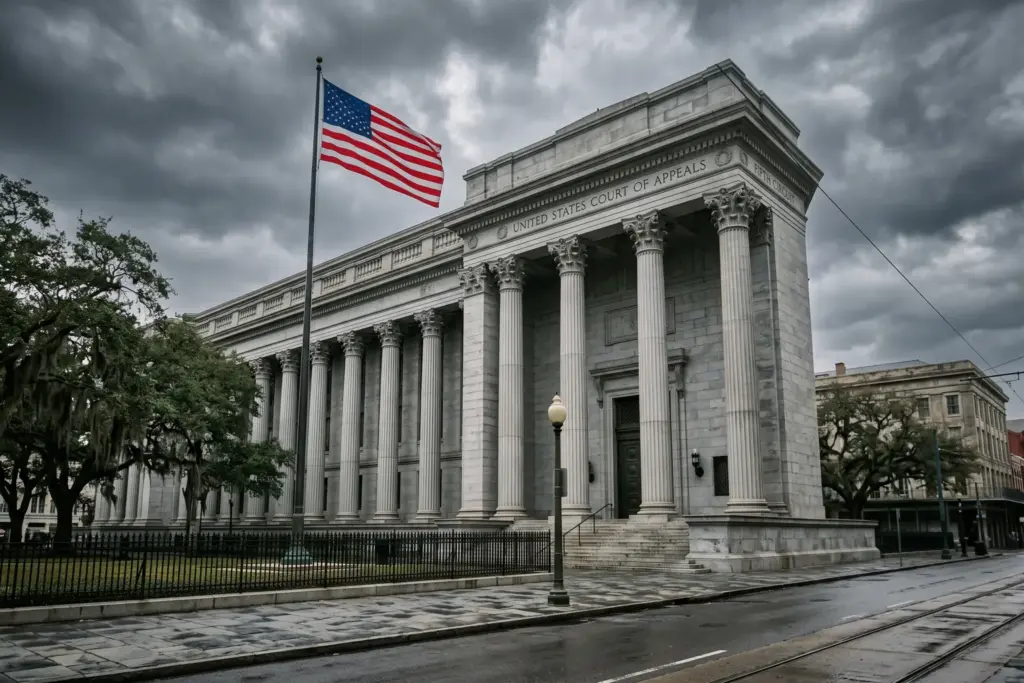
Key Takeaways
- The Fifth Circuit Court of Appeals ruled in Bodin v. City of New Orleans (August 5, 2026) that New Orleans’ Non-Commercial STR regulations do not constitute an unconstitutional taking under the Fifth Amendment. The takings-clause defense is foreclosed in the Fifth Circuit.
- The court also upheld the platform payment verification mandate, ruling constitutionally valid the requirement that platforms like Airbnb verify permit status before processing any booking payments.
- This ruling is binding precedent across the entire Fifth Circuit, covering Texas, Louisiana, and Mississippi. Federal district courts in those states are bound by it.
- Airbnb is pursuing further appeals (en banc review or cert petition), but no enforcement stay exists. The New Orleans NSTR framework and platform verification rules are operative now.
- Investors in TX, LA, and MS must now factor local regulatory risk directly into their underwriting. Cities have a constitutionally validated playbook for implementing owner-occupancy requirements, lottery caps, and platform verification mandates.
The Fifth Circuit Court of Appeals ruled on August 5, 2026 that New Orleans can limit residential short-term rentals to one permit per city block, require owner-occupancy as a condition of that permit, and force platforms to verify every listing before processing a single booking payment. For investors holding or evaluating short-term rental assets in Texas, Louisiana, and Mississippi, the ruling in Bodin v. City of New Orleans closes off the constitutional defense they have been counting on.
The takings-clause strategy is gone in the Fifth Circuit. That is the story here.
For several years, STR investors and platform lawyers treated the Fifth Amendment Takings Clause as a backstop. The theory worked like this: if a city’s STR regulations were so restrictive they effectively destroyed the economic value of a property right, a federal court could strike them down as an unconstitutional taking of property without compensation. It was a compelling argument. STR advocates pointed to it regularly. It shaped how cities calculated litigation risk before implementing aggressive ordinances.
The Fifth Circuit just buried it.
What the Fifth Circuit Actually Decided
The case arose from Airbnb’s 2025 lawsuit against the City of New Orleans challenging the city’s Non-Commercial STR (NSTR) ordinances. New Orleans’ 2023 ordinance created one of the most restrictive residential STR frameworks in a major American city: only one NSTR permit per city block, awarded by lottery, requiring the operator to live in the unit as their primary residence and maintain a Louisiana homestead exemption. The 2024 follow-up ordinance required platforms to verify the permit status of every listing before facilitating transactions or collecting booking fees.
Airbnb and five individual STR hosts challenged both ordinances on multiple constitutional grounds, including the Takings Clause, Due Process, and the First Amendment.
The court rejected each claim.
On the core question, the Fifth Circuit was direct. The 2023 Ordinance, the court wrote, “may have frustrated the Hosts’ ambitions to operate short-term rentals. But it did not extinguish their ability to rent entirely. They can still rent long term.”
That sentence is the key. The court distinguished between a regulation that eliminates a property right entirely and one that limits a specific use while leaving other profitable uses intact. Long-term rentals remain available. The property still generates income. That analysis kills the takings claim in the Fifth Circuit.
Documents from the ruling confirm the court also found no “fundamental right” to operate short-term rentals. That holding matters because constitutional challenges get more favorable traction when the right at stake is fundamental. The court refused to elevate STR operations to that status. That decision will shape litigation in Texas, Louisiana, and Mississippi for years.
Why the Takings Clause Mattered to Investors
Understanding what this ruling costs investors requires understanding why the takings argument was so valuable in the first place.
STR investors buy properties and underwrite them based on projected short-term rental income. In markets where STR income represents a meaningful premium over long-term rental income, that gap is part of what makes the deal pencil. If a city can regulate STRs out of existence after a property is purchased, without compensation, the underwriting assumptions evaporate.
The takings theory was, in essence, a regulatory risk hedge. Buy the property, operate the STR, and if the city comes for your permit, challenge the ordinance as an unconstitutional taking. Maybe the city backs down. Maybe a court agrees. Either way, the threat of litigation gave operators leverage and gave investors reason to believe their regulatory risk had a ceiling.
That ceiling is lower now in the Fifth Circuit. As long as the property can still be rented in some form and the regulation is rationally related to a legitimate government purpose, such as neighborhood preservation or housing stock protection, it does not constitute a taking. Cities in Texas, Louisiana, and Mississippi understand exactly what that means.
The ruling also has a practical effect on acquisition risk. Deals underwritten on STR income premiums in cities that have been moving toward NSTR-style frameworks now carry more downside exposure than they did a month ago. Investors who closed in 2024 or early 2025 expecting the takings theory to provide a floor have lost that floor.
The Platform Verification Mandate Is Now Constitutional Law in the Fifth Circuit
The second major holding in Bodin is equally significant for the broader STR industry.
New Orleans’ 2024 ordinance required platforms to verify permit status before processing bookings or collecting fees. Airbnb challenged this as preempted by federal law and as an unconstitutional burden on the platform. The Fifth Circuit rejected both arguments.
What this means in practice is stark. Under New Orleans’ framework, platforms face $1,000-per-day penalties for each listing processed without a verified, valid permit. Data indicates enforcement has already removed more than 1,000 listings from platforms in New Orleans since enforcement began in mid-2025. The verification requirement is not theoretical.
Before Bodin, cities that wanted to implement platform verification mandates faced genuine litigation risk. Platform companies would argue preemption and constitutional overreach. Now any city within the Fifth Circuit can point to Bodin as binding authority: a platform verification mandate passes constitutional muster. That makes this policy tool dramatically easier to replicate across Texas, Louisiana, and Mississippi.
Sponsored — Beeline
Finance Your Next STR With a DSCR Loan
Qualify on property cash flow, not W-2 income. Beeline specializes in fast DSCR closings for STR investors. No personal income verification required.
Check Your DSCR Eligibility →Affiliate disclosure: StaySTRA may earn a referral fee.
Binding Precedent Across TX, LA, and MS: What Investors Need to Understand
The Fifth Circuit covers Texas, Louisiana, and Mississippi. Its rulings are binding on every federal district court in those states. That means any STR investor in those three states who challenges a similar local ordinance on takings grounds in federal court is fighting upstream against Bodin. A federal judge in Austin, Baton Rouge, or Biloxi is not going to reach a different conclusion on the same constitutional theory. That is how binding precedent works.
This does not mean STR regulations will blanket every city in these states. Most cities are not New Orleans. Most local governments lack the regulatory infrastructure and political will to implement a full NSTR lottery-cap framework. But the constitutional shield that once made cities hesitate to adopt aggressive STR ordinances is now gone.
Before Bodin, a city attorney advising a Texas city council on STR policy had to include real litigation risk in the analysis. Challenging platforms on verification requirements carried constitutional uncertainty. Implementing owner-occupancy requirements raised takings questions. Within the Fifth Circuit, those questions now have answers that favor the cities.
Sources familiar with municipal housing policy note that the Bodin decision will feature in discussions about STR ordinances in Texas cities that have been weighing restrictions for years.
The Cities in TX, LA, and MS With the Most Exposure
Not every city in the Fifth Circuit has the political infrastructure to implement a New Orleans-style NSTR framework. But several do, and several have been moving in that direction already.
Texas has the largest STR market footprint among the three states. Dallas has been in an extended legal battle over STR restrictions, including a push to ban certain STRs in residential zones that reached the Texas Supreme Court. The Bodin ruling does not determine the outcome of state-law challenges, but it closes off the federal takings route as an additional avenue for investors. Austin began platform-level enforcement requiring verified licenses as of July 1, 2026. That approach now has stronger constitutional footing under Bodin. Houston has faced persistent STR enforcement challenges. Across Texas, the federal constitutional backstop investors thought existed is no longer in place.
Louisiana outside of New Orleans has been watching the NSTR framework closely. New Orleans’ experience, now court-validated, gives other Louisiana cities a tested, litigation-resistant model to follow.
Mississippi has lighter regulatory activity, but Gulf Coast cities carry significant vacation rental volume. The Bodin ruling does not mandate new regulations anywhere. It removes a legal barrier for any Gulf Coast city that decides to move toward tighter controls.
The Market Stakes: What StaySTRA Data Shows
The scale of the STR market across these three states gives this ruling real financial weight.
New Orleans itself illustrates what happens when regulation tightens under this framework. StaySTRA data shows the market averages 52% occupancy and an average daily rate of $221, with roughly 8,800 active listings. The regulatory environment has already pushed the market score to 47 out of 100. Platform-level enforcement and permit restrictions have constrained supply. Investors who entered New Orleans before the NSTR framework was implemented have seen the market change substantially beneath them.
In Austin, StaySTRA data shows average occupancy at 62% and an average daily rate of $229, with more than 24,000 active listings. That is a substantial pool of investor capital in a market where the constitutional fallback has weakened and where the city is already running platform-level permit enforcement. Investors evaluating Austin now need to model what a tightening regulatory environment does to those numbers. The full data is on the StaySTRA Austin market page.
The supply trend picture matters here too. When platforms remove listings under verification mandates, remaining compliant operators see supply compress around them. Occupancy and ADR tend to rise for licensed listings in the near term. That is a dynamic investors in New Orleans have already experienced. Our STR supply trends analysis covers what supply contraction means for investor returns across markets.
Sponsored — Beeline
Finance Your Next STR With a DSCR Loan
Qualify on property cash flow, not W-2 income. Beeline specializes in fast DSCR closings for STR investors. No personal income verification required.
Check Your DSCR Eligibility →Affiliate disclosure: StaySTRA may earn a referral fee.
What Investors Are Doing Differently Now
The Bodin ruling does not make Texas, Louisiana, and Mississippi uninvestable. It makes the due diligence requirements more demanding.
The investors navigating this well share a few consistent approaches.
Running hyper-local regulatory due diligence before every close. Not all cities in TX, LA, and MS are on the same trajectory. Parts of Texas outside major metros operate with light STR regulation. The question is not whether a state is risky. The question is whether this specific city has shown intent to restrict STRs, and what a NSTR-style framework would do to the specific deal’s numbers. That analysis has to happen at the local level before every closing.
Stress-testing DSCR underwriting against long-term rental income. If a property cannot cover its debt service on long-term rental income alone, it carries no margin for regulatory error. DSCR lenders are already paying attention to regulatory risk in STR markets. Investors who want to understand how DSCR financing intersects with this regulatory landscape can start with our guide to DSCR loans for STR investors.
Identifying markets where regulatory risk is structurally low. The Bodin decision does not change the investment thesis for well-selected STR markets with favorable regulatory environments. It changes the calculus for markets trending toward restriction. Our best Airbnb markets guide uses StaySTRA data to identify markets where the regulatory environment supports the long-term investment case.
The Appeal Is Still Active. Here Is What Does Not Change Today.
Airbnb has indicated it will pursue further appeals. The options are an en banc petition asking the full Fifth Circuit to rehear the case, or a certiorari petition to the U.S. Supreme Court. Neither path is fast. Neither guarantees a different outcome.
En banc review is granted sparingly. The full Fifth Circuit would need to agree the panel decision was wrong. The panel in Bodin followed established constitutional precedent on regulatory takings. A cert petition to the Supreme Court would take longer. The Court has shown interest in property rights cases, but there is no certainty it would take this one.
The practical point for investors is simple. No enforcement stay exists. New Orleans’ NSTR framework and platform verification mandate are operative today. Whatever Airbnb ultimately achieves through further litigation, the near-term regulatory environment in the Fifth Circuit is defined by what Bodin says it is. Plan accordingly.
For context on how state-level STR frameworks are evolving alongside these federal court developments, our coverage of Arizona’s new STR occupancy limits and license suspension rules shows the parallel legislative direction in other states.
We do our best to keep our reporting accurate and up to date, but situations evolve and we are only human. Always verify current details directly with local officials and sources before making decisions.
Frequently Asked Questions
What did the Fifth Circuit rule in Bodin v. City of New Orleans?
The Fifth Circuit Court of Appeals ruled on August 5, 2026 that New Orleans’ Non-Commercial STR regulations, including the one-per-block lottery system and owner-occupancy requirement, do not constitute an unconstitutional taking under the Fifth Amendment. The court also upheld the platform payment verification mandate. All major constitutional challenges by Airbnb and individual STR hosts were rejected. The court found no fundamental right to operate short-term rentals.
Does this ruling affect STR investors outside of New Orleans?
Yes, significantly. The Fifth Circuit’s jurisdiction covers Texas, Louisiana, and Mississippi, making Bodin binding precedent in all three states. Any STR investor who challenges a similar local ordinance on takings-clause grounds in federal court within those states will face this ruling as controlling authority. Federal district courts in TX, LA, and MS cannot reach a different conclusion on the same constitutional theory.
Can Texas cities now implement owner-occupancy requirements for STRs?
The Bodin ruling removes the federal constitutional takings-clause barrier for cities within the Fifth Circuit implementing owner-occupancy and lottery-cap STR frameworks. Texas state law may separately govern what Texas cities can do, and preemption questions at the state level are distinct from the federal constitutional analysis. Investors should assess both state and local law when evaluating regulatory risk for specific Texas markets.
Is Airbnb still fighting the ruling?
Yes. Airbnb has indicated plans to pursue further appeals, either through en banc review by the full Fifth Circuit or a petition for certiorari to the U.S. Supreme Court. No stay of enforcement is in place. The New Orleans NSTR regulations and platform verification mandate are being enforced today, regardless of the appeal status.
What should STR investors in Texas, Louisiana, and Mississippi do now?
Update your regulatory risk analysis for any market where local government has shown interest in restricting STRs. Stress-test your DSCR underwriting against long-term rental income scenarios. Prioritize markets where the local political and regulatory environment is unlikely to follow the New Orleans model. StaySTRA’s market pages and analyzer tool have the market-level data needed to run that analysis by city.
Sponsored — Beeline
Finance Your Next STR With a DSCR Loan
Qualify on property cash flow, not W-2 income. Beeline specializes in fast DSCR closings for STR investors. No personal income verification required.
Check Your DSCR Eligibility →Affiliate disclosure: StaySTRA may earn a referral fee.