

Key Takeaways
- Fayette County went from 1,290 active STRs to 787 after enforcing its license ordinance, a 39% drop representing 503 removed units.
- Of 61 enforcement citations issued, 52 targeted unregistered operators, confirming unlicensed hosts bear the greatest removal risk.
- Remaining licensed operators now have 503 fewer competitors in the same market with the same demand base.
- Austin, TX began requiring platforms to display licenses and remove unlicensed listings as of July 1, 2026, with Decatur, AL following the same path.
- StaySTRA data shows Lexington hosts average 62% occupancy and $241 per night, among the strongest fundamentals in Kentucky.
Fayette County, Kentucky went from 1,290 active short-term rentals to 787 in under two years. A 39% drop. Five hundred and three properties gone from the market.
That number, published by the Lexington-Fayette Urban County Government and reported by WEKU on July 3, 2026, is the clearest enforcement data point we have heading into the summer of 2026. It is what happens when a city actually follows through.
Not every city does. Many cities write ordinances and then do essentially nothing. A hotline gets answered some of the time. A few fines get issued. The market adjusts slightly and moves on. Lexington is not that city.
For STR investors in any market watching a similar timeline unfold, the Fayette County numbers are worth studying carefully. They tell you something about risk. They also tell you something about opportunity.
What Fayette County Actually Did
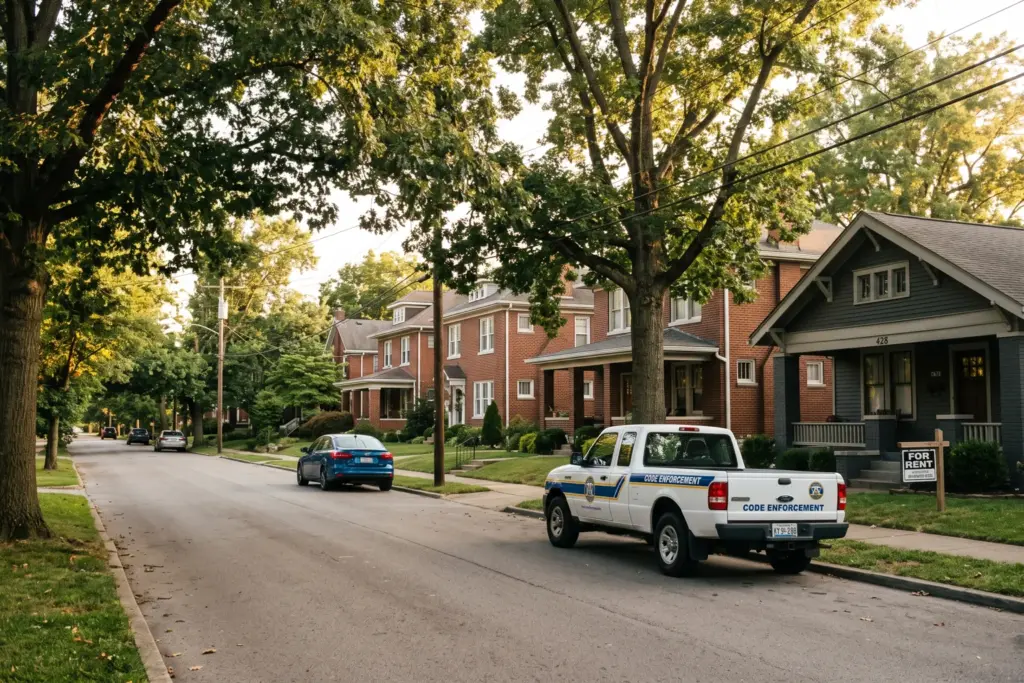
The city passed its STR ordinance in 2023, then began active enforcement in January 2024. That timeline matters. Lexington gave operators more than a year to come into compliance before the citations started. A year later, the gap between those who did and those who did not became visible in the data.
The requirements are not unusual: a $200 annual registration fee, $100 per year for each additional unit, and renewal by January 31. Two violations in a calendar year triggers license revocation. The city established a community hotline so neighbors could report problems directly.
In December 2024, Fayette County tightened the rules further. Maximum occupancy dropped from 12 to 10 people. Any new short-term rental property now needs to be at least 600 feet from another STR. These changes were not retroactive for existing registered operators, but they closed a door for anyone who had delayed getting licensed.
Documents from city enforcement show 61 total citations since enforcement began. Fifty-two of those citations were for operating without a registration. Nine were for nuisance violations: noise complaints, parking problems, the kinds of neighbor issues that draw public attention. The split tells you something. The biggest enforcement target was not bad behavior. It was simply operating without a license.
Who Left and What the Numbers Show
The city issued $78,125 in total fines. So far, $19,000 has been collected. That leaves $59,125 outstanding, including a single property carrying $22,000 in unpaid citations.
Those uncollected fines suggest something important about who left the market. Some operators did not exit because they were deterred by the fines alone. They left because enforcement made continuing too costly or too complicated to justify. Others may still be disputing citations or winding down operations. The $22,000 single-property balance points to an operator who either could not or chose not to pay, and who appears to have stopped operating as a result.
Since July 2025, the city hotline received 68 calls. Fifty-one were invalid. Seventeen were valid, and six of those led to unauthorized rental reports. For a market that once had 503 more active units, that is a relatively quiet enforcement environment. Most of the unlicensed operators appear to have exited rather than contest the process.
What remains is 787 licensed, registered operators. And a market that looks meaningfully different from the one that existed two years ago.
Sponsored — OfferMarket
Buy Your First STR With Long-Term Rental Financing
Flexible, long-term financing for short-term rental buyers. Rates from 5.75%. Instant online quote, no credit pull.
Explore RTL Financing Options →Affiliate disclosure: StaySTRA may earn a referral fee.
What a 39% Inventory Drop Actually Means for the Operators Who Stayed
This is where the analysis matters for investors watching from outside Kentucky.
When Fayette County lost 503 STR units, it did not lose 503 units worth of visitor demand. Kentucky Wildcats basketball fills hotels and vacation rentals alike. The Keeneland fall race meet draws serious money into Lexington every October and April. The University of Kentucky’s graduation and homecoming weekends create sustained seasonal demand spikes. None of that changed when the unlicensed operators exited.
What changed is how many operators are competing for those guests.
StaySTRA data shows that Lexington STR hosts currently average $241 per night and 62% occupancy, generating approximately $48,000 in annual revenue. Those metrics were produced in a market environment that included a much larger inventory base. Data indicates that markets experiencing enforcement-driven supply contractions, as opposed to demand-driven slowdowns, tend to see average daily rates hold or improve in the 12 to 18 months following the inventory reduction. The demand stays. Fewer licensed units share it. The operators who went through the compliance process get the benefit.
That is not speculation. That is the math. Five hundred and three fewer listings chasing the same visitors is a competitive advantage for every operator who remains.
The National Pattern Investors Cannot Ignore
Lexington is not operating in isolation. The summer of 2026 is shaping up as the most consequential enforcement period in recent STR market history, and Fayette County’s July 3 data release gives us the first real-world benchmark for what active enforcement produces.
Austin, Texas went live with platform enforcement on July 1. Starting that date, booking platforms are required to display valid license numbers on all Austin listings and remove any unlicensed property within 10 days of a city request. Platforms that fail to comply face fines of up to $500 per day. Sources familiar with Austin’s licensing data indicate the city has approximately 2,400 active licensed STRs, against a total listing count approaching 15,000 on major platforms. The gap between those numbers is significant. If Austin produces an enforcement outcome in the range of Lexington’s 39%, the inventory contraction would be measured in thousands of units.
In Decatur, Alabama, the grace period for short-term rental registration expired July 1, 2026. Operators without registration now face fines of up to $500 per day. A city that had moved slowly on enforcement is now in active penalty territory.
These are not isolated events. Our earlier reporting on STR enforcement across major markets documented a consistent pattern: cities pass ordinances, set grace periods, and move to active enforcement when political pressure and neighbor complaints accumulate to a threshold. The summer of 2026 is when multiple cities are hitting that threshold simultaneously.
Fayette County gives us the first clean number on what that threshold produces. Thirty-nine percent.
The Legal Counterweight That Matters
Enforcement is not always the end of the story. Courts have become increasingly skeptical of STR restrictions that move from regulation into what looks like a taking without compensation.
Federal courts have blocked aggressive STR bans in multiple jurisdictions, and the legal standard they keep applying creates real uncertainty for cities that attempt to eliminate short-term rentals entirely rather than regulate them. Licensing ordinances like Lexington’s sit on firmer legal ground than outright bans. They ask operators to follow rules, not to stop operating entirely. That distinction is important for investors assessing regulatory risk in their own markets.
A city with an active licensing ordinance and genuine enforcement is a different risk environment than a city attempting an outright ban. In the former, compliance protects you. In the latter, even compliance may not be enough if a ban survives court review.
Lexington chose the licensing route. Operators who complied kept their businesses. Operators who did not lost theirs.
How to Read Your Own Market Against This Data
The Fayette County outcome gives STR investors in other markets a calibration point. The 39% figure is not an estimate or a model. It is what the city counted when it compared its registered operator list to the listing activity it had tracked before enforcement began.
For investors in any market with a pending or active licensing ordinance, that 39% is the most concrete risk estimate currently available. If your market’s enforcement pattern looks like Lexington’s (ordinance passed, grace period granted, active enforcement then executed) and you are not licensed, the data says nearly 4 in 10 operators do not make it through the transition.
If you are licensed, the same data says nearly 4 in 10 of your competitors have left.
Not every city enforces with equal seriousness. Some pass ordinances as political theater. Others mean what they say from day one. The signals worth watching in your market:
- Did the city fund its enforcement operation? Lexington established a real hotline with staff to follow up on citations. Cities that pass ordinances without funding an enforcement mechanism rarely produce Lexington-scale outcomes.
- Is there a clear citation penalty structure? Fayette County issued $78,125 in citations. That is real financial consequence, not a warning letter. Cities serious about enforcement attach real costs to non-compliance.
- Has the city amended its ordinance mid-cycle? Lexington revised its rules in December 2024, tightening occupancy limits and adding a 600-foot distance requirement. Cities that iterate on regulations are signaling sustained investment in the outcome.
- What does the local political environment look like? Lexington’s enforcement came from sustained neighbor pressure and a city council that responded to it. Watch for ordinance amendments, public comment sessions, and city council votes as leading indicators of where enforcement is headed.
Markets with all four of those signals running simultaneously look like Lexington looked in late 2023. Investors who read that environment correctly, obtained licenses, and maintained compliance are now operating in a market with 39% less competition than existed two years ago.
That is what enforcement actually does. Not just to the people it removes. To the people it leaves behind.
Sponsored — OfferMarket
Buy Your First STR With Long-Term Rental Financing
Flexible, long-term financing for short-term rental buyers. Rates from 5.75%. Instant online quote, no credit pull.
Explore RTL Financing Options →Affiliate disclosure: StaySTRA may earn a referral fee.
Frequently Asked Questions
What caused Fayette County’s STR inventory to drop from 1,290 to 787?
Fayette County began actively enforcing its STR licensing ordinance in January 2024, following passage of the ordinance in 2023. Operators who failed to obtain the required $200 annual registration were cited and ultimately removed from the active market. Of the 61 total citations issued, 52 were specifically for operating without a registration. The city also tightened rules in December 2024, reducing maximum occupancy from 12 to 10 and adding a 600-foot distance requirement between STR properties.
Does a 39% STR inventory drop hurt or help licensed operators?
For licensed operators already in the market, the drop generally helps. Visitor demand does not shrink in proportion when unlicensed operators exit. The same number of guests are looking to book, with fewer available properties competing for those bookings. Markets that see enforcement-driven supply contractions, as opposed to demand-driven slowdowns, often maintain or improve average daily rates in the months following the reduction. Lexington’s StaySTRA data shows $241 per night and 62% occupancy, metrics reflecting what the remaining licensed market is producing.
Is the Fayette County enforcement pattern typical of what other cities are doing in 2026?
Increasingly, yes. Lexington’s approach follows a pattern common to well-resourced enforcement programs: pass an ordinance, set a grace period, then actively enforce once operators have had reasonable time to comply. Austin, TX went live with platform enforcement July 1, 2026, requiring platforms to remove unlicensed listings within 10 days. Decatur, AL ended its grace period the same date, with $500-per-day fines for non-compliant operators. Multiple cities are entering active enforcement phases simultaneously this summer.
What does the Fayette County data mean for investors evaluating Lexington?
Lexington’s remaining 787 licensed STRs are operating in a market with 503 fewer competitors than it had before enforcement. StaySTRA data shows hosts averaging 62% occupancy and $241 per night. Investors entering the market today would do so with a less competitive inventory environment than existed two years ago, provided they obtain proper licensing before listing. The enforcement process has effectively pre-qualified the remaining operator pool.
What is the primary risk for STR investors in markets with pending enforcement?
Operating without a valid license when enforcement begins. The Fayette County data shows that unlicensed operators were the primary target: 52 of 61 citations went to unregistered properties. Licensed operators were largely not affected. In a market with active licensing enforcement, regulatory risk is almost entirely a compliance risk. Licensed operators find that enforcement clears competition. Unlicensed operators find that enforcement clears them.
We do our best to keep our reporting accurate and up to date, but situations evolve and we are only human. Always verify current details directly with local officials and sources before making decisions.
Become a StaySTRA Insider
Join free — get our newsletter + 1 free property analysis/month.
No spam. Unsubscribe anytime. Free membership includes property analyses and market insights.