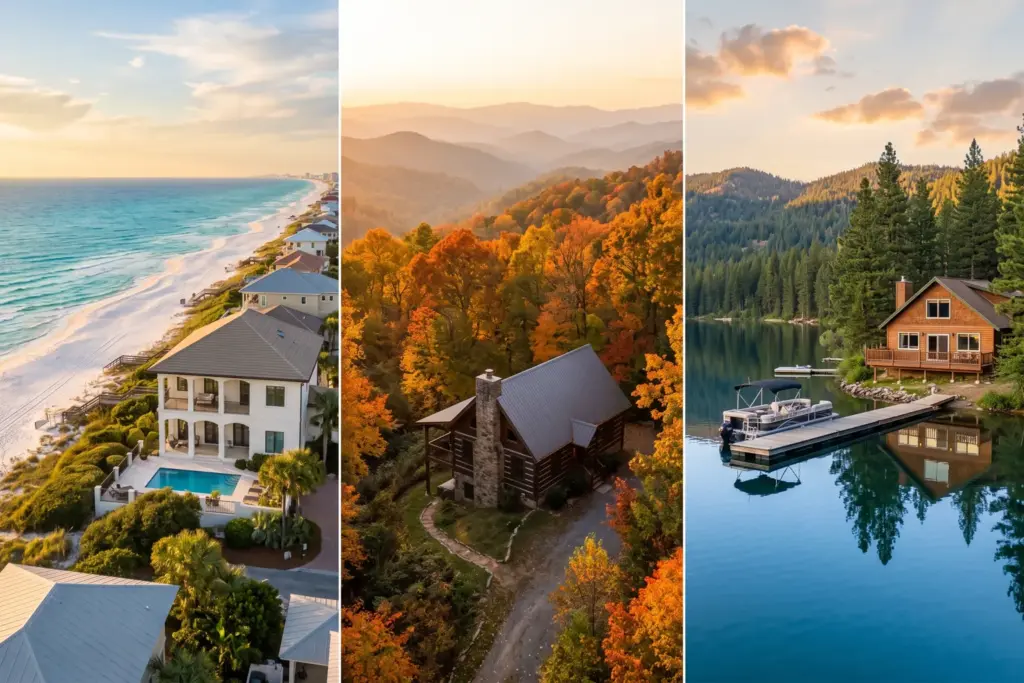
Key Takeaways
- Beach and mountain STR markets are statistically tied on median annual gross revenue, both landing around $55,000 to $56,000 per active listing in 2026, while lake markets average closer to $34,000.
- Mountain markets are the only category with two distinct demand peaks (ski season and summer/fall hiking), which reduces the single-season income risk that beach and lake investors carry.
- Beach markets deliver the most consistent occupancy (54 to 67% annually), making them easier to underwrite but harder to enter at productive acquisition prices.
- Lake markets offer the lowest entry prices and the least regulatory complexity, but the shortest peak window of any STR category.
- For first-time investors with a $350K to $500K budget, the Smoky Mountain corridor (Gatlinburg, Blue Ridge) offers the best risk-adjusted returns in the data right now.
Destin, Florida delivered $67,000 in median annual gross revenue per active short-term rental listing in 2026. That number is from StaySTRA data, measured over the last twelve months, and it puts Destin near the top of the beach category nationally. Now hold that number next to this one: the median for lake markets, using South Lake Tahoe and Lake of the Ozarks as representative markets, lands closer to $34,000. Same year. Different category.
That gap between $67,000 and $34,000 is essentially the cost of choosing the wrong market type before you ever pick a city.
I have been running STR market analyses for nearly four decades, first as a government statistician, now tracking vacation rental data from my desk in Santa Fe. The question I hear most from first-time buyers is not which city to target. It is this: should I be looking at beach, mountain, or lake? They know those are the primary categories. What they want to know is what the data actually says about them. That is what this article covers.
We are running this analysis in early July 2026, which is an unusually useful moment for it. Beach and lake markets are at their absolute peak right now. The calendars in Destin and Door County are as full as they get all year. Mountain markets are in shoulder season. That combination gives us live summer performance data for two categories and a clear picture of how shoulder seasons affect mountain returns. These are not forward projections. These numbers are from the current season.
The Numbers Side by Side
Before I take each category apart, here is the summary comparison. Think of this table the way you would think of a nutritional label: it tells you what is in the package, but not whether the package is right for you. That part comes after.
| Category | Median ADR | Median Occupancy | Median Annual Revenue | Seasonal Peaks | Top Market (2026) |
|---|---|---|---|---|---|
| Beach | ~$305 | ~57% | ~$55K | 1 (summer) | Destin, FL: $67K/yr |
| Mountain | ~$380 | ~42% | ~$56K | 2 (ski + summer/fall) | Vail, CO: ~$63K/yr |
| Lake | ~$360 | ~29% | ~$34K | 1 (summer only) | S. Lake Tahoe: $41K/yr |
Category medians computed from representative StaySTRA markets. Beach: Destin FL, Myrtle Beach SC, Virginia Beach VA. Mountain: Gatlinburg TN, Vail CO, Park City UT. Lake: South Lake Tahoe CA, Lake of the Ozarks MO. Vail annual revenue estimated from ADR and occupancy rate. Lake of the Ozarks supplementary data from a third-party industry platform. All other figures from StaySTRA location pages.
The most common investor reaction when seeing this table: surprise that beach and mountain land in the same revenue neighborhood. Beach markets do not run away with the comparison the way people expect. Mountain markets compensate for lower occupancy with meaningfully higher nightly rates. What separates the two categories is not how much money you make. It is how reliably you make it, and when.
Sponsored — Beeline
Finance Your Next STR With a DSCR Loan
Qualify on property cash flow, not W-2 income. Beeline specializes in fast DSCR closings for STR investors. No personal income verification required.
Check Your DSCR Eligibility →Affiliate disclosure: StaySTRA may earn a referral fee.
Beach STR Markets: The Consistent Workhorse
The beach category produces the most predictable income of the three. Not always the highest, but the most reliable path to that income.
StaySTRA data shows Destin, Florida at $67,000 annual revenue and 59% occupancy. Myrtle Beach, South Carolina comes in at $43,000 annually and 54% occupancy. Virginia Beach is running roughly $49,000 in annual revenue with a 66.7% occupancy rate. Think of occupancy the way you would think of a batting average: a hitter at .540 is extraordinary. In the STR world, 54 to 67% year-round occupancy is the kind of consistency that makes a pro forma pencil cleanly, supports a DSCR loan qualification, and lets you plan debt service with real confidence.
Beach markets have one dominant peak: summer. June through August is when the majority of annual revenue is earned. But the floor in the off-season (November through March) is higher for beach markets than for lakes, because there is always a segment of travelers chasing warm weather, romantic winter weekends, or school-break family trips regardless of the calendar. Destin’s RevPAR sits at $212 annually. Myrtle Beach is at $136. Those are the full-year averages, including January.
What Beach Investors Are Actually Buying
When you invest in a beach market, you are buying a single-peak engine with a durable off-season floor. The engine runs very hard in summer. It slows considerably in winter but does not stop. Demand is primarily domestic, which means international travel disruptions and currency volatility do not hit beach markets the way they affect gateway city vacation rentals.
The risks in beach markets right now are worth naming. We are watching RevPAR soften in select coastal markets this July: Dare County, North Carolina, Horry County, South Carolina, and several Hawaii markets are each showing year-over-year softness. Not every beach market is Destin. Supply has grown faster than demand in some of the most popular coastal corridors, and investors who bought into those corridors in 2021 and 2022 are now competing harder for the same number of guests. Choosing which beach market to target matters as much as choosing the beach category itself. The best Airbnb markets analysis gives you the data rankings if you want to compare specific coastal markets side by side.
Property size also changes the math considerably in this category. A two-bedroom condo in Myrtle Beach at $252 per night performs differently from a six-bedroom Outer Banks home at $700 per night. Smaller properties in high-supply beach markets need occupancy to carry the revenue load. Larger properties in constrained coastal markets can rely more on rate premium. Both approaches work at the right acquisition price.
Who Beach Markets Are For
Beach markets are the right choice for investors who want predictable, consistent cash flow over maximum upside potential; who can afford acquisition prices in the $450,000 to $700,000-plus range typical of productive coastal Florida and Carolina properties; and who want the simplest, most intuitive demand story to explain to their lenders.
Mountain STR Markets: The Two-Peak Advantage
Here is what most investors miss about mountain markets: the best ones do not have one season. They have two.
Gatlinburg, Tennessee is earning $59,000 in average annual revenue per listing with 54% occupancy and a $319 average daily rate. That occupancy number looks familiar: it is nearly identical to Destin’s 59%. But Gatlinburg gets there very differently. Winter (ski cabins, holiday getaways, Christmas in the Smokies) is strong. Summer and fall hiking season is equally strong. The cabin market in the Smoky Mountain corridor fills twice a year by completely different groups of people, which is a level of demand diversification that no single-peak market can match.
Stay with me here, because the high-altitude ski towns tell a different story. Vail, Colorado sits at a $454 average nightly rate with 38% occupancy, which estimates to roughly $63,000 in annual gross revenue per listing. The ADR is 42% higher than Gatlinburg’s. But that 38% occupancy means all of that money is earned in far fewer nights. When ski season is strong, Vail hosts produce exceptional revenue. When a low-snow winter hits, or when affluent skiers choose European destinations for a season, the falloff is sharp.
Park City, Utah illustrates this risk in the current data. StaySTRA’s location page has Park City at 16% occupancy and $46,000 annual revenue. Part of that low figure reflects where we are right now: the middle of summer shoulder season in a market that runs primarily on ski demand. Park City also carries a 182-night annual rental cap, which mechanically limits the maximum occupancy a property can achieve regardless of demand. Mountain ski towns look very different in their January data than their July data, and investors should model the full annual earnings curve rather than either season in isolation.
The Two-Peak Structure as Risk Management
Think of a two-peak mountain market like a business with two revenue streams. If one weakens (a poor snow year, a regional event cancellation, a shoulder season that runs long), the other keeps the lights on. Gatlinburg is the clearest example in the United States of an STR market that does not depend on any single demand driver. It sits within driving distance of Atlanta, Charlotte, and Nashville. It has the Smokies for hiking. It has winter cabin demand. It has Christmas and New Year’s. The demand calendar is genuinely full throughout the year, and that year-round nature is what makes it competitive with coastal markets on total annual revenue despite the gap in name recognition among first-time investors.
The real tradeoff is shoulder season. April through mid-May in the Smokies is quieter. Early November is quieter. Mountain markets have real shoulder periods that do not exist at the same intensity in warm-weather beach markets. If your debt service math requires high occupancy in May, mountain markets will disappoint you. If your math works with strong winters and summers and softer springs, mountain markets offer the strongest risk-adjusted profile of the three categories in 2026.
Sponsored — Beeline
Finance Your Next STR With a DSCR Loan
Qualify on property cash flow, not W-2 income. Beeline specializes in fast DSCR closings for STR investors. No personal income verification required.
Check Your DSCR Eligibility →Affiliate disclosure: StaySTRA may earn a referral fee.
Mountain Market Entry Costs
This is where mountain markets become particularly interesting for first-time investors. Gatlinburg and the broader Smoky Mountain area offer entry points in the $300,000 to $450,000 range for a viable STR cabin, compared to $500,000 or more for most productive beach properties. Blue Ridge, Georgia, another mountain cabin market I track regularly, showed $62,500 in average annual revenue with 53% occupancy at a $361 average daily rate in 2026. Entry prices in Blue Ridge run $250,000 to $400,000 for a well-located cabin. That math puts gross yields in the 14 to 17% range before expenses, which is among the strongest in any STR category at current acquisition prices.
Vail and Park City operate at a completely different price point, $800,000 to $1.5 million or more for viable investment properties, which changes the yield calculation entirely. Premium ski towns look attractive on revenue but rarely pencil well on gross yield at current acquisition prices, particularly in markets with annual night caps.
Who Mountain Markets Are For
Mountain markets are the right choice for investors who want the best risk-adjusted returns in the accessible $300,000 to $500,000 price range; who can absorb a 6 to 8 week shoulder season; who value the two-peak demand structure; and who are comfortable with a cabin property type that requires a specific amenity set (hot tub, mountain views, fireplace) to command premium rates.
Lake STR Markets: The Hidden Opportunity and the Hidden Risk
The lake category is where investors get most surprised by the data. The ADRs look competitive: South Lake Tahoe, California is at a $405 nightly rate. Lake of the Ozarks is at $316. Those numbers sit in the same ballpark as mountain markets. But the occupancy tells the real story. South Lake Tahoe sits at 25% annual occupancy. Lake of the Ozarks is around 33%. That is where the revenue gap opens.
Don’t let those occupancy figures alarm you before you understand the structure of lake markets, because the story here is more nuanced than it first appears.
Lake markets operate on the shortest peak window of any STR category. The peak runs roughly Memorial Day through Labor Day, about 14 weeks out of 52. In that window, occupancy in good lake markets is genuinely high. But the other 38 weeks are quiet. A lake cabin that earns $4,000 a week in July might earn $600 in October and essentially nothing in February. The annual average gets pulled way down by those low-season weeks in a way that monthly peak figures completely obscure.
Lake Markets by Sub-Type
Not all lake markets perform the same way, and understanding the distinction matters for underwriting.
Premium lake and mountain hybrid markets (South Lake Tahoe, the Adirondacks, certain North Carolina mountain lake communities) benefit from both summer lake demand and a secondary winter demand from skiing or snow recreation. South Lake Tahoe’s $405 nightly rate reflects this dual-demand structure. The 25% annual occupancy is still low by beach standards, but the $41,000 annual revenue is the strongest in the lake category precisely because it is not a pure summer-only market. If you are targeting the lake category, these hybrids offer the most resilient annual income story.
Drive-to summer lake markets (Lake of the Ozarks in Missouri, Smith Mountain Lake in Virginia, many Midwest and Southeast lake communities) operate almost entirely within the summer window. Annual revenues cluster in the $25,000 to $40,000 range for average properties. Entry prices in many of these markets are $200,000 to $350,000, which means gross yields can still be reasonable even at lower revenue numbers when you are not overpaying on acquisition.
The Regulatory Advantage
One factor that rarely shows up in market comparison tables but shows up constantly in operator experience: lake markets are significantly less regulated than coastal markets in most states. Cities like Myrtle Beach, Destin, and Outer Banks have developed detailed permitting frameworks. Mountain ski towns like Park City have instituted annual night caps. Most interior lake communities have minimal or no STR-specific regulation. For a first-time investor who wants simplicity of ownership and low regulatory risk, many lake markets offer a meaningfully easier operating environment than the better-known coastal and ski destinations.
The StaySTRA Analyzer shows property-level revenue projections that account for each market’s full seasonal pattern. For lake markets specifically, always run the full 12-month projection before buying, not just the summer peak months. The annual number is what pays your mortgage every month, not July alone.
Sponsored — Beeline
Finance Your Next STR With a DSCR Loan
Qualify on property cash flow, not W-2 income. Beeline specializes in fast DSCR closings for STR investors. No personal income verification required.
Check Your DSCR Eligibility →Affiliate disclosure: StaySTRA may earn a referral fee.
Who Lake Markets Are For
Lake markets are the right choice for investors with a lower acquisition budget ($200,000 to $350,000 in most drive-to lake communities); who can manage the property for the 14-week peak season; who are comfortable owning a summer-primary business; or who are targeting a premium lake and mountain hybrid where winter demand fills in the seasonal gaps.
Which Category Should You Buy? Three Investor Profiles
Now for the question you came here to answer. Here is how the data maps to three different investor situations.
Profile 1: First-Time Buyer, $350K to $500K Budget
The data points clearly toward mountain markets, specifically the Smoky Mountain corridor (Gatlinburg, Pigeon Forge, the Blue Ridge area of Georgia). You can acquire a viable STR cabin in this price range. The two-peak demand structure reduces income concentration risk. Annual revenues in the $50,000 to $65,000 range are achievable. Tennessee is a pro-host state with minimal STR restriction outside of Nashville. Gross yields in the 12 to 16% range are realistic in sub-markets where inventory is not dominated by premium inventory. For most first-time STR buyers in 2026, this is the strongest risk-adjusted story in the data.
The STR Revenue Benchmarks by Market Type article breaks down ski, beach, urban, and rural category data in more detail if you want to compare mountain cabin numbers against additional market types before deciding.
Profile 2: Experienced Investor, $500K to $800K Budget, Prioritizing Consistency
Beach markets, specifically the Southeast coast (Destin and the 30A corridor in Florida, Hilton Head in South Carolina, the Outer Banks in North Carolina), deliver the most consistent cash flow at this price point. Occupancy in the 55 to 67% range across a full year is hard to match anywhere in the STR market. You will not see the ADR upside of a premium ski town, but you also will not carry the shoulder season compression of a ski-primary market. The RevPAR consistency of productive beach markets makes them easier to underwrite and more straightforward to finance with a DSCR loan. For investors who want a predictable, stable-income asset with a clearly understood demand driver, this is the category.
Profile 3: Budget-Conscious First-Timer, Under $350K
Lake markets are accessible at $200,000 to $350,000 in many Midwest and Southeast lake communities. The revenue is lower (plan for $25,000 to $40,000 annually in most accessible drive-to lake markets), but the yield at these acquisition prices can still produce solid monthly cash flow. The key requirement for this profile: understand that you are buying a summer-primary business. If you can manage the property for peak season and handle a quiet winter, lake markets can generate real cash flow at lower absolute investment levels than either of the other two categories.
Before committing to any category, the analytical process is the same. The step-by-step framework is at How to Analyze an STR Market Before You Buy. For operating costs, financing, and real-world margins, Short-Term Rental Investing in 2026: What the Numbers Actually Look Like covers the full picture.
The Bottom Line
Beach and mountain markets are statistically tied on median annual gross revenue in 2026, both landing around $55,000 to $56,000 from representative markets. Beach wins on occupancy consistency and predictability. Mountain wins on demand diversification through two-peak seasonality. Lake markets come in lower on revenue but offer the lowest entry costs and the most accessible regulatory environment of the three categories.
For a first-time investor deciding where to put capital in 2026, the category answer is mountain cabin markets at accessible price points. Two-peak demand, reasonable acquisition costs, and pro-host regulatory environments in Tennessee and Georgia create the clearest risk-adjusted story in the data.
The category choice narrows your search. It does not replace the property-level analysis. A well-located Gatlinburg cabin at the right acquisition price outperforms a poorly located Destin condo at an inflated price regardless of what the category medians say. Choose your category with data, then verify the specific property before you write a check.
Sponsored — Beeline
Finance Your Next STR With a DSCR Loan
Qualify on property cash flow, not W-2 income. Beeline specializes in fast DSCR closings for STR investors. No personal income verification required.
Check Your DSCR Eligibility →Affiliate disclosure: StaySTRA may earn a referral fee.
We do our best to keep our data accurate and up to date, but markets move fast and we are only human. Always verify current figures directly with local sources before making investment decisions.
Frequently Asked Questions
Which type of vacation rental market makes the most money, beach or mountain?
Beach and mountain STR markets generate nearly identical median annual gross revenue in 2026, roughly $55,000 to $56,000 per active listing. Beach markets achieve this through higher occupancy (averaging 57%). Mountain markets compensate for lower occupancy with higher nightly rates ($380 ADR versus $305 for beach). Individual market performance varies considerably within both categories.
Are lake vacation rentals worth investing in?
Lake markets deliver lower median annual revenue (around $34,000 in representative 2026 data) than beach or mountain categories, largely because of the short peak season. However, lake markets have lower acquisition prices ($200,000 to $350,000 for drive-to markets) and less regulatory complexity. Premium hybrid markets like South Lake Tahoe can generate $41,000 or more annually. Lake markets can produce solid gross yields when acquisition prices are in the right range.
What is the best STR market type for a first-time investor in 2026?
Mountain cabin markets in the Smoky Mountain corridor (Gatlinburg, TN and Blue Ridge, GA in particular) offer the strongest risk-adjusted case for first-time investors in 2026. Entry prices of $300,000 to $450,000 are more accessible than comparable productive beach properties. Two-peak demand reduces single-season income risk. Average annual revenues in Gatlinburg are running $59,000 with 54% occupancy, which supports DSCR loan qualification at reasonable acquisition prices. Tennessee’s regulatory environment remains among the most host-friendly in the country.
How does seasonality compare between beach, mountain, and lake STR markets?
Beach markets have one primary peak (June through August) with a moderate year-round floor, particularly in warm-weather destinations like Florida. Mountain markets with both ski and hiking demand operate two distinct seasonal peaks, which is the category’s key structural advantage for investors. Lake markets have the most concentrated seasonality of the three, with the majority of annual revenue earned in a 12 to 14 week window from Memorial Day through Labor Day. The off-season in a typical drive-to lake market is substantially quieter than in either beach or multi-peak mountain markets.
Does Gatlinburg or Destin have better short-term rental returns?
Destin delivers a higher annual revenue figure at $67,000 per active listing versus Gatlinburg’s $59,000. However, Gatlinburg’s acquisition prices are typically lower ($300,000 to $450,000 for viable cabins versus $450,000 to $700,000-plus for productive Destin properties), which can produce a higher gross yield despite the lower absolute revenue number. Destin wins on occupancy consistency; Gatlinburg wins on two-peak demand diversification and the price-to-revenue ratio that first-time investors can realistically access.
Ready to analyze a specific property? The StaySTRA Analyzer gives you projected annual revenue, monthly occupancy curves, and ADR estimates for any address in the US. Free, no signup required.
Become a StaySTRA Insider
Join free — get our newsletter + 1 free property analysis/month.
No spam. Unsubscribe anytime. Free membership includes property analyses and market insights.