

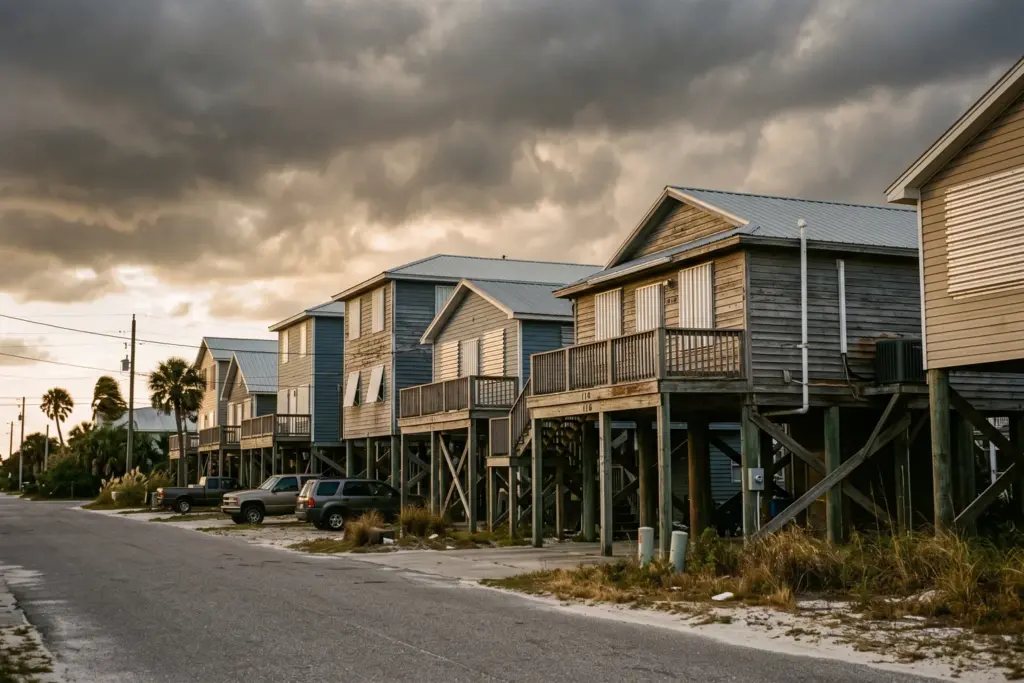
Key Takeaways
- Florida coastal short-term rental insurance reached $6,000 to $10,000+ per year in 2026, with Florida Keys properties routinely exceeding $15,000 annually.
- That is 5 to 9 times higher than comparable inland markets: Gatlinburg, TN averages around $1,100 per year and Branson, MO runs $1,200 to $2,400 per year.
- More than 30 insurance carriers have exited or reduced coverage in Florida since 2020, pushing coastal properties into surplus lines markets where rates have no regulatory ceiling.
- Flood insurance is a separate, additional cost. Beachfront properties in FEMA VE flood zones pay $5,000 to $15,000 or more per year through NFIP or private flood carriers, on top of the STR property policy.
- At $10,000 in annual insurance, a $400,000 Florida beach property must generate approximately $70,000 in gross revenue just to cover debt service and insurance before other expenses.
Florida coastal short-term rental insurance now routinely costs six to nine times what the same investor pays for a comparable property in Tennessee. A BiggerPockets forum thread that circulated widely among STR investors in late May 2026 captured this gap in precise dollar terms. Jason Wray, a banker with 21 years of experience, documented it plainly: his Tennessee STR property costs $1,100 per year to insure. His Florida coastal clients are dealing with premiums that have made otherwise viable deals simply not work.
Deals are collapsing. Multiple transactions fell through this year over insurance costs alone, according to Wray’s post in the thread “Has insurance become a deal-breaker variable in certain STR markets?” on BiggerPockets (forum 530, topic 1289947). That thread has since been shared widely across STR investor communities.
This investigation documents who is raising rates, which Florida, Georgia, and South Carolina markets are most exposed, what the real investor math looks like after insurance normalization, and where the numbers still hold for operators willing to look inland.
The Collapse of the Florida Coastal Insurance Market
More than 30 home insurance carriers have exited Florida or gone insolvent since 2020. The exits accelerated after Hurricane Ian in 2022, continued through Hurricane Helene in 2024, and show limited signs of reversal heading into 2026. Florida leads the nation in home insurance non-renewal rates at 3.35%, a figure that has risen 280% since 2018, according to a 2025 analysis by the Center for Public Integrity.
The roster of departed or restricted carriers includes Farmers, Southern Fidelity, Weston Property and Casualty, United Insurance Holdings, FedNat, Bankers Insurance, Lighthouse Property Insurance, Avatar Property and Casualty, Lexington, and St. Johns Insurance. AAA, Progressive, and State Farm also reduced Florida exposure. As of May 2024, 11 Florida home insurance companies were in active liquidation, per the Florida Insurance Guaranty Association.
The gap left by those exits gets filled by surplus lines carriers, the excess and surplus (E&S) market. Unlike admitted carriers, surplus lines insurers are not subject to Florida rate filing requirements. They price for risk without regulatory caps. The Florida Surplus Lines Service Office reported that E&S market share of Florida homeowner policies rose from 30% in 2018 to 36% in 2024. Average E&S homeowner premiums reached approximately $7,030 per policy in early 2025, according to Insurance Journal analysis of FSLSO market data.
Data indicates the statewide consequences are severe. Florida’s average residential insurance premium reached approximately $15,460 per year in 2025, according to Insurify’s market analysis. The national average is $3,259. Coastal STR properties sit at the top of Florida’s already elevated premium range.
Florida also accounted for 72% of the nation’s homeowners claim-related litigation in 2023, despite representing roughly 10% of national claims. That litigation environment is a compounding driver of carrier exits alongside hurricane losses and reinsurance repricing.
What Florida Coastal STR Operators Are Actually Paying in 2026
The numbers from the 2026 Florida STR insurance market break down roughly as follows, based on data from the STR Guard Insurance 2026 Florida cost guide and investor disclosures in BiggerPockets forum discussions:
- Standard coastal single-family STRs (Panhandle, Gulf Coast, Atlantic beaches): $4,000 to $8,500 per year
- High-value coastal properties (above $800,000 value, large capacity, premium amenities): $8,500 to $15,000 per year
- Florida Keys (Monroe County): $10,000 to $15,000+ per year, with many placements above that threshold
- Florida inland (Orlando corridor and comparable markets): $2,000 to $4,000 per year
These ranges cover the property and loss-of-income portion of coverage only. Named-storm wind deductibles are a separate cost exposure, typically set at 2%, 5%, or 10% of dwelling value. On a $600,000 coastal property with a 5% wind deductible, a single hurricane claim carries a $30,000 out-of-pocket threshold before insurance pays anything.
The premium trajectory over time tells an equally important story. County-level data from Broward.us tracking March 2022 through September 2024 shows these increases for standard residential policies:
- Lee County: +47.0%
- Charlotte, Sarasota, and Manatee counties: +45 to 50%
- Palm Beach County: +37.5%
- Monroe County (Florida Keys): +34.6%
- Miami-Dade: +21.1%
These are residential averages. STR-specific policies carry additional liability and income replacement requirements and index higher than standard homeowners premiums in the same zones.
Documents show the trajectory in sharp relief at the property level. One investor in a BiggerPockets discussion documented their $1.6 million Florida coastal STR property’s annual insurance progression: $17,000 in 2022, $28,000 in 2023, and above $40,000 per year by 2024. That is a 135% increase in two years on a single property. The STR Guard Insurance 2026 Florida guide documents a $1.2 million Destin beach house generating $85,000 per year in rental income: base STR coverage of $5,400 per year, rising above $7,800 per year when the owner selected a lower named-storm deductible for additional protection. Neither figure includes flood insurance.
You can explore current revenue, occupancy, and ADR benchmarks for Florida STR markets at the StaySTRA Florida short-term rental market page.
Georgia and South Carolina: Following Florida’s Lead
Sources reveal that coastal Georgia and South Carolina are facing the same structural pressures as Florida, though neither state has reached Florida’s premium extremes. The reinsurance market repricing that underlies Florida’s crisis applies to any coastal property in the Atlantic hurricane corridor.
South Carolina’s Department of Insurance published its 2024 Status Report on the Coastal Property Insurance Market, documenting rising premium pressures along the Grand Strand and the Low Country. The South Carolina Wind and Hail Underwriting Association, the state’s insurer of last resort for coastal properties, has seen increasing placement volume as admitted carriers tighten underwriting. STR operators in Myrtle Beach and Hilton Head should budget $4,000 to $8,000 per year for standard coastal property coverage, with higher-value oceanfront properties tracking toward $10,000 or above.
Georgia’s coastal market, centered on Tybee Island and the Golden Isles, faces similar Atlantic storm exposure. While Georgia has not experienced the same pace of carrier exits as Florida, the underlying reinsurance cost increases driving Florida’s crisis are applying upward pressure on Georgia coastal premiums as well. Budget assumptions based on 2022 or 2023 Georgia coastal insurance costs need to be revisited with current quotes before any acquisition closes.
The Flood Problem Most Investors Do Not Price In
Standard STR property insurance does not cover flooding. Flood coverage is a separate purchase, either through NFIP or private carriers, and mandatory for most coastal Florida properties carrying mortgage debt. This cost is frequently underweighted in investor underwriting.
NFIP annual premiums for $250,000 in building coverage by flood zone:
- X Zone (moderate risk): $400 to $1,200 per year
- AE Zone (high-risk coastal): $2,000 to $5,000 per year
- VE Zone (beachfront, very high risk): $5,000 to $15,000+ per year
Private flood insurance in VE zones runs $3,000 to $20,000 or more per year depending on elevation certificate, proximity to water, and replacement cost. NFIP building coverage caps at $250,000, which is structurally insufficient for most Florida coastal STRs carrying replacement costs of $500,000 to $1.5 million or more. Investors in this range typically layer private flood on top of NFIP coverage, paying two separate annual flood premiums.
FEMA’s Risk Rating 2.0 methodology, fully implemented for all policies by April 2022, uses property-specific factors rather than flood zone maps alone. According to Atesa Risk Advisors’ 2026 private flood analysis, 77% of NFIP policyholders saw premium increases after the transition, with an 18% annual cap. Properties currently underpriced relative to actual flood risk can hit substantially higher premiums within a few renewal cycles.
The practical result: a coastal Florida STR in an AE or VE flood zone carries three insurance costs, not one. STR property insurance, NFIP flood coverage, and potentially supplemental private flood layered on top. At the high end of each range, the combined annual insurance burden exceeds $20,000 before any named-storm deductible exposure.
Sponsored — Beeline
Finance Your Next STR With a DSCR Loan
Qualify on property cash flow, not W-2 income. Beeline specializes in fast DSCR closings for STR investors. No personal income verification required.
Check Your DSCR Eligibility →Affiliate disclosure: StaySTRA may earn a referral fee.
The DSCR Math: What Insurance Does to Deal Underwriting
DSCR lenders underwrite short-term rental loans against projected net operating income. Insurance is an operating expense. Higher insurance directly reduces NOI and therefore raises the gross revenue threshold a property must hit to qualify for financing.
Consider a standard scenario: a $400,000 Florida beach property with 20% down and a $320,000 loan at 7% interest. Annual debt service runs approximately $25,500. DSCR qualification at 1.25x requires annual NOI of roughly $31,900 minimum. With operating expenses (management, maintenance, property taxes, utilities) running 30% of gross revenue and $10,000 in annual insurance as a discrete additional line item: NOI equals 0.70 times gross minus $10,000. Solving for gross revenue at the 1.25x threshold produces a requirement of approximately $70,000 in gross revenue just to clear DSCR qualification, before the investor captures any cash flow.
In 2022, when Florida coastal STR insurance ran $3,000 to $4,000 per year, the same loan structure required approximately $58,000 to $62,000 in gross revenue for DSCR qualification. The $6,000 to $10,000 increase in insurance since then translates to $12,000 to $20,000 in additional gross revenue that a property must generate to hold the same debt service coverage ratio.
The numbers have moved. For investors using DSCR financing on Florida coastal properties, this is not a margin compression issue. It is a deal qualification issue. Properties that passed DSCR underwriting in 2022 and 2023 now require substantially higher revenue projections to qualify, and projected gross revenue in many coastal Florida markets has not increased proportionally to match the insurance cost increases.
We covered the earlier phase of this problem in our investigation into which STR markets are being blacklisted by insurance carriers in 2026. The coastal premium explosion documented here is a more widespread development: not about being dropped entirely, but about the cost of staying insured reaching levels that break the investment model entirely.
Sponsored — Beeline
Finance Your Next STR With a DSCR Loan
Qualify on property cash flow, not W-2 income. Beeline specializes in fast DSCR closings for STR investors. No personal income verification required.
Check Your DSCR Eligibility →Affiliate disclosure: StaySTRA may earn a referral fee.
Inland Alternatives: What Insurance Looks Like in Non-Coastal Markets
The inland STR insurance market operates in an entirely different pricing environment. The gap is large enough that it is now actively redirecting acquisition capital away from the Florida coast.
Gatlinburg, Tennessee and the Smoky Mountains: The BiggerPockets thread that opened this investigation cited a Tennessee STR at $1,100 per year for insurance. Steadily’s published data for Tennessee landlord insurance lists a median annual premium of $1,197.50. StaySTRA data shows Gatlinburg STRs averaging $59,000 per year in gross revenue with 54% occupancy and a $319 average daily rate. At $1,100 to $1,200 in annual insurance, this market’s operating cost structure looks nothing like Florida’s coast. Explore current Gatlinburg market data at StaySTRA’s Gatlinburg market page.
Branson, Missouri and Lake of the Ozarks: STR insurance in Branson and the broader Ozarks region runs $1,200 to $2,400 per year for a standard 3-bedroom property, according to expense data published by The Short Term Shop for Branson. No hurricane exposure. No coastal flood zones. Missouri remains in the admitted insurance market at regulated rates.
Blue Ridge, Georgia: The mountain cabin market in Blue Ridge sits in a sharply different risk tier than Georgia’s coast. The absence of coastal wind and flood exposure keeps these properties in the admitted market category that Florida coastal operators can no longer reliably access.
A caution on Asheville, North Carolina: Asheville is frequently cited as an inland STR market alternative. The situation changed after Hurricane Helene hit western North Carolina in September 2024. One operator in the area reported approximately $10,000 per year for STR insurance in the post-Helene market. North Carolina’s Rate Bureau has filed for a 68.3% average increase in dwelling insurance rates over two years statewide, with a regulatory decision still pending. Asheville’s Airbnb inventory declined 20% after the storm. Treat Asheville as a recovering market with elevated insurance uncertainty, not as a clean inland low-cost alternative.
Net Yield Comparison: Coastal Florida vs. Inland Alternatives After Insurance
| Market | Typical Annual Gross Revenue | Annual STR Property Insurance | Annual Flood Insurance | Combined Insurance Burden |
|---|---|---|---|---|
| FL Coastal (Gulf/Atlantic standard) | $60,000 to $90,000 | $6,000 to $8,500 | $2,000 to $8,000 | $8,000 to $16,500 |
| FL Keys / High-Value Coastal | $80,000 to $140,000 | $10,000 to $15,000+ | $5,000 to $15,000+ | $15,000 to $30,000+ |
| Gatlinburg, TN (Smoky Mountains) | $50,000 to $70,000 | $1,100 to $1,200 | Not applicable | $1,100 to $1,200 |
| Branson, MO | $40,000 to $65,000 | $1,200 to $2,400 | Not applicable | $1,200 to $2,400 |
At 40% operating expense margins (excluding insurance), the $8,000 to $15,000 annual insurance differential between mid-tier coastal Florida and inland markets translates to roughly $13,000 to $25,000 in additional gross revenue that a coastal property must generate to produce equivalent net yield. That is before accounting for higher property acquisition costs in Florida coastal markets.
For a data-backed comparison of coastal versus inland STR market fundamentals, see our earlier analysis of coastal vs. mountain STR markets in 2026.
Sponsored — Beeline
Finance Your Next STR With a DSCR Loan
Qualify on property cash flow, not W-2 income. Beeline specializes in fast DSCR closings for STR investors. No personal income verification required.
Check Your DSCR Eligibility →Affiliate disclosure: StaySTRA may earn a referral fee.
What Investors Are Actually Doing About This
The BiggerPockets threads reveal an active reallocation already underway. Investors naming Tennessee, Indiana, Ohio, and Missouri as target states specifically cite insurance cost as a primary factor. One investor in the forum described a self-insurance strategy for paid-off coastal Florida properties: carrying liability coverage only and eliminating the property component entirely. That approach eliminates the STR insurance premium but removes all protection against catastrophic property loss.
The more durable strategy emerging among portfolio operators involves geographic diversification. Operators who cannot make new coastal Florida acquisitions pencil are pairing existing paid-off coastal properties (where insurance is painful but manageable without debt service) with new acquisition capital directed toward inland markets where the operating cost structure makes DSCR financing viable again.
The investors for whom this math is hardest are those in the pre-purchase phase. They are looking at properties that worked in 2022, running the same revenue projections, and not updating the insurance line item. That is where deals collapse before they close. Documents from the BiggerPockets discussion confirm this failure mode: banker Jason Wray reported that multiple client deals fell through this year because buyers did not obtain current insurance quotes until late in due diligence. Insurance is now a first-call item in deal evaluation, not a final adjustment at closing.
Sponsored — Beeline
Finance Your Next STR With a DSCR Loan
Qualify on property cash flow, not W-2 income. Beeline specializes in fast DSCR closings for STR investors. No personal income verification required.
Check Your DSCR Eligibility →Affiliate disclosure: StaySTRA may earn a referral fee.
Geographic Diversification Checklist: What to Verify Before You Buy
- Get an insurance quote before making an offer. Florida coastal properties require a binding quote, not an estimate. Contact Proper Insurance, CBIZ, Steadily, and at least one surplus lines broker. Do not rely on a comps-based number from 2022 or 2023.
- Determine your flood zone. FEMA’s Flood Map Service Center (msc.fema.gov) provides this free. AE and VE zone properties with mortgages require separate flood insurance policies with dedicated pro forma line items.
- Price the named-storm deductible exposure. A 5% wind deductible on a $700,000 dwelling is $35,000 out of pocket before insurance activates. Budget this as a capital reserve, not a rounding error.
- Calculate insurance as a percentage of projected gross revenue. In inland markets, insurance typically runs 2 to 4% of gross. In coastal Florida, it commonly runs 10 to 20% or more. Markets where insurance exceeds 15% of gross require exceptional income performance to generate positive cash flow.
- Verify the insurance figure your DSCR lender uses in underwriting. Some lenders impute an estimate rather than actual quotes. Confirm their input matches your real insurance cost before signing loan documents.
- Run the inland comparison. Use the StaySTRA Analyzer to compare projected returns in a coastal market against a comparable inland market at the same acquisition price. The insurance differential is often the deciding variable in the comparison.
- Check Citizens Property Insurance eligibility for your target property. Citizens is Florida’s insurer of last resort. It holds 772,000 policies as of late 2025, down from 1.4 million at peak, and received an 8.7% average rate decrease in 2026. Eligibility is not guaranteed for all coastal STR properties, and policy limits differ from commercial STR coverage requirements.
We do our best to keep our reporting accurate and up to date, but situations evolve and we are only human. Always verify current details directly with local officials and sources before making decisions.
Frequently Asked Questions
How much does short-term rental insurance cost in Florida in 2026?
Coastal Florida STR insurance typically runs $4,000 to $8,500 per year for standard beach-area properties. High-value properties and Florida Keys locations commonly exceed $10,000 to $15,000 per year. These figures cover the property and income replacement policy only and do not include flood insurance, which is a separate required purchase for most coastal properties carrying mortgage debt. Inland Florida markets like the Orlando corridor run $2,000 to $4,000 per year.
What inland STR markets have the lowest insurance costs?
Tennessee consistently produces the lowest STR insurance costs among established vacation rental markets. Gatlinburg averages around $1,100 to $1,200 per year per BiggerPockets investor data and Steadily published rates. Branson, Missouri runs $1,200 to $2,400 per year. Both markets carry no coastal flood or hurricane exposure and remain in the admitted insurance market at regulated rates, unlike Florida coastal properties which frequently require surplus lines placement.
Why has Florida coastal STR insurance gotten so expensive?
Three compounding factors drive the increase: hurricane losses from Irma, Ian, and Helene; a litigation environment where Florida accounted for 72% of national homeowners claim-related litigation in 2023 while representing only 10% of national claims; and a reinsurance market repricing that raised costs for every carrier still writing in coastal Florida. More than 30 carriers have exited Florida since 2020, leaving coastal STR properties to be placed in unregulated surplus lines markets at substantially higher rates.
Does DSCR underwriting account for the real cost of Florida coastal insurance?
Not always. Some DSCR lenders use estimated insurance inputs rather than actual quotes. Investors should request the specific insurance figure used in the lender’s underwriting model and compare it to current quotes from STR insurance specialists. Understating insurance in the DSCR calculation can produce a loan that qualifies at origination but does not cash flow once the actual insurance bill arrives at renewal.
Which STR insurance carriers are still writing Florida coastal policies in 2026?
Proper Insurance describes itself as the leading STR insurer remaining active statewide in Florida. CBIZ relaunched its national vacation rental program in June 2025 backed by an A-rated carrier and claims 50-state availability. Steadily and Safely continue to offer products in Florida. All carriers conduct address-level underwriting for coastal properties, meaning availability and pricing vary significantly by ZIP code and flood zone. Obtain a binding quote with the specific property address rather than relying on general state-level availability statements.
Become a StaySTRA Insider
Join free — get our newsletter + 1 free property analysis/month.
No spam. Unsubscribe anytime. Free membership includes property analyses and market insights.