

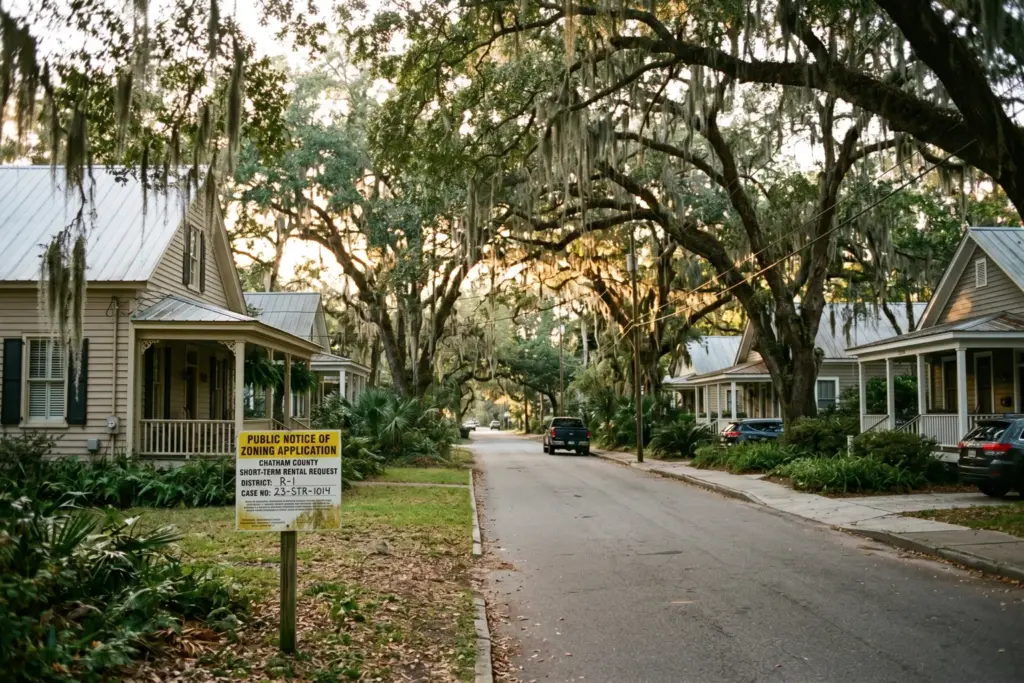
Key Takeaways
- Chatham County commissioners passed a first reading on May 11, 2026, of a proposed 500-foot buffer zone between short-term rentals in unincorporated areas. The final vote is May 22.
- The ordinance would also ban STRs on homestead-exempt properties, effectively closing the door on owner-occupied hosts who claim both benefits simultaneously.
- StaySTRA data shows 2,540 active short-term rental listings across the Savannah market, with average daily rates of $319 and a 43% supply increase since 2021.
- National precedent from Bend, Oregon, shows that a 500-foot buffer increased the share of ineligible residential land from 34% to 54%, making more than half the city off-limits for new STR permits.
- Existing licensed operators may be grandfathered, but new applicants and future property sales could face a dramatically smaller map of eligible locations.
Chatham County’s planning department has been quietly building a case for months. Documents show the result: a proposed ordinance that would require every new short-term rental in unincorporated Chatham County to sit at least 500 feet from the nearest existing one. The county commission passed the first reading on May 11. The final vote is six days away.
If it passes on May 22, the rule would reshape where short-term rentals can legally operate across one of the Southeast’s most active vacation rental markets. For investors who bought into the Savannah area expecting stable permit access, the timing matters.
What the Chatham County 500-Foot Buffer Actually Proposes
The ordinance revision targets unincorporated Chatham County, the suburban and island communities outside Savannah’s city limits where the county’s 2021 STR ordinance already applies. It does not directly affect the City of Savannah, which runs its own overlay district with a ward-by-ward 20% cap on residential STR parcels in the Downtown, Victorian, and Streetcar historic districts.
Two provisions stand out in the proposed changes.
The first is the 500-foot minimum distance requirement. No new STR certificate would be issued for any property within 500 feet of an existing licensed short-term rental. This creates a de facto density cap without formally limiting the total number of permits.
The second is the homestead exemption ban. Properties receiving Georgia’s homestead property tax exemption would be prohibited from operating as short-term rentals. This targets owner-occupied hosts who have been collecting both the tax benefit of primary-residence status and the income of vacation rental operations. County officials framed this as closing a loophole that let homestead properties function as commercial lodging while paying reduced property taxes.
The county also proposes increased fines for occupancy and noise violations and a requirement that local contacts respond to complaints within one hour. Target implementation is July 1, 2026.
The Market at Stake
StaySTRA data shows 2,540 active short-term rental listings across the greater Savannah market as of early 2026. The market has grown 43% since 2021, climbing from 1,796 tracked listings to 2,566. That supply surge has come with a cost: occupancy rates dropped from 65.2% to 49.3% over the same period.
The average daily rate sits at $319, with monthly revenue averaging $3,555. Top performers (90th percentile) pull $7,093 per month. Peak season hits in March and April, when occupancy reaches 66% and monthly revenue climbs above $5,200.
These numbers represent the entire Savannah-area market tracked by StaySTRA, including listings inside city limits. But the unincorporated county areas, including the islands and suburban communities where much of the recent growth has concentrated, are where the buffer would bite hardest.
The math tells a story the county commission has clearly been reading. Supply grew 43%. Occupancy fell 16 points. The buffer is a response to that trajectory.
How a 500-Foot Buffer Reshapes the Map
A 500-foot radius is roughly the length of one and a half football fields. In suburban neighborhoods with standard lot sizes, that circle can encompass 15 to 25 residential parcels. Once one property in that radius holds a permit, every neighbor within that circle is locked out.
The effect compounds in areas where STRs are already clustered. First-mover advantage becomes everything. The property that already holds a license becomes the anchor that freezes out surrounding parcels, regardless of whether those neighbors might be better-suited operators.
Bend, Oregon, offers the clearest precedent. When Bend doubled its STR buffer from 250 feet to 500 feet, the share of residential land where new permits were ineligible jumped from 34% to 54%. More than half the city’s residential zones became functionally closed to new short-term rental applicants overnight.
Chatham County would be starting from zero. No buffer currently exists. Going from no distance requirement to 500 feet would represent an even more dramatic shift than what Bend experienced.
Which Areas Get Hit Hardest
The unincorporated communities surrounding Savannah include Wilmington Island, Whitemarsh Island, Isle of Hope, Dutch Island, and the suburban corridors leading toward Pooler and the Savannah Hilton Head International Airport. Many of these areas have seen a wave of STR permits since the county’s 2021 ordinance created the licensing framework.
Island communities are particularly vulnerable to buffer effects. The geography is constrained. Residential lots are packed tighter than mainland suburban parcels. A 500-foot radius on an island like Wilmington covers a larger percentage of the available residential footprint than the same radius in a sprawling subdivision off Highway 80.
Data indicates that the highest concentration of permitted STRs in unincorporated Chatham County clusters around waterfront and island properties. These are also the highest-revenue areas. StaySTRA data shows that top-quartile Savannah-area listings earn $4,547 per month or more, and waterfront properties tend to drive those numbers.
The buffer creates a paradox: the neighborhoods that generate the most revenue and attract the most investor interest become the ones where new permits are hardest to obtain.
The Homestead Question
The homestead exemption ban adds a second layer of displacement. In Georgia, the homestead exemption reduces property tax liability for owner-occupied primary residences. Chatham County’s proposal would force homestead-exempt property owners to choose: keep the tax break or keep the STR income.
This provision targets a specific class of operator. Part-time hosts who rent out rooms, guest houses, or accessory dwelling units on their primary-residence property while claiming homestead status would lose access to STR permits unless they give up the exemption.
The county’s argument is straightforward. If a property functions as commercial lodging, it should not receive residential tax treatment. Opponents counter that occasional hosting from a primary residence is not the same thing as running an investment property as a full-time vacation rental.
For investors who bought properties specifically for STR use and never claimed homestead exemption, this provision changes nothing. For owner-occupiers who treat hosting as supplemental income, it is a direct hit.
What Is Happening Nationally with Buffer Zones
Chatham County is not inventing this approach. Buffer zones have become one of the preferred tools for cities and counties that want to limit STR concentration without enacting outright bans. The mechanism is politically attractive because it sounds reasonable and avoids the legal challenges that total prohibitions invite.
Here is where other markets stand.
Las Vegas, Nevada: The city requires 660 feet between licensed STRs. Clark County (the surrounding jurisdiction) requires 1,000 feet. Applications that fail the distance check are denied regardless of all other qualifications. The buffer has made permit acquisition in established neighborhoods extremely competitive, with applicants racing to file before neighbors within the radius.
Kansas City, Missouri: Non-resident STRs in single-family homes and duplexes must be at least 1,000 feet from any other non-resident STR. The ordinance also caps STRs at 12.5% of units in buildings with three or more units. Resident-operated STRs (owner-occupied for at least 270 days per year) are exempt from the distance rule.
Bend, Oregon: The 500-foot buffer (doubled from 250 feet in an earlier ordinance) increased the share of ineligible residential zones from 34% to 54%. Existing permits were not revoked, but any permit granted after April 2015 terminates upon sale of the property.
Albuquerque, New Mexico: The city council voted down a proposed 330-foot buffer (amended to 100 feet during debate). The failure shows that buffer zones face political opposition too, especially from property-rights advocates who frame distance requirements as de facto regulatory takings.
The pattern shows buffers ranging from 250 feet to 1,000 feet across the country. At 500 feet, Chatham County would land in the middle of that range. But starting from zero makes the transition sharper than markets that phased in gradually.
What Happens to Existing Permit Holders
The ordinance’s treatment of currently licensed operators is the most important detail for existing Savannah-area STR investors. Based on the first reading and public comments, the county appears to be considering a grandfathering approach for existing certificate holders.
Bend’s model is instructive. When Bend implemented its 500-foot buffer, existing licensed STRs were allowed to continue operating. They were not forced to shut down simply because a neighbor within the radius also held a license. However, newer permits (those issued after April 2015) were tagged: if the property sells, the permit does not transfer to the new owner.
If Chatham County follows a similar path, current operators would be protected from immediate displacement. But the long-term trajectory would still thin the herd. Every property sale within a cluster would reduce the number of active permits, with no new license able to fill the gap if another permitted STR sits within 500 feet.
This matters for investment exit strategy. A property’s value as an STR asset depends partly on whether the buyer can continue operating under the existing permit. If permits terminate on sale, the resale premium for permitted STR properties evaporates.
How Operators Are Navigating the Uncertainty
Savannah-area hosts and investors are not waiting for the May 22 vote to act. Several patterns are emerging in host communities and local investor forums.
Some operators are rushing to secure permits before any new restrictions take effect. If the ordinance grandfathers existing certificate holders, having a valid license on May 22 becomes significantly more valuable than applying on May 23.
Others are evaluating whether the homestead exemption ban changes their tax calculus. For owner-occupied hosts earning $3,000 to $5,000 per month in peak season, losing the homestead exemption could mean $1,500 to $3,000 in additional annual property taxes, depending on assessed value and millage rate. The math is specific to each property, but the question is now on every operator’s spreadsheet.
Professional operators with multiple non-homestead properties are relatively insulated from the homestead provision. Their concern is the buffer’s impact on future portfolio expansion in the county. Several hosts in online forums have noted they are looking at properties in incorporated municipalities (where the county ordinance does not apply) or pivoting to mid-term rental strategies as a hedge.
Smart operators are also reviewing their existing STR certificates, confirming renewal dates, and documenting compliance. If grandfathering provisions include conditions like continuous operation or no lapse in licensing, a gap in compliance history could become the difference between keeping and losing a permit.
What to Watch on May 22
The public hearing scheduled for May 18 will be the last opportunity for stakeholder input before the final vote. Key questions that remain unresolved:
Will existing operators be fully grandfathered, or will there be a sunset period? Will the buffer apply to pending applications that were filed before the ordinance takes effect? How will the county measure the 500-foot distance: property line to property line, or structure to structure? And will the homestead exemption ban include any carve-outs for accessory dwelling units or room rentals?
The answers to these questions will determine whether the ordinance is a manageable adjustment or a market-reshaping event.
We do our best to keep our reporting accurate and up to date, but situations evolve and we are only human. Always verify current details directly with local officials and sources before making decisions.
Frequently Asked Questions
Does the Chatham County 500-foot buffer apply to short-term rentals inside Savannah city limits?
No. The proposed buffer zone applies only to unincorporated Chatham County. The City of Savannah operates its own STR overlay district with a separate ward-by-ward cap system. Properties inside Savannah’s city limits are governed by the city’s ordinance, not the county’s.
What happens to my existing STR permit if the buffer passes?
Based on the first reading and precedent from other markets, existing licensed operators are expected to be grandfathered. However, the specific terms of grandfathering (whether permits transfer on sale, whether there is a sunset period) have not been finalized. Attend the May 18 public hearing for the latest details.
How does the homestead exemption ban affect owner-occupied hosts?
If the ordinance passes, property owners who claim Georgia’s homestead exemption would be prohibited from operating an STR on that property. Owners would need to choose between the property tax savings of the homestead exemption and the income from short-term rental operations.
Which other U.S. cities have STR buffer zone requirements?
Las Vegas requires 660 feet between licensed STRs (1,000 feet in Clark County). Kansas City requires 1,000 feet for non-resident STRs. Bend, Oregon, uses a 500-foot buffer. These distance requirements vary widely, and enforcement outcomes have differed by market.
Is a 500-foot STR buffer zone legal in Georgia?
Georgia does not currently have statewide STR preemption legislation that would block local buffer requirements. Counties and municipalities retain the authority to regulate short-term rentals through their zoning and licensing powers. However, legal challenges are always possible, particularly on property-rights grounds.
Run the Numbers Before the Rules Change
If you are evaluating a Savannah-area property for short-term rental investment, the regulatory landscape is shifting. Use the StaySTRA Savannah Airbnb Calculator to model projected revenue, occupancy, and ROI before committing capital. And check StaySTRA’s Savannah market data page for the latest ADR, occupancy, and supply trends across the metro area.
Sponsored — OfferMarket
Buy Your First STR With Long-Term Rental Financing
Flexible, long-term financing for short-term rental buyers. Rates from 5.75%. Instant online quote, no credit pull.
Explore RTL Financing Options →Affiliate disclosure: StaySTRA may earn a referral fee.
If you have already received a permit denial or expect to be affected by the new buffer requirements, read our STR Permit Denial Appeals Legal Guide for a breakdown of your options.
Become a StaySTRA Insider
Join free — get our newsletter + 1 free property analysis/month.
No spam. Unsubscribe anytime. Free membership includes property analyses and market insights.