

Key Takeaways
- Most successful remote STR buyers ran market data before booking a flight, using numbers rather than vacation memories to identify their target market.
- Property management fees for remotely owned STRs typically run 20 to 30 percent of gross revenue, a cost that makes or breaks projections if not modeled carefully before closing.
- The Smoky Mountains, Gulf Coast, Scottsdale, and Finger Lakes consistently attract the most out-of-state STR buyers because the data, not nostalgia, points investors there.
- The most common remote buyer mistake is choosing a market based on a personal vacation experience rather than investment fundamentals.
- Before closing on any property you have never visited, you need an honest answer to one question: who handles the 2am call when something goes wrong?
The spreadsheet told Marcus he had found his market. He had never been to Tennessee.
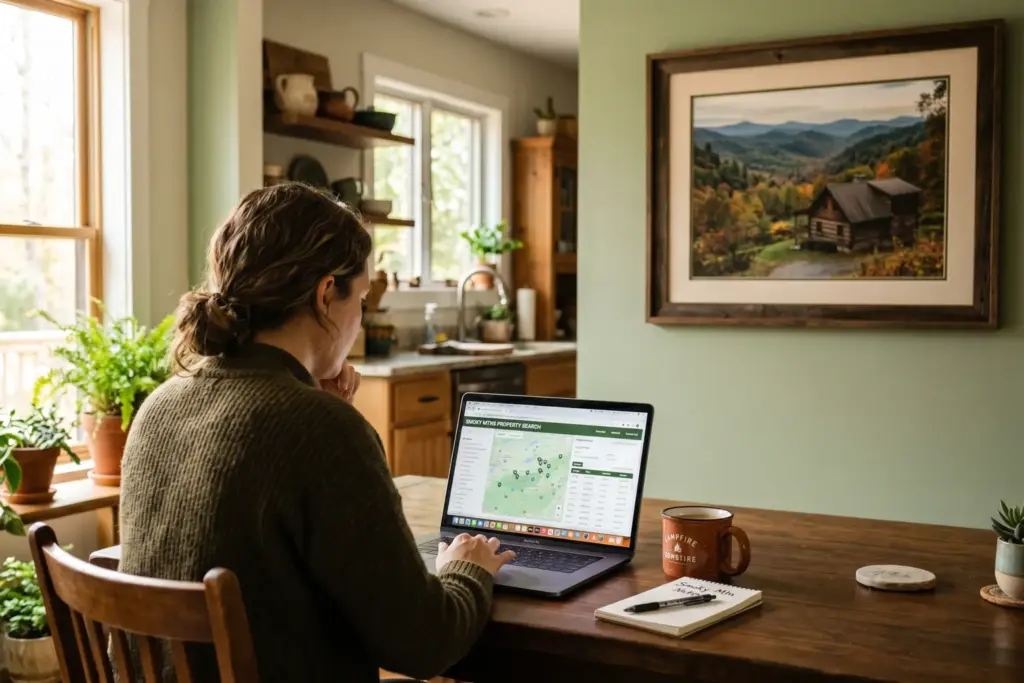
It was a Saturday afternoon in February, and he was sitting at his kitchen table in Chicago, a mug of coffee going cold beside him, staring at occupancy rates and nightly revenue averages for the Smoky Mountains region. He had spent three weekends running numbers on different markets across the country. The Smokies kept coming back to the top of his list.
“I grew up camping in Michigan,” he told me. “I had never even thought about Tennessee as a place to invest. But the data was very clear.” (Marcus is not his real name; he asked to remain anonymous.)
Marcus is not alone in this. Across the country, short-term rental investors are buying properties in markets they have never visited, or visited only briefly, attracted by data that points them somewhere their vacation memories never went. Some are escaping restrictive cities like New York or Los Angeles, where local STR regulations have made it nearly impossible to run a legal listing at home. Others are following pure math: a market in Tennessee or Arizona or the Gulf Coast pencils out better than anything within driving distance.
Some of them get it exactly right. Some make expensive mistakes. And most say the same thing when you ask what they wish they had known before closing.
Buying an Airbnb property remotely in a new market is not a reckless idea. It can be a very good one. But it requires a different kind of due diligence than buying close to home, and the investors who succeed tend to approach it differently than those who struggle.
Here are three of their stories.
Sponsored — Beeline
Finance Your Next STR With a DSCR Loan
Qualify on property cash flow, not W-2 income. Beeline specializes in fast DSCR closings for STR investors. No personal income verification required.
Check Your DSCR Eligibility →Affiliate disclosure: StaySTRA may earn a referral fee.
The Numbers Before the Flight: Marcus and the Smoky Mountains
Before Marcus ever booked a plane ticket to Tennessee, he ran three different markets through the StaySTRA analyzer.
He looked at the Outer Banks. He looked at the Gulf Coast. He looked at the Smoky Mountains. Every time, Gatlinburg and the surrounding area came back with the strongest data for his price range. StaySTRA data shows the Gatlinburg market averaging $319 per night with occupancy running around 54 percent annually, with more than 23,000 active listings in the broader area. The Great Smoky Mountains National Park draws more than 12 million visitors per year, making it the most visited national park in the country. Those visitors need somewhere to stay.
“I had never seen a Tennessee mountain in my life,” Marcus said. “But I understood what 54 percent occupancy means for cash flow. That I could work with.”
He made his offer on a three-bedroom log cabin contingent on a satisfactory inspection. Then he bought a plane ticket. He spent two nights in the area, walked through the property, drove the roads around it, had dinner in town twice, and sat down with two property management companies. He chose a company charging 25 percent of gross revenue, which he had already modeled into his projections.
Year one beat his conservative projection by about 11 percent. He attributes much of that to one decision he made before he ever looked at a single listing.
“I promised myself I would not look for a property until the data told me where to look,” he said. “The market came first. The property came second. Most people do it backwards.”
The step-by-step guide to buying an Airbnb property makes the same point: market selection is more consequential than property selection, because a mediocre property in a strong market will outperform a beautiful property in a weak one. For a buyer who cannot rely on local intuition, that principle matters even more.
The Vacation That Became a Plan: Sofia and the Gulf Coast
Sofia Mendez (a composite character based on conversations with several Gulf Coast STR investors) had the opposite origin story. She had been to Orange Beach, Alabama twice, loved it both times, and started thinking seriously about buying there.
“It was one of those vacations where you feel it in your bones,” she told me. “You are standing on the beach and you think, esto podria ser mio, this could be mine.”
That feeling is not a bad starting point. The problem, Sofia says, was that she let the feeling do the analysis.
She found a two-bedroom Gulf-front condo listed at $489,000 and made an offer within a week of finding it. She had browsed Airbnb listings in the area and felt confident she could generate $50,000 or more per year in gross revenue. What she had not modeled was what would happen to the number after gross revenue.
“I was focused on the top line,” she said. “I did not think carefully enough about what was going to come out of it.”
Property management was the first surprise. Remote-managed STR properties in popular beach markets typically run between 20 and 30 percent of gross revenue for full-service management, meaning the company handles guest communications, check-ins, cleanings, and maintenance coordination. Sofia’s manager charged 28 percent. On $48,000 in gross revenue in year one, that was more than $13,000 before she paid a single repair bill or HOA fee.
“I had modeled 20 percent in my head,” she said. “I had seen that number somewhere online. I did not know that beach resort markets often run toward the higher end of that range, or that the lower numbers you see advertised are usually for different service tiers.”
The HOA was the second surprise. The condo association had rental restrictions buried in the documents she had reviewed but not fully understood. She could only rent to guests staying a minimum of seven nights. In a market where a significant share of bookings come in at three and four nights, that restriction cost her meaningful occupancy, especially during shoulder months.
Sponsored — Beeline
Finance Your Next STR With a DSCR Loan
Qualify on property cash flow, not W-2 income. Beeline specializes in fast DSCR closings for STR investors. No personal income verification required.
Check Your DSCR Eligibility →Affiliate disclosure: StaySTRA may earn a referral fee.
Sofia did not lose the property. She did not have to sell at a loss. But she describes the first year as “a very expensive education.” She renegotiated her PM contract at the end of year one, pulling it to 24 percent after demonstrating she was generating consistent bookings. She also found that the seven-night minimum, frustrating as it was, pushed her average booking value up, which helped offset the occupancy gap.
By year two, she had found her footing. But she is clear about what she would do differently.
“I would have read the HOA documents with someone who understood STR restrictions before I made an offer, not after,” she said. “I would have called five property managers before closing, not after. And I would have modeled three scenarios: optimistic, realistic, and what happens if the property performs 30 percent below what I expected.”
The lesson she returns to most often: “The vacation was real. The numbers I did not do were also real.”
The Research That Took Six Months: Derek and Scottsdale
Derek (not his real name) lives in Portland, Oregon. Portland’s STR laws require a primary residence designation, which means you can only list a property where you actually live. He had watched the regulations tighten for years and finally decided that if he wanted an STR income, he needed to look somewhere else entirely.
“I was not going to fight my city,” he said. “I was going to go find a city that wanted me.”
He spent six months researching markets. He studied Arizona’s preemption law, which prevents cities from banning STRs outright and gives investors meaningful regulatory stability. He read the rankings of the best states for STR investment in 2026. He ran properties in Scottsdale, Sedona, and the broader Phoenix metro through the StaySTRA analyzer, comparing occupancy curves, ADR ranges, and seasonal demand patterns.
Scottsdale, he found, had something the others did not for his price range: a submarket of townhomes and smaller single-family homes between $400,000 and $550,000 that showed strong short-stay data, particularly during the October-to-April high season when Phoenix-area warmth draws visitors from colder climates.
“Before I ever booked a flight, I ran three markets through the StaySTRA analyzer and read everything I could find on the Scottsdale regulatory environment,” he said. “I knew the seasonality curve. I knew the ADR ranges. I knew what I was walking into.”
Walking in, though, was something he actually did. Unlike Marcus, who flew out after making his offer, Derek visited Scottsdale before making any offer at all. He spent four days there, drove neighborhoods at different times of day, and walked into property management offices without an appointment to ask if someone would be willing to sit down and talk. Three of them did.
“That was the most important thing I did,” he said. “Not the data. The PM interviews.”
He was testing for responsiveness, for how they talked about difficult guests, for whether they had a real answer when he asked what happens if something breaks on a Saturday night and the guest is stuck. Two of the three gave him what felt like scripted responses. The third pulled up a recent incident on his phone and walked Derek through exactly what they did, how they communicated with the property owner throughout, and what the guest said in their review afterward.
That is the company Derek hired. They charge 22 percent. He has now owned the Scottsdale property for fourteen months and describes it as performing “solidly within the range I projected, maybe five percent better.”
The piece of the process he credits most is the question he brought to every PM interview. Not “what are your fees?” and not “how many properties do you manage?” Both matter, but neither is the answer.
The question was: “Walk me through the last time something went wrong at 2am and what happened next.”
How They Evaluated Markets Without Being There
All three of these investors used data tools to evaluate markets before they visited. The specific approach differed, but the underlying logic was the same: understand the market through numbers before you try to understand it through experience.
The StaySTRA analyzer was central to the process for Marcus and Derek both. It provides revenue projections, occupancy data, ADR ranges, comparable property analysis, and investment metrics including DSCR, cap rate, and cash-on-cash return, all built from actual STR market data. For an investor evaluating a market from 1,200 miles away, it replaces a significant portion of the on-the-ground intuition that local investors take for granted.
Running the StaySTRA analyzer for a specific property address gives you market context that you cannot get from browsing Airbnb listings. You can see what similar properties nearby are actually earning, not what they are asking, and how that compares to a realistic model for your specific property.
Beyond data tools, all three investors emphasized reading the actual short-term rental regulations in their target markets before making any offer. The STR financing guide for DSCR loans covers the regulatory landscape that lenders evaluate when underwriting remote STR purchases, and lenders in 2026 are increasingly attentive to regulatory risk in ways that first-time remote buyers often are not.
“I had a lender tell me he would not finance in a specific county because of pending regulatory changes,” Derek said. “I had not thought to ask about that. He flagged it in the first five minutes of our call.”
What They Wish They Had Known Before Closing
I asked each of these investors the same question: if you could go back and tell your earlier self one thing, what would it be?
Marcus: “The property manager is as important as the property. Maybe more. You are trusting them with your asset. Vet them the way you would vet a business partner.”
Sofia: “Read the HOA documents as if your investment depends on them. Because it does. Hire someone local to review them with you.”
Derek: “Visit before you close, not after. I know investors who fly out to celebrate closing day, and that is when they see the things they missed. Visit as a skeptic, not as an owner.”
There is a common thread in all three answers. The due diligence that matters most for a remote purchase is not the data analysis, which all three credit with pointing them in the right direction. It is the human layer. The property manager, the HOA documents, the local regulations, the neighbor who knows the access road turns into a river in heavy rain. That layer is harder to research from a laptop, and it is where most remote buyers make their most costly mistakes.
The lessons from hosts who got it wrong the first time tell the same story from the other direction. The properties that underperformed usually had a data problem or a human-layer problem. The data problems are increasingly solvable with the tools that exist in 2026. The human-layer problems still require showing up.
Sponsored — Beeline
Finance Your Next STR With a DSCR Loan
Qualify on property cash flow, not W-2 income. Beeline specializes in fast DSCR closings for STR investors. No personal income verification required.
Check Your DSCR Eligibility →Affiliate disclosure: StaySTRA may earn a referral fee.
The Question That Changes Everything
One question came up in every conversation I had with these investors. Not because I raised it, but because each of them raised it independently, in their own words, usually near the end when they were talking about what they would tell a new remote buyer today.
Derek now sends it in a message before he will get on a phone call with anyone who reaches out asking for advice on remote STR investing. He wants to see how they respond before deciding whether the conversation will be useful.
The question is simple: who handles the call when something goes wrong at 2am and you are 1,200 miles away?
Not “do you have a property manager?” Anyone planning to buy a remote STR intends to have a property manager. The question is whether you have a person, not a service. A person who picks up the phone. A person who makes decisions without waiting for you. A person who knows your property, your guests, and how to handle a broken water heater or a guest who will not leave at checkout.
La tranquilidad, the peace of mind, of owning a remote property entirely depends on the honest answer to that question. And the answer has to exist before you close, not after.
Marcus has that person. So does Derek. Sofia found hers by the middle of year two, which she describes as the turning point when the investment started to feel like something sustainable rather than something she was managing around the edges of her real life.
If you are evaluating a market from a distance right now, running numbers on a screen in a city you hope to leave the investing behind, the data is a very good place to start. Run the analyzer. Learn the regulations. Model three scenarios. Read the complete guide to buying an Airbnb property and then read it again once you think you know what you are doing.
But somewhere in that process, you also have to answer the 2am question. And then you have to go check.
Frequently Asked Questions
Can I buy an Airbnb property in a market I have never visited?
Yes, and many investors do it successfully. The key is letting market data guide your market selection before you invest time in visiting, then conducting thorough in-person due diligence before closing. Investors who struggle tend to choose their market based on a vacation memory and skip the data verification step entirely. Once you have identified a market through data, visiting before closing is strongly recommended, not optional.
How much do property managers charge for remotely owned STRs?
Full-service property management for remotely owned short-term rentals typically runs 20 to 30 percent of gross revenue, with beach and resort markets often landing toward the higher end of that range. Half-service arrangements that handle only guest communications or channel management can run 10 to 15 percent, but they require the owner to coordinate maintenance and cleaning separately. Always model the higher end of the range into your projections before making any offer.
What are the most common mistakes remote STR buyers make?
The three most common are: choosing a market based on personal vacation preference rather than market data, underestimating property management costs and failing to model them into projections before closing, and not vetting the property management company before signing a contract. HOA restrictions on short-term rental activity are also a frequent blind spot that can significantly constrain revenue after closing.
Which markets attract the most out-of-state STR investors?
The Smoky Mountains (Gatlinburg and Pigeon Forge, Tennessee), the Gulf Coast (Orange Beach, Alabama and Destin, Florida), Scottsdale, Arizona, and the Finger Lakes region of New York consistently attract the highest concentration of out-of-state STR buyers. These markets combine strong year-round demand fundamentals with investor-friendly regulatory environments and accessible price points for new investors.
Sponsored — Beeline
Finance Your Next STR With a DSCR Loan
Qualify on property cash flow, not W-2 income. Beeline specializes in fast DSCR closings for STR investors. No personal income verification required.
Check Your DSCR Eligibility →Affiliate disclosure: StaySTRA may earn a referral fee.
We do our best to keep our content accurate and up to date, but things change and we are only human. Always verify details directly with local sources before making decisions.