

Key Takeaways
- On a cool Sunday afternoon in early October, Maria Gonzalez stands on the porch of her Hyde Park bungalow, watching a young couple from Seattle unload their luggage.
- October: When Austin Becomes a Tax Revenue Symphony “In October, the eyes of the world are on Austin,” says Wesley Lucas from Visit Austin.
- City officials expect the new platform collection system to “drastically increase” the $7 million previously collected from STRs.
- The festival welcomes 450,000 fans over two weekends, creating massive demand for lodging, dining, and entertainment.
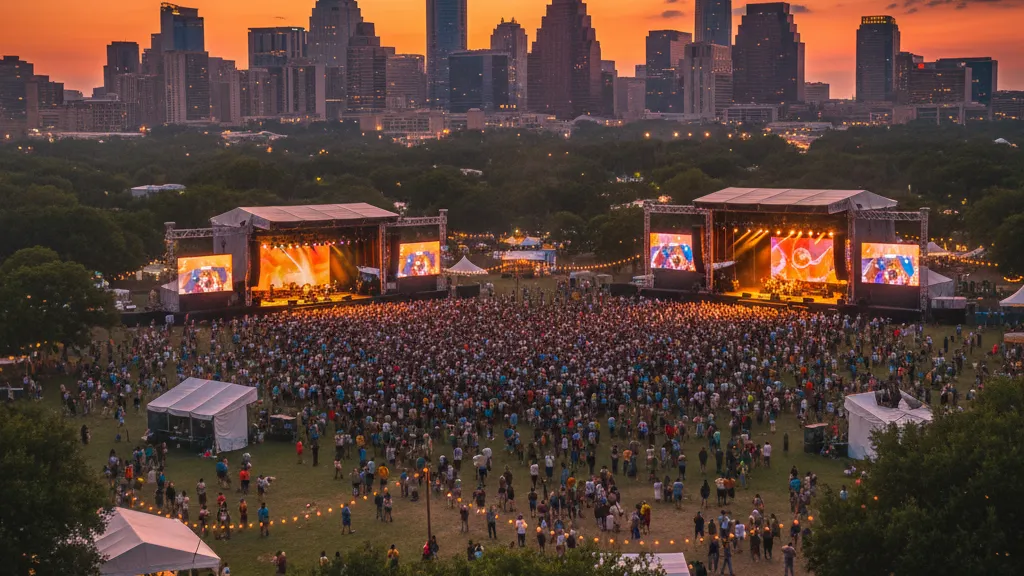
On a warm October evening in Austin, as 75,000 music lovers stream into Zilker Park for Austin City Limits, another story unfolds in neighborhoods across the city—one of short-term rental hosts, new tax policies, and the half-billion dollars flowing through Austin’s economy.
On a cool Sunday afternoon in early October, Maria Gonzalez stands on the porch of her Hyde Park bungalow, watching a young couple from Seattle unload their luggage. They’re here for Austin City Limits, and they’ve booked her guest cottage for the entire first weekend. As she hands them the keys, Maria thinks about how much has changed since April—not just in her own life as a short-term rental host, but in the very fabric of how Austin collects revenue from visitors like these.
“Bienvenidos,” she says warmly, slipping into Spanish as she often does when excitement takes over. “You picked the perfect weekend to visit our city.”
What Maria’s guests might not realize as they settle in for their ACL adventure is that their stay is part of a much larger story—one that intertwines music, money, and a fundamental shift in how Austin captures the economic value of its most beloved events.
A New Chapter in Austin’s Tourism Tax Story
The sense of comunidad (community) around Austin City Limits has always been palpable. But in 2025, there’s something different in the air—a new understanding of how the city’s biggest music festival contributes to its fiscal health, particularly through the short-term rental market.
This year marks the first ACL festival since Austin implemented a groundbreaking change: as of April 1, 2025, platforms like Airbnb and Vrbo must collect and remit the city’s 11% Hotel Occupancy Tax directly from short-term rental bookings. The policy shift, designed to close loopholes that allowed thousands of unlicensed rentals to operate without paying taxes, arrives just in time for ACL’s October weekends—when the city welcomes 450,000 music fans over two consecutive weekends.
Walking through East Austin one Thursday before the festival, I couldn’t help but notice the preparations. Hosts were refreshing their outdoor spaces, stocking their kitchens, and preparing welcome guides filled with ACL tips. Each of these properties, whether licensed or not, would now contribute to the city’s tax base in a way they hadn’t before.
The Half-Billion Dollar Harmony
Where some see disruption in new tax policies, others see opportunity—and Austin City Limits 2025 represents the perfect moment to witness both perspectives in action.
The numbers tell a compelling story: ACL generates approximately half a billion dollars for Austin’s economy each year. That’s not a typo—$500 million flowing through hotels, restaurants, shops, music venues, and yes, short-term rentals. In 2024 alone, the festival generated $534.8 million, the highest in its history, with attendee spending jumping to $415.4 million.
But here’s where the story gets interesting for our community of STR hosts: before April 2025, Austin collected only about $7 million annually in hotel occupancy taxes from short-term rental operators. That represented just 4% of the city’s total Austin City Limits tax revenue, despite thousands of properties hosting visitors during peak events like ACL.
Ziyu Huang, who manages rental properties through Austin Homes and Rental Management, shared his perspective: “We do a lot of marketing from the beginning of the year to drive the demand.” His company’s properties get booked months in advance for ACL, and now, for the first time, they’re automatically contributing their full share to the city’s tourism infrastructure.
The Human Side of Tax Collection
A host who’s run her South Congress STR for five years shared a candid moment with me over coffee at Jo’s. Let’s call her Rebecca, because she asked me not to use her real name—she’s still navigating the new licensing requirements.
“Look, I always wanted to pay my fair share,” Rebecca explained, stirring her cortado thoughtfully. “But the old system was confusing. You had to register, track everything yourself, file quarterly… For someone running just one property while working a full-time job, it felt overwhelming. Now Airbnb just handles it automatically. Honestly? It’s a relief.”
Rebecca’s ACL weekend bookings exemplify the festival’s impact on short-term rental revenue. Her two-bedroom cottage near St. Edward’s University, which typically rents for $150 a night, commands $450 per night during ACL weekends. With the 11% hotel tax now automatically collected, her three-night ACL booking generates $148.50 in tax revenue for the city—money that previously might have slipped through the cracks if she’d been operating without proper licensing.
Multiply that by thousands of properties across Austin, and you begin to understand the scale of the revenue shift.
October: When Austin Becomes a Tax Revenue Symphony
“In October, the eyes of the world are on Austin,” says Wesley Lucas from Visit Austin. And when those eyes arrive, they bring wallets—and now, thanks to the new collection system, they bring Austin City Limits tax revenue in a way the city has never quite captured before.
The Austin City Limits festival doesn’t just fill Zilker Park; it fills every corner of the city. Properties in neighborhoods miles from the festival grounds see booking spikes. Guests want to experience “real Austin,” as one visitor from Germany told me, staying in a Clarksville apartment and taking the ACL shuttle from downtown each day.
Austin-Bergstrom International Airport expects up to 35,000 passengers on high-volume days across both ACL weekends. Many of those travelers will bypass traditional hotels in favor of short-term rentals, seeking the authenticity and space that a whole house or apartment provides.
The city’s 11% hotel occupancy tax—comprised of a 9% base tax and an additional 2% venue project tax—now captures revenue from nearly all of these stays. The tax revenues, by law, must be spent on tourism promotion, creating a virtuous cycle: ACL generates STR bookings, STR bookings generate tax revenue, and that revenue supports the tourism infrastructure that makes events like ACL possible.
The Enforcement Evolution
Behind every policy change lies a network of people working to make it real. Mayor Pro Tem Vanessa Fuentes has emphasized the urgency of acquiring enforcement technology to capture “thousands of hotel tax dollars” from properties that were previously operating under the radar.
The city estimates around 10,000 unlicensed short-term rental properties have been operating in Austin. While the city has nearly 2,200 active licenses, data suggests the true number of operating STRs is far higher. The new platform collection requirement means that even unlicensed properties contribute to the tax base when guests book through major platforms—a significant shift in enforcement philosophy.
Marc, a Hyde Park homeowner who attended city council meetings about the new regulations, told me: “It’s not about punishment. It’s about fairness. Traditional hotels have always paid these taxes. Now we all do, and honestly, it should have been this way from the beginning.”
The Ripple Effect Beyond Tax Revenue
The story of ACL’s tax revenue impact extends beyond the literal dollars flowing into city coffers. It touches on questions of equity, community impact, and what it means to be a responsible host in a rapidly changing city.
During ACL weekend, some neighborhoods transform entirely. Streets that are normally quiet hum with out-of-state license plates and groups of festival-goers comparing outfits before heading to Zilker. Long-term residents share sidewalks with visitors trying to navigate unfamiliar streets.
I spoke with Thomas, a long-time Bouldin Creek resident who lives next door to an STR property. “Look, I love ACL. I’ve gone every year since 2008,” he said, standing in his driveway as festival traffic hummed nearby. “But I also want to know that the impact on our neighborhood—the noise, the parking challenges, the strain on our infrastructure—is at least generating some benefit for the city. If these properties are paying hotel taxes like they’re supposed to, that helps me accept the trade-off.”
His neighbor, the STR host, sees it similarly: “I want to be a good neighbor and a good citizen. Paying the hotel tax is part of that responsibility. The new system makes it easier to do the right thing.”
What the Future Holds
As I watched Maria’s guests head out for their first night at ACL, festivalgoers dressed in their finest Austin weird, I thought about what this all means for the future of our city’s relationship with tourism, music, and short-term rentals.
The Austin City Limits tax revenue from October’s ACL weekends will help fund Visit Austin’s marketing efforts, support the convention center, and contribute to the live music infrastructure that makes Austin the Live Music Capital of the World. Fifteen percent of new revenue from hotel occupancy taxes goes directly to Austin’s live music scene, another 15% to historic preservation.
City officials expect the new platform collection system to “drastically increase” the $7 million previously collected from STRs. While exact projections aren’t available yet, some estimates suggest the city could see a 300-500% increase in STR tax revenue, potentially adding $20-30 million annually to the city’s tourism budget.
For hosts like Maria, the change means peace of mind. For guests, it’s largely invisible—just another line item in their booking cost. But for Austin as a whole, it represents a fundamental shift in how the city captures value from its tourism economy.
The Music Plays On
As dusk settled over Austin on that first Friday of ACL 2025, I found myself at a coffee shop near Barton Springs, talking with yet another host preparing for the weekend’s guests. She’d been part of the short-term rental community for nearly a decade, watching Austin grow and change, watching regulations come and go, watching neighborhood debates flare and settle.
“You know what’s beautiful about ACL?” she said, looking out the window toward Zilker Park, where stage lights were beginning to glow in the distance. “It’s not just about the music, though God knows that’s magical. It’s about what happens when people come together. And now, for the first time, we’re all really coming together—hosts, the city, the platforms—to make sure this incredible event benefits everyone.”
The half-billion dollars that ACL generates for Austin’s economy isn’t just a number. It’s Maria welcoming guests to her cottage. It’s Rebecca finally feeling like the system works for her instead of against her. It’s Thomas accepting the trade-offs because he knows his neighborhood’s impact is recognized and compensated. It’s tax revenue that will support the very cultural infrastructure that makes events like ACL possible in the first place.
As the first notes of Friday’s headliners drifted across the city that evening, Austin’s short-term rental hosts could rest easy knowing they were part of something larger—a symphony of music, community, and now, finally, fair taxation.
The music plays on, and so does the city’s economic engine, now running more efficiently than ever before.
Frequently Asked Questions
How much hotel tax do short-term rentals pay during Austin City Limits?
Short-term rentals in Austin pay an 11% Hotel Occupancy Tax, comprised of a 9% base tax and 2% venue project tax. During ACL weekends, when nightly rates often triple, a typical $450/night STR booking generates $49.50 in tax revenue per night. With thousands of properties booked across two festival weekends, this represents millions in Austin City Limits tax revenue for the city.
When did Austin start requiring platforms to collect STR taxes?
On April 1, 2025, Austin implemented a new requirement mandating platforms like Airbnb and Vrbo to automatically collect and remit Hotel Occupancy Tax for short-term rental properties. This policy change arrived just months before ACL 2025, ensuring maximum tax collection during the festival’s peak booking season.
How much revenue does Austin City Limits generate for the local economy?
Austin City Limits generates approximately half a billion dollars annually for Austin’s economy. In 2024, the festival reached a record $534.8 million in economic impact, with attendee expenditures alone totaling $415.4 million. The festival welcomes 450,000 fans over two weekends, creating massive demand for lodging, dining, and entertainment.
What happens to hotel tax revenue collected from STRs?
By law, Austin’s Hotel Occupancy Tax revenue must be spent on tourism promotion and related infrastructure. Currently, 15% of new revenue goes to Austin’s live music scene, another 15% supports historic preservation, and 70% funds convention center expansion. This creates a cycle where festival tax revenue supports the tourism infrastructure that makes festivals possible.
How many unlicensed short-term rentals operate in Austin?
Austin officials estimate around 10,000 unlicensed short-term rental properties operate in the city, despite only 2,200 active licenses on record. The new platform collection requirement means even unlicensed properties now contribute hotel taxes when guests book through major platforms, significantly closing the tax gap without requiring immediate licensing compliance.
Frequently Asked Questions
What are the Airbnb rules in Austin, Texas?
Austin distinguishes between Type 1 (owner-occupied) and Type 2 (non-owner-occupied) STR licenses. Type 2 licenses are no longer being issued in most residential zones, making existing licenses valuable. All operators must obtain a license, collect hotel occupancy taxes, post the license number on listings, and comply with occupancy and noise restrictions.
Is Austin still a good market for short-term rentals?
Austin remains strong for STRs due to its robust event calendar (SXSW, ACL, F1), tech sector business travel, and tourism appeal. However, restrictive regulations on non-owner-occupied properties have limited new supply, which benefits existing permitted operators. Investors should focus on Type 1 properties or look at surrounding areas with fewer restrictions.
Do I need a permit to operate a short-term rental?
Most cities and counties require some form of permit, license, or registration to operate a short-term rental legally. Requirements vary significantly by jurisdiction, so check your local government website or contact your city clerk before listing your property. Operating without required permits can result in fines ranging from several hundred to several thousand dollars per violation.
How do I find the STR regulations for my area?
Start by searching your city or county government website for short-term rental or vacation rental ordinances. Many municipalities have a dedicated STR registration page with application forms and requirements. You can also contact your local planning department directly or consult with a real estate attorney who practices in your area.
What is the short-term rental tax loophole?
The STR tax loophole allows property owners who materially participate in managing their short-term rental to deduct losses against active income like W-2 wages. This works because rentals with an average guest stay of seven days or fewer are not classified as passive rental activities under IRS rules. It is one of the most powerful tax strategies available to real estate investors.