

Key Takeaways
- The first ten minutes after arrival set the emotional tone for the entire Thanksgiving stay. Get them right and guests will forgive almost anything else.
- A handwritten welcome note that names the holiday does more for your reviews than any upgraded amenity. It costs ninety seconds to write.
- A single printed card with the best local pie shop hours, the nearest grocery open on Thursday, and one good trail is worth more to a Thanksgiving guest than a smart TV.
- The one thing most hosts overlook: extra blankets staged visibly near the fireplace before check-in. Not in a closet. On the couch, where guests can find them without asking.
- Guests who book a cabin for Thanksgiving are buying a feeling, not features. Give them warmth, welcome, and the sense that someone thought about them before they arrived.
I had a guest leave a five-star review that said, “It felt like someone actually thought about us.” She did not mention the new kitchen appliances I had just spent four hundred dollars on. She mentioned the candle I lit before check-in and the note I left on the kitchen counter.
That is Thanksgiving hosting in one sentence.
Guests who book a cabin for Thanksgiving are not shopping for square footage or an amenities checklist. They are buying a feeling. They want the fireplace ready and the throw blankets close. They want to feel like they came somewhere that was actually prepared for them. Not a hotel-prepared version of that. The real version, where the person who owns this place thought about what a family would want to find on a cold November afternoon after driving three hours together.
I have been hosting at my two cabins outside Gatlinburg since 2018. Thanksgiving week has become my favorite week of the year. The guests who book it are different. They planned this. They told their grandmother to clear her schedule. They have expectations, and almost none of those expectations involve the specs in your listing.
What Your Thanksgiving Guests Are Actually Carrying In
They arrive with a cooler full of groceries, a twelve-year-old who already found the Wi-Fi password, and a quiet hope that this trip was worth it. That hope is doing a lot of work by the time they pull into your driveway. Three hours in a car, one wrong turn, a gas station stop that went longer than it should have. They are tired and they want to feel good about choosing to be here.
Your job in those first ten minutes is to confirm that decision.
This is where hosts lose Thanksgiving guests. Not always with broken things or missing supplies, though both will cost you. They lose them in the gap between what the listing photos promised and what actually greets them at the door.
The listing shows a glowing fireplace. They arrive at four in the afternoon and the fireplace has not been touched. No note anywhere. The welcome book is a binder from two years ago with a coffee stain on the cover. It takes them twenty minutes to figure out the TV. By then the hope has done most of its deflating.
Now let me tell you what the five-star Thanksgiving arrival looks like instead.
The Arrival That Gets Remembered
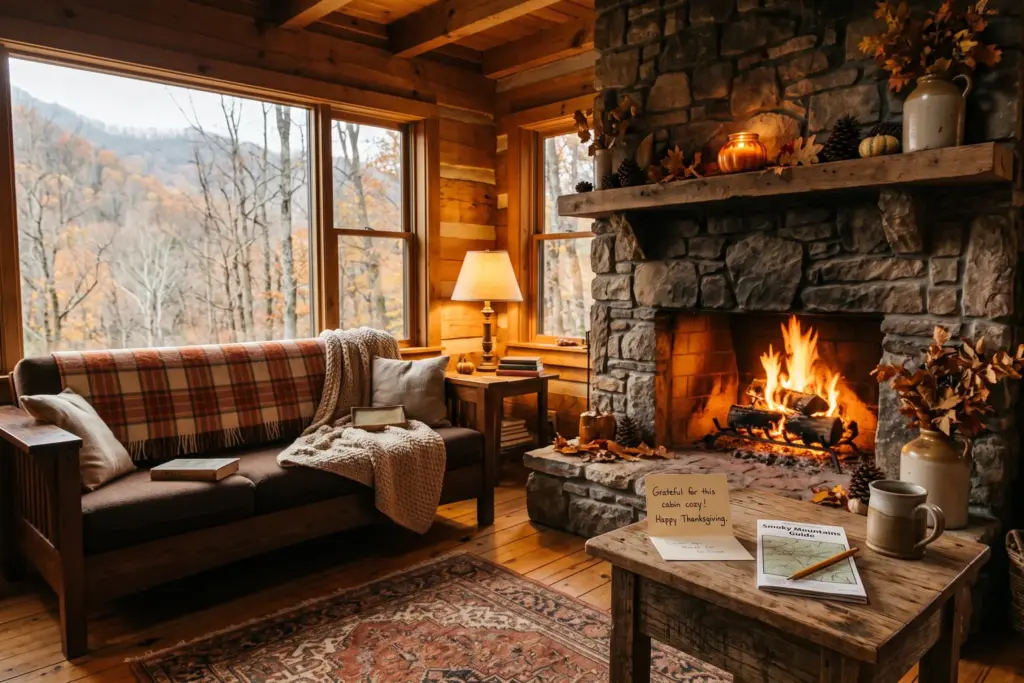
You stage the fireplace before they get there. In Tennessee that means kindling already laid, a lighter placed on the mantel where anyone walking in can see it. If you have a gas fireplace, leave the remote on the coffee table with a small sticky note: “the button on the right.” That level of specific. Not assumed. Explained.
You put three throw blankets on the couch. Not folded in a basket across the room. On the couch, where someone will sit within ten minutes of walking in the door.
You light a candle before you leave. Something with clove or cedar or spiced apple, anything that says late November rather than “someone cleaned here recently.” When I can visit before check-in, I light a candle and crack a window for a few minutes so the cabin breathes in some cold air before it fills back up with warmth. It sounds like nothing. My guests mention it constantly.
You do not need a diffuser system or a fifty-dollar holiday candle. What matters is the intention behind it. Guests can feel when a host did something for them versus when a host checked a box.
Write the Note
I have been leaving handwritten welcome notes for six years and guests still mention them in reviews. Not because my handwriting is impressive (it is not), but because a handwritten note says that a real person was here thinking about you before you arrived.
For Thanksgiving guests, the note should name the holiday. That sounds obvious, but most hosts write the same welcome note year-round. “Welcome to the cabin! Hope you enjoy your stay.” That note is for everyone, which means it is really for no one.
My Thanksgiving note says something like this: “So glad you chose to spend Thanksgiving here. The fireplace lighter is on the mantel. There is a local guide on the kitchen counter with my favorite spots for the week. Help yourselves to the coffee. Have a wonderful holiday.”
Four sentences. It takes ninety seconds. But it lands differently because it proves I knew it was Thanksgiving when I wrote it. Guests feel seen. That is half the job right there.
The Local Guide Card
This is the single recommendation I push hardest whenever I talk to other hosts, and it is also the one almost nobody does. Not a welcome binder. Not a digital guidebook. A printed card, one piece of paper on cardstock if you have it, with five or six specific things written in plain language.
For Thanksgiving week, mine looks like this:
For the holiday: The Apple Barn in Sevierville is open the day before Thanksgiving and closes early on Thursday. Get your apple pies and cider Tuesday or Wednesday morning. They sell out and they are worth the drive.
For Thursday groceries: Check the Kroger on Winfield Dunn Parkway in Sevierville for Thanksgiving morning hours (Source). Closer than you think and usually open until midday.
For a morning walk: Alum Cave Trail off Newfound Gap Road is my recommendation for families. About 4.6 miles round trip to the bluffs, steady climb, beautiful in fall color (Source). Check nps.gov/grsm before you go since conditions change in November and closures happen.
For a meal out: The Old Mill in Pigeon Forge serves a full Thanksgiving dinner. Reservations are not accepted, so go early and expect a wait (Source).
Four items. All specific, all true. I update this card every October because hours change and businesses close and the world does not stand still. A recommendation I have not verified since last year is a recommendation I should not be making.
Guests love this card not because the information is impossible to find online. They love it because a person who actually lives here handed it to them and said, in effect: I thought about what you might need this week. That is the difference between a host and a landlord.
For a deeper look at how these kinds of personal touches connect to the reviews you earn, the full guide to getting consistent 5-star Airbnb reviews is worth reading before you finalize your Thanksgiving setup.
The One Thing Most Hosts Forget
Extra blankets. Placed visibly. Not stored in a closet.
I cannot explain why this one catches hosts, but it does every single winter. I hear from people in host groups about guests who mentioned feeling cold, and when I ask where the extra blankets were, the answer is “in the hall closet” or “inside the ottoman” or “I definitely have them.”
Guests should not have to look.
A Thanksgiving guest arrives with a grandmother who runs cold, with children, with people who are going to be awake late in front of the fire on Thursday night. By eight o’clock someone is going to want another blanket. If they have to ask for it or search for it, that is a small friction. Small frictions at Thanksgiving pile up. The grandmother mentions it at breakfast. Your listing gets quietly filed in someone’s memory as “the place where we were a little cold.”
Put a stack on the couch. Fold one over the arm of the chair by the fireplace. If you have a second sitting area, put one there too. When guests walk in and see blankets already placed like someone anticipated them, something relaxes in the room. They stop problem-solving and start settling in.
The Sensory Details That Cost Almost Nothing
While you are staging the cabin, walk through it and ask yourself what you notice before the lights go on. Because your guests will notice it too, even if they never say so out loud.
Cold cabin. Candle. Warm lamps on low. Blankets on the couch. Fireplace ready. Welcome note on the counter. Local guide next to it. Coffee already stocked in the kitchen. Those details cost somewhere between nothing and twenty dollars and they produce reviews that sound like they were written by someone describing a favorite memory.
One guest left a review of my cabin that said: “It felt like walking into someone’s grandmother’s house, but stylish.” I have thought about that sentence for two years. It is exactly what Thanksgiving guests are searching for when they book a cabin instead of a hotel room.
They are not looking for a hotel. They have hotels. They booked a cabin because they wanted something that felt inhabited and warm and chosen for them. Your job is to deliver that feeling in the first ten minutes. Everything after that is gravy, and I mean that both ways.
The Review That Follows
When hosts ask me what to do to improve their reviews, I always say the same thing: stop thinking about your listing and start thinking about your guest’s first hour inside the door.
Most of what ends up in a five-star review happened in that first hour. The candle that was lit. The note that said their name or their holiday. The blankets that were already there. The fireplace that was already laid. Guests settle in. They exhale. They feel like they were expected. By Thursday evening they are already wondering whether to book again for Christmas.
The hard thing about hospitality is that it does not appear anywhere in your listing. You cannot bullet-point warmth. You cannot add “you will feel genuinely welcomed” to your amenities. The only way to compete on hospitality is to actually do the work, every stay, every season, every time someone drives three hours to spend a holiday in a place they have never been.
Thanksgiving gives you a natural opening because guests arrive already in a hopeful frame of mind. They chose this week on purpose. They are primed to feel something good if you give them the chance. Be the host who knew that before they pulled into your driveway.
If you want to see how your cabin is performing compared to similar properties in your market, the StaySTRA Analyzer is a free tool that pulls occupancy and revenue data for your area so you know exactly where you stand heading into the holiday season.
Frequently Asked Questions
What do Airbnb guests want most in a cabin for Thanksgiving?
Thanksgiving cabin guests want to feel expected and welcomed. The details that show up consistently in five-star reviews are sensory and personal: a warm cabin on arrival, a handwritten note that mentions the holiday, visible blankets near the fireplace, and a specific local guide with Thanksgiving-week recommendations. Guests respond to evidence that the host thought about them before they arrived, not the length of the amenities list.
How do I make Airbnb guests feel welcome at Thanksgiving?
The highest-impact moves are also the simplest: light a fall candle before check-in, stage blankets visibly on the couch, lay the fireplace so it is ready to go, and leave a handwritten note that names the holiday. A one-page printed local guide with a pie shop recommendation, the nearest grocery open on Thursday, and one good walk turns a generic welcome into something guests remember and describe in reviews.
Should I leave a welcome gift for Thanksgiving Airbnb guests?
A physical gift is not necessary, but a gesture always lands well. A bottle of apple cider, a small bag of locally made coffee, or a seasonal candle costs almost nothing and reinforces the warmth of the stay. That said, the handwritten welcome note consistently outperforms any gift in terms of what guests actually mention. It costs nothing but a moment of your time and it tells guests that a real person was thinking about them.
What local information should I include in a Thanksgiving welcome guide?
Keep it Thanksgiving-specific and practical. Include a local bakery or pie shop with hours, noting if they close early on Wednesday. Add the nearest grocery store open on Thanksgiving Thursday. Give one outdoor trail recommendation for a morning walk. Include a restaurant that serves Thanksgiving dinner if guests want a night off from cooking. One printed card with four to six items beats a full binder every time. Update it every October so the hours are current.
What is the one thing Airbnb cabin hosts forget for Thanksgiving guests?
Extra blankets placed where guests can see them without searching. Cabin guests at Thanksgiving often arrive with elderly relatives or young children who get cold. If blankets are folded inside an ottoman or stored in a hall closet, guests feel less cared for, even if they can technically find them. Put blankets on the couch, fold one over a chair near the fireplace, and let your guests grab what they need without ever having to ask.
Preparing your cabin for Thanksgiving is one of the best things you can do for your fall reviews, your repeat bookings, and your own satisfaction as a host. If you want the StaySTRA take on what is moving in cabin markets heading into the holiday season, sign up below and we will put it straight in your inbox.
Become a StaySTRA Insider
Join free — get our newsletter + 1 free property analysis/month.
No spam. Unsubscribe anytime. Free membership includes property analyses and market insights.
Loretta May Jenkins is a StaySTRA columnist and active Airbnb host. Her views are her own and reflect her personal hosting experience.