

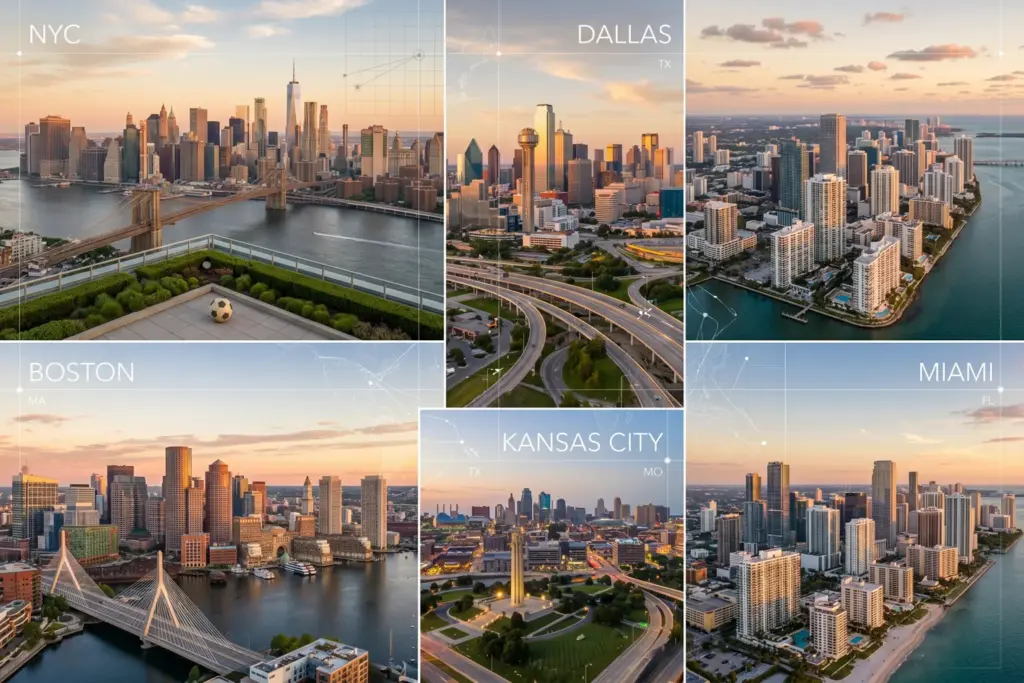
Key Takeaways
- A Deloitte study commissioned by Airbnb projects the average US World Cup host will earn $4,000 during the June 11-July 19 tournament, with New York-New Jersey leading at $5,700 per host and Boston at $5,200.
- Vancouver’s accommodation crisis previews the US supply problem: Deloitte projects a 70,000-night shortfall over just nine critical tournament days, with up to 15,000 fans unable to find beds on peak nights.
- StaySTRA data shows Miami leads US host cities for baseline monthly revenue at $4,879, while Kansas City and San Francisco carry the strongest occupancy rates and tightest active inventory among all 11 markets.
- The three widest supply-demand gaps belong to Philadelphia (roughly 426 licensed STRs serving an estimated 149,000 visitors), Boston (2,952 active listings under a primary-residence restriction that prevents new supply), and Kansas City (1,892 active listings with match-day rates already hitting $508).
- For DSCR investors, Kansas City is the standout: median home prices near $310,000, a Market Score of 94 out of 100, and debt-service coverage ratios that comfortably clear the 1.25 threshold lenders require.
A Deloitte study commissioned by Airbnb projects the average US short-term rental host will earn $4,000 during the 2026 FIFA World Cup, with hosts in the New York-New Jersey metro projected to collect $5,700 over the June 11 through July 19 tournament window. Those numbers have been circulated widely, and they deserve attention. But they are projections based on demand. The more useful question for investors right now is: how much supply actually exists to meet that demand, and what does the gap look like city by city?
I spent forty years as a government statistician before I started doing this work, and I have seen more than a few projections outrun the reality. The Deloitte figures are credible and well-sourced. What they do not capture is the supply side of the ledger, which in several of these markets is genuinely thin. That gap is where the investor story lives.
What Vancouver Tells Us About Supply Constraints
Before turning to the US cities, it helps to look north. Vancouver is hosting seven World Cup matches, and a separate Deloitte report commissioned by Airbnb projects the city will face a shortfall of roughly 70,000 accommodation nights over the nine busiest tournament days. Total accommodation capacity across hotels and short-term rentals in Metro Vancouver is estimated at about 41,800 nights. On peak match days, up to 15,000 fans may find no available room at any price. The projected spending loss from that gap runs to approximately CAD $45 million.
Vancouver’s regulatory environment is the reason. Short-term rentals under 30 days are only legal for hosts who live on the property and hold a city license. That means supply cannot expand to meet demand no matter how high rates climb. The hosts who are licensed and listed are positioned to earn at extraordinary rates. Those who are not cannot participate at all.
Several US host cities are dealing with similar structural limits. Understanding that dynamic is what separates a good revenue projection from an actionable investment thesis.
All 11 US Host Cities: What StaySTRA Data Shows
Think of the table below as two dials set next to each other. One dial shows what the market does on a normal day. The other shows what Deloitte expects it to do during the tournament. The gap between those two readings is where the opportunity sits, and it varies considerably across the 11 markets.
StaySTRA data for each US host city, with Deloitte World Cup projections:
| City | WC Matches | StaySTRA ADR | Annual Occ. | Avg Monthly Revenue | Active Listings | Deloitte WC Projection |
|---|---|---|---|---|---|---|
| New York-NJ | 8 | $169 | 76.7% | $3,443 | 23,394 | $5,700 per host |
| Boston | 7 | $221 | 64.8% | $3,607 | 2,952 | $5,200 per host |
| Los Angeles | 8 | $208 | 67% | $3,822 | Limited (primary-res. rules) | $5,100 per host |
| Miami | 7 | $282 | 61% | $4,879 | 8,743 | $5,000 per host |
| Dallas | 9 | $221 | 47% | $3,141 | 4,739 | $4,400 per host |
| Seattle | 6 | $159 | 63% | $2,690 | 8,738 | $3,800 per host |
| Atlanta | 8 | $172 | 58.2% | $2,735 | 13,156 | $3,700 per host |
| Kansas City | 6 | $212 | 64% | $3,598 | 1,892 | $3,500 per host |
| Houston | 7 | $159 | 51.6% | $2,456 | 21,579 | $3,000 per host |
| San Francisco | 6 | $221 | 72% | $4,264 | Limited (primary-res. rules) | $3,000 per host |
| Philadelphia | 6 | $150 | 61% | $2,486 | ~426 licensed | $1,900 per host |
StaySTRA data as of early 2026. Monthly revenue reflects market averages across listing tiers. Deloitte projections represent tournament-period estimates per host, not annual figures. Los Angeles and San Francisco active listing counts reflect primary-residence-only regulatory environments; total metro supply is larger than city-level figures indicate.
A Few Numbers Worth Pausing On
Miami’s $4,879 monthly revenue figure stands out. It is the highest baseline of any US host city in StaySTRA data. The World Cup projection of $5,000 per host for the tournament period is adding roughly one strong month of earnings on top of a market that produces strong months routinely. The Miami story gets more complicated when you examine entry costs, which we cover in the DSCR section below.
San Francisco shows $4,264 monthly revenue and 72% annual occupancy, which are genuinely strong numbers for any STR market. San Francisco also requires primary-residence hosting, meaning the market is structurally closed to outside investors. Existing licensed operators there are holding a scarce asset during a tournament that brings significant new demand to the Bay Area.
New York-New Jersey leads Deloitte’s projections at $5,700 per host, but New York City itself rejected lifting its short-term rental restrictions for the tournament. The projected earnings primarily reflect New Jersey supply, with hosts in Jersey City and Newark absorbing MetLife Stadium demand that New York turned away.
Where the Supply-Demand Gap Is Widest
Supply constraints matter because they are the mechanism by which demand turns into pricing power. When supply is fixed and demand rises, rate increases are not limited by what hosts are used to charging. They are limited only by what visitors will pay. In a city with 426 licensed STRs and 149,000 expected visitors, that ceiling is quite high.
Philadelphia: The Most Extreme Ratio
Approximately 426 licensed short-term rentals are serving an estimated 149,000 visitors expected for the Philadelphia tournament matches. That is roughly a 350-to-1 ratio. StaySTRA data puts Philadelphia’s ADR at $150 and annual occupancy at 61%, modest numbers by national standards. But those figures reflect a normal market. The licensed hosts who exist during peak tournament weeks will face pricing power that annual averages cannot predict. Deloitte’s projection of $1,900 per Philadelphia host may actually be conservative given how thin the supply is. The investment complication is that Philadelphia’s licensing constraints are real, and prospective investors who do not already hold a local STR license will find entry difficult.
Boston: Primary-Residence Rules Cap Supply
Boston’s 2,952 active listings operate under a primary-residence requirement that prevents investors from adding capacity. As of late March, 58 to 63 percent of Boston tournament-period inventory was already booked, with opening-weekend rates averaging $453. Deloitte projects $5,200 per host at an average of $339 per night, the highest projected nightly rate of any US host city. The gap in Boston is structural and permanent for the tournament window. Hosts who are already operating there should price accordingly and price confidently.
Kansas City: Limited Supply Meets Concentrated Match Demand
Kansas City has 1,892 active listings and six World Cup matches. Match-day average daily rates were already tracking at $508 with 42 to 49 percent fill rates as of late March. The Deloitte projection of $3,500 per host likely understates what peak game days will produce for well-located properties. Kansas City also established a special short-term rental permit program for the World Cup, which is a meaningful detail for any investor navigating the regulatory environment there.
Sponsored — Beeline
Finance Your Next STR With a DSCR Loan
Qualify on property cash flow, not W-2 income. Beeline specializes in fast DSCR closings for STR investors. No personal income verification required.
Check Your DSCR Eligibility →Affiliate disclosure: StaySTRA may earn a referral fee.
The DSCR Investment Case: Three Markets Worth the Math
The Deloitte tournament ranking is useful for existing hosts making pricing decisions. For investors evaluating whether to buy using a DSCR loan, a different ranking applies. It weighs year-round revenue against entry cost and debt service, with the tournament premium as an additional upside, not the foundation of the case. Here are the three markets where that analysis produces the most compelling result.
Market 1: Kansas City
Kansas City is the strongest DSCR case among all 11 US World Cup host markets. StaySTRA data shows a Market Score of 94 out of 100, annual occupancy of 64%, a $212 average daily rate, and $3,598 in monthly revenue. The market has only 1,892 active listings, which is a narrow supply base for a city hosting international matches. Median home prices in Kansas City run around $310,000, making it significantly more affordable than any coastal host market.
A straightforward DSCR underwriting at current rates:
- Purchase price: $310,000
- Down payment (25%): $77,500
- Loan amount: $232,500 at 7.25% over 30 years
- Monthly debt service: approximately $1,587
- Annual debt service: $19,044
- Annual revenue at StaySTRA baseline: $43,176
- Operating expenses (35%): $15,112
- Annual net operating income: $28,064
- DSCR: approximately 1.47
That passes the standard 1.25 minimum with room to spare, and it does not include any tournament premium. A conservative $3,000 to $5,000 in World Cup earnings during game weeks improves the picture further. Do not let the Midwest location make you dismiss this one. The combination of affordable entry and a tight, high-quality market with a grade-A rating is exactly what DSCR underwriters want to see.
Sponsored — Beeline
Finance Your Next STR With a DSCR Loan
Qualify on property cash flow, not W-2 income. Beeline specializes in fast DSCR closings for STR investors. No personal income verification required.
Check Your DSCR Eligibility →Affiliate disclosure: StaySTRA may earn a referral fee.
Market 2: Dallas
Dallas hosts nine World Cup matches, more than any other US city. That makes it the market with the greatest total tournament exposure for short-term rental operators. StaySTRA data shows a $221 ADR, $3,141 monthly revenue, and 4,739 active listings. Annual occupancy sits at 47%, which is lower than Kansas City, but June and July are historically Dallas’s peak months at 51 to 52% occupancy. The tournament falls squarely in that window.
The DSCR math for Dallas depends on purchase price discipline:
- Purchase price: $375,000
- Down payment (25%): $93,750
- Loan amount: $281,250 at 7.25% over 30 years
- Monthly debt service: approximately $1,920
- Annual debt service: $23,040
- Annual revenue at StaySTRA mean: $37,692
- Operating expenses (35%): $13,192
- Annual net operating income: $24,500
- DSCR: approximately 1.06
At the market average, Dallas requires careful property selection to clear 1.25. The top quartile of Dallas STR performers earns $2,837 or more per month per StaySTRA data. Properties targeting that performance tier, combined with purchase prices at or below $350,000, bring the DSCR ratio to a cleaner level. The $4,400 tournament premium adds meaningful first-year income. Dallas is not the cleanest DSCR case in the group, but the nine-match schedule and peak-season alignment make it worth the analysis for investors who can find the right entry point.
Market 3: Miami
Miami carries the highest baseline monthly revenue of any US World Cup host market in StaySTRA data at $4,879. A $282 ADR, seasonal peak revenues exceeding $6,000 in March, and the WC projection of $5,000 per host make the income case straightforward. The obstacle is entry cost.
A typical STR-suitable property in Miami runs $500,000 or higher, which compresses DSCR margin considerably. The investor path in Miami runs through smaller condos and units in the $350,000 to $450,000 range:
- Purchase price: $425,000
- Down payment (25%): $106,250
- Loan amount: $318,750 at 7.25% over 30 years
- Monthly debt service: approximately $2,175
- Annual debt service: $26,100
- Conservative annual revenue for smaller unit (est. $3,300/month): $39,600
- Operating expenses (35%): $13,860
- Annual net operating income: $25,740
- DSCR: approximately 0.99
Even at the smaller entry point, Miami is tight for DSCR financing at current rates. The year-round revenue foundation is the strongest of any host city, but investors relying on DSCR loans need to be patient about purchase price and exacting about which specific unit they are buying. Property management tools like Guesty can help Miami hosts manage the operational complexity of high-demand tournament periods across multiple platforms. For pure DSCR qualification, Kansas City is the more reliable path. Miami is the market for investors who already have equity positioned there or who can find the rare well-priced unit in a high-revenue submarket.
Sponsored — Beeline
Finance Your Next STR With a DSCR Loan
Qualify on property cash flow, not W-2 income. Beeline specializes in fast DSCR closings for STR investors. No personal income verification required.
Check Your DSCR Eligibility →Affiliate disclosure: StaySTRA may earn a referral fee.
The Window Is Now
The World Cup opens tomorrow. For investors still evaluating these markets, a realistic closing timeline puts any acquisition after the tournament window closes. The investment case for WC host cities extends well beyond the six weeks of play. These are major metros with durable STR demand, and the tournament is accelerating awareness of markets that have solid year-round fundamentals.
For hosts already operating in these cities, the final pricing window is today and tomorrow. The booking data from Boston and Kansas City suggests that operators who priced early and priced confidently captured the strongest rates. The data also suggests that markets with the tightest supply, notably Philadelphia, Boston, and Kansas City, still have last-minute demand to capture at premium rates. This is not the time to second-guess your pricing downward.
The supply gap is the story that the national projections miss. Deloitte’s $4,000 national average is a mean across markets ranging from Philadelphia’s 426 licensed STRs to Houston’s 21,000-plus listings. The hosts positioned to outperform that average are almost all in markets where supply is structurally constrained. That is the real number to focus on.
We do our best to keep our data accurate and up to date, but markets move fast and we are only human. Always verify current figures directly with local sources before making investment decisions.
Frequently Asked Questions
Which World Cup host city has the highest short-term rental revenue potential in 2026?
Deloitte projects New York-New Jersey hosts will earn the most at $5,700 per host during the tournament, followed by Boston at $5,200 and Los Angeles at $5,100. However, StaySTRA data shows Miami leads all host cities in year-round baseline revenue at $4,879 per month before tournament adjustments, which matters most for investors evaluating total annual return rather than event-specific earnings.
What is the World Cup STR supply gap and which US cities have the biggest shortfall?
The supply gap is the difference between projected visitor accommodation demand and available short-term rental inventory. Vancouver’s gap is the most documented at a projected 70,000-night shortfall over nine peak tournament days. In the US, Philadelphia has the most extreme ratio at roughly 426 licensed STRs serving an estimated 149,000 tournament visitors. Boston and Kansas City also show tight inventory relative to match demand, which translates into stronger pricing power for hosts already operating in those markets.
Which World Cup host city offers the best DSCR short-term rental investment case in 2026?
Kansas City is the strongest DSCR candidate among all 11 US World Cup host cities. A median home purchase at approximately $310,000 combined with StaySTRA’s documented $3,598 monthly revenue produces a DSCR of roughly 1.47 at a 7.25% loan rate, which comfortably clears the 1.25 minimum most DSCR lenders require. The market also earns a 94 out of 100 Market Score in StaySTRA data, operates with only 1,892 active listings, and sits in an affordable price range that makes the math work where coastal host cities cannot.
How much can a short-term rental host earn in Dallas during the World Cup?
Deloitte projects Dallas hosts will earn approximately $4,400 during the June 11 through July 19 tournament period, supported by a projected nightly rate around $250. Dallas is hosting nine World Cup matches, more than any other US city. StaySTRA data shows a $221 annual ADR and $3,141 in average monthly revenue, with June and July representing Dallas’s strongest seasonal months. Tournament demand stacks directly on top of the market’s natural peak-season window.
Is it too late to buy a short-term rental in a World Cup host city before the tournament starts?
For most investors, closings will not complete before the June 11 opening match given standard mortgage and title timelines. Investors buying now are building a position in these markets for the long term, with the World Cup serving as proof of demand and a revenue accelerant in the first year. Kansas City, Dallas, and Miami all have year-round STR demand that justifies investment independently of the tournament. Hosts who already own in these markets should focus their energy on final pricing optimization, which is still meaningful this close to opening day.
Run Your Numbers Before the Opener
The Deloitte projections are a useful starting point. The most important question for any STR investor is not what the average host in a city earns. It is what a specific property at a specific price produces against a specific debt obligation. That number differs considerably across the 11 host markets and changes based on property type, purchase price, and location within the metro.
The StaySTRA Analyzer lets you run that analysis using StaySTRA city-level revenue benchmarks alongside your actual purchase price and financing terms. For any of the host city markets above, the analyzer is worth using to pressure-test the DSCR math before you commit.
For existing hosts, the market-specific data in this article gives you the context to price confidently against your city’s actual supply constraints. The hosts who capture the full World Cup premium are the ones who understand what their market cannot supply. That scarcity, not the Deloitte average, is what sets the ceiling.
For detailed market analysis on key host cities, see StaySTRA’s data pages for Los Angeles, Miami, and Dallas.
Become a StaySTRA Insider
Join free — get our newsletter + 1 free property analysis/month.
No spam. Unsubscribe anytime. Free membership includes property analyses and market insights.