Key Takeaways
- 61% of STR operators now use AI in their businesses, and guest communication is where hosts are seeing the fastest, most measurable time savings.
- ChatGPT, Claude, and Gemini are free or low-cost tools any host can use today to write check-in messages, house rules, welcome guides, and review responses.
- PMS platforms like Hospitable and Lodgify add automation on top of AI writing, sending the right message at the right time without manual effort.
- Good prompts are the whole game. Specific, detailed prompts produce messages guests actually remember. Vague prompts produce templates that sound like every other rental.
- Build a library of 8 to 10 polished templates once. After that, your guest communication runs itself across every booking.
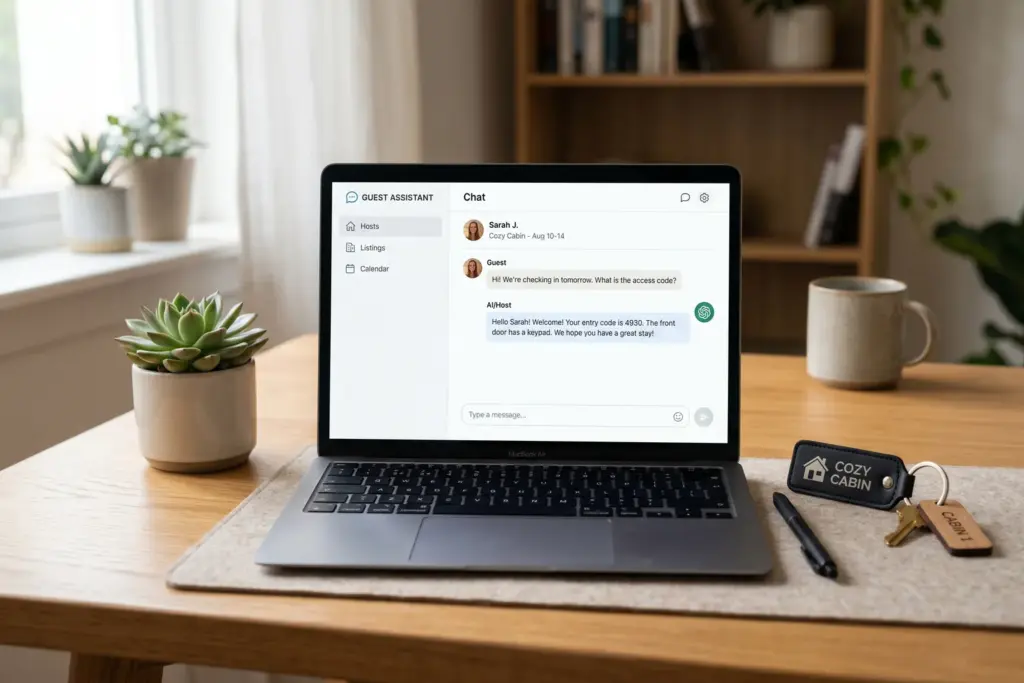
Hospitable is now handling 90% of incoming guest messages automatically for tens of thousands of STR hosts. That is not a beta feature. That is live, right now, across more than 26 million guest interactions per year. The platform detects what a guest is asking, pulls in the reservation details, and sends a personalized reply without a human touching anything.
That is where STR communication is in 2026. Not where it is headed. Where it is.
This guide covers the practical side: which tools to use, how to write prompts that actually work, and what the workflow looks like for a host who wants to save time without sacrificing the quality of the guest experience.
Why Guest Communication Is Where AI Delivers Immediately
The average STR host answers the same questions every single week. Where is parking? What is the WiFi password? Can I check in early? These messages arrive at midnight, during dinner, and on Saturday mornings.
AI does not care what time it is.
Communication quality also directly affects your reviews. A clear check-in message prevents the “I am standing outside and the door code is not working” text at 4pm. A thorough welcome guide keeps guests from calling about the coffee maker. A calm response to a critical review tells future guests that you are a real host who takes feedback seriously.
HotelTechReport’s 2026 PMS study found that 89% of hospitality operators using modern platforms save between 2 and 10 hours per week on operational tasks. Guest communication is consistently where the most time is recovered.
The AI Tools STR Hosts Are Using in 2026
I have tested every major AI tool in this space over the past year. The landscape is moving fast. What was a research project six months ago is now a polished product shipping weekly updates. Here is what actually works for STR host communication right now.
ChatGPT (OpenAI)
ChatGPT is where most STR hosts start. The free tier handles basic drafting well. GPT-4o, available on the free plan with usage limits, manages longer and more nuanced prompts. It is strong for check-in messages, policy rewrites, and anything where you want to soften firm language without losing clarity.
Best for: First drafts of any guest-facing communication and rewriting existing templates in a better tone.
Claude (Anthropic)
Claude has a stronger editorial voice for longer documents. If you are writing a full house guide or welcome book, Claude tends to produce cleaner structure with less cleanup. The free tier handles multi-thousand-word documents in one session.
Best for: Welcome books, house manuals, house rules documents, and anything where you want a warm, natural tone that does not read like a hotel policy page.
Gemini (Google)
Gemini integrates directly into Google Workspace. If you build guest guides in Google Docs, Gemini is already embedded. It draws on more current web information than the other tools, which helps when writing neighborhood and activity recommendation sections.
Best for: Local guide sections and hosts already working inside the Google ecosystem.
Hospitable and Lodgify (Automated Delivery)
General AI tools write your content. Hospitable and Lodgify send it automatically based on booking events. That distinction matters.
Hospitable detects over 20 guest message intents and handles up to 90% of incoming messages without manual action. It pulls reservation data to personalize responses and runs around the clock. For a full platform comparison including pricing, see our STR guest communication tools guide.
Lodgify’s AI Assistant is a GPT-powered bot inside its unified inbox that covers pre-check-in flows and same-day questions. If you are already on Lodgify for channel management, activating the AI layer takes minutes.
Guesty also supports AI messaging workflows through third-party integrations, letting property managers build automated sequences tied to booking status and guest lifecycle events.
Going forward, the gap between hosts using automated messaging and those still handling everything manually will widen. These platforms are shipping new AI features every quarter. Getting set up now means you start building the template library that compounds in value over every future booking.
7 Use Cases With Copy-Ready Prompts
Copy the prompts below, fill in your property details, and you will get drafts that need minimal editing before you save them as templates.
1. Check-In Message
A good check-in message arrives the morning of arrival, gives guests exactly what they need, and sounds like a human wrote it.
Write a check-in message for vacation rental guests arriving today. Property: [BEDROOMS]-bedroom [HOUSE/CONDO/CABIN] in [CITY] called [PROPERTY NAME]. Check-in at [TIME]. Access details: [DOOR CODE / KEY BOX / PARKING]. WiFi: [NETWORK NAME], password [PASSWORD]. Tone: warm, clear, brief. Under 150 words.
2. Welcome Guide Introduction
This prompt turns generic hospitality language into something that actually sounds like you.
Write a welcome introduction for my vacation rental guide. Property: [BEDROOMS]-bedroom [TYPE] in [CITY/NEIGHBORHOOD], best suited for [COUPLES / FAMILIES / GROUPS]. Top things guests love: [LIST 2-3 HIGHLIGHTS]. Host name: [YOUR NAME]. Under 120 words. Sound like a real person, not a hotel brochure.
3. House Rules (Firm Without Feeling Cold)
House rules written like a lease agreement make guests defensive before they arrive. This prompt rewrites yours in a tone that feels fair and human.
Rewrite these house rules for a short-term rental in a friendly but clear tone. Each rule should be one short sentence. Sound like a real host, not a legal document. Rules: [PASTE YOUR RULES HERE].
Or starting from scratch:
Write house rules for a short-term rental in [CITY] that sleeps [NUMBER] guests. Key concerns: noise after [TIME], no smoking indoors, no pets, check-out by [TIME], parking for [NUMBER] vehicles only. Tone: warm and firm. Bullet points.
4. Pre-Arrival Reminder
This message surfaces arrival details guests forgot to save and prevents the 11pm “wait, where do I go?” message.
Write a friendly pre-arrival reminder for vacation rental guests checking in tomorrow. Include: check-in time [TIME], address [ADDRESS], door code [CODE], parking instructions [DETAILS], note to message with questions. Under 120 words. Warm, helpful tone.
5. Post-Checkout Follow-Up and Review Request
A timely follow-up meaningfully increases review submission rates. Send it within two hours of check-out.
Write a post-checkout message for vacation rental guests who just left. Thank them for their stay. Add a personal detail if possible (example: “hope you got on that hiking trail”). Ask them to leave a review if they enjoyed their visit. Mention you would love to host them again. Under 80 words.
6. Review Response (Positive)
Responding to good reviews builds trust with future guests and signals to the Airbnb algorithm that you are an engaged host.
Write a short, genuine response to this 5-star guest review. Sound like a real host. Reference one specific thing the guest mentioned. Here is the review: [PASTE REVIEW]. Under 60 words.
7. Review Response (Critical or Mixed)
A thoughtful response to a 3-star review can reassure future guests more than the perfect score next to it.
Write a calm, professional response to this guest review. Acknowledge their concern without being defensive. Briefly explain what has been or will be addressed. End on a positive note. Under 75 words. Here is the review: [PASTE REVIEW].
Do not argue. Do not over-apologize. Let AI help you hit the right tone the first time.
What to Watch Out For
AI makes guest communication faster. It also makes a few predictable mistakes that hosts should know before diving in.
Hallucinated local details. If you ask AI for neighborhood restaurant recommendations and your area is not well-represented in its training data, it will invent things with full confidence. Write your own local knowledge section and use AI to clean up the language, not to generate the facts.
Tone mismatches. AI defaults to formal English unless you push it. “Please ensure the premises are vacated by the stated departure time” is technically correct and sounds like a parking citation. Add the phrase “sound like a real host, not a hotel policy” to any prompt involving rules or instructions.
Identical messages at scale. Sending every guest the exact same automated message can flag your account on some platforms. Use the guest’s name. Reference their trip length. This takes one extra sentence in your prompt and makes a real difference in how messages land.
The polished-but-empty problem. Communication that is too smooth and too perfectly structured can read as robotic to experienced travelers. Add one specific, real detail about your property or their trip in each message. AI gives you the structure. You add the texture.
Building Your Reusable Template Library
The approach that scales: build your library once and use it across every booking forever.
Your core set should cover 8 to 10 messages:
- Booking confirmation
- Pre-arrival reminder (24 hours before check-in)
- Check-in message (morning of arrival)
- Day 2 check-in for stays of three or more nights
- Pre-checkout reminder (evening before departure)
- Post-checkout follow-up and review request
- Review responses in three versions: positive, neutral, and critical
Draft each one using the prompts above. Edit for your voice. Save in a shared document. Platforms like Hospitable and Lodgify can trigger them automatically based on booking events, no manual sending required.
The total setup is about 90 minutes. After that, every guest gets a message that sounds like you personally wrote it, because you shaped the templates it is built from. One afternoon of work pays out across every future booking.
If you are building out your full hosting setup alongside your communication workflow, our must-have items for Airbnb hosts in 2026 guide covers the tech and physical gear worth pairing with your messaging system.
Want to see how your market is performing against other STR destinations? The StaySTRA Analyzer shows occupancy, ADR, and revenue data across hundreds of US markets.
Sponsored — OfferMarket
Buy Your First STR With Long-Term Rental Financing
Flexible, long-term financing for short-term rental buyers. Rates from 5.75%. Instant online quote, no credit pull.
Explore RTL Financing Options →Affiliate disclosure: StaySTRA may earn a referral fee.
Frequently Asked Questions
What is the best AI tool for Airbnb host messages?
For writing templates, ChatGPT and Claude are both strong free options. ChatGPT handles short drafts and tone rewrites well. Claude is stronger for longer documents like welcome guides and house manuals. For automated delivery, Hospitable handles up to 90% of incoming guest messages without manual action and is the top-rated platform for STR guest communication automation in 2026.
Is using AI for Airbnb guest messages allowed by the platform?
Yes. Using AI as a writing tool to draft or improve host messages is fully permitted on Airbnb and VRBO. AI writing assistants are a productivity tool, not a policy violation. Note that Airbnb has a separate policy about AI-generated evidence in damage claim disputes, which is a different issue covered in this article. That policy covers documentation submitted in disputes, not routine host-to-guest communication.
How do I write effective prompts for Airbnb messages?
Specificity is everything. Include the property type, location, number of guests, tone you want, and a word count limit in every prompt. Vague prompts produce generic output. Prompts that include your specific access details, the phrase “sound like a real host, not a hotel,” and a target length produce messages you can send with one small edit.
How much time can AI save on STR guest communication?
HotelTechReport’s 2026 PMS study found that 89% of hospitality operators using modern platforms save 2 to 10 hours per week on operational tasks. For STR hosts, guest communication is consistently the top category where time is reclaimed. The Hostaway 2026 STR Report confirms that 61% of STR operators now use AI, with messaging cited as the leading use case.
Can AI messaging tools work across both Airbnb and VRBO?
Yes. Platforms like Hospitable and Lodgify connect to both Airbnb and VRBO through a unified inbox. AI-drafted messages trigger automatically across both platforms based on booking events. A guest booking through VRBO gets the same quality of communication as one booking through Airbnb, with no extra manual work from the host.
We do our best to keep our tech reviews accurate and up to date, but products evolve fast and we are only human. Always verify current features and pricing directly with vendors before purchasing.
Sponsored — OfferMarket
Buy Your First STR With Long-Term Rental Financing
Flexible, long-term financing for short-term rental buyers. Rates from 5.75%. Instant online quote, no credit pull.
Explore RTL Financing Options →Affiliate disclosure: StaySTRA may earn a referral fee.
Want weekly intel on the tools, platforms, and strategies moving the STR industry forward? Join the StaySTRA Insider newsletter below.
Become a StaySTRA Insider
Join free — get our newsletter + 1 free property analysis/month.
No spam. Unsubscribe anytime. Free membership includes property analyses and market insights.