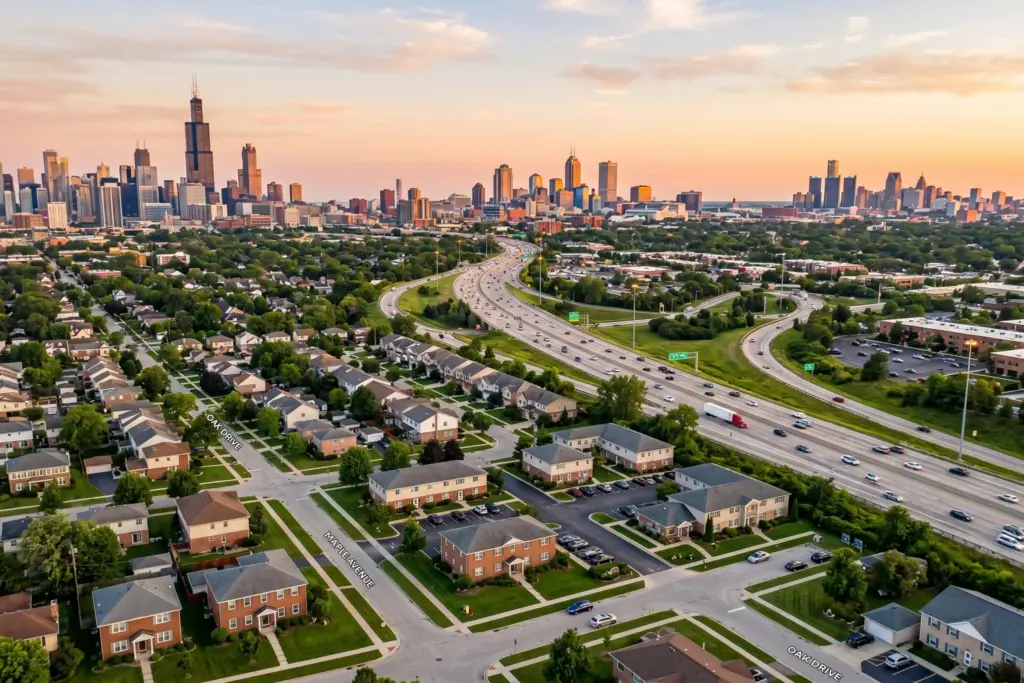
Key Takeaways
- Salem, MA leads all World Cup adjacent markets with $4,429 in average monthly STR revenue and a $284 ADR, making it the strongest non-host-city play near a FIFA venue.
- Several adjacent markets (Jersey City, Overland Park, Fort Lauderdale) outperform their nearby host cities in monthly revenue, occupancy, or both.
- Overland Park, KS has just 350 active STR listings serving the Kansas City World Cup corridor, creating the tightest supply-demand ratio of any adjacent market analyzed.
- Adjacent markets within 50 to 100 miles of host cities capture World Cup spillover demand without the regulatory tightening that host cities are imposing ahead of the tournament.
- Investors who use DSCR loans to acquire in these adjacent markets can underwrite based on year-round fundamentals, with World Cup demand as upside rather than the entire thesis.
Salem, Massachusetts is pulling $4,429 a month in average STR revenue, 30 miles from a World Cup host city, and almost nobody in the investment community is talking about it. Think of adjacent markets like the parking lot outside a sold-out concert: you do not need a ticket to benefit from the crowd.
The FIFA World Cup kicks off June 11, 2026, just 28 days from now. Meredith Lane’s enforcement roundup, publishing today, details what STR operators in the 11 U.S. host cities are facing: tighter rules, new permit requirements, and an enforcement spotlight that was not there six months ago. That is the risk side. This article is the opportunity side.
I want to show you where the numbers actually work, in markets close enough to capture World Cup spillover but far enough from the regulatory spotlight to let investors sleep at night. Every figure below comes from StaySTRA data. I pulled it myself this week.
One important note before we dig in: this article covers non-host-city markets only. If you are looking for host city investment data, I covered that in the April FIFA host city analysis. Different article, different thesis.
Sponsored — Beeline
Finance Your Next STR With a DSCR Loan
Qualify on property cash flow, not W-2 income. Beeline specializes in fast DSCR closings for STR investors. No personal income verification required.
Check Your DSCR Eligibility →Affiliate disclosure: StaySTRA may earn a referral fee.
Why Adjacent Markets Deserve Your Attention Right Now
Here is the dynamic that makes this interesting. Host cities are where the games happen, but they are also where the regulatory friction is highest. Philadelphia has just 426 active STR licenses for 149,000 expected visitors across six matches. New York’s Local Law 18 functionally bans most entire-home Airbnb rentals and the city refused to loosen rules for the tournament. Dallas is asking the Texas Supreme Court to enforce its STR ban before the first whistle.
Meanwhile, the cities 30 to 90 minutes away? Most of them have lighter regulatory frameworks, lower acquisition costs, and year-round demand that does not depend on a single sporting event. The World Cup is a demand accelerant for these markets, not the foundation of the investment case.
A Deloitte analysis commissioned by Airbnb projects $212 million in total host earnings across all U.S. host cities during the tournament. But those projections do not capture what happens when fans, priced out of Manhattan or restricted by Miami’s permit requirements, search for accommodations 20 or 40 miles down the road. That overflow is where adjacent market investors are positioned to benefit.
The Data: 13 Adjacent Markets and What the Numbers Show
I looked at markets within roughly 50 to 100 miles of each World Cup host city, focusing on places where STR fundamentals stand on their own regardless of the tournament. Stay with me here, because this table tells the whole story at a glance.
| Adjacent Market | Nearby Host City | ADR | Occupancy | Avg Monthly Revenue | Active Listings |
|---|---|---|---|---|---|
| Salem, MA | Boston | $284 | 67.7% | $4,429 | 431 |
| Jersey City, NJ | New York/NJ | $220 | 72.4% | $3,227 | 2,287 |
| Fort Lauderdale, FL | Miami | $237 | 66.7% | $3,191 | 9,458 |
| Overland Park, KS | Kansas City | $207 | 64.7% | $3,099 | 350 |
| Providence, RI | Boston | $194 | 62.5% | $2,793 | 1,225 |
| Frisco, TX | Dallas | $213 | 58.1% | $2,737 | 718 |
| Atlantic City, NJ | Philadelphia | $262 | 37.9% | $2,531 | 1,413 |
| Fort Worth, TX | Dallas | $176 | 57.1% | $2,429 | 2,723 |
| Newark, NJ | New York/NJ | $181 | 58.6% | $2,393 | 2,430 |
| Tacoma, WA | Seattle | $162 | 70.8% | $2,349 | 1,151 |
| Katy, TX | Houston | $189 | 55.2% | $2,211 | 854 |
| Marietta, GA | Atlanta | $176 | 60.0% | $2,114 | 939 |
| Oakland, CA | SF Bay Area | $163 | 61.3% | $1,941 | 2,176 |
Source: StaySTRA data, last twelve months (LTM). All figures represent average performance across the full listing pool in each market.
Where Adjacent Markets Outperform Their Host Cities
This is the part that surprised me, and I have been staring at STR spreadsheets for longer than most of you have been investing. Several adjacent markets are not just catching spillover. They are outperforming the host city next door on core metrics.
Jersey City vs. New York City
Jersey City posts $3,227 in average monthly revenue with 72.4% occupancy. New York City’s STR market has been functionally crippled by Local Law 18. The city refused to relax its rules for the World Cup, which means fans arriving at MetLife Stadium (technically in East Rutherford, NJ) will be looking across the Hudson anyway. Jersey City sits on the PATH train, 15 minutes from Lower Manhattan, with 2,287 active listings and none of New York’s registration headaches. Current ADR is trending at $252, up from the $220 LTM average.
Fort Lauderdale vs. Miami
Fort Lauderdale’s LTM ADR of $237 edges out Miami’s $227, and its 66.7% occupancy matches Miami nearly point for point. The difference? Fort Lauderdale has 9,458 active listings to absorb demand without the price gouging spiral that tends to alienate guests. It also has a more permissive regulatory environment than Miami-Dade County. Think of Fort Lauderdale as the deep bench on a championship team: the talent is there, the capacity is there, and the cost of entry is lower.
Overland Park vs. Kansas City
This is the hidden gem in the dataset. Overland Park, just across the state line in Kansas, posts $3,099 in monthly revenue with only 350 active listings. That is the tightest supply ratio of any market in this analysis. Kansas City proper has $2,493 in monthly revenue with heavier supply and a brand-new World Cup permit system (Ordinance 250965) that every host must navigate. Overland Park sits 20 minutes from Arrowhead Stadium with no special event permit required. Do not let the small listing count scare you. Low supply with steady demand is exactly the dynamic DSCR lenders like to see.
Sponsored — Beeline
Finance Your Next STR With a DSCR Loan
Qualify on property cash flow, not W-2 income. Beeline specializes in fast DSCR closings for STR investors. No personal income verification required.
Check Your DSCR Eligibility →Affiliate disclosure: StaySTRA may earn a referral fee.
Salem and Providence vs. Boston
The Boston corridor gives investors two adjacent options with very different profiles. Salem is the premium play: $4,429 in monthly revenue, $284 ADR, 431 listings. October alone (Salem’s famous Halloween tourism season) generates $8,797 in average monthly revenue at 87.3% occupancy. That seasonal peak happens independently of the World Cup, which means your revenue model does not hinge on a once-in-a-generation event.
Providence is the volume play: 1,225 listings, $2,793 monthly revenue, 62.5% occupancy. It is a university city (Brown, RISD, Providence College) with year-round demand drivers that have nothing to do with soccer. Forward booking data shows 61.9% of inventory already reserved for the next three months.
Tacoma vs. Seattle
Tacoma’s 70.8% LTM occupancy is the second highest of any adjacent market in this analysis, behind only Jersey City. At $162 ADR it is the most affordable entry point on the list, which keeps acquisition costs low and DSCR ratios healthy. Seattle’s host city status will push demand south along the I-5 corridor. Tacoma’s 1,151 listings are modest enough that even a small surge in tournament traffic could move the needle on occupancy during peak weeks.
The Texas Markets: Frisco, Fort Worth, and Katy
Texas contributes two host cities (Dallas and Houston), and the adjacent options range widely. Frisco is the strongest play at $213 ADR and $2,737 monthly revenue with just 718 listings. It also hosts the FC Dallas stadium and the National Soccer Hall of Fame, giving it a built-in tournament connection that most adjacent markets lack.
Fort Worth ($176 ADR, $2,429 monthly, 2,723 listings) and Katy ($189 ADR, $2,211 monthly, 854 listings) offer lower entry points but also lower returns. Both have year-round demand from corporate travel and regional tourism, but neither stands out the way Frisco does for this particular event window.
Marietta, Oakland, and Atlantic City: Read the Fine Print
I want to be transparent about the three markets where the investment case is thinner. Marietta, outside Atlanta, posts $2,114 in monthly revenue with 60% occupancy. Atlanta itself is not far behind at $2,218, and the host city has a more established STR infrastructure. The adjacent market premium here is slim.
Oakland ($1,941 monthly revenue, $163 ADR) carries the lowest revenue of any market in this analysis. The Bay Area’s regulatory complexity extends into Oakland with its own permitting requirements. South Bay and Peninsula submarkets may offer a better regulatory fit, though I did not have sufficient StaySTRA data on those areas to include them in the table.
Atlantic City has the highest ADR on the list ($262) but the lowest occupancy (37.9%). That 37.9% is a full-year average dragged down by brutal winter months where occupancy dips below 25%. Summer performance is strong (64.5% occupancy in July at $333 ADR), but investors need to budget for significant seasonal revenue gaps. Philadelphia’s 426 active STR licenses create a genuine supply crunch that could redirect World Cup demand to Atlantic City, about 60 miles southeast. The opportunity is real, but so is the off-season risk.
The Supply-Demand Dynamic That Matters Most
Here is where I put on my old government statistician hat. (Forty years of counting things teaches you to pay attention to ratios, not just raw numbers.)
The markets with the strongest investment cases are where supply is constrained relative to the demand the World Cup will generate. Three markets stand out:
- Overland Park, KS: 350 listings for a metro that will host World Cup matches 20 minutes away. The math is simple.
- Salem, MA: 431 listings absorbing demand from a metro of 4.9 million people. Salem already runs near capacity in peak months (87.3% in October). World Cup summer traffic stacks on top of an already tight market.
- Frisco, TX: 718 listings in the fastest-growing suburb in the Dallas metro, with a direct connection to the tournament venue. Forward bookings show 59.7% of inventory already reserved for the next three months.
Compare that to Fort Lauderdale (9,458 listings) or Oakland (2,176 listings), where supply depth means individual operators face more competition for each booking. Higher supply does not make these bad investments, but it does mean pricing power distributes differently across operators.
What This Means for DSCR Borrowers
If you are financing an STR acquisition with a DSCR loan, adjacent markets offer a specific advantage: you can underwrite on year-round performance, and the World Cup becomes upside. A property in Salem generating $4,429 monthly ($53,148 annually) does not need the World Cup to pencil out. A property in Overland Park at $3,099 monthly ($37,188 annually) hits DSCR thresholds on its own fundamentals.
That is a very different risk profile than buying in a host city where the thesis depends on a six-week demand spike that may or may not materialize as projected. For a deeper look at how DSCR loans work for this kind of purchase, see the STR Financing Guide 2026.
For historical context on how these markets were performing before World Cup demand started building, the Q1 2026 STR Market Performance report provides a useful baseline.
How to Use This Data
I have sat at my desk in Santa Fe, coffee going cold, running these numbers for a week. Here is what I would tell any investor who asks me where to look:
- Start with Salem or Overland Park if you want the strongest revenue-to-supply ratio. Both have year-round demand drivers that outlast the tournament.
- Look at Jersey City if you want exposure to the New York metro without New York’s regulatory burden. The MetLife Stadium final on July 19 will be the single highest-demand night of the entire tournament.
- Consider Frisco if you want a Texas play with a direct tournament connection and growing suburban demand.
- Use Fort Lauderdale if you prefer a deep, liquid market where scale operations across multiple units are easier to build.
Run every property through the StaySTRA analyzer before you make an offer. The market averages in the table above are starting points, not guarantees. Individual property performance varies by bedroom count, location within the city, amenity package, and management quality. If you want to see how the best-performing markets stack up nationally, the Best Airbnb Markets for Investors 2026 analysis provides the broader picture.
Sponsored — Beeline
Finance Your Next STR With a DSCR Loan
Qualify on property cash flow, not W-2 income. Beeline specializes in fast DSCR closings for STR investors. No personal income verification required.
Check Your DSCR Eligibility →Affiliate disclosure: StaySTRA may earn a referral fee.
We do our best to keep our data accurate and up to date, but markets move fast and we are only human. Always verify current figures directly with local sources before making investment decisions.
Frequently Asked Questions
Are STR markets near World Cup cities safe to invest in?
Adjacent markets within 50 to 100 miles of host cities generally carry less regulatory risk than the host cities themselves. Most have established STR frameworks without the event-specific enforcement measures being rolled out in host cities. That said, “safe” depends on the specific market. Always check local permit requirements and any pending ordinance changes before acquiring a property.
Which World Cup adjacent market has the strongest STR fundamentals?
Based on StaySTRA data, Salem, MA leads with $4,429 in average monthly revenue, a $284 ADR, and 67.7% occupancy. Salem also benefits from a powerful independent demand driver (its October Halloween tourism season generates $8,797 in average monthly revenue) that makes the investment case year-round, not event-dependent.
How does the World Cup affect STR revenue in nearby markets?
World Cup host cities have seen ADRs roughly double for tournament dates compared to the same period in 2025, according to industry projections. Adjacent markets benefit from overflow demand as fans seek lower-priced or more available accommodations. The effect is strongest where supply is constrained (Overland Park with 350 listings, Salem with 431) and weaker where supply is deep (Fort Lauderdale with 9,458 listings). The World Cup is a short-term demand accelerant, but the strongest adjacent markets have fundamentals that work year-round.
Can I use a DSCR loan to buy an STR in a World Cup adjacent market?
Yes. DSCR (Debt Service Coverage Ratio) loans qualify borrowers based on the property’s rental income rather than personal income, making them popular for STR acquisitions. Adjacent markets with strong year-round revenue (Salem at $53,148 annually, Overland Park at $37,188 annually) can meet typical DSCR thresholds of 1.0 to 1.25 on their baseline performance without relying on World Cup demand to make the numbers work.
Become a StaySTRA Insider
Join free — get our newsletter + 1 free property analysis/month.
No spam. Unsubscribe anytime. Free membership includes property analyses and market insights.