Key Takeaways
- County assessors in Tennessee, Missouri, North Carolina, and Colorado have reclassified (or attempted to reclassify) STR properties from residential to commercial for property tax purposes, increasing tax bills by 60% or more.
- Most states give assessors discretion to classify properties by “use.” Operating an STR as a business triggers commercial classification where the statute allows it.
- In Sevier County, Tennessee, reclassification moved 10,000+ STR properties from a 25% residential assessment rate to a 40% commercial rate, adding roughly $1,100 per year on a $500,000 property.
- Missouri passed SB 1066 in 2026 to block a “transient housing” loophole that tripled some owners’ property tax bills. Not every state has passed similar protections.
- Investors should check their current tax classification, model a 60% to 70% property tax increase into acquisition underwriting, and understand the appeal process before a reclassification notice arrives.
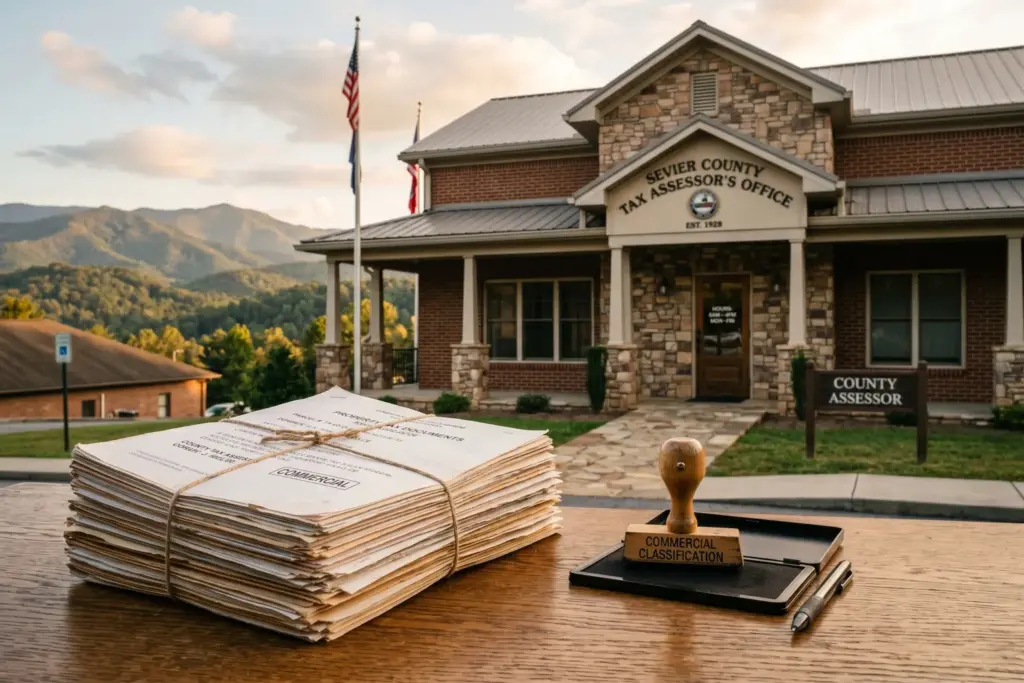
Sevier County, Tennessee, home to Gatlinburg and Pigeon Forge, reclassified more than 10,000 short-term rental properties from residential to commercial in 2023. Overnight, the assessment rate on those cabins jumped from 25% to 40% of appraised value. A $500,000 property that had been taxed at $1,850 per year suddenly owed $2,960. That is not a hypothetical scenario from a tax seminar. That is what actually showed up in the mail.
If you own or are considering buying an STR property in 2026, this is a cost threat that deserves your attention. As federal tax benefits like bonus depreciation continue to phase down (dropping from 40% to 20% this year and heading to zero in 2027), the local property tax line on your P&L is becoming a proportionally larger share of your carrying costs. And in a growing number of jurisdictions, that line is about to get bigger.
This article provides general information and should not be construed as legal advice. Consult a qualified attorney in your jurisdiction for advice specific to your situation.
Sponsored — OfferMarket
Buy Your First STR With Long-Term Rental Financing
Flexible, long-term financing for short-term rental buyers. Rates from 5.75%. Instant online quote, no credit pull.
Explore RTL Financing Options →Affiliate disclosure: StaySTRA may earn a referral fee.
How Short-Term Rental Property Tax Reclassification Works
County assessors classify every property into a category (residential, commercial, industrial) that determines its assessment rate, which is the percentage of market value actually subject to the tax levy. A higher rate means a higher bill, even if the appraised value has not changed by a single dollar.
The legal hook for STRs is the concept of “use.” When a property generates nightly income from transient guests rather than serving as a primary residence or long-term rental, assessors in certain jurisdictions have the statutory authority to call that commercial. The reasoning: the property functions more like a hotel than a home.
Picture this: you buy a cabin in Gatlinburg, pull a business license, list it on Airbnb, and never live in it yourself. From the assessor’s perspective, that is a commercial lodging operation. And in Tennessee, the state legislature agreed.
Where Reclassification Has Already Happened
Tennessee: The First Large-Scale Reclassification
Tennessee’s 2021 state law gave county assessors the authority to classify STR properties as commercial when the property has a business license and is not the owner’s principal residence. Sevier County, which contains the state’s densest concentration of vacation rental cabins, applied the reclassification broadly starting in 2023.
The numbers tell the story. Residential properties in Tennessee are assessed at 25% of appraised value. Commercial properties are assessed at 40%. That 15-percentage-point gap means a property with a $500,000 appraisal sees its assessed value jump from $125,000 to $200,000. At Sevier County’s tax rate of $1.48 per $100 of assessed value, the annual tax bill goes from approximately $1,850 to $2,960 (an increase of roughly $1,110 per year, or 60%).
Across more than 10,000 affected properties, the reclassification generated an estimated $8 million in new annual revenue for the county. I have reviewed a lot of property tax codes in my career (more than I would wish on anyone), and what surprised me about Sevier County is how many owners simply absorbed the increase without realizing they could appeal.
Missouri: The “Transient Housing” Loophole
Missouri’s situation is a case study in how assessor discretion can create costly surprises. Some county assessors discovered they could reclassify STR properties under a “transient housing” provision in state law (yes, that is a real legal category). That moved the assessment ratio from 19% to 32%. On a $400,000 property, assessed value jumped from $76,000 to $128,000. In some cases, the reclassification tripled the owner’s annual tax bill.
Jackson County attempted this reclassification in 2025 and reversed course under political pressure. But the legal vulnerability remained until the legislature acted. Missouri’s SB 1066 passed the Senate 30-3 on March 25, 2026, and a companion bill (HB 1768) passed the House on April 2. The legislation explicitly classifies single-family homes rented for fewer than 30 consecutive days as residential property, blocking the transient housing reclassification. It caps the protection at 15 properties per owner and requires assessors to consult the property owner before attempting any reclassification.
SB 1066 is a legislative fix to a specific problem. But it only protects Missouri STR owners. If your state has not passed similar legislation, your assessor may still have the legal authority to reclassify your property.
Where Reclassification Is Being Proposed or Litigated
North Carolina: The Buncombe County Challenge
Joe Minicozzi, principal of the Asheville-based urban planning firm Urban3, filed a challenge with North Carolina’s Property Tax Commission in early 2026, arguing that Buncombe County’s entire property valuation schedule undervalues short-term rentals by assessing them identically to owner-occupied homes. His argument is that STR properties are income-producing commercial assets and should be valued accordingly.
Minicozzi estimates Buncombe County loses approximately $15 million annually in unrealized tax revenue from STRs (nearly 3.5% of the county’s general fund budget). He points to a luxury Asheville property purchased for $1.2 million in 2024 that was assessed at roughly half that value despite generating estimated annual returns of up to 31%.
Buncombe County disputes the characterization. But if the commission rules in Minicozzi’s favor, it could empower all 100 North Carolina counties to reassess their STR valuations using income-based commercial methodology.
Colorado: Nearly 4x the Tax Rate
Colorado presents the most dramatic rate differential in the country. Residential properties are assessed at 7.15%, while commercial lodging properties pay 27.9% (nearly a four-to-one ratio). Two bills introduced in 2024 proposed different reclassification frameworks: SB 33 would have applied commercial rates to any property rented 90 or more days per year, while HB 1299 targeted only properties that are not the owner’s primary or secondary residence.
Neither bill passed, but they are expected to return. For investors in Colorado’s mountain markets, this rate gap is worth modeling into carry cost projections now.
New Mexico and Montana: Different Approaches
New Mexico’s House Memorial 52 created a statewide work group to study STR taxation and recommended that homes used as short-term rentals remain classified as residential, preventing counties from reclassifying them based solely on transient occupancy. Follow-up legislation is expected in 2026.
Montana took a different route. Starting in 2026, the state created a tiered property tax system where primary residences and long-term rentals qualify for reduced rates, while STRs and second homes pay a flat 1.9% rate. It is not technically a commercial reclassification, but the effect is similar: STR operators pay more than owner-occupants and long-term landlords for the same type of property.
What This Costs You in Dollar Terms
The tax impact of reclassification depends entirely on your state’s rate differential. Here is what the math looks like across the states where reclassification is active or proposed, using a $500,000 property as the baseline:
| State | Residential Assessment Rate | Commercial/STR Assessment Rate | Estimated Annual Tax Increase |
|---|---|---|---|
| Tennessee | 25% | 40% | ~$1,100 |
| Missouri | 19% | 32% | ~$1,500 to $3,000+ |
| Colorado | 7.15% | 27.9% | Varies widely by county mill levy; potentially $3,000 to $8,000+ |
Over a 10-year hold, a $1,100 annual increase becomes $11,000 in additional property taxes. A $3,000 increase becomes $30,000. For investors running thin margins on a DSCR-financed property, that is the difference between positive and negative cash flow.
How to Appeal a Reclassification
If your property has been reclassified, you have options. Property tax appeals have a general success rate of 40% to 60% nationally, and commercial property appeals succeed at even higher rates in some jurisdictions.
- Review the notice. Check whether the reclassification is based on actual use or an assumption. Assessors sometimes rely on platform listing data without verifying ownership structure or rental frequency.
- File with the Board of Equalization (or equivalent). Deadlines are strict, often 30 to 90 days from the assessment notice. Do not wait.
- Document your case. Gather utility records showing personal use, homestead exemption filings, and platform booking histories showing fewer than the threshold number of rental days.
- Hire a property tax attorney if the stakes justify it. For increases exceeding $2,000 per year, professional representation (many firms work on contingency) is likely worth the cost.
The strongest arguments center on owner-occupancy, limited rental days, or the assessor’s failure to follow procedural requirements. Missouri’s SB 1066 now requires assessors to consult with property owners before reclassifying. If your jurisdiction has a similar requirement, check whether the assessor followed it.
What STR Investors Should Do Now
The trend is moving in one direction. Here is what proactive investors are doing:
- Check your current classification. Pull your property’s tax record from the county assessor’s website. Verify it is classified as residential. If it has already been reclassified and you missed the notice, you may still be within the appeal window.
- Model the worst case. When underwriting a new acquisition, add a line item for a potential 60% to 70% property tax increase. If the deal does not work at commercial rates, you are making a bet on a classification your assessor has the legal tools to change.
- Track your state’s legislation. Missouri and New Mexico have moved to protect STR owners. Tennessee codified commercial classification into law. Colorado’s bills stalled but are expected to return.
- Document personal use. In every jurisdiction that has implemented or proposed reclassification, owner-occupied properties are either exempt or treated more favorably. If you live in the property part-time, keep records.
- Use StaySTRA’s analyzer tool to stress-test your numbers. Run your property’s revenue projections against a higher property tax scenario before committing to a purchase.
We do our best to keep our regulatory guides accurate and up to date, but ordinances change and we are only human. Always verify current requirements directly with your local municipality before making business decisions.
Frequently Asked Questions
Can my county assessor reclassify my short-term rental as commercial without a new law?
In many states, yes. Most property tax codes give assessors discretion to classify properties by “use.” If your property operates as a nightly rental business and is not your primary residence, the assessor may already have the authority. Whether they exercise it depends on local policy and revenue needs.
How much more would I pay in property taxes if my STR is reclassified as commercial?
The increase depends on your state’s rate differential. In Tennessee, the jump from residential (25%) to commercial (40%) assessment increased annual taxes by roughly 60% on affected properties. In Missouri, the shift from 19% to 32% tripled some bills. Colorado’s differential (7.15% residential vs. 27.9% commercial) would represent the largest potential increase in the country.
Does renting my primary residence on Airbnb trigger commercial reclassification?
Generally, no. In every jurisdiction that has implemented or proposed reclassification, owner-occupied primary residences are exempt or treated more favorably. The trigger is a combination of a business license, non-owner-occupancy, and regular short-term rental activity.
Can I appeal a short-term rental property tax reclassification?
Yes. Property tax appeals succeed 40% to 60% of the time nationally. The process starts with your county’s Board of Equalization and you typically have 30 to 90 days from the assessment notice to file. Common grounds include owner-occupancy, limited rental days, and procedural errors by the assessor.
Is property tax reclassification different from the bonus depreciation phase-out?
Yes. Bonus depreciation is a federal income tax benefit (accelerated asset write-offs). Property tax reclassification is a local issue where the assessor changes how your property is categorized. They are separate mechanisms, but both increase your total tax burden in 2026. For more on bonus depreciation, see our STR bonus depreciation guide.
Sponsored — OfferMarket
Buy Your First STR With Long-Term Rental Financing
Flexible, long-term financing for short-term rental buyers. Rates from 5.75%. Instant online quote, no credit pull.
Explore RTL Financing Options →Affiliate disclosure: StaySTRA may earn a referral fee.
The Carry Cost Equation Is Changing
Short-term rental property tax reclassification is not a hypothetical risk. It is happening in Tennessee. It was attempted in Missouri (and blocked only because the legislature intervened). It is being litigated in North Carolina. And it is being debated in Colorado, where the rate differential would quadruple affected owners’ property tax bills.
For STR investors, the carry cost equation is shifting. Federal tax benefits are phasing out. Local tax authorities are looking for new revenue from the STR economy. And the legal tools to reclassify your property already exist in most states. The investors who will handle this environment successfully are the ones who see the bill coming before it arrives.