

Key Takeaways
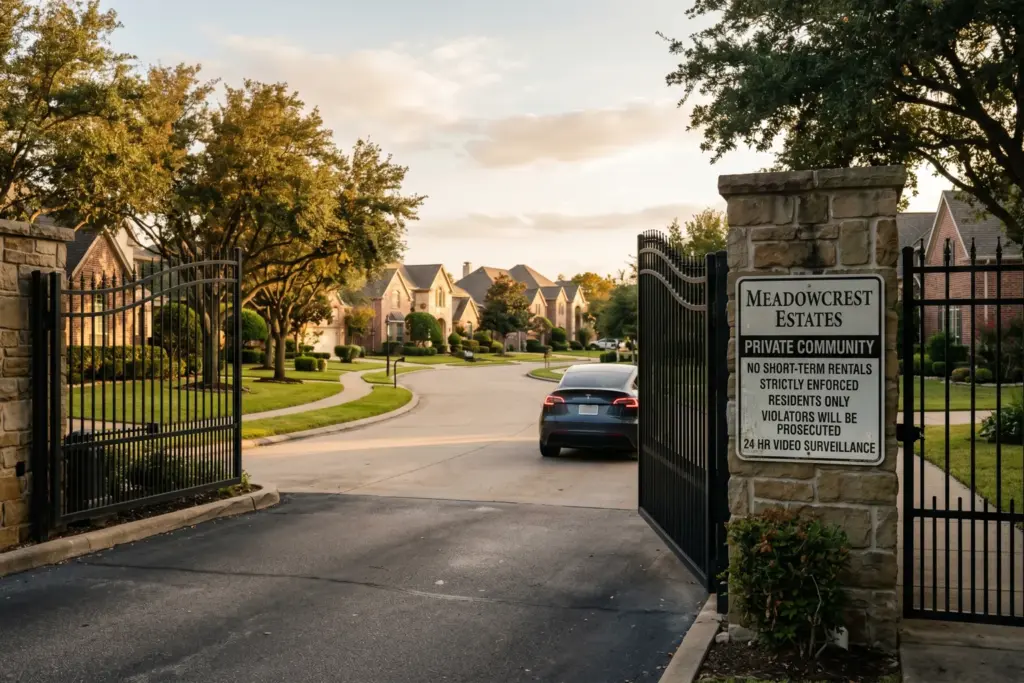
- HOAs enforce short-term rental restrictions through contract law (CC&Rs), which state preemption laws generally cannot override.
- Fines for violating HOA STR bans can reach $100 per day in Florida, and legal costs for hosts who fight back regularly exceed $50,000.
- Court rulings in Arizona, Texas, and California show that HOAs with explicit STR language in their CC&Rs almost always win. Vague “residential use” clauses are the host’s best defense.
- About 53% of U.S. homeowners live in HOA-governed communities, meaning more than half of potential STR properties face this layer of regulation.
- Before buying a property in an HOA community for STR use, investors must read the full CC&Rs, check amendment history, and review board meeting minutes for STR-related votes.
A vacation rental host in Scottsdale, Arizona thought state law was on her side. Arizona’s preemption statute prevents cities from banning short-term rentals outright. She listed her property on Airbnb, collected bookings for six months, and then received a letter from her HOA. The fines started at $100 per violation. The cease-and-desist followed two weeks later. By the time she consulted an attorney, the bill had already crossed $3,000 in penalties alone.
Her state’s preemption law could not help her. It was never designed to.
This is the enforcement front that most STR coverage misses. While state legislatures pass preemption laws stripping cities of the power to ban vacation rentals, HOAs operate on a completely different legal track. They enforce through contract law, not municipal ordinances. That distinction is why the fight between HOAs and STR hosts is intensifying in 2026, even as city-level restrictions get rolled back.
Why HOAs Can Ban Short-Term Rentals Even in Preemption States
State preemption laws restrict government entities from prohibiting or unreasonably restricting short-term rentals. Arizona’s A.R.S. § 9-500.39 is the textbook example. Idaho’s HB 583 does the same. Indiana’s HEA 1210, passed in 2026, joins a growing list of states pulling enforcement power away from local governments.
But HOAs are not government entities. They are private organizations governed by contracts that homeowners agree to when they buy. The covenants, conditions, and restrictions (CC&Rs) attached to a deed are a binding legal agreement. When a state passes a preemption law, it overrides municipal codes. It does not override private contracts.
The Central Arizona Association of Realtors put it plainly: “State law prevents government prohibition but does not give owners the right to ignore private restrictions.” That protection evaporates at the HOA boundary line.
The Legal Tools HOAs Use to Shut Down STR Operations
HOAs do not need a city ordinance to enforce rental restrictions. Their toolkit is more direct than anything most municipalities can deploy.
Daily fines. In Florida, HOAs and condo associations can impose fines of up to $100 per violation per day under Florida Statutes §720.306(1)(h) and §718.110(13), capped at $1,000 aggregate per violation. For a host running bookings every weekend, that compounds fast.
Liens on the property. Unpaid fines become a lien. Once recorded, the lien attaches to the property and must be resolved before the owner can sell or refinance. In some states, HOAs have “super lien” priority that puts their claim ahead of even the first mortgage.
Suspension of amenities. Florida associations can suspend access to common elements (pool, gym, clubhouse, parking) for non-compliance with rental restrictions. For a host marketing amenity access as part of the listing, this guts the value proposition overnight.
Injunctive relief. HOAs can seek a court injunction ordering the homeowner to stop all STR activity immediately. This is the nuclear option, and courts grant it regularly when the CC&Rs contain explicit rental restrictions.
Foreclosure. In extreme cases, accumulated unpaid fines and assessments can trigger foreclosure proceedings. States like Florida allow HOA foreclosure when delinquent amounts exceed certain thresholds. The HOA does not need to prove the property was used as an STR. It only needs to show the homeowner owes money.
What the Courts Are Saying: Three Rulings Every STR Host Should Know
The legal landscape is not one-sided. Hosts have won in court, but only under very specific circumstances. Documents show a clear pattern in recent rulings: explicit CC&R language wins for the HOA. Vague language loses.
Tarr v. Timberwood Park Owners Association (Texas Supreme Court, 2018)
Kenneth Tarr listed his San Antonio home on VRBO after relocating to Houston. His HOA sued, arguing STRs violated covenants limiting the property to “residential purposes.” The Texas Supreme Court ruled unanimously in Tarr’s favor: “residential purpose” defines how a property is used, not who uses it or for how long. But the court explicitly limited this interpretation to these particular covenants. HOAs with explicit STR prohibitions would likely reach a different outcome.
Kalway v. Calabria Ranch HOA (Arizona Supreme Court, 2022)
While not an STR case, this ruling set the standard Arizona courts now apply to rental restriction amendments. The Arizona Supreme Court held that non-unanimous CC&R amendments must be “reasonable and foreseeable” based on the original covenants. An HOA cannot adopt brand-new restrictions without unanimous homeowner consent. Arizona HOA attorneys now apply this directly to STR bans added after purchase.
Gross v. The Shores at Rainbow Lake (Arizona Court of Appeals, 2024)
The court invalidated a 30-day minimum lease term amendment because it prohibited activity previously allowed under the original CC&Rs. This reinforced the Kalway standard.
Data indicates a clear pattern. When CC&Rs explicitly ban STRs from the start, courts enforce them. When HOAs try to add bans later through majority-vote amendments, courts are increasingly skeptical.
The Real Cost of Fighting Your HOA
Sources reveal that the financial math of fighting an HOA STR ban is brutal for individual homeowners. Attorney fees run $150 to $500 per hour. Mediation costs $1,000 to $5,000. Full litigation can exceed $100,000.
Fee-shifting is the hidden trap. Many states award attorney fees to the prevailing party. In California, Civil Code § 5975 means that if a host sues the HOA and loses, the host pays both sides’ legal bills. In the 2024 California case Haidet v. Del Mar Woods Homeowners Association, the HOA was awarded $48,000 in attorney fees after the homeowner dropped the case.
HOAs fund their legal battles from association reserves, spreading the cost across all homeowners. An individual host fighting a well-funded HOA faces asymmetric financial exposure. Most STR-HOA conflicts never reach a courtroom for this reason. Hosts either comply, sell, or quietly continue operating and hope enforcement never comes.
Which States Give HOAs the Most Enforcement Power Over STRs
The legal framework varies by state. Florida gives associations the broadest authority, with statutes explicitly authorizing rental restrictions, $100/day fines, lien authority, and amenity suspension. Arizona has one of the strongest preemption laws in the country, but courts have consistently held that private CC&R restrictions survive preemption. Texas sits in the middle: the Tarr ruling gives hosts a pathway when CC&Rs use vague language, but supermajority amendments (typically 67%) are enforceable. Colorado layers local regulation on top of HOA restrictions. Mountain resort communities like Breckenridge require both a town STR license and an HOA compatibility letter, and many condos ban STRs entirely through their HOA documents. Tennessee allows HOAs to restrict STRs per their CC&Rs, and the state’s limited preemption framework does not extend protections to properties in private covenant communities.
How Hosts Are Responding
The smart operators are not fighting blind. They are adapting. Some have shifted their acquisition strategy entirely, screening for HOA restrictions with the same rigor they apply to zoning and permitting. Others are working within the system, adjusting minimum stay requirements to comply with CC&R duration limits. A 30-day minimum eliminates the highest-revenue short stays but keeps the property in the rental market.
In vacation-oriented communities where a large share of owners are non-resident investors, some hosts are fighting back through the amendment process itself, organizing to vote against restrictive amendments or to elect board members who support rental rights.
And some hosts have simply moved on. The growing wave of state preemption laws makes non-HOA markets increasingly attractive for STR investment. Buying in a jurisdiction with strong preemption protections and no private covenant restrictions eliminates the HOA variable entirely.
The Due Diligence Checklist: What to Verify Before Buying in an HOA Community
If you are evaluating a property in an HOA-governed community for STR use, this is the minimum due diligence before you close.
Read the full CC&Rs. Not the summary. The entire recorded document. Look for any language about rentals, lease terms, minimum stay durations, or “commercial use” restrictions.
Check the amendment history. An HOA that allowed STRs five years ago may have added a prohibition since then. Request copies of all recorded amendments from the management company or the county recorder’s office.
Review board meeting minutes. If the board has been discussing STR restrictions, it will show up in the minutes. This gives you advance warning of potential rule changes.
Ask about enforcement history. An HOA with a track record of enforcement is far more likely to come after you than one that has never enforced its rental restrictions.
Understand your state’s amendment rules. In Arizona, non-unanimous amendments cannot add restrictions that were not contemplated by the original CC&Rs (per Kalway). In Texas, supermajority amendments are generally enforceable.
Run the numbers with the restriction in mind. Use StaySTRA’s analyzer to evaluate the market, but model your returns assuming you may need to comply with a minimum stay requirement. If the deal only works as a 2-night-minimum Airbnb, the HOA risk may kill the investment.
If you are navigating both HOA restrictions and permit challenges, budget for legal review before closing, not after.
Sponsored — OfferMarket
Buy Your First STR With Long-Term Rental Financing
Flexible, long-term financing for short-term rental buyers. Rates from 5.75%. Instant online quote, no credit pull.
Explore RTL Financing Options →Affiliate disclosure: StaySTRA may earn a referral fee.
The Bigger Picture
The 2026 preemption wave is real. States are pulling enforcement authority away from cities at a pace not seen before. But the coverage that treats preemption as a blanket victory for STR hosts is missing half the story.
About 53% of U.S. homeowners live in HOA-governed communities. That share is growing. Census data shows that 65% of new homes built in 2023 were in HOA communities, up from 49% in 2009. The newer the housing stock, the more likely it sits inside an HOA.
As city enforcement weakens under preemption, HOA enforcement is filling the vacuum. Neighbors who used to call city code enforcement to complain about a vacation rental next door are now calling the HOA board. And the HOA has tools that most cities do not: direct financial penalties, lien authority, and the ability to shut down amenity access without a court order.
This is not a fight that is going away. It is a fight that is shifting from city hall to the HOA boardroom. For investors, that means the due diligence does not end at the city permit office. It starts at the CC&Rs.
We do our best to keep our reporting accurate and up to date, but situations evolve and we are only human. Always verify current details directly with local officials and sources before making decisions.
Frequently Asked Questions
Can an HOA ban Airbnb even if my state allows short-term rentals?
Yes. State preemption laws restrict government entities (cities and counties) from banning STRs. HOAs are private organizations that enforce restrictions through contract law (CC&Rs), which preemption laws do not override. If your CC&Rs prohibit short-term rentals, the state preemption law will not protect you.
What happens if I operate an STR in violation of my HOA rules?
The HOA can impose daily fines (up to $100/day in Florida, capped at $1,000 aggregate per violation), place a lien on your property, suspend access to community amenities, seek a court injunction to stop your rental activity, or in extreme cases pursue foreclosure for unpaid fines and assessments.
Can my HOA add an STR ban after I already bought my property?
It depends on state law. In Arizona, courts have ruled that non-unanimous CC&R amendments cannot add restrictions that were not contemplated by the original covenants (Kalway v. Calabria Ranch, 2022). In other states, a supermajority vote (often 67%) may be sufficient to add rental restrictions. Check your state’s HOA amendment requirements.
How much does it cost to fight an HOA STR ban in court?
Attorney fees in HOA disputes range from $150 to $500 per hour. Mediation costs $1,000 to $5,000. Full litigation can exceed $100,000. Many states have fee-shifting provisions that require the losing party to pay both sides’ legal costs, making the financial risk even higher for homeowners who challenge their HOA.
How do I check if an HOA allows short-term rentals before buying?
Read the full CC&Rs (not a summary), request all recorded amendments, review recent board meeting minutes for STR-related discussions, ask the management company about enforcement history, and understand your state’s rules on CC&R amendments. Run your investment numbers assuming you may need to comply with minimum stay requirements.
Use Data Before You Buy
If you are evaluating a property in an HOA community for short-term rental use, check the market fundamentals first. StaySTRA’s free analyzer tool shows occupancy rates, average daily rates, and revenue estimates for any market in the country. Run the numbers before you commit.
Become a StaySTRA Insider
Join free — get our newsletter + 1 free property analysis/month.
No spam. Unsubscribe anytime. Free membership includes property analyses and market insights.