Key Takeaways
- Maui Bill 9 phases out 6,208 apartment-zoned short-term rental units, with West Maui conversions required by January 1, 2029, and the rest of the county by January 1, 2031.
- Once the deadlines pass, nonconforming-use protections expire permanently. Hosts who continue operating face $20,000 initial fines plus $10,000 per day under existing Maui County enforcement.
- The Maui Planning Commission rejected a hotel rezoning proposal that would have exempted roughly 4,500 units, voting 8-1 against it in February 2026.
- Two lawsuits challenging Bill 9 as an unconstitutional taking of property rights have been filed. No injunctions have been granted.
- Ninety-four percent of the affected units are owned by people who do not live in Maui County. The law offers no compensation, no opt-out, and no renewal pathway.
Maui County just set a deadline for the largest short-term rental conversion in American history. And the clock is already running.
On December 15, 2025, Mayor Richard Bissen signed Bill 9 into law after the Maui County Council approved the measure in a 5-3 vote. The legislation targets 6,208 apartment-zoned vacation rental units operating under what is known as the “Minatoya List,” a grandfathered nonconforming-use framework that has allowed these properties to operate as short-term rentals since a 2001 county legal interpretation. That framework is now gone.
“Decisions about Maui’s housing should be guided by the needs of the people who live here,” Bissen said at the signing.
The bill was introduced in May 2024, nine months after the Lahaina wildfire killed over 100 people and destroyed thousands of homes. That fire turned Maui’s longstanding housing crisis into an emergency. Survivors competed for the same limited rental inventory that tourists had occupied for decades. Bill 9 is the legislative response: take back the apartments.
What the Maui Short Term Rental Ban Actually Requires
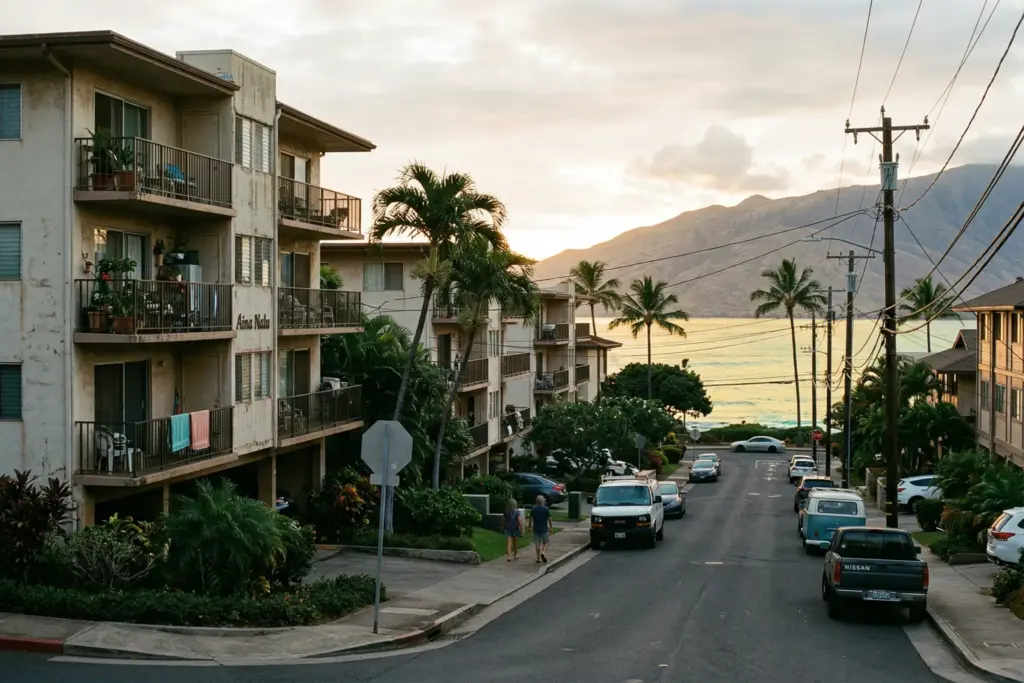
Bill 9 does not ban all vacation rentals on Maui. It phases out short-term rental use specifically in apartment-zoned districts. Hotel-zoned and resort-zoned properties are unaffected. Permitted bed-and-breakfast homes and short-term rental homes under separate chapters of the county code continue to operate.
The phase-out works on a staggered timeline:
- West Maui (Lahaina, Ka’anapali, Honokowai, Kahana, Kapalua): All apartment-zoned STR use must cease by January 1, 2029.
- Rest of Maui County (Ma’alaea, Kihei, Wailea, South Maui, Hana, Molokai): All apartment-zoned STR use must cease by January 1, 2031.
There is no renewal option. There is no opt-out. There is no pathway to preserve apartment-zoned STR use beyond those deadlines. When the amortization period expires, nonconforming-use protections disappear. Full stop.
Hosts can continue operating legally through 2028 in West Maui and through 2030 in South Maui. But those years are not an extension. They are the countdown.
Who Enforces This, and What Happens If You Do Not Comply
This is where the accountability question lands. Bill 9 does not create a new enforcement agency. It does not establish a dedicated compliance office. It relies on Maui County’s existing code enforcement apparatus, which will be responsible for flagging units that continue operating past their phase-out deadlines.
The enforcement teeth come from existing county law. Maui County voters approved a charter amendment in 2018 that dramatically increased penalties for illegal vacation rental operations. Those penalties went into effect in December 2019:
- Initial fine: $20,000 for operating an STR without a valid permit
- Daily fine: $10,000 for each day of continued illegal operation
Once the Bill 9 deadlines pass, every apartment-zoned STR that keeps taking bookings becomes an unpermitted operation. The fines are not theoretical. They are codified. A host who continues operating for even 10 days past the deadline would face $120,000 in penalties.
The county was originally supposed to notify affected property owners by January 1, 2026. An amendment pushed that notification deadline to March 1, 2026. Whether every owner has actually been reached is another question entirely.
The Hotel Zoning Escape Hatch That Closed
Bill 9 was not supposed to be the final word. At least not for everyone.
A Temporary Investigative Group appointed during the legislative process identified approximately 4,500 units that it argued were unsuitable for long-term residential conversion. The reasoning: some buildings sit in flood zones, face sea-level rise threats, or carry HOA fees too high for residential tenants. Council member Tom Cook introduced legislation to create two new hotel zoning districts, H-3 and H-4, that would have let these units continue operating as vacation rentals under a different classification.
Mayor Bissen supported the proposal. The Maui Planning Commission did not.
In February 2026, the commission voted 8-1 to recommend denial. Commissioner Mark Deakos called the measure “a way to undermine Bill 9.” The Molokai and Lanai Planning Commissions held subsequent hearings in March 2026. The County Council can still override the commission’s recommendation, but it would need a two-thirds supermajority of six out of nine votes to proceed.
The council passed Bill 9 with five votes. Finding six to override the planning commission’s rejection would require flipping at least one of the three members who voted against the phase-out in the first place.
The Lawsuits Have Already Started
Property owners did not wait long to challenge the law. Two lawsuits were filed within a week of Bissen’s signature.
Malter v. Maui County (Case No. 2CCV-25-0003778) was filed December 19, 2025, by owners at the Kaanapali Royal luxury condominiums. Attorneys H. Maxwell Kopper and Francis Chandler argue that the phase-out constitutes “a total denial of plaintiffs’ viable economic use of their property rising to the level of an unconstitutional per se regulatory taking.”
Lynam v. County of Maui (Case No. 2CCV-25-0003780) was filed three days later and seeks class-action status representing all 7,000 Minatoya List properties. The plaintiffs cite Article 1, Section 20 of the Hawaii Constitution: “Private property shall not be taken or damaged for public use without just compensation.”
Both suits seek preliminary injunctions to block enforcement while litigation proceeds. Neither has received a ruling. If an injunction is granted, it could pause the entire phase-out timeline. If not, the clock keeps running.
Legal observers have noted that a previous attempt to restrict vacation rentals on Oahu was blocked by federal courts on similar property-rights grounds. But Maui’s law is structured differently. Bill 9 uses an amortization framework, giving owners years to recoup investment before the use is terminated. Courts have historically been more receptive to amortization periods than immediate bans.
Who Gets Hurt, and Who Was Never Going to Stay
Documents from the Maui County Council show that 94% of the affected units are owned by people who do not live in Maui County. Most do not live in Hawaii at all. This is not primarily a story about local families losing supplemental income from a spare bedroom. This is about mainland and international investors losing access to a revenue stream that local housing advocates say came at the direct expense of Maui’s residents.
The county estimates Bill 9 will reduce annual tax revenue by approximately $60 million. That sounds catastrophic until you look at the context: officials describe it as a return to prior-year budget levels, with long-term stabilization expected as properties are reclassified from commercial vacation rental rates to residential tax rates.
On the housing side, the numbers are significant. Maui County data indicates that approximately 11,600 households could afford the affected units at 30% of their income. An additional 15,500 households could stretch to 30-50% affordability. That is a total of 27,100 households in a county where the housing waitlist has been measured in years, not months.
What STR Investors Watching Maui Should Be Doing Right Now
If you own an apartment-zoned STR unit on Maui, the calculus has changed. The legal challenges offer a thread of hope, but no court has intervened. The hotel rezoning escape hatch has been rejected by the planning commission. The phase-out deadlines are approaching.
Operators in West Maui have less than three years before their units must convert. South Maui operators have less than five. For investors evaluating whether to hold, sell, or convert, the decision framework is straightforward:
- Hold and operate through the deadline: Legal if you comply with existing permit requirements. Revenue continues through 2028 (West Maui) or 2030 (South Maui). But property values for apartment-zoned STR units are already adjusting.
- Sell before the deadline: The buyer pool is shrinking. Who buys a vacation rental that cannot be a vacation rental in three years? Expect discounted offers.
- Convert to long-term rental: This is what the county wants. The rental demand is there. The question is whether the economics work at residential rental rates versus STR revenue.
StaySTRA tracks Hawaii STR markets across multiple submarkets, including Haiku on Maui, where data shows 216 active listings with a $327 average daily rate and 67.3% occupancy generating $5,488 in average monthly revenue. Those revenue numbers reflect what apartment-zoned hosts stand to lose. Across the state, Hawaii’s STR markets consistently rank among the highest-performing in the country for occupancy and ADR.
Sponsored — OfferMarket
Buy Your First STR With Long-Term Rental Financing
Flexible, long-term financing for short-term rental buyers. Rates from 5.75%. Instant online quote, no credit pull.
Explore RTL Financing Options →Affiliate disclosure: StaySTRA may earn a referral fee.
Why This One Passed When Others Did Not
Maui has tried this before. A proposed STR moratorium in 2023 failed to gain enough council support. Oahu’s attempt to restrict vacation rentals was blocked in federal court. The Hawaii legislature has repeatedly considered statewide STR regulation without passing anything.
Bill 9 succeeded for three reasons that previous attempts lacked.
First, the Lahaina wildfire created a housing emergency that made the status quo politically untenable. When fire survivors were competing with tourists for apartments, the argument that vacation rentals are a housing problem became visceral, not abstract.
Second, the amortization structure gave the law a stronger legal footing than an outright ban. Courts have generally accepted that governments can phase out nonconforming uses over a reasonable period. The three-to-five-year timeline positions the county to argue that owners had sufficient time to adjust.
Third, Mayor Bissen made it his signature issue and pushed it through a divided council. The 5-3 vote was narrow, but it was enough.
Every city in America that is watching housing-first STR policy is now watching Maui. The question is not whether Bill 9 is bold. The question is whether it holds up in court, whether the county can enforce it at scale, and whether 6,208 units actually become housing.
We do our best to keep our reporting accurate and up to date, but situations evolve and we are only human. Always verify current details directly with local officials and sources before making decisions.
Frequently Asked Questions
Does Maui Bill 9 ban all short-term rentals on Maui?
No. Bill 9 specifically phases out short-term rental use in apartment-zoned districts. Hotel-zoned and resort-zoned properties are not affected. Permitted bed-and-breakfast homes and short-term rental homes under separate county code chapters also continue to operate.
When do Maui vacation rental owners have to stop operating?
West Maui apartment-zoned STR units must cease operations by January 1, 2029. All other areas of Maui County, including South Maui, have a deadline of January 1, 2031. Hosts can continue legal operations until those dates.
What are the fines for operating an illegal vacation rental on Maui after the phase-out?
Maui County imposes a $20,000 initial fine for operating an STR without a valid permit, plus $10,000 per day for each day of continued illegal operation. These penalties were established by a voter-approved 2018 charter amendment and took effect in December 2019.
Can a court block Maui’s vacation rental phase-out?
Two lawsuits have been filed challenging Bill 9 on constitutional grounds, arguing the phase-out is an unconstitutional taking of property without just compensation. Both seek preliminary injunctions. No court has issued a ruling or injunction as of April 2026. If an injunction is granted, it could pause the phase-out timeline.
How many housing units will Maui’s STR phase-out create?
The law targets 6,208 apartment-zoned units currently operating as vacation rentals. Maui County data indicates approximately 11,600 households could afford these units at 30% of income, with an additional 15,500 households at the 30-50% affordability range. Whether all units actually convert to long-term housing depends on owner decisions and market conditions.
Run the Numbers on Hawaii STR Markets
Whether you are evaluating a Maui property for conversion, exploring other Hawaii markets, or watching the regulatory ripple effects across the islands, StaySTRA’s analyzer gives you the occupancy, revenue, and ADR data you need to make informed decisions. Check current Hawaii STR market data or run projections for any US market with the StaySTRA Airbnb Calculator.
Become a StaySTRA Insider
Join free — get our newsletter + 1 free property analysis/month.
No spam. Unsubscribe anytime. Free membership includes property analyses and market insights.