Key Takeaways
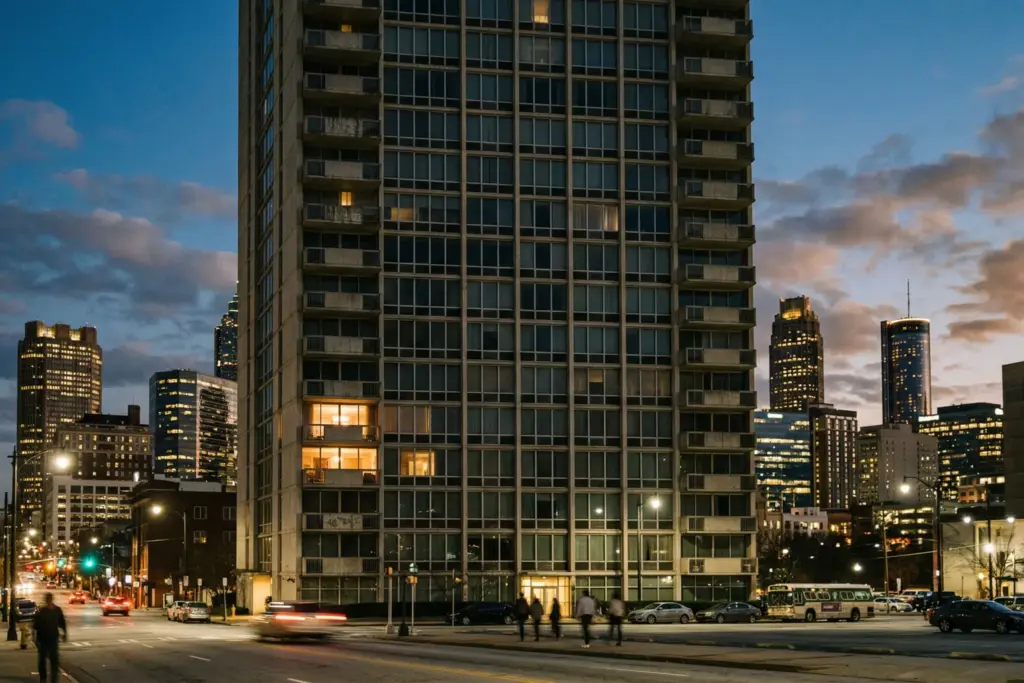
- Roughly 50 LLCs and trusts now control more than 90 of the approximately 200 units in Atlanta’s Landmark Condominium, a 21-story downtown high-rise built in 1963.
- Four of five HOA board members operate short-term rental businesses, creating a governance structure where investor interests routinely override those of full-time residents.
- Atlanta’s regulatory response includes the Home Park neighborhood STR ban (Ordinance 25-O-1249, approved August 2025) and Councilmember Michael Julian Bond’s proposed 10% unit cap for multifamily buildings.
- StaySTRA data shows Atlanta’s 13,156 active short-term rental listings generate an average of $183 per night at 57% occupancy, helping explain why investor capital flows into STR-permissive buildings like the Landmark.
- The Landmark pattern (investor concentration, HOA capture, declining livability for residents) is replicable in any city where a handful of condo buildings allow short-term rentals and enforcement lags behind.
On a Tuesday evening in downtown Atlanta, the elevator doors on the seventh floor of the Landmark Condominium do not open. Someone inside is pressing buttons. Someone inside is asking for help. “Help, help, does anybody care? I can’t breathe in here.” Two of the building’s three elevators have been out of service. In a 21-story tower, that is not an inconvenience. It is a sentence.
The Landmark was built in 1963. For decades it was what longtime residents describe as a “tranquil condo community,” a place where people knew their neighbors, where the hallways were quiet on Sunday mornings. Nicky Buggs has lived here for 17 years. She raised her life around this building. And now, standing in front of Atlanta City Council, she is telling elected officials that she fears losing her home. Not to a bank. Not to a storm. To a wave of LLCs.
“We have predatory property investors who have taken over our building in its entirety,” Buggs told the council. The building, she said, has taken “a dramatic nose dive.”
La comunidad (the community) that once held the Landmark together is fracturing. And the story of how it happened is not unique to one building in one city. It is a warning.
How Fifty LLCs Quietly Took Over a Historic Building
An investigation by the Atlanta Journal-Constitution, later amplified by Hoodline, found that roughly 50 LLCs, trusts, and companies now control more than 90 of the Landmark’s approximately 200 units. The AJC called it an “Airbnb gold rush.” Public records show dozens of nightly rental listings inside the tower, operated by entities like FHS Homes LLC and LuLu Homes.
The sisters behind LuLu Homes are registered agents for multiple LLCs holding units in the building. Neither lives in the Landmark. Yet one of them, Yali Lu, sits on the HOA board.
The Landmark is one of only a handful of Atlanta condo buildings whose HOA documents explicitly permit short-term rentals. Peachtree Towers (a sister building downtown) and 525 Parkway are among the few others. In a city where most condo associations impose six-to-twelve-month minimum lease requirements to maintain lending eligibility, the Landmark’s permissive covenants made it a target. Investors did not break any rules. They simply found the one building where the rules allowed what they wanted to do, and they filled it.
Walking through these numbers, I found myself thinking about a phrase my mother uses when she talks about a neighborhood changing too fast. “Se les fue de las manos,” she says. It got away from them. Nobody voted for this transformation. It accumulated, unit by unit, LLC by LLC, until the building’s character was no longer a matter of choice for the people who actually live there.
When the HOA Board Works for the Investors
Four of the Landmark’s five HOA board members operate short-term rental businesses. That single fact reshapes everything about how the building functions.
Residents say the board has raised HOA fees (a 50% increase, according to the AJC investigation), allowed common-area repairs to lag, and repeatedly sided with STR operators over long-term residents. Building insurance costs have surged. An insurer sued the association in early 2025, seeking to void its property policy after a 2024 fire. The insurer alleged that the HOA’s application misrepresented sprinkler coverage, claiming protection was limited to a small section of the basement rather than the full building. Court filings reference a $567,000 premium increase.
George Weidman, another longtime resident, received a cease-and-desist letter from the HOA in May 2025 after speaking publicly about conditions in the building. Nicky Buggs was served with a defamation lawsuit by the HOA on August 5, 2025, while she was speaking at an Atlanta City Council meeting about the Landmark.
Read that again. A resident testified before her own city council about safety conditions in her building, and the HOA served her with a lawsuit in response.
Where some see governance, others see control. The HOA board’s position is that Buggs is “significantly delinquent in her HOA payments” and that the association has launched “multiple assistance programs for struggling residents.” The residents’ position is that they are being silenced. Both things can be true at once. But when the board that sets the fees also profits from the business model driving those fees up, the conflict of interest is structural, not personal.
What It Actually Feels Like to Live There Now
The numbers tell one story. The daily reality tells another.
Residents report fire alarms triggered repeatedly by short-term guests. Marijuana smoke drifting through hallways. Parties on weekends that bring strangers through the lobby at all hours. “You don’t know who’s coming in or going out,” resident Stanley Zayed Sartor said. “You don’t feel safe.”
Council Member Liliana Bakhtiari, who represents the district, has visited the building multiple times over three years. She described certain levels as “party floors” and called conditions “unacceptable.” Bakhtiari told Fox 5 Atlanta: “The City of Atlanta has the authority to hold negligent property owners accountable.”
WSB-TV obtained elevator inspection records through an open records request. A July 2024 inspection found a worn guide wheel, an out-of-date fire extinguisher, and a non-functioning elevator phone. All three elevators were overdue for annual testing. A guest named Renee Savage, who booked a stay at the Landmark through a short-term rental platform, arrived to find someone else in her parking space, a concierge unaware of her reservation, and missing keys. She left a review: “If I could give my experience at this location a zero I would.”
An environmental firm, EFI Global, found smoke and soot contamination through upper ventilation systems and recommended deep cleaning. The building’s parking lot is owned by a separate company, and the HOA says it has made “repeated requests for improvements, including the hiring of a parking attendant, enhanced lighting, better cleanliness, and improved safety measures.” Those requests, residents say, remain unaddressed.
Why Investors Chose the Landmark (and Why This Pattern Repeats)
To understand why the Landmark attracted so much capital, look at the market.
StaySTRA data shows Atlanta currently has 13,156 active short-term rental listings generating an average daily rate of $183, with 57% occupancy and average monthly revenue of $2,218 per unit. Peak months push above $2,500. The city’s LTM RevPAR sits at $128, with an average length of stay of 3.5 nights. For an investor buying a condo unit in a building that explicitly allows nightly rentals, the math can work.
That is the critical context. The Landmark’s covenants made it one of the very few Atlanta condo buildings where an investor could legally operate a short-term rental without navigating HOA opposition. In a metro area with more than 13,000 active listings, the supply of STR-permissive condo buildings is tiny. Peachtree Towers, 525 Parkway, and perhaps a handful of others. Investor demand concentrated in the few buildings where the door was open.
A 2022 Georgia Tech study of the nearby Home Park neighborhood found that only 25% of properties were owner-occupied. The Landmark’s trajectory mirrors that statistic at a vertical scale: a building where full-time residents have become the minority, outnumbered by short-term guests who cycle through weekly.
Use the StaySTRA Airbnb calculator for Atlanta to see what current revenue projections look like for specific property types. The estimated annual revenue for an average Atlanta STR is $37,873. For a well-located downtown condo with concierge services, the ceiling is higher.
Atlanta’s Regulatory Response Is Fragmented (and That Is Part of the Problem)
Atlanta does not lack STR regulations. The city passed a licensing ordinance in 2021 requiring permits for any property rented for fewer than 30 consecutive days. The permit system distinguishes between owner-occupied and non-owner-occupied units, imposes safety inspections, requires liability insurance, and mandates a local responsible party available around the clock for non-owner-occupied properties. The combined hotel/motel tax burden reaches 21% across city, county, and state levies.
On paper, this is a serious regulatory framework. In practice, enforcement has been inconsistent. Councilmember Jason Dozier, who voted against the Home Park ban, has been blunt about the gap. “I thought the legislation that this body put together and adopted was really good legislation,” he said. “Our city has unfortunately been unwilling to enforce that legislation.”
Dozier’s position is enforcement-first: address the backlog of non-registered, non-compliant STRs before layering on new bans. “I’m not going to support any new short-term rental legislation until we make an attempt to enforce the existing legislation that’s on the books,” he told SaportaReport.
The Home Park neighborhood took a different path. On August 18, 2025, Atlanta City Council approved Ordinance 25-O-1249 by an 11-2 vote, banning new short-term rental permits in the Home Park neighborhood near Georgia Tech. Existing permit holders can continue operating, but no new permits will be issued. Councilmember Liliana Bakhtiari framed the vote clearly: “My concern is not protecting people who own 10 of these. My concern is protecting my constituents who have used this to supplement their income.”
Then there is Councilmember Michael Julian Bond’s broader proposal. Bond introduced legislation that would cap short-term rentals at 10% of total units in multifamily buildings. A separate, more comprehensive citywide rewrite of the STR ordinance (introduced in December 2024) would add a 1,000-foot spacing requirement between non-owner-occupied STRs. Both proposals remain in committee.
Buckhead Councilmember Howard Shook has introduced a similar neighborhood ban proposal for his district. The pattern is clear: individual council members are responding to constituent pressure with localized solutions because the citywide framework has not kept pace.
For deeper context on Atlanta’s short-term rental market, including current occupancy and revenue data by property type, explore our full city profile.
What Other Cities With “Landmark Buildings” Can Expect
The Landmark is not an anomaly. It is a case study in what happens when three conditions converge: permissive HOA covenants, concentrated investor capital, and lagging enforcement.
Every mid-sized and large American city has at least a few condo buildings where the governing documents do not prohibit short-term rentals. Some of those buildings were designed as “condo-tel” properties from the start. Others simply never updated their covenants to address platforms like Airbnb and Vrbo. In either case, the same dynamic can unfold. Investors identify the permissive buildings. Capital concentrates. The ownership mix shifts. The HOA board composition follows. Residents who bought into a residential community find themselves living in something closer to an unregulated hotel.
Atlanta’s experience suggests that the regulatory response will be reactive and fragmented. Neighborhood-by-neighborhood bans (like Home Park) address symptoms in specific areas but do not solve the structural problem. Percentage caps (like Bond’s 10% proposal) get closer to the root cause but face resistance from investor blocs that are already organized and, in some cases, already control the governance levers.
We have seen similar patterns in other cities grappling with STR concentration. New Jersey’s expanding STR bans ahead of the FIFA World Cup reflect the same tension between investor economics and community livability. The details differ. The dynamics do not.
Airbnb, in its response to the Home Park ban, argued that the restriction would “deprive many Atlantans of the ability to generate needed income” and reduce affordable lodging options. That is a real concern. Host Nadia Giordani, who rents in the Cabbagetown neighborhood, told SaportaReport that her Airbnb income helped her achieve home ownership and fund her daughter’s college tuition. The benefits of short-term rental income are genuine. The question is whether those benefits can coexist with livable conditions for everyone in a building.
Esa es la pregunta (that is the question) that Atlanta has not yet answered. And it is the same question facing every city where STR-permissive buildings exist.
What Happens Next at the Landmark
The Landmark’s legal battles are ongoing. The HOA’s defamation suit against Nicky Buggs, the insurer’s fraud claim against the association, the cease-and-desist letters to vocal residents: none of these have resolved. Meanwhile, the elevators still need testing. The ventilation still needs cleaning. The residents who remain are still outnumbered.
Bond’s 10% cap would, if passed, prevent the next Landmark from happening. It would not undo what has already happened at this one. Dozier’s enforcement-first approach would, if executed, remove non-compliant operators across the city. But it would not change the fact that the Landmark’s STR operators are, by the building’s own rules, compliant.
And that may be the hardest part of this story. The investors who transformed the Landmark did not violate the building’s covenants. They used them. The residents who are suffering the consequences did not do anything wrong either. They just stayed.
Some problems do not have a villain. They have a system.
We do our best to keep our content accurate and up to date, but things change and we are only human. Always verify details directly with local sources before making decisions.
Frequently Asked Questions
Are short-term rentals allowed in Atlanta condos?
Most Atlanta condo buildings prohibit short-term rentals through HOA covenants that require six-to-twelve-month minimum lease terms. Only a small number of buildings, including the Landmark Condominium, Peachtree Towers, and 525 Parkway, explicitly allow nightly rentals. Investors should review HOA governing documents carefully before purchasing, as rules can change by owner vote.
What is the proposed 10% STR cap for Atlanta multifamily buildings?
Councilmember Michael Julian Bond has proposed legislation that would limit short-term rental units to 10% of total units in any multifamily building. A separate, broader ordinance rewrite introduced in December 2024 would also impose a 1,000-foot spacing requirement between non-owner-occupied STRs. Both proposals remain in committee as of early 2026.
What happened with the Home Park short-term rental ban in Atlanta?
Atlanta City Council approved Ordinance 25-O-1249 on August 18, 2025, by an 11-2 vote, banning new short-term rental permits in the Home Park neighborhood near Georgia Tech. Existing permit holders can continue operating. The ban was driven by resident complaints about noise, transient occupancy, and a Georgia Tech study showing only 25% owner-occupancy in the neighborhood.
How much do Atlanta short-term rentals earn on average?
StaySTRA data shows Atlanta’s 13,156 active short-term rental listings generate an average daily rate of $183, with 57% occupancy and average monthly revenue of $2,218. Peak months (July, October, May) push above $2,500. Estimated average annual revenue is $37,873, though individual performance varies by location, property type, and management quality.
What STR regulations does Atlanta currently enforce?
Atlanta requires permits for all rentals under 30 consecutive days, distinguishing between owner-occupied and non-owner-occupied properties. Requirements include safety inspections, liability insurance, a local responsible party (for non-owner-occupied units), and combined hotel/motel taxes reaching 21%. The city has increased enforcement efforts using technology to identify unlicensed listings, though enforcement gaps persist.
Check the Numbers for Yourself
If you are evaluating Atlanta for short-term rental investment or trying to understand how your building compares, start with real data. The StaySTRA Airbnb calculator for Atlanta provides property-specific revenue projections, occupancy estimates, and comparable rental data. Explore the full Atlanta STR market profile for current ADR, occupancy, and revenue trends by neighborhood.
Become a StaySTRA Insider
Join free — get our newsletter + 1 free property analysis/month.
No spam. Unsubscribe anytime. Free membership includes property analyses and market insights.