

Key Takeaways
- Breckenridge STR operators average $11,116 per month during peak ski season (February), with a last-twelve-month average daily rate of $393 across 5,008 active listings.
- The town’s four-zone licensing system caps STR permits by area, and waitlists are active in both the downtown core (Zone 2) and residential neighborhoods (Zone 3).
- HOA restrictions are the hidden gatekeeper in this market. Many condo associations ban short-term rentals entirely, and deed-restricted workforce housing neighborhoods are off-limits to investors.
- Breckenridge occupancy swings from 89.3% in February to 23.3% in May, making seasonality management the single biggest operational challenge for owners here.
- With 68% of all housing units classified as second homes or vacation rentals and a workforce housing shortfall exceeding 2,500 units, the tension between tourism revenue and community livability shapes every regulation in this market.
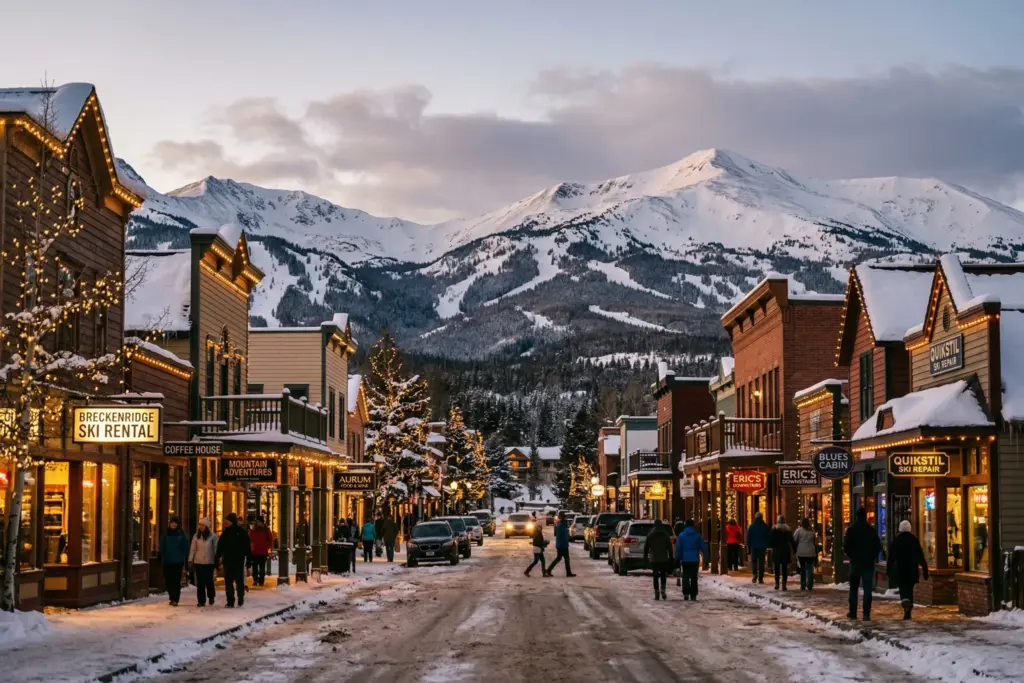
On a February evening in Breckenridge, the sidewalks along Main Street glow under string lights, and you can hear the scrape of ski boots on pavement three blocks away. The town is full. Every condo in the resort zone is booked. StaySTRA data shows the average short-term rental here pulled in $11,116 that month, on an average daily rate of $570.43 and occupancy hitting 89.3%. Those are numbers that make investors lean forward in their chairs.
But here is the part that separates Breckenridge from almost every other STR market in the country: most people who want to list here simply cannot. Between the town’s four-zone licensing cap system, aggressive HOA restrictions, and a growing supply of deed-restricted workforce housing, the gap between “I want to invest in Breckenridge” and “I can legally operate an STR in Breckenridge” is wider than most buyers realize. La brecha es real, as my grandmother would say. The gap is real.
What the Revenue Numbers Actually Look Like
Let me walk through the full picture, because the peak season numbers alone would be misleading.
Sponsored — Beeline
Finance Your Next STR With a DSCR Loan
Qualify on property cash flow, not W-2 income. Beeline specializes in fast DSCR closings for STR investors. No personal income verification required.
Check Your DSCR Eligibility →Affiliate disclosure: StaySTRA may earn a referral fee.
Over the last twelve months, Breckenridge short-term rentals averaged a $393 daily rate and 62.5% occupancy, generating $5,346 in monthly revenue per listing. That is strong for a mountain market. For context, national STR occupancy dropped roughly 13% year-over-year, and many markets are struggling to hold above 55% annual occupancy. Breckenridge, with its 6 million annual visitors and a permanent population of just over 5,000, operates in a different orbit.
But the seasonal swing is dramatic. Here is the month-by-month breakdown from StaySTRA:
| Month | ADR | Occupancy | Monthly Revenue |
|---|---|---|---|
| January 2025 | $536 | 78.3% | $9,510 |
| February 2025 | $570 | 89.3% | $11,116 |
| March 2025 | $532 | 86.7% | $10,828 |
| December 2024 | $499 | 62.1% | $7,351 |
| July 2024 | $312 | 80.7% | $5,520 |
| June 2025 | $339 | 46.4% | $3,413 |
| May 2025 | $318 | 23.3% | $2,041 |
The winter months (December through March) account for roughly 60% of a Breckenridge STR’s annual income. February alone can generate more than May, June, September, and October combined. If you are underwriting a Breckenridge investment, you need to build your model around four strong months, a solid summer, and several shoulder months where your property may sit largely empty.
I have talked to operators here who describe the rhythm like a heartbeat. “Invierno nos da vida, el verano nos sostiene, y la primavera nos pone nerviosos,” one host told me. Winter gives us life, summer sustains us, and spring makes us nervous.
The Zone System That Controls Everything
Breckenridge does not just allow short-term rentals. It rations them.
The town divides properties into four licensing zones, each with its own cap on how many STR permits can be active at once. These licenses are not transferable. If you buy a property, you do not inherit the seller’s license. You apply fresh, and you wait in line if the zone is full.
Here is where the zones stand as of early 2026:
| Zone | Cap | Licenses Issued | Status |
|---|---|---|---|
| Resort Zone | 1,816 | 1,723 | Open (93 available) |
| Zone 1 (Tourism) | 1,680 | 1,220 | Open (460 available, 92% eligible) |
| Zone 2 (Downtown Core) | 130 | 130+ | Waitlist active |
| Zone 3 (Residential) | 390 | 390+ | Waitlist (160+ waiting) |
The Resort Zone and Zone 1 still have availability, and those areas contain the bulk of the purpose-built condo complexes and resort lodging that tourists expect. Zone 2 and Zone 3 are effectively closed to new entrants. If you are looking at a charming downtown condo or a house in one of Breckenridge’s residential neighborhoods, you may be buying a property that cannot legally operate as a short-term rental for years.
This is not a bureaucratic inconvenience. This is the fundamental investment risk in this market. A $1.17 million property (the current typical home value in Breckenridge, per StaySTRA data) that cannot get licensed is a second home, not an income property.
The HOA Layer That Nobody Talks About Until Closing Day
Even if your property falls in a zone with available licenses, you are not done clearing hurdles. HOA restrictions represent an entirely separate gatekeeping layer in Breckenridge, and they have been tightening for years.
Many condo associations in Breckenridge ban short-term rentals outright. Others impose minimum lease periods of 30, 60, or even 90 days, which effectively eliminates nightly vacation rental use. Before the town will issue an STR license, the HOA must verify that short-term rentals are a “harmonious, compatible use” for the property. If the HOA will not provide that letter, the license application stops cold.
Walking through some of these neighborhoods, you would never know which buildings allow rentals and which ones fought tooth and nail to ban them. They look the same from the outside. Same mountain views, same proximity to the lifts. But the economics of ownership are completely different depending on which side of an HOA vote you land on.
I think about the buyers who fall in love with a unit during a ski trip, picture it listed on Airbnb by spring, and only discover the HOA prohibition buried in the CC&Rs during due diligence. It happens more than you would expect. The smart investors here work with local brokers who know, building by building, which associations allow nightly rentals and which ones slammed that door shut.
The Workforce Housing Pressure Behind Every Rule
To understand why Breckenridge regulates STRs the way it does, you have to understand the housing crisis underneath it all.
Sixty-eight percent of all housing units in Breckenridge are classified as second homes or vacation rentals. That is not a typo. In a town of roughly 5,000 permanent residents welcoming 6 million visitors a year, the housing stock primarily serves people who do not live here. The workers who keep the restaurants open, who teach at the schools, who drive the plows are competing for a shrinking slice of the remaining 32%.
Summit County estimates it needs over 2,500 additional rental and for-sale units at all price points to meet current workforce demand. A recent study found that 60% of all renters in the county, and 86% of Latino renters, spend more than a third of their income on housing. Eso duele. That hurts. Those are not abstract statistics. Those are your barista, your ski instructor, the person who cleans the rental unit between guests.
Breckenridge has responded more aggressively than most ski towns. About 75% of the town’s full-time residences are now deed-restricted for workforce housing, the highest percentage of any Colorado ski community. Since passing a $50 million housing plan in 2022, the town has built more than 400 new deed-restricted units, with 300 more in the pipeline over the next four years.
None of those deed-restricted units are available for short-term rental use. Every unit added to the workforce housing supply is one more property taken off the potential STR map. This is intentional. The town is choosing long-term residents over short-term visitors in specific neighborhoods, and the regulatory apparatus reflects that priority.
What This Means for Investors in 2026
If you are evaluating Breckenridge as an STR investment, the numbers are genuinely compelling. An annual revenue average above $64,000 per listing, a $393 ADR that outperforms most mountain markets, and a demand floor supported by 6 million visitors annually. The StaySTRA Colorado analyzer can help you model specific properties against these market averages.
But the opportunity is narrower than the headline numbers suggest. Here is what separates the investors who succeed here from the ones who get stuck:
Zone awareness is non-negotiable. The Resort Zone and Zone 1 are your realistic entry points for new STR licenses. Zone 2 and Zone 3 require patience and a willingness to wait on a list with no guaranteed timeline.
HOA due diligence has to happen before the offer. Not during inspection. Not at closing. Before you write the check. Get the CC&Rs, get the HOA’s position on short-term rentals in writing, and confirm the association will issue the compatibility letter the town requires.
Seasonality has to be built into the model. Do not underwrite this property based on February numbers. Build your projections around 62.5% annual occupancy and a $393 ADR. If February gives you $11,000, that is wonderful. But May will give you $2,000, and you need to be able to carry the mortgage either way.
Forward bookings tell a real story. StaySTRA data shows Breckenridge properties are 67.1% booked four to six months out, which is strong. That kind of forward demand visibility helps with cash flow planning and suggests the market is not softening in the near term.
Summit County Beyond Breckenridge
The broader Summit County regulatory landscape adds another dimension for investors considering this corridor. Unincorporated areas of the county operate under their own overlay zone system, with caps that vary by basin. The Snake River and Ten Mile basins are already over their license caps. New Type II applications are not being accepted county-wide. And properties in the Neighborhood Overlay Zone face a 35-booking-per-year limit, which sharply limits the revenue potential compared to Breckenridge’s town-licensed properties.
Each incorporated town in Summit County (Frisco, Silverthorne, Dillon, Keystone) has its own rules on top of the county framework. If you are looking at Summit County broadly, the regulatory homework multiplies. But Breckenridge, with its four-zone system and substantial license inventory in the Resort and Tourism zones, remains the most liquid and best-documented STR market in the county.
The Property Mix
Breckenridge’s 5,008 active listings skew heavily toward condos and smaller units, which makes sense for a ski market. StaySTRA tracks the following property type breakdown:
- Studios: 216 listings
- 1-bedroom: 750 listings
- 2-bedroom: 1,233 listings (the sweet spot)
- 3-bedroom: 910 listings
- 4-bedroom: 556 listings
- 5+ bedroom: 395 listings
Two-bedroom units dominate the inventory, and for good reason. They are the workhorses of the ski rental market. A couple traveling together or a small group of friends can split the cost, the nightly rate is accessible, and the units are easy to manage. If you are entering this market for the first time, the 2-bedroom condo in the Resort Zone or Zone 1 is the classic Breckenridge play.
The 5+ bedroom segment is smaller but commands significantly higher nightly rates during peak season. These larger properties serve a different guest, typically multigenerational groups or corporate retreats who book well in advance and stay longer. The revenue ceiling is higher, but so is the entry cost and the operational complexity.
Looking Forward
Breckenridge is wrapping up another ski season, and investors are already looking at summer and fall potential. July 2024 showed 80.7% occupancy at a $312 ADR, proving this is not strictly a winter market. The Colorado STR landscape is evolving, with Denver’s primary residence requirement limiting that market and smaller mountain towns tightening their own regulations.
What makes Breckenridge unusual is that the supply constraint is baked in. Between zone caps, HOA restrictions, deed-restricted workforce housing, and a town government that is actively choosing housing preservation over tourism expansion, the total addressable supply of legal STRs is unlikely to grow meaningfully. For investors who clear the licensing process and find properties in the right zones with the right HOA rules, that supply constraint is the moat.
Para los que logran entrar, el mercado recompensa. For those who manage to get in, the market rewards. But getting in is the hard part, and that is by design.
We do our best to keep our content accurate and up to date, but things change and we are only human. Always verify details directly with local sources before making decisions.
Frequently Asked Questions
Can I operate a short-term rental in any part of Breckenridge?
No. Breckenridge divides properties into four licensing zones, each with a cap on the number of STR permits. The Resort Zone and Zone 1 (Tourism) still have available licenses, but Zone 2 (Downtown Core) and Zone 3 (Residential) have active waitlists. Your ability to list a property as a short-term rental depends entirely on which zone it falls in and whether your HOA allows it.
How much does a Breckenridge short-term rental make per year?
StaySTRA data shows Breckenridge STRs average $5,346 per month over the last twelve months, or roughly $64,000 annually. However, revenue is heavily seasonal. February averages $11,116 per listing, while May averages just $2,041. Your actual returns depend on property type, zone, pricing strategy, and how well you capture the winter peak.
What role do HOAs play in Breckenridge short-term rental investing?
HOAs are the hidden gatekeeper. Many condo associations in Breckenridge ban short-term rentals entirely or impose minimum lease periods that eliminate nightly use. The town requires an HOA compatibility letter before issuing an STR license. Investors must confirm HOA rules before making an offer, not after.
Are Breckenridge STR licenses transferable when a property sells?
No. Breckenridge STR licenses are not transferable. When a property changes hands, the new owner must apply for their own license. If the property is in a zone with a waitlist (Zones 2 and 3), the new owner goes to the back of the line. This is a critical factor in investment underwriting.
Is Breckenridge only a winter STR market?
No, though winter dominates. July 2024 showed 80.7% occupancy at a $312 ADR, generating $5,520 in monthly revenue. Summer hiking, biking, and festival season creates a meaningful secondary peak. The true shoulder months are April, May, September, and October, when occupancy drops below 45%.
Run Your Own Breckenridge Analysis
The numbers in this article reflect market-wide averages. Your specific property, in its specific zone, with its specific bedroom count, will perform differently. The StaySTRA Colorado analyzer lets you model individual properties against Breckenridge market data, including ADR, occupancy, and revenue projections by property type. If you are serious about this market, run the numbers before you make the call.
Become a StaySTRA Insider
Join free — get our newsletter + 1 free property analysis/month.
No spam. Unsubscribe anytime. Free membership includes property analyses and market insights.