
Key Takeaways
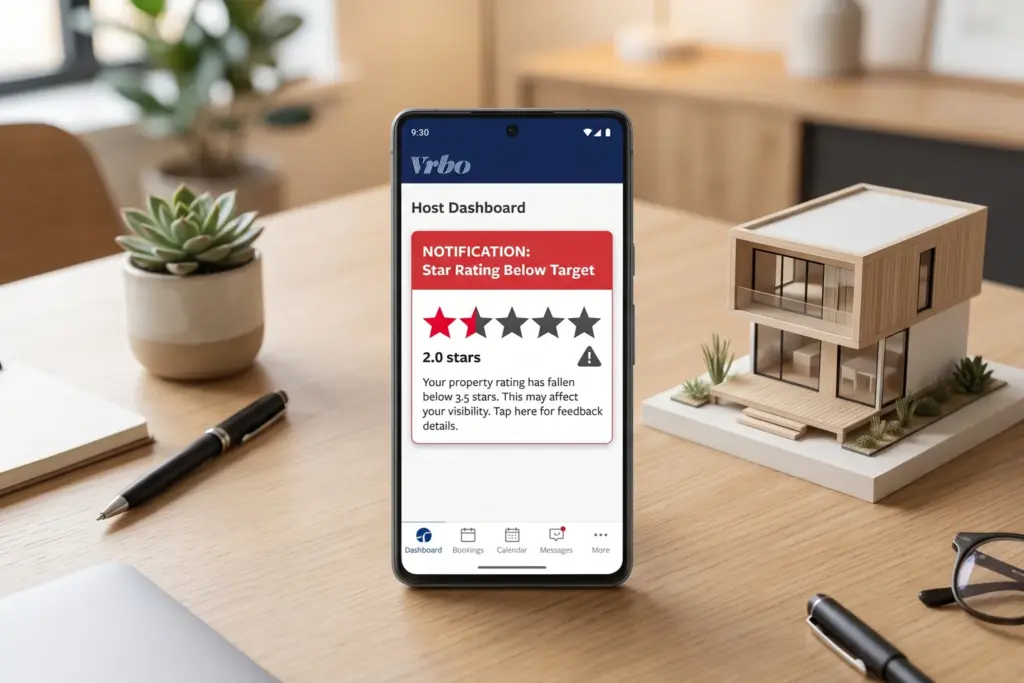
- Vrbo’s Minimum Standards program began permanently suspending host listings with average guest ratings below 2.0 stars on September 15, 2026.
- The program evaluates three metrics independently: acceptance rate (must stay above 50%), host-initiated cancellation rate (must stay below 10%), and average overall rating (must stay above 2.0 stars).
- Vrbo scores reviews in four sub-categories: cleanliness, location, check-in and amenities, and property condition (Source). The overall star rating is a separate guest input, not an average of those categories.
- Vrbo documents waivers only for suspensions caused by cancellations or declined booking requests due to extenuating circumstances, not for low ratings (Source). Vrbo uses the word “permanent.”
- Multi-platform hosts who actively monitor Airbnb metrics but let Vrbo numbers drift are the most exposed right now.
Vrbo started pulling the trigger on September 15, 2026. Listings with average guest review ratings below 2.0 stars are now permanently removed from receiving new reservations under Vrbo’s Minimum Standards program. Not suspended for a month. Not put on probation. Permanently suspended from new bookings.
This is not a future threat. It is live right now.
I track platform policy changes as closely as some people track earnings reports. Vrbo’s Minimum Standards rollout is one of the most aggressive quality-enforcement moves any major vacation rental platform has made, and from what I am seeing in host communities, a lot of Vrbo operators have not yet connected what this means for their accounts. Many are managing their Airbnb metrics closely and treating Vrbo as a secondary channel that mostly runs itself.
That approach stopped being safe on September 15.
What the Policy Actually Says
Vrbo’s Minimum Standards program launched with a warning period starting August 31, 2026. Enforcement began September 15, 2026. Three metrics can put your listing at risk of permanent suspension:
- Acceptance rate: Must stay above 50%
- Host-initiated cancellation rate: Must stay below 10%
- Average guest review rating: Must stay above 2.0 stars
Each metric is evaluated independently. Failing any one of the three triggers suspension. You can have a 4.9-star rating and still get suspended if your cancellation rate crosses 10%. The system does not weigh good performance in one category against poor performance in another.
The evaluation window is the previous 12 months of activity. That means every review your listing received in the past year is actively counting toward your current standing right now. If you had a rough stretch six months ago that you have since recovered from, those reviews are still in the calculation.
When a listing is suspended, Vrbo honors existing confirmed bookings. Guests who already have a reservation can still complete their stay. But no new reservations flow in. Your listing disappears from search results for new guests. The Owner Dashboard shows which metric triggered the suspension.
It is worth being clear about what this program is not. Minimum Standards is the floor. It is not the Premier Host program, which requires a 4.6-star average, 99% acceptance rate, and 0% host-initiated cancellations. Those are the standards for earning Premier Host status. The Minimum Standards threshold at 2.0 stars is the baseline below which Vrbo will not allow you to continue operating on the platform.
How Vrbo Calculates Your Rating
Understanding exactly how your rating works is the most important thing before you audit your account.
Vrbo asks guests to leave an overall star rating on a 1-to-5 scale. On the platform’s public search pages, Vrbo converts those ratings to a 10-point display scale. A guest who gives your property 4.5 stars out of 5 shows up as 9.0 in search results. The 2.0-star threshold in the Minimum Standards program refers to your average on the 5-point scale, which would display as 4.0 out of 10.
In addition to the overall rating, guests can rate four specific sub-categories (Source):
- Cleanliness
- Location
- Check-in and amenities
- Property condition
Here is the piece most hosts get wrong. The sub-category scores do not mathematically calculate your overall rating. The overall star rating is a separate input from the guest. A guest can give you 5 stars on cleanliness and 5 stars on check-in and still leave a 3-star overall if the trip did not meet their expectations for some other reason.
This distinction matters a great deal for how you respond to low ratings. Improving individual category scores is worthwhile and will help future guests find your listing. But the metric that protects your account from the 2.0-star suspension threshold is the overall rating that guests provide independently.
For context: a 2.0-star average on a 5-star scale reflects repeated, significant guest dissatisfaction. The average Vrbo listing maintains a rating well above 4.0 stars. Getting to 2.0 requires consistently poor guest experiences over an extended period. But the risk is real for hosts who have had problem guests, had a property go through a difficult maintenance stretch, or who have not been active enough on Vrbo to maintain the service standards they apply to other platforms.
The Rating Categories That Most Often Drag Hosts Down
The four sub-categories, plus listing accuracy and communication, are your diagnostic tool. Here is what most often drives ratings toward dangerous territory for hosts who are not actively monitoring their Vrbo numbers.
Cleanliness
This is the most-cited source of negative reviews across every major OTA, and it is also the most preventable. A single cleaning failure can cascade into a 1-star or 2-star review that takes months of strong ratings to average out.
The specific risk for multi-platform hosts: turnover standards that work for Airbnb do not always translate to Vrbo stays. Vrbo bookings tend to skew toward longer stays and whole-home rentals with larger groups. More guests, more days, more wear on the property means a deeper clean standard is often required.
Practical step: use a turnover checklist with photo documentation. A visual record of the property’s condition at each turnover protects you if a guest reports a cleanliness issue that developed after arrival, not before.
Listing Accuracy
Vrbo guests value accuracy highly. They are booking whole-home rentals, often for family reunions, group trips, or milestone events. If the listing says the property sleeps 10 and one of those sleeping spots is a lumpy pullout couch in a cramped den, that is a listing accuracy problem.
Common accuracy triggers: overstating sleeping capacity, listing amenities that are seasonal or currently broken, photos that do not reflect the current state of the property, and descriptions that do not mention known issues like road noise, nearby construction, or a shared driveway.
Practical step: audit your listing as if you were discovering the property for the first time. If anything at the property has changed since you last updated the listing, update the listing now.
Communication
Slow pre-arrival responses, unclear check-in instructions, and hard-to-reach hosts during a stay all show up in your reviews. Multi-platform hosts are especially exposed here. If your property management system or channel manager prioritizes Airbnb message routing over Vrbo, your Vrbo response times may be longer than you realize.
Practical step: verify that your channel manager is routing Vrbo messages with the same urgency as other platforms. Automated pre-arrival messages (check-in instructions, WiFi credentials, house rules, emergency contacts) eliminate most guest communication friction before it becomes a review issue.
Check-In and Amenities
A failed check-in is the worst possible start to a stay. A guest who cannot get into the property, receives an incorrect door code, or arrives to an uncleaned unit is frustrated before they have spent a single night at your listing.
The specific risk for tech-forward hosts: keyless entry codes that sync correctly with Airbnb bookings do not automatically appear in your Vrbo dashboard. Many property management systems handle this sync, but it requires active setup and testing. Verify that your smart lock is generating and distributing correct access codes for each Vrbo booking specifically, not just across all platforms in aggregate.
Location
Location is the only category you cannot change after listing. If your listing implies walkable access to downtown amenities and the property is a 25-minute drive, guests will mark the location score down. Set honest expectations in your listing description. “A short drive from the main strip” is more defensible than implying proximity you cannot deliver.
The Pre-Suspension Audit: What to Check Right Now
If your listing is active on Vrbo, run this audit before you receive another rating. This takes about 30 minutes and tells you exactly where you stand relative to the three Minimum Standards thresholds.
Step 1: Pull your current Minimum Standards metrics from the Owner Dashboard. Log into the Owner Dashboard. Go to your property’s performance section. Your current overall star average, acceptance rate, and cancellation rate are all visible there. Know your exact numbers before you do anything else. If any metric is within a point or two of the threshold, treat it as urgent.
Step 2: Calculate your 12-month review exposure. Count how many reviews your listing has received in the past 12 months and note how many are below 3 stars. A single 1-star review across 30 bookings has minimal impact on your average. Two 1-star reviews across 8 bookings moves the needle significantly. Understanding your exposure tells you how urgent the situation actually is.
Step 3: Audit your listing content for accuracy gaps. Go through your photos, description, and amenity list as a first-time guest would. Are the photos current? Is the sleeping capacity accurate for each sleeping area? Are all listed amenities functional? Flag anything that could cause an “expectations not met” reaction at check-in.
Step 4: Test your check-in process end to end. Use your next booking as a live test. Verify that the correct door code or access instructions reach the guest through the Vrbo platform specifically. Confirm that your pre-arrival message goes out automatically with check-in details, parking instructions, WiFi credentials, and your contact information.
Step 5: Audit your Vrbo response time specifically. Check how quickly your team or system responds to Vrbo guest messages as a separate metric from your overall response time. If you use a unified inbox, confirm that Vrbo messages are not sitting unread while you work through messages from other platforms.
Step 6: Read every sub-4-star review from the past 12 months. Look for patterns. If three guests in the past year mention the same problem (kitchen equipment, noise level, cleanliness at a specific point in the property), that is an actionable pattern. A single unique complaint is less urgent. Address the patterns first.
Step 7: Update your listing photos if the property has changed. If the property has been refreshed, renovated, or if any featured amenity has changed since your last photo update, new photos are overdue. Stale photos that no longer match the property are a leading source of accuracy complaints on Vrbo.
What Happens After Suspension and What Your Options Actually Are
This is the part nobody wants to read. Vrbo uses the word “permanent” in its Minimum Standards suspension language. There is no documented formal appeal process for the rating threshold. Vrbo does not provide a structured way to contest individual reviews that contributed to a low average.
Some hosts have reported limited success by contacting Vrbo host support directly and escalating to senior account representatives, particularly when fraudulent or retaliatory reviews were part of the story. Documenting any disputed reviews in writing before starting those conversations gives you something to reference. Multi-property operators with long-standing Vrbo relationships have slightly more leverage in escalation conversations.
The honest assessment: if your listing reaches suspension, options narrow sharply. The far more reliable strategy is preventing the situation entirely through active monitoring and ongoing listing maintenance.
Here is what I keep telling multi-platform operators in my own network: the Vrbo account you ignore is the one that bites you. Airbnb hosts who have built Superhost status understand the feedback loop, check the metrics regularly, and act on patterns quickly. That same discipline applied to Vrbo is what keeps you clear of this threshold.
Why Multi-Platform Operators Have the Most to Lose
The most exposed group right now is whole-home hosts who list on multiple platforms and actively manage Airbnb metrics while treating Vrbo as a set-it-and-forget-it channel. Airbnb gets the attention because the Superhost badge is visible, the metrics dashboard is prominent, and the feedback loop is fast. Vrbo runs in the background, bookings come in, reviews accumulate, and nobody is watching the average as closely.
Vrbo matters a great deal in certain market types. Beach, mountain, and rural markets often see Vrbo driving a significant share of whole-home bookings, sometimes at higher average daily rates than Airbnb because Vrbo’s traveler base skews toward longer stays and larger groups. Losing Vrbo access in those markets is not a minor revenue disruption.
Going forward, platforms will continue tightening quality standards. Vrbo’s Minimum Standards program is one signal in a broader trend toward automated quality enforcement across the OTA landscape. The next wave of platform policy changes will keep raising the floor on what constitutes acceptable hosting performance. Hosts who build their operations to meet or exceed current standards are the ones who will still be operating across all channels when those standards move.
If you want to understand what that revenue exposure looks like, StaySTRA’s Analyzer has the market-level data on revenue by property type. Knowing how much revenue is at stake in your market tells you how seriously to prioritize this audit for your specific situation.
For context on how Vrbo’s fee structure has also shifted alongside this quality enforcement push, our guide to Vrbo’s flat 12% commission change breaks down the October 2026 fee update now in effect. And if you are evaluating how your platforms compare on net revenue per booking, our Airbnb vs. Vrbo platform comparison has the breakdown by market and property type.
Sponsored — Beeline
Finance Your Next STR With a DSCR Loan
Qualify on property cash flow, not W-2 income. Beeline specializes in fast DSCR closings for STR investors. No personal income verification required.
Check Your DSCR Eligibility →Affiliate disclosure: StaySTRA may earn a referral fee.
Frequently Asked Questions
What is Vrbo’s Minimum Standards program and when did it start?
Vrbo’s Minimum Standards program permanently suspends listings from receiving new reservations if they fall below any one of three thresholds: acceptance rate below 50%, host-initiated cancellation rate above 10%, or average guest review rating below 2.0 stars. The warning period began August 31, 2026, with full enforcement starting September 15, 2026. Existing confirmed bookings are honored after suspension, but no new reservations can be made.
Does Vrbo calculate your overall rating from sub-category scores?
No. Vrbo scores reviews in four sub-categories (cleanliness, location, check-in and amenities, and property condition) plus a separate overall rating (Source). The overall rating is its own guest input, not a mathematical average of the sub-categories. Guests can rate all sub-categories highly and still give a lower overall rating based on their general experience. The Minimum Standards threshold applies to your overall star average, not sub-category averages.
Can you appeal a Vrbo host account suspension under the Minimum Standards program?
Vrbo documents no formal appeal for a rating-based suspension. Its documented relief is a Cancellation Waiver or Booking Request Decline Waiver when cancellations or declines came from extenuating circumstances (Source). The program describes rating suspensions as permanent. Some hosts have had limited success contacting Vrbo host support directly and escalating to senior account representatives, particularly when fraudulent or retaliatory reviews played a role. Documentation of any disputed reviews is important for those conversations.
What rating do I need on Vrbo to avoid suspension vs. achieving Premier Host status?
The Minimum Standards floor requires an average rating above 2.0 stars out of 5. That is the survival threshold. Vrbo’s Premier Host status requires a much higher standard: 4.6 stars or higher, combined with a 99% acceptance rate and 0% host-initiated cancellations. Targeting Premier Host standards keeps you well above the Minimum Standards suspension threshold and positions your listing for better search visibility.
How do I check if my Vrbo listing is at risk under the Minimum Standards program?
Log into your Vrbo Owner Dashboard and navigate to your property’s performance section. You will see your current overall star average, acceptance rate, and host-initiated cancellation rate. Compare each against the three thresholds: acceptance rate above 50%, cancellation rate below 10%, and average rating above 2.0 stars. The program evaluates the previous 12 months of activity, so any reviews from the past year are part of your current standing.
We do our best to keep our tech coverage accurate and up to date, but platform policies evolve and we are only human. Always verify current Vrbo policies directly on Vrbo’s help center or owner dashboard before making decisions about your account.
Become a StaySTRA Insider
Join free — get our newsletter + 1 free property analysis/month.
No spam. Unsubscribe anytime. Free membership includes property analyses and market insights.