
Key Takeaways
- Yale Assure Lock 2 and Schlage Encode Plus are the two strongest smart lock choices for STR operators in 2026, with native Airbnb integration and automatic guest code generation.
- Minut leads the noise monitoring category with smoke detection, occupancy tracking, and temperature alerts in one device, starting at $10 per month per home.
- Airbnb banned all indoor cameras in April 2024. Exterior cameras are allowed on both Airbnb and Vrbo, but only with full disclosure in your listing.
- Smart thermostats like the Ecobee Premium can cut HVAC costs by up to 26%, and most qualify for utility rebates between $25 and $150.
- RemoteLock acts as a universal access layer across 100+ lock brands and multiple PMS platforms, making it the go-to for operators managing more than a few properties.
The Yale Assure Lock 2 now runs on over 50,000 managed vacation rental properties with a 99.7% uptime rate. That is not a press release stat. That is millions of guest check-ins happening without a single lockout call. If you are still using a lockbox with a combination you text to guests, the gap between you and the professionals just got wider.
Smart home tech for short-term rentals is not new. But 2026 is the year where the winners and losers in each product category have become clear. I have been tracking these tools since the first wave of Wi-Fi deadbolts hit the market, and the landscape has finally settled enough to give you a definitive answer in each category: locks, noise monitors, cameras, and climate control.
This is not a generic smart home buying guide. Every product in this article was evaluated for one thing: does it solve a real problem for someone managing one to five short-term rental properties? If it does not integrate with your PMS, if it does not generate guest codes automatically, if it has no STR-specific use case, it is not here.
If you have already built out your software stack (your channel manager, PMS, and pricing tools), this is the hardware layer that completes the picture.
Smart Locks: The Front Door Is Your First Automation
The smart lock is the single most impactful piece of STR tech you can buy. It eliminates key handoffs, lets you grant and revoke access remotely, and creates a digital log of every entry. For insurance and liability purposes alone, that access log is worth the cost of the lock.
Here are the locks that have earned their place in STR operations.
Yale Assure Lock 2
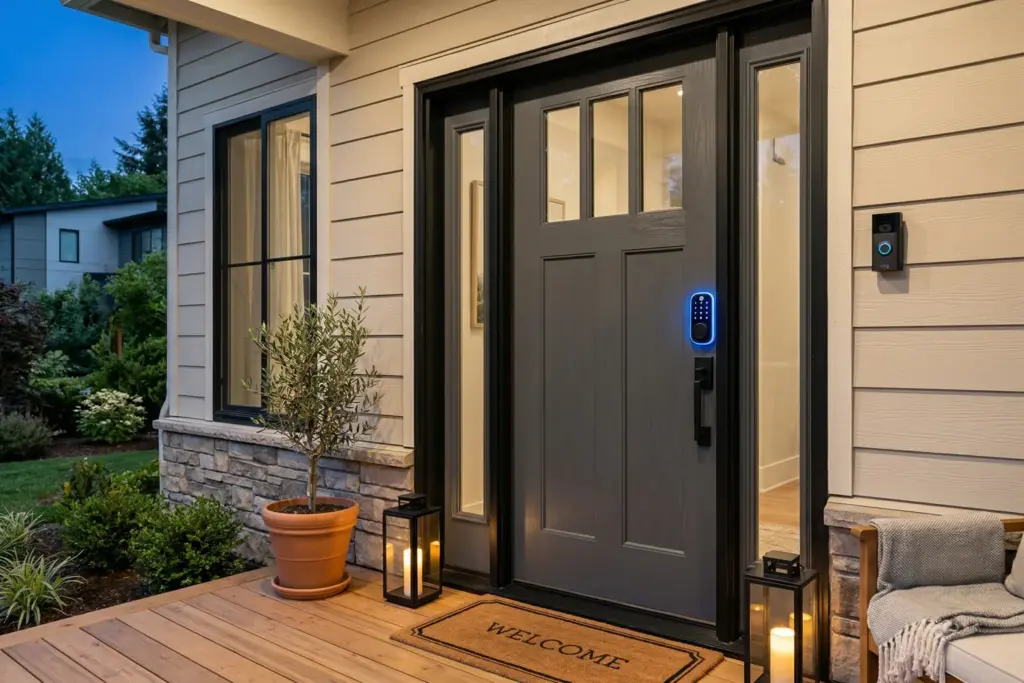
The Yale Assure Lock 2 is the lock most professional STR operators are running right now. It has native Airbnb integration, which means the platform automatically generates unique access codes and sends them to guests before check-in. The codes expire after checkout. No manual work required.
Battery life runs 12 months or longer. It fits most standard door preps. The touchscreen and keypad versions are both solid, though the keypad is more durable in high-turnover environments. Price runs roughly $200 to $250 depending on the configuration.
For operators managing multiple properties, Yale also plays well with RemoteLock (more on that below), which means you can manage access across your entire portfolio from one dashboard.
Schlage Encode Plus
If you want the most secure lock on the market, the Schlage Encode Plus is it. Built-in Wi-Fi (no hub required), military-grade encryption, and a three-year warranty that is the longest in the category. It also has direct Airbnb integration for automatic guest codes.
The Encode Plus costs a bit more, typically $250 to $300. But if your properties are in higher-end markets or you have had security concerns in the past, the extra investment in build quality pays off. Schlage locks are heavier, tighter, and harder to tamper with. The brand has over 100 years of lock-making behind it, and you can feel that in the hardware.
RemoteLock: The Access Management Layer
RemoteLock is not a lock. It is the software that sits on top of your locks and manages access across your entire portfolio. It works with over 100 lock brands, including Yale, Schlage, Kwikset, and August. If you are running three or more properties, especially with different lock hardware, RemoteLock is how you keep everything in one place.
Pricing is $6 per lock per month on the Premium plan, or $9 per lock per month on the Business plan. It integrates with Airbnb, Vrbo, and most major PMS platforms.
Think of it this way: Yale and Schlage are the locks. RemoteLock is the brain. If you are scaling past two or three doors, the brain matters more than any individual lock.
August Smart Lock
The August is the best value entry point for a host getting started with one or two properties. It runs about $200, integrates with Airbnb through the August app, and does the basics well: remote lock and unlock, guest access codes, and activity logs.
Where August falls short compared to Yale and Schlage is durability and battery life. It is a lighter-duty lock. For a single property that you manage closely, it works fine. For a growing portfolio, you will outgrow it.
Noise Monitoring: The Tech That Prevents Your Worst Night
A noise complaint from a neighbor can get your listing suspended. A party that goes sideways can cost you thousands in damage. Noise monitors catch problems before they become disasters, and in 2026, there are really only two serious options for STR operators.
Minut: The Clear Category Leader
Minut has pulled ahead of the pack by doing something smart: it stopped being just a noise monitor. The current Minut sensor tracks noise levels, occupancy, temperature, humidity, and mold risk. The Gen 3 and newer sensors use AI to distinguish between cigarette smoke and burnt toast. It also detects window breaks and motion when your unit is vacant.
Pricing starts at $10 per month per home for core monitoring. The $15 per month plan adds a free Minut sensor and PMS integrations with over 20 platforms, including Hospitable and Guesty. If noise levels spike, Minut can automatically send a message to guests through the Airbnb app asking them to keep it down.
Here is a detail that matters: Airbnb offers hosts up to 10 free Minut devices with three months of subscription included. That is a significant subsidy if you are just getting started. The program is available in 65 countries.
Minut sensors are battery-powered with roughly 10 months of life, so placement is flexible. Stick one on the ceiling of the main living area and you are covered. No outlet needed.
NoiseAware: The Specialist for Larger Operations
NoiseAware does one thing: noise monitoring. It does it well, but it does not try to be a multi-sensor platform like Minut. The indoor sensor plugs into an outlet (no battery to worry about), and the outdoor sensor ($99) connects to the indoor hub for monitoring decks, pools, and patios.
Pricing runs $15 per month per unit. The standout feature is AutoResolve, available on accounts with 10 or more properties. When noise exceeds your threshold, AutoResolve automatically messages guests and resolves 90% of noise incidents in under 30 minutes without you lifting a finger.
The catch: NoiseAware is only available in the US and Canada. If you have international properties, Minut is your only real option.
Which One Should You Pick?
For most operators managing one to five properties, Minut wins. The multi-sensor approach (noise plus smoke plus temperature plus occupancy) gives you more protection per dollar. The Airbnb free device program sweetens the deal.
NoiseAware makes more sense for larger portfolios (10+ properties) where the AutoResolve automation justifies the higher per-unit cost and the lack of multi-sensor features.
If you have already set up guest screening tools, noise monitoring is the second layer of protection that catches what screening misses.
Cameras: What the Platforms Allow (and What They Do Not)
This is the category where the rules matter more than the hardware. You can buy a great camera for $50. But if you place it wrong or fail to disclose it, you can lose your listing permanently.
Airbnb’s Camera Policy (Updated April 2024)
Airbnb banned all indoor security cameras globally, effective April 30, 2024. This is not a suggestion. It is a hard rule. Even if the camera is turned off, it cannot be inside the property. Violations result in listing removal.
Exterior cameras are permitted under three conditions:
- You disclose the exact location in your listing description (for example, “I have a camera on the front porch” or “I have a camera facing the driveway”).
- The camera does not face any area where guests would expect privacy, like an enclosed outdoor shower or sauna.
- The camera complies with local and state laws.
Noise decibel monitors (like Minut and NoiseAware) are allowed indoors because they do not record audio or video. They only measure sound levels. But they still must be disclosed and cannot be placed in bedrooms, bathrooms, or sleeping areas.
If you have not reviewed Airbnb’s April 2026 Terms of Service update, do that now. The camera rules sit within a broader set of host obligations that tightened this year.
Vrbo’s Camera Policy
Vrbo follows a nearly identical framework. No indoor surveillance devices. Exterior cameras allowed for security purposes only, pointed at access points (front door, driveway). All devices must be disclosed in the listing. Guests must be informed of the location and coverage of every device.
Direct Booking Properties
If you take direct bookings through your own website, camera placement is governed by state and local law, not platform policy. Most states require disclosure of any recording device. Some states require two-party consent for audio recording, which means your Ring doorbell’s audio recording could technically violate wiretapping laws if you do not disclose it.
The safest approach across all channels: exterior cameras only, fully disclosed, no audio recording unless you have verified your state allows it.
Best Exterior Camera Setup for STR
Keep it simple. A Ring or Google Nest doorbell camera covers the front entry point. A weatherproof exterior camera (Reolink and Wyze both make solid budget options) covers the driveway or back entrance. Total investment: $100 to $200. Disclose everything in your listing. Done.
Do not overcomplicate this. The camera is there to document who enters and exits your property. It protects you from false damage claims and gives you evidence if something goes wrong. Two cameras, fully disclosed, is all most STR operators need.
Smart Thermostats: The Silent Money Saver
A vacant rental running heat or AC at full blast is burning money every hour. Smart thermostats fix this automatically, and the savings are not trivial.
Ecobee Smart Thermostat Premium
The Ecobee Premium can cut HVAC costs by up to 26% annually, according to Ecobee’s own data from real deployments. It uses occupancy sensors to detect when the property is empty and adjusts the temperature automatically. It also monitors local weather forecasts and adjusts proactively.
For STR operators, the remote access is what matters most. You can set temperature limits so guests cannot crank the AC to 60 degrees in August. You can set “away” schedules that align with your checkout and check-in times. And you can get alerts if the temperature drops below a threshold in winter. Frozen pipe prevention alone is worth the price of the thermostat.
Price runs roughly $250. Most ENERGY STAR certified smart thermostats qualify for utility rebates between $25 and $150, depending on your location. In California, New York, and the Pacific Northwest, rebates can reach $150 or more through Demand Response enrollment programs.
Honeywell Home T9
The Honeywell T9 is the budget-friendly alternative at roughly $170 to $200. Its standout feature is room-specific temperature control using wireless sensors. If your property has a master bedroom that runs hot while the living room stays cold, the T9 handles that better than most. It also has vacancy detection to save energy between guests.
The T9 does not have quite the same polish or integration depth as the Ecobee, but for operators who need a reliable thermostat at a lower price point, it gets the job done.
What This Stack Costs (and What It Saves)
Here are real numbers for a full smart home stack on a single STR property:
- Smart lock (Yale Assure Lock 2): $225 one-time
- Noise monitor (Minut, $15/month plan): $180 per year (sensor included)
- Exterior cameras (Ring doorbell + one outdoor): $150 one-time, plus $100 per year for cloud storage
- Smart thermostat (Ecobee Premium): $250 one-time (minus $25 to $150 rebate)
First-year total: roughly $800 to $900. Annual recurring cost after that: roughly $280.
Now compare that to what it protects against. A single noise complaint that results in a listing suspension can cost you thousands in lost bookings. One party-related damage event can easily exceed $5,000. A frozen pipe from an unmonitored thermostat in winter can cause $10,000 or more in water damage. Insurance deductibles alone often exceed the entire cost of this tech stack.
The math is not close. The smart home stack pays for itself after preventing one incident.
PMS Integration: Making Everything Talk to Each Other
The best hardware in the world is useless if it does not connect to your property management software. Here is how the major smart home products integrate with the PMS platforms STR operators actually use:
- Minut: Integrates with Hospitable, Guesty, OwnerRez, Lodgify, Hostaway, and 15+ additional platforms. Also connects directly to Airbnb.
- RemoteLock: Integrates with Airbnb, Vrbo, and most major PMS platforms. Works with 100+ lock brands.
- Yale Assure Lock 2: Native Airbnb integration. Also works through RemoteLock for PMS connectivity.
- Schlage Encode Plus: Native Airbnb integration. PMS access through RemoteLock or direct Wi-Fi API.
- Ecobee: Integrates with most smart home platforms (HomeKit, Google Home, Alexa). PMS integration typically through Zapier or IFTTT automations.
The pattern here is clear. Your PMS is the hub. Minut and RemoteLock are the two smart home products that treat PMS integration as a first-class feature. If your PMS already works with both, your entire hardware stack can be managed from one dashboard. That is the goal.
We do our best to keep our tech reviews accurate and up to date, but products evolve fast and we are only human. Always verify current features and pricing directly with vendors before purchasing.
Frequently Asked Questions
What is the best smart lock for an Airbnb in 2026?
The Yale Assure Lock 2 is the top choice for most STR operators. It has native Airbnb integration that automatically generates and sends unique access codes to guests, 12+ month battery life, and works with RemoteLock for multi-property management. The Schlage Encode Plus is the strongest alternative if you prioritize maximum security and durability.
Are indoor security cameras allowed in Airbnb rentals?
No. Airbnb banned all indoor security cameras globally effective April 30, 2024. Even cameras that are turned off cannot be inside the property. Exterior cameras are allowed if you disclose their exact location in your listing and they do not face private areas. Noise monitors (which do not record audio or video) are allowed indoors with disclosure.
Is Minut or NoiseAware better for short-term rental noise monitoring?
For operators with one to five properties, Minut is the better value. It monitors noise, cigarette smoke, occupancy, temperature, and humidity in one device starting at $10 per month. Airbnb also offers up to 10 free Minut devices. NoiseAware is better suited for larger portfolios (10+ properties) where the AutoResolve automated guest messaging feature justifies the $15 per month per unit cost.
How much does a full STR smart home tech stack cost?
A complete setup (smart lock, noise monitor, two exterior cameras, and a smart thermostat) costs roughly $800 to $900 in the first year. Annual recurring costs after that drop to about $280. This investment typically pays for itself after preventing a single noise complaint, party damage event, or frozen pipe incident.
Do smart thermostats actually save money in vacation rentals?
Yes. The Ecobee Premium can reduce HVAC costs by up to 26% annually through occupancy detection, weather-responsive adjustments, and remote temperature controls. Most ENERGY STAR smart thermostats also qualify for utility rebates of $25 to $150. For STR operators, the ability to set temperature limits and get freeze alerts adds protection beyond energy savings.
Run the Numbers on Your Market
The smart home tech stack protects your property. But before you invest in hardware, you need to know whether your market supports the revenue to justify it. Use the StaySTRA Analyzer to see occupancy rates, average daily rates, and revenue projections for your specific market. The data is free, and it takes 30 seconds.
Become a StaySTRA Insider
Join free — get our newsletter + 1 free property analysis/month.
No spam. Unsubscribe anytime. Free membership includes property analyses and market insights.
Sponsored — OfferMarket
Buy Your First STR With Long-Term Rental Financing
Flexible, long-term financing for short-term rental buyers. Rates from 5.75%. Instant online quote, no credit pull.
Explore RTL Financing Options →Affiliate disclosure: StaySTRA may earn a referral fee.