Key Takeaways
- Reactive maintenance typically costs two to three times more than a proactive schedule because of emergency service premiums, last-minute contractor fees, and review damage that plays out over weeks.
- The three most common guest complaint categories that trace back to deferred maintenance are HVAC failures, plumbing problems, and appliance malfunctions.
- Breezeway is the most feature-complete STR-specific maintenance platform in 2026, with automated inspection checklists, vendor management, and photo documentation built in at roughly $19.99 per unit per month.
- A seasonal inspection calendar, customized by property type, is the single most reliable system for catching problems before guests arrive rather than after they leave a review.
- Build a minimum of two pre-vetted vendor contacts per trade before your first booking. Three is better. This is the difference between a quick fix and an emergency.
The property management software industry just shipped something that should change how every STR host thinks about their maintenance budget. STR operations platforms now generate per-property repair logs detailed enough to show exactly how much more reactive maintenance costs versus scheduled inspections. The data keeps pointing to the same answer: emergency calls run two to three times the cost of the same repair done proactively, once you factor in the premium rate, the scramble cost, and the revenue lost to a bad review.
That last part is what most hosts miss. The repair itself is just the start. A one-star review citing a broken AC unit in July or a leaky faucet discovered at check-in can drop your search ranking for weeks. Recovering from a maintenance-related two-star review requires a significant run of positive reviews to counterbalance. That is not math you want to be doing in peak season.
I track patent filings from property tech companies for fun. I follow product roadmaps the way other people follow sports. And the consistent signal from every serious STR operations platform in 2026 is this: the professional host gap is growing fastest in maintenance. Operators with systems are pulling ahead. Operators still reacting to guest texts are falling behind.
This article is about building the system. Not a generic checklist you forget about in a week. A real operational structure that catches problems before guests do.
The Maintenance Revenue Problem
Maintenance failures hit STR revenue in three places at once. There is the repair cost. There is the refund or compensation to the guest. And there is the review impact.
The repair cost is the only one most hosts see clearly. The review impact is the one that actually does the lasting damage.
Airbnb and Vrbo both weight recent reviews heavily in their ranking algorithms. A single maintenance-related complaint review does not just hurt your rating. It signals to the algorithm that your property may be declining in quality, which pushes it down in search results at exactly the moment when you want to be visible. The revenue hit from a ranking drop can easily run five to ten times the cost of the original repair.
The three maintenance categories that show up most consistently in guest complaint data are HVAC issues, plumbing failures, and appliance malfunctions. These categories share two important characteristics: they are predictable, and they are preventable with scheduled attention.
HVAC systems fail under load during hot summers and cold winters, which is exactly when occupancy is highest. Plumbing shows stress during high-turnover periods when fixtures and drains are used more heavily than in a typical residence. Appliances break on predictable cycles tied to age and use frequency. None of this is random. All of it can be caught early with the right inspection schedule.
The cost math is straightforward. An emergency HVAC service call during peak season carries a dispatch premium that contractors typically set at $150 to $300 above standard rates. A preventive HVAC tune-up at the start of the cooling season runs $80 to $150 total. The proactive approach costs less than the emergency premium alone, and it catches the failing capacitor before it becomes a compressor replacement at 10 PM on a Saturday.
Deferred maintenance is not a discipline problem. Most reactive hosts simply have not built the infrastructure to run differently. That is what this article covers.
Sponsored — OfferMarket
Buy Your First STR With Long-Term Rental Financing
Flexible, long-term financing for short-term rental buyers. Rates from 5.75%. Instant online quote, no credit pull.
Explore RTL Financing Options →Affiliate disclosure: StaySTRA may earn a referral fee.
Building a Preventive Inspection Schedule
The inspection frequency that works for a beach condo in humid Florida is not the same one that works for a mountain cabin in Colorado. Property type and turnover volume both drive how quickly things degrade. The seasonal schedule has to match the property.
Beach and Coastal Properties
Salt air and humidity accelerate everything. HVAC filters clog faster. Window seals fail sooner. Outdoor hardware corrodes at twice the rate of inland properties. Patio furniture, outdoor showers, and exterior fixtures need attention every season, not annually.
For a high-turnover coastal property running 60 or more check-ins per year, monthly spot checks of the highest-stress systems are justified. At minimum, a full pre-season inspection before Memorial Day and a full post-season check in October are mandatory. You want to know what summer did to the property before you stop watching closely.
Mountain and Ski Properties
Freeze-thaw cycles are the category-specific threat. Water infiltration, pipe stress, and roofing failures happen during the spring thaw, not during winter bookings when hosts are paying close attention. The most important inspection of the year is the April or May walkthrough after the last hard freeze. That is when the damage from winter shows itself.
Fall pre-season checks before the first winter booking are equally critical. Pipe insulation, heat tape in vulnerable spots, chimney and fireplace inspection, and weatherstripping are all fall checklist items that become emergencies if they are skipped.
Urban Condos and Suburban Properties
Lower environmental stress means quarterly inspections are generally sufficient. The focus areas are different: HVAC filter changes every 60 to 90 days for high-turnover properties, smoke and CO detector batteries every six months, kitchen appliances and plumbing fixtures, and guest-facing tech (smart locks, WiFi routers, streaming devices).
The Core Seasonal Checklist
Spring (March to April for most markets):
- HVAC system: transition from heat to cooling, full service
- Water heater: inspection and sediment flush
- Window seals and weatherstripping
- Outdoor spaces, furniture, and decking for winter damage
- Smoke detectors, CO detectors, and fire extinguisher check
Summer (June to July, before peak season):
- HVAC filter change (mid-season change for properties running 8 or more check-ins per month)
- Kitchen appliance check: garbage disposal, dishwasher, refrigerator seals
- Guest-facing tech: smart locks, WiFi, streaming devices, thermostat
- Outdoor fixtures, pool and hot tub if applicable
Fall (September to October):
- HVAC transition to heat: full service
- Gutter cleaning
- Chimney and fireplace inspection (mountain and cabin properties)
- Winterization: pipe insulation, heat tape in cold climates
Winter (December to January):
- Active winter properties: spot checks between turnovers focused on heat and plumbing
- Seasonal properties in warm climates: opening inspection before the first booking of the new season
The seasonal schedule needs to be locked into a calendar before the season starts. Scheduling a pre-season HVAC service call in March is easy. Scheduling one on June 28 when your first summer guest checks in July 1 is not.
If you have linked operational systems, the automation framework you use for guest communications can also trigger maintenance reminders tied to your booking calendar. More on that in the automation section.
Software Comparison: Breezeway vs Properly vs Manual Tracking
Most small STR operators are running their maintenance workflow on text messages and spreadsheets. That works until it does not. When it stops working, it usually stops working at the worst possible time.
The STR operations software category has matured significantly in the last two years. These are the three realistic options for a host managing one to five properties in 2026.
Breezeway
Breezeway is the most STR-specific operations platform on the market in 2026. It started as a housekeeping coordination tool and has built steadily into a full property operations platform that handles maintenance workflows better than any alternative in its category.
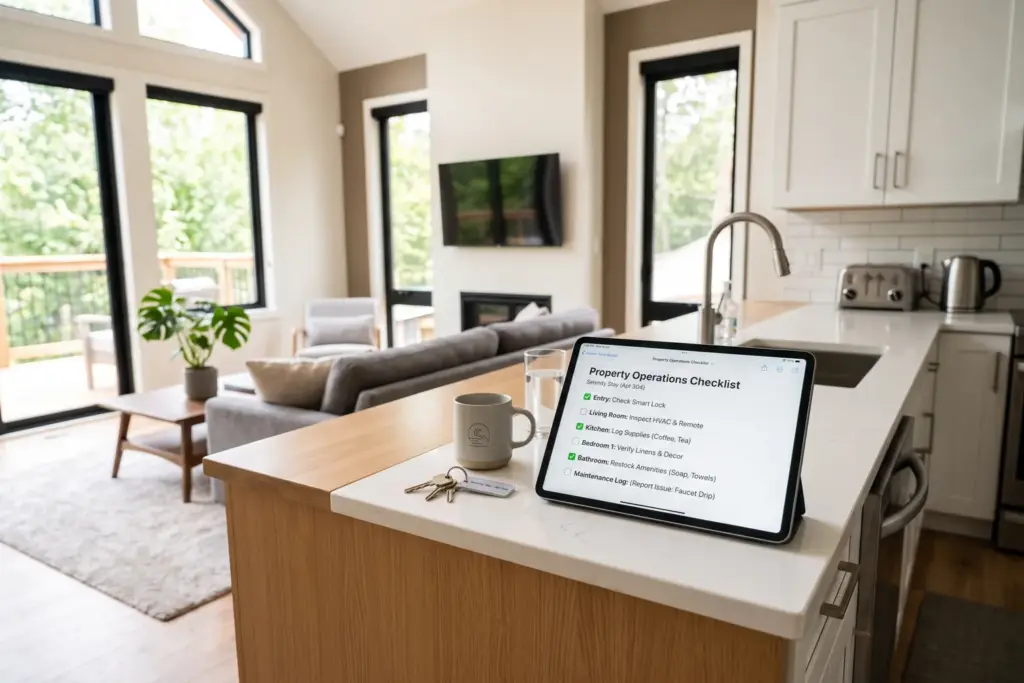
What makes it worth the cost: automated inspection checklists. You build property-specific checklists once, and they auto-assign at whatever cadence you set. Checklists are photo-documented by default, so every task completion includes a dated photo attached to the property record. Vendors receive mobile-friendly task assignments without needing to create accounts or navigate a complex interface.
The maintenance tracking creates a running repair log per property. When something breaks, you can look up exactly what was replaced, when, and by which vendor. That log matters when you are tracking warranty coverage, evaluating whether a system needs replacing instead of repairing again, or filing an insurance claim.
Breezeway runs approximately $19.99 per unit per month, making it more expensive than a cleaning-only tool but significantly more capable for operators who need the full ops infrastructure. The AI-assisted guest messaging integration is a useful bonus. The maintenance tracking and inspection documentation are the core value.
What to watch: Breezeway has a native integration with Hospitable (Source). It also integrates natively with OwnerRez (Source). Verify integration compatibility before committing, since the STR integration landscape changes frequently.
Properly
Properly takes a visual-first approach to task management. Photo-guided checklists show workers exactly what done looks like for each task, with before-and-after verification against a reference image. For maintenance workflows involving distributed teams or vendors working in properties they are unfamiliar with, this visual verification model is more reliable than a text-based checklist.
The differentiation from Breezeway is the photo verification layer. A task is not marked complete when someone checks a box. It is verified when the completion photo matches the reference. For quarterly inspections of a property you are not visiting personally, that is a meaningful quality control step.
Properly pricing is per property rather than team-size-based. Pricing starts at $12.99 per property per month on the Standard plan, though this category changes quickly (Source). Verify current pricing directly with Properly before subscribing.
What to watch: Properly is stronger on workflow management than on data analytics. Task completion records and photo documentation are excellent. Maintenance trend analysis, which properties are breaking down most often, which vendors have the best response times, requires manual work to extract.
Manual Tracking: Spreadsheets and Shared Notes
Honest assessment: manual tracking works fine until it does not.
A shared Google Sheet with columns for property, date, task, status, and vendor handles a single property without much friction. At two properties, it still works if you are disciplined. At three properties, the gaps start appearing. Who checked the HVAC filter last month? When was the last smoke detector test at Property 3? Who has the current access code for the exterior utility closet?
Manual systems fail not because they are poorly designed but because they depend on consistent human attention during periods when that attention is being pulled in multiple directions. High-turnover summer weeks are exactly when manual maintenance tracking breaks down and exactly when maintenance failures cause the most damage.
If you are managing one or two properties and building your first systems, a well-structured spreadsheet is a fine starting point. Use it consistently and build calendar reminders for every inspection date. When you add a third property, add maintenance software to the budget.
Sponsored — OfferMarket
Buy Your First STR With Long-Term Rental Financing
Flexible, long-term financing for short-term rental buyers. Rates from 5.75%. Instant online quote, no credit pull.
Explore RTL Financing Options →Affiliate disclosure: StaySTRA may earn a referral fee.
Building and Vetting Your Vendor Network
Software tells you what needs attention. Vendors actually do the work. Your vendor network is what matters most at 10 PM on a Saturday when something breaks between check-out and check-in.
The baseline rule: two vendor contacts per trade before your first booking. Three is better.
That means at minimum two plumbers, two HVAC technicians, and two electricians who know your properties, have your access codes, and have agreed to prioritize STR calls. Not two people you found in a search. Two vendors you have called, explained your business to, and received a direct acknowledgment from.
The reason for multiple contacts is availability, not quality. Your best plumber might be excellent. They are also human, and they will be on vacation or fully booked at some point during your peak season. When that happens, you need a real backup.
Finding Vendors Who Understand STR
The best source for STR-aware contractors is other hosts in your market. BiggerPockets forums and local STR Facebook groups are where this information actually lives. Ask specifically: who do you call for emergency HVAC in this city? Hosts who have been operating three or more years in a market have already learned the hard way who shows up at 9 PM and who does not return calls until Monday.
Property management companies that operate in your market are another source. When evaluating a property manager, asking about their contractor relationships as part of the vetting conversation is reasonable. The answer tells you something about how they operate.
The STR cleaner problem and the STR vendor problem share the same dynamics. Finding turnover help that shows up reliably follows the same principles as finding maintenance vendors who do.
Negotiating STR-Friendly Rates
Emergency rate premiums are standard across every trade. You cannot eliminate them entirely. But you can negotiate a preferred customer relationship that reduces them over time.
The conversation is simple: I have X properties in this area. I expect roughly Y service calls per year. If I commit to calling you first, what does your preferred customer rate look like?
Most contractors who have worked with STR operators understand the model. A portfolio of three properties generates six to ten service calls per year. That is consistent work, and the steady relationship has value to both parties.
What to Track in Your Vendor Log
For each vendor, keep: name and trade, primary and after-hours contact, your actual experience with response times (not what they quoted), rate structure for standard and emergency calls, which of your properties they have worked on, and notes from the most recent job.
Breezeway has a vendor management module built in. Properly integrates vendor assignment into the task workflow. If you are on manual tracking, a dedicated vendor tab in your operations spreadsheet does the job.
What to Automate vs What Requires Human Eyes
The STR tech industry is pushing hard to automate every part of property operations. That energy is pointed at the right problem. But not everything should be automated, and the line between what works and what creates new problems matters more than most operators realize.
Automate These
Task assignment and scheduling. When a booking closes, Breezeway or Properly can trigger an automatic inspection or turnover checklist assigned to the appropriate person. No manual scheduling required. Going forward, trigger-based maintenance automation will become more sophisticated as platforms add predictive maintenance features. Early versions of HVAC system monitoring integrations already exist on premium deployments.
Seasonal inspection reminders. Every seasonal inspection date should be a recurring calendar event with a 30-day advance reminder. This prevents the I-meant-to-schedule-that call when peak season is two weeks out. Automate it once and never miss a pre-season service call again.
Maintenance documentation. After every vendor visit, a quick photo documentation workflow in your maintenance platform creates a date-stamped record attached to the property. This matters for insurance claims, warranty tracking, and evaluating whether to repair or replace aging systems.
Smart home data monitoring. Smart thermostats collect HVAC runtime data that indicates system efficiency. Unusual patterns, more cycles than normal to reach the set temperature, can signal a developing problem worth checking before the next check-in. Noise monitors like Minut provide occupancy behavior data that is useful context for wear and tear patterns.
Guest communication acknowledgment. Automated pre-arrival messages that include a prompt for guests to report any issues within the first hour of check-in surface problems early. Pair that with an automated acknowledgment that confirms receipt and promises human follow-up within 15 minutes. The automation handles the logistics. The human response handles the relationship.
Do Not Try to Automate These
The physical walkthrough. No software replaces someone walking the property. A smart sensor can confirm the HVAC is running. It cannot tell you the compressor sounds wrong. A photo verification tool documents a cracked tile. It cannot tell you the floor beneath it is soft and the subfloor is showing moisture damage. Physical walkthroughs are the system. Everything else supports them.
Vendor selection for significant repairs. Automated vendor assignment tools exist in some platforms. Avoid using them for anything above a $200 repair. For a plumbing or electrical job, you want to choose who shows up. Automated assignment sends whoever is available in the moment, which is not always the vendor you want inside your property on short notice with a complex problem.
Guest communication during active maintenance issues. Guests who report a maintenance problem mid-stay are stressed and watching how you respond. An automated acknowledgment followed by any delay signals that no real person is engaged with their problem, which is the fastest path to a negative review even if you resolve the issue quickly. Automate the acknowledgment. Put a real person on the response within 15 minutes.
The next wave of STR maintenance tech is moving toward predictive maintenance, using appliance usage data and smart home sensor feeds to flag likely failures before they happen. This category will look very different in 24 months. The operators who have built inspection and documentation habits now will integrate those tools naturally when they arrive.
Building the System Before You Need It
The STR hosts running proactive maintenance programs share one characteristic: they built the system before they needed it. Not after the first emergency. Before.
Start with the inspection calendar. Set your seasonal dates before the next season starts. Build the vendor list. Make the introductory calls. Evaluate whether Breezeway or Properly fits your workflow better than a spreadsheet.
The STR investors who calculate their actual maintenance spend often find that year two costs significantly more than year one, because deferred maintenance from the setup period catches up. The hidden costs that appear in year two consistently include maintenance surprises that a proactive inspection schedule would have caught earlier.
The system does not have to be perfect. It has to be consistent. A quarterly walkthrough with a written checklist beats a thorough-but-rare inspection every time. Show up on schedule, fix small things, and document everything. That is the whole program.
Sponsored — OfferMarket
Buy Your First STR With Long-Term Rental Financing
Flexible, long-term financing for short-term rental buyers. Rates from 5.75%. Instant online quote, no credit pull.
Explore RTL Financing Options →Affiliate disclosure: StaySTRA may earn a referral fee.
We do our best to keep our tech reviews accurate and up to date, but products evolve fast and we are only human. Always verify current features and pricing directly with vendors before purchasing.
Frequently Asked Questions
How often should I inspect my STR property?
The right frequency depends on property type, climate, and turnover volume. For most suburban and urban properties, quarterly inspections are sufficient. Coastal and mountain properties with environmental stress factors benefit from monthly spot checks of high-stress systems plus full seasonal inspections before and after peak season. Properties running 60 or more check-ins per year should be inspected more frequently than lower-turnover properties regardless of property type.
What is the best maintenance software for STR hosts in 2026?
Breezeway is the most feature-complete STR-specific operations platform in 2026, with automated checklists, photo documentation, vendor management, and per-property repair logs. At approximately $19.99 per unit per month, it is priced for professional operators. Properly is a strong alternative for operators who prioritize visual workflow management and work with distributed teams. For hosts managing one or two properties who are not ready for paid software, a well-structured spreadsheet with calendar reminders handles the basics.
What maintenance failures cause the most negative STR reviews?
The three most common categories are HVAC failures, plumbing problems, and appliance malfunctions. HVAC failures peak in summer and winter, which is also when occupancy is highest and the review impact is most damaging. Plumbing issues increase during high-turnover periods. Appliance failures are tied to appliance age and use frequency. All three categories are predictable and catchable with a scheduled inspection program, which is why deferred maintenance in these areas is an avoidable cost.
How do I find reliable maintenance vendors for my STR property?
Ask other STR hosts in your market. BiggerPockets forums and local STR Facebook groups are where experienced operators share contractor recommendations. Aim for at minimum two contacts per trade (plumbing, HVAC, electrical) before your first booking, with introductory calls completed so vendors know your properties and have your access information. When you have enough properties to offer consistent work volume, negotiate a preferred customer relationship for better availability and reduced emergency rate premiums.
Is Breezeway worth it for a host managing just two or three properties?
At two properties, the math depends on how much you value the inspection documentation, vendor tracking, and systematic task assignment relative to the monthly cost. For operators planning to grow, building the documented maintenance habit from the start is worth more than the subscription cost. For operators staying at two properties, a well-built manual system can work. The practical rule: if you have had even one maintenance-related negative review, the software is already cost-justified by the review damage you are trying to prevent.
Become a StaySTRA Insider
Join free — get our newsletter + 1 free property analysis/month.
No spam. Unsubscribe anytime. Free membership includes property analyses and market insights.