

Key Takeaways
- Mountain/ski STR markets produce the widest revenue range of any category, from $45,000 to $94,000 per year, with ADRs reaching $986 per night in Park City. But entry prices often exceed $1 million.
- Coastal/beach markets deliver the single highest per-listing revenue ($143,000 annually in Key West) but also the lowest ($19,000 in Myrtle Beach), making market selection within this category more consequential than in any other.
- Urban/metro markets offer the most predictable occupancy (38% to 58%) and the lowest ADR ceiling ($472 in New Orleans), keeping annual revenue in a tighter $31,000 to $58,000 band.
- Rural/drive-to markets like Gatlinburg and Blue Ridge quietly outperform most urban markets on annual revenue ($62,000 to $69,000) despite lower occupancy, because their ADRs run higher than you might expect.
- All figures reflect trailing StaySTRA market data through early 2025. Every market referenced is searchable in the StaySTRA analyzer.
Park City, Utah, averaged a $986 nightly rate over the last twelve months. Charlotte, North Carolina, averaged $198. Both are short-term rental markets. Both have investors making money. But the gap between those two numbers tells you something that most STR market guides skip over: the category of market you choose shapes your revenue ceiling, your risk profile, and your capital requirements more than almost any other decision you will make as an investor.
I have been pulling apart STR data for four decades now (the first twenty years were government statistics, but the instinct is the same). What I have learned is that investors spend too much time comparing individual cities and not enough time understanding the structural differences between market types. A ski town and a beach town may both rent well in season. They do not behave the same way financially. Not even close.
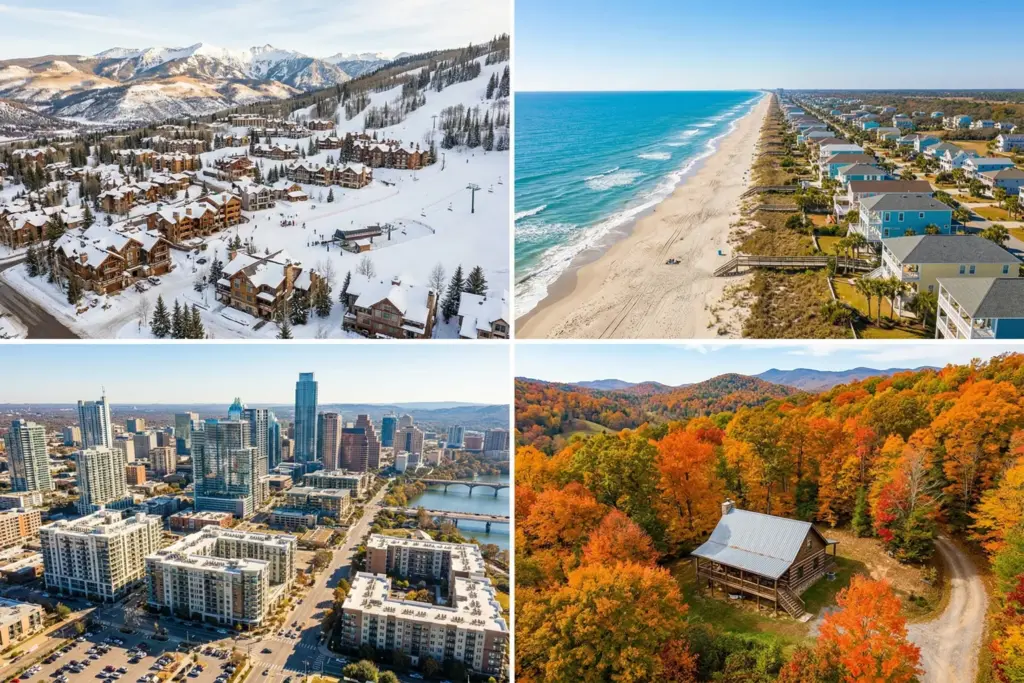
This piece breaks down the revenue benchmarks for four STR market categories using StaySTRA data: mountain/ski, coastal/beach, urban/metro, and rural/drive-to. Every number in the tables below comes from actual trailing market data. I will show you what each category earns, where the revenue concentrates, and which type fits different investor profiles.
How to Read These Benchmarks
Before I lay out the numbers, a note about what they mean. Think of these ranges like the sticker price on a car lot. The range tells you what the dealership is working with, not what every buyer pays.
StaySTRA tracks thousands of listings across each market. The figures below reflect per-listing averages and medians from the trailing twelve months of data (most recent period through early 2025). That means:
- The ADR (average daily rate) is what a typical listing charges per booked night.
- The occupancy rate reflects how many nights per year that listing is actually booked.
- The annual revenue is the gross rental income a median listing produced over twelve months.
Not every property in Park City earns $94,000 a year. The top performers earn more. The bottom quartile earns considerably less. A two-bedroom condo and a five-bedroom ski chalet in the same zip code will produce very different numbers. (If you want a deeper look at how property type affects revenue, I broke that down in the property type revenue analysis published last week.)
Stay with me here. The ranges are the point. They tell you the revenue band you are operating within when you choose a category.
Mountain and Ski Market Revenue Benchmarks
Mountain markets are where the biggest nightly rates live. They are also where the widest revenue gaps exist between peak season and the dead months.
| Market | ADR | Occupancy | Annual Revenue | Active Listings |
|---|---|---|---|---|
| Park City, UT | $986 | 39% | $94,359 | 4,085 |
| Vail, CO | $563 | 47% | $74,875 | 3,377 |
| Mammoth Lakes, CA | $584 | 49% | $68,806 | 2,632 |
| Breckenridge, CO | $393 | 63% | $65,063 | 5,008 |
| Steamboat Springs, CO | $392 | 55% | $60,841 | 3,747 |
| Bend, OR | $294 | 56% | $46,057 | 1,430 |
Source: StaySTRA trailing market data. Markets with inactive location pages (Jackson Hole, Big Sky, Telluride, Aspen, Sun Valley) excluded from this table but referenced below from published StaySTRA analyses.
The range here is striking. Park City at the top pulls nearly double the annual revenue of Bend at the bottom, and the ADR gap is even wider ($986 vs. $294). What connects them is the seasonal revenue pattern.
Seasonality in Mountain Markets
Mountain markets live and die by winter. In Steamboat Springs, January through March accounts for roughly 62% of annual revenue. Vail hit $14,073 per listing in February 2025, its single highest month. By May, that same Vail listing averaged $1,852. That is a 7.6x swing from peak to trough.
Mammoth Lakes is the exception worth noting. It runs strong in both winter and summer, with June through September revenue holding above $8,000 per month. That dual-season pattern makes it more resilient than pure ski towns, even though its annual number is lower than Park City or Vail.
Breckenridge deserves attention for a different reason: its 63% occupancy rate is the highest of any mountain market in this dataset. More nights booked at a moderate ADR ($393) can compete with fewer nights at a premium rate. That consistency matters for DSCR loan qualification, where lenders want to see steady income, not volatile spikes.
From the published StaySTRA analyses of markets without active location pages: Aspen averages $640 to $1,025 ADR with annual revenue of $85,000 to $90,000, but median home values of $3.5 million for condos and $13.2 million for single-family homes make the DSCR math nearly impossible without 40% or more down. Sun Valley runs $274 ADR with $45,000 annual revenue and only 306 active listings, the smallest mountain market in our dataset.
Mountain category summary: ADR range $274 to $986. Occupancy range 39% to 63%. Annual revenue range $45,000 to $94,000. Entry prices typically $500,000 to $3.5 million (condos) and up.
Coastal and Beach Market Revenue Benchmarks
Coastal markets are the most internally diverse category. The difference between Key West and Myrtle Beach is not a gap. It is a canyon.
| Market | ADR | Occupancy | Annual Revenue | Active Listings |
|---|---|---|---|---|
| Key West, FL | $903 | 49% | $143,412 | 1,172 |
| Outer Banks (Corolla), NC | $442 | 76% | ~$77,000 | 2,231 |
| Palm Springs, CA | $423 | 60% | $63,360 | 6,018 |
| Hilton Head Island, SC | $369 | 69% | $55,440 | 10,084 |
| Gulf Shores, AL | $369 | 32% | $39,384 | 5,124 |
| Myrtle Beach, SC | $213 | 27% | $19,248 | 8,308 |
Source: StaySTRA trailing market data. Cape Cod and Lake Tahoe location pages are not currently available; data from published StaySTRA analyses is referenced in the text.
Key West is the outlier in every sense. A hard license moratorium limits supply to 1,172 listings, and that scarcity drives a $903 ADR and $143,000 in annual revenue per listing. Good luck finding one to buy, though. The moratorium means existing licensed properties trade at steep premiums.
The Outer Banks corridor shows a different kind of strength. Corolla’s 76% occupancy rate is the highest of any beach market in this dataset. The week-booking tradition (Saturday to Saturday rentals) and barrier island geography that limits new construction help explain why. That $442 ADR paired with high occupancy produces around $77,000 in annual revenue. (For the full Outer Banks breakdown including Nags Head and Kill Devil Hills, see the Outer Banks market analysis.)
Seasonality in Coastal Markets
Beach markets are summer-heavy, and the swings can be dramatic. In the Outer Banks, Corolla generates $11,277 per listing in June and $1,372 in January. That is an 8.2x seasonal swing, even wider than most mountain markets.
Gulf Shores and Myrtle Beach both carry low annual occupancy rates (32% and 27% respectively) because their off-seasons are genuinely quiet. The summer numbers look fine. The January numbers do not.
Hilton Head is the standout for year-round consistency in this category. A 69% annual occupancy rate means the property works across seasons, not just during summer weeks. That steadiness, combined with 10,084 active listings, makes it the most liquid coastal STR market in the dataset.
For a deeper comparison of how coastal and mountain markets stack up against each other, I published a coastal vs. mountain synthesis earlier this week that goes market by market.
Coastal category summary: ADR range $213 to $903. Occupancy range 27% to 76%. Annual revenue range $19,000 to $143,000. Entry prices vary enormously by market, from under $300,000 in Myrtle Beach condos to $1 million or more in Key West.
Urban and Metro Market Revenue Benchmarks
Urban markets are the most predictable category. The highs are not as high. The lows are not as low. For investors who value consistency over ceiling, that is not a flaw.
| Market | ADR | Occupancy | Annual Revenue | Active Listings |
|---|---|---|---|---|
| Miami, FL | $325 | 49% | $57,739 | 8,743 |
| New Orleans, LA | $472 | 43% | $56,336 | 5,384 |
| Austin, TX | $284 | 38% | $55,234 | 9,289 |
| San Antonio, TX | $217 | 38% | $32,234 | 5,712 |
| Charlotte, NC | $198 | 58% | $30,791 | 5,396 |
Source: StaySTRA trailing market data.
The revenue band here is the tightest of any category: $31,000 to $58,000. No urban market in this dataset cracks $60,000 in annual per-listing revenue. That is a structural feature of urban STR economics, not a temporary condition.
Think of it this way. In a beach town, your listing competes with maybe a few thousand other properties, and demand is intensely seasonal. In a city like Austin, you are one of 9,289 active listings competing year-round against hotels, extended stays, and corporate housing. Supply pressure keeps ADRs moderate.
New Orleans has the highest ADR in the group ($472) because of event-driven demand. Mardi Gras, Jazz Fest, and Saints games create pricing spikes that pull the average up. But 43% occupancy tells you those spikes do not fill the calendar. Austin tells a similar story: occupancy dropped from 69% in 2021 to 38% today as listing counts surged past 9,000.
Charlotte stands out for the opposite reason. Its $198 ADR is the lowest here, but its 58% occupancy is the highest. Steady corporate travel, NASCAR events, and Panthers game weekends create reliable, if not spectacular, demand. No single month dominates the calendar.
The Urban Advantage: Demand Diversity
What urban markets lack in revenue ceiling, they make up in demand sources. A mountain town relies on skiers. A beach town relies on vacationers. A city like Miami draws from business travel, medical tourism, conventions, events, and leisure. When one source dips, others fill in. That diversity is why urban occupancy rates tend to cluster in a narrower range.
For investors running DSCR calculations, that predictability matters. Lenders like steady income. A Charlotte listing producing $2,500 per month twelve months a year may qualify more easily than a Park City listing that earns $12,000 in January and $1,800 in May.
Urban category summary: ADR range $198 to $472. Occupancy range 38% to 58%. Annual revenue range $31,000 to $58,000. Entry prices: $200,000 to $500,000 in most metros, with Miami and Austin at the higher end.
Sponsored — Beeline
Finance Your Next STR With a DSCR Loan
Qualify on property cash flow, not W-2 income. Beeline specializes in fast DSCR closings for STR investors. No personal income verification required.
Check Your DSCR Eligibility →Affiliate disclosure: StaySTRA may earn a referral fee.
Rural and Drive-To Market Revenue Benchmarks
This is the category that surprises people. Do not let the word “rural” fool you. These markets quietly outperform most urban metros on annual revenue.
| Market | ADR | Occupancy | Annual Revenue | Active Listings |
|---|---|---|---|---|
| Gatlinburg, TN | $338 | 32% | $69,071 | 3,914 |
| Blue Ridge, GA | $361 | 34% | $62,513 | 1,484 |
| Branson, MO | $228 | 20% | $41,476 | 3,077 |
Source: StaySTRA trailing market data. Finger Lakes, NY location page is not currently available.
Gatlinburg at $69,071 annual revenue per listing outearns every urban market in this analysis. Blue Ridge at $62,513 beats Miami, Austin, and New Orleans. Let that sink in for a moment.
The mechanism is straightforward. These are cabin markets. The typical listing in Blue Ridge is an entire home accommodating eight or more guests. That larger footprint commands a higher nightly rate ($361 in Blue Ridge, $338 in Gatlinburg) than a downtown condo or apartment in Charlotte ($198) or San Antonio ($217). Weekend and holiday demand fills the gaps even with low annual occupancy.
Blue Ridge draws from Atlanta, 90 miles away. Gatlinburg draws from the entire Southeast. Branson pulls from Kansas City, St. Louis, and the broader Midwest. These are not fly-to destinations. They are load-the-car-Friday-afternoon markets. That drive-to demand is remarkably recession-resistant. When travel budgets tighten, a family is more likely to cancel a flight to Hilton Head than a two-hour drive to the mountains.
The Rural Risk: Supply Growth
The caution here is supply. Blue Ridge has seen listing counts grow 77% since 2021 (from 839 to 1,484). Gatlinburg grew 83% in the same period. Occupancy has fallen as supply expanded. Blue Ridge dropped from 69% occupancy in 2021 to 34% today. That is a steep decline even if revenue per listing has held up because ADRs rose.
Branson’s 20% occupancy is the lowest in this entire analysis across all four categories. The market has 3,077 active listings competing for a visitor base that, while loyal, is not growing at the same pace. If you are considering Branson, the DSCR math gets difficult at that occupancy level.
Rural category summary: ADR range $228 to $361. Occupancy range 20% to 34%. Annual revenue range $41,000 to $69,000. Entry prices: $250,000 to $500,000 for cabins, significantly lower than mountain or premium coastal markets.
Category Comparison at a Glance
| Category | ADR Range | Occupancy Range | Annual Revenue Range | Typical Entry Price |
|---|---|---|---|---|
| Mountain/Ski | $274 – $986 | 39% – 63% | $45,000 – $94,000 | $500K – $3.5M+ |
| Coastal/Beach | $213 – $903 | 27% – 76% | $19,000 – $143,000 | $250K – $1M+ |
| Urban/Metro | $198 – $472 | 38% – 58% | $31,000 – $58,000 | $200K – $500K |
| Rural/Drive-to | $228 – $361 | 20% – 34% | $41,000 – $69,000 | $250K – $500K |
Which Market Type Fits Your Investment Profile
The question is not “which category earns the most?” The question is “which category fits the way I invest?”
I have a piece of Pueblo pottery on my desk that a friend gave me years ago. She said it was worth what the right buyer was willing to pay. STR markets work the same way. The “best” category depends on what you are optimizing for.
If you have $250K to $400K and want cash flow: Rural/drive-to
A cabin in Blue Ridge or Gatlinburg can be purchased for under $400,000 and produce $60,000 or more in gross annual revenue. The gross yield math (revenue divided by purchase price) works better here than almost anywhere else. The trade-off is low occupancy and heavy weekend concentration. You need a good property manager because you will likely live hours away from the asset.
If you have $300K to $500K and want stability: Urban/metro
A condo or townhouse in Charlotte or San Antonio will not produce headlines. It will produce steady monthly income with fewer seasonal dead zones. DSCR lenders tend to like these markets because the income is predictable. The ceiling is lower, but so is the variance. This is the Toyota Camry of STR investing. It works. It is not exciting. You will not lose sleep.
If you have $400K to $800K and can tolerate seasonality: Coastal/beach
Beach markets offer the widest range of outcomes. Choose carefully. Hilton Head and the Outer Banks reward investors with strong occupancy and mid-range ADRs. Myrtle Beach has lower barriers to entry but lower returns. Key West is essentially a closed market. The seasonal swings are real: you need reserves to cover mortgage payments during the off-season months when revenue drops 80% or more from the summer peak.
If you have $500K or more and want top-line revenue: Mountain/ski
Mountain markets produce the highest raw ADRs and some of the highest annual revenue per listing. Park City and Vail are premium. Breckenridge and Steamboat offer slightly lower entry points with more consistent occupancy. The capital requirements are significant, and the DSCR math often requires 30% to 40% down. If you can clear that bar, the revenue upside is substantial.
How to Move from Category to Specific Market
These benchmarks give you the category picture. They tell you whether mountain, beach, urban, or rural aligns with your capital and risk profile. The next step is narrowing to a specific market.
That is where the StaySTRA analyzer comes in. Run your target market through it. See the ADR, occupancy, and revenue data for that specific location. Compare it against the category benchmarks in this article. If a market is performing well below its category average, dig into why. If it is performing above, ask whether that is sustainable.
The category benchmarks are the map. The analyzer is the turn-by-turn directions.
Sponsored — Beeline
Finance Your Next STR With a DSCR Loan
Qualify on property cash flow, not W-2 income. Beeline specializes in fast DSCR closings for STR investors. No personal income verification required.
Check Your DSCR Eligibility →Affiliate disclosure: StaySTRA may earn a referral fee.
A Note on Data Currency
All figures in this analysis reflect trailing StaySTRA market data, with the most recent period covering through early 2025. Markets move. Occupancy shifts with supply changes, regulatory actions, and demand trends. The benchmarks above represent the structural performance of each category, not a guarantee of future results. Always verify current figures directly with local sources before making investment decisions.
Frequently Asked Questions
Which STR market type has the highest average revenue per listing?
Mountain/ski markets produce the highest average annual revenue per listing, with Park City, UT leading at $94,359. Coastal markets have the single highest outlier (Key West at $143,412), but that market is supply-constrained by a license moratorium. Across the full range of markets in each category, mountain towns tend to produce the highest median revenue.
Are rural STR markets a good investment compared to urban markets?
Rural drive-to markets like Gatlinburg ($69,071 annual revenue) and Blue Ridge ($62,513) outperform most urban markets on gross revenue per listing. The trade-off is lower occupancy (20% to 34% vs. 38% to 58% in urban markets) and higher seasonal concentration. Rural markets tend to work best for investors who can handle lumpy income and want higher gross yield at a lower entry price point.
What is the best STR market type for a first-time investor with limited capital?
Urban metros (Charlotte, San Antonio) and rural markets (Branson, Blue Ridge) offer the lowest entry prices, typically $200,000 to $400,000. Urban markets provide more predictable monthly income, which makes DSCR loan qualification easier. Rural markets offer higher gross revenue potential but with more seasonal volatility. Your choice depends on whether you prioritize consistency or upside.
How seasonal are STR revenues in beach and ski markets?
Both coastal and mountain markets experience dramatic seasonal swings. Vail generates $14,073 per listing in February and $1,852 in May (a 7.6x swing). Outer Banks Corolla earns $11,277 in June and $1,372 in January (an 8.2x swing). Investors in these markets should maintain three to six months of mortgage reserves to cover the low-revenue months.
Where can I find STR revenue data for a specific market?
The StaySTRA analyzer provides market-specific ADR, occupancy, and revenue data for hundreds of US markets. You can run any target city through the tool to see how it compares against the category benchmarks in this article. StaySTRA location pages also provide monthly revenue breakdowns for tracked markets.
We do our best to keep our data accurate and up to date, but markets move fast and we are only human. Always verify current figures directly with local sources before making investment decisions.
Ready to see how a specific market stacks up? Run your target city through the StaySTRA analyzer and compare the results against the category benchmarks above.
Become a StaySTRA Insider
Join free — get our newsletter + 1 free property analysis/month.
No spam. Unsubscribe anytime. Free membership includes property analyses and market insights.