Key Takeaways
- STR host advocacy organizations have grown 62% in one year, with the Right to Rent Collaborative funding eight state-level associations and protecting over 57,000 listings nationwide.
- Grassroots host coalitions helped defeat targeted STR tax bills in Colorado, Washington, and Maine during the 2026 legislative session, with hundreds of hosts testifying at hearings.
- Idaho and Indiana both signed STR preemption laws in March 2026 after sustained host lobbying, blocking cities from imposing caps and owner-occupancy rules.
- Effective advocacy relies on data, relationships, and showing up consistently. Reactive panic and confrontational tactics almost always backfire.
- Any host can start by joining (or founding) a local alliance. The Rent Responsibly network lists dozens of active groups across the U.S.
On a Thursday evening in January 2026, Danielle Dixon sat at her kitchen table in Washington state, refreshing a legislative tracking page every few minutes. House Bill 2559 had just been introduced, proposing a 4% excise tax on every short-term rental booking in the state. She had been Executive Director of the Washington Hosts Collaborative Alliance for barely two months. “I remember thinking, this is it,” she later recalled. “This is why this organization exists.”
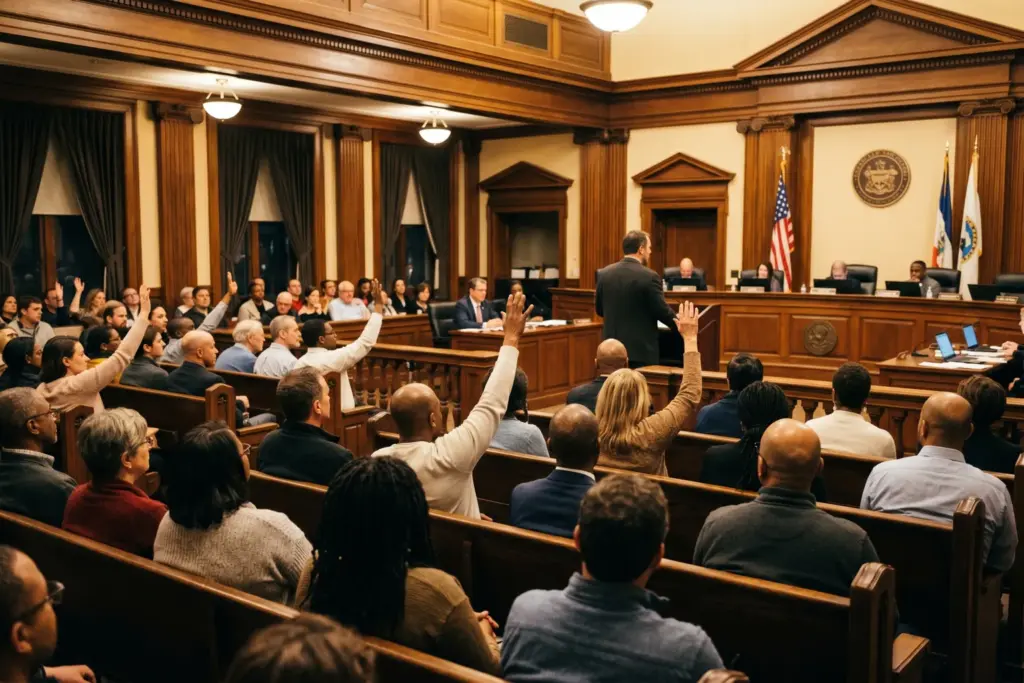
Within days, Dixon had coordinated a response that brought more than 250 hosts to testify against the bill. It never received a floor vote.
Across the country, in living rooms and church basements and city council chambers, scenes like this one are playing out with increasing frequency. STR hosts are organizing. Not through corporate lobbying firms or billion-dollar platforms, but through grassroots coalitions built by the people who actually own the properties and clean the linens and greet the guests. La lucha es real (the fight is real), and in 2026, it is producing results that would have been unthinkable five years ago.
The Stakes Have Never Been Higher
The regulatory wave of 2024 through 2026 has been relentless. Maui passed the largest STR phase-out in U.S. history. Monterey County banned short-term rentals in residential zones outright. Dallas pushed its STR ban all the way to the Texas Supreme Court. Cities from Hoboken to Santa Monica have introduced or tightened restrictions, many citing housing affordability and neighborhood disruption.
For hosts who built retirement income, college funds, or small businesses around their rental properties, these actions feel existential. Some sold and relocated to friendlier states. But not everyone wants to leave. Many hosts are choosing to stay and fight, and they are discovering that the fight requires organization.
Walking through this landscape over the past several months, I have been struck by the sheer number of new advocacy groups that have appeared. What was once a scattered handful of Facebook groups and email chains has matured into a national network of funded, staffed, and strategically coordinated alliances. The question is no longer whether hosts will organize. It is whether they can organize fast enough.
Meet the People Behind the Movement
Julie Marks: From Vermont Host to National Organizer
Julie Marks started hosting in 2018 at her Vermont property, Homestead Hospitality, drawing on her background in environmental health consulting to build a sustainable operation. Then the pandemic hit, and a local hotel operator publicly accused STR hosts of violating state health guidelines. Marks wrote op-eds for the Brattleboro Reformer and the Bennington Banner defending responsible hosting. Those columns caught the attention of Dana Lubner at Rent Responsibly, who connected Marks with other state advocates.
Marks founded the Vermont Short-Term Rental Alliance (VTSTRA) and grew it into a recognized voice in state policy. By 2025, she had been appointed Executive Director of the Right to Rent Collaborative (R2RC), a national initiative that funds state-level STR associations with grants for staffing, legal counsel, and sustained advocacy.
In its first year, R2RC raised $193,124 and distributed grants to eight associations, producing a 62% increase in “thriving groups,” six new Executive Director positions, and more than 57,000 listings now covered by funded advocacy organizations. In April 2026, R2RC awarded new grants to the Missouri Vacation Home Alliance ($20,000) and the Viva Puerto Rico Short-Term Rental Alliance ($10,000).
“Prevention tactics don’t work like fixing a leaky faucet,” Marks has said. “They can take years to effect change.” Her model reframes advocacy investment as protective business strategy. Think of it less as a donation and more like insurance for your right to operate.
Lisa Sievers: Holding the Line in Dallas
In June 2023, the Dallas City Council voted to ban short-term rentals from single-family residential neighborhoods, a move that threatened over 90% of the city’s STR inventory. Lisa Sievers, President of the Dallas Short-Term Rental Alliance, had been organizing hosts for months before the vote. The ban passed anyway.
Rather than dissolving, the Dallas STRA pivoted to legal action while building its membership and political relationships. The alliance filed suit, won an injunction, survived an appeal, and watched the case climb to the Texas Supreme Court. Through every stage, Sievers maintained one message: hosts want regulation, not elimination.
“Short-term rental owners and operators want an ordinance,” Sievers told Rent Responsibly in 2026. Her framing matters. By positioning hosts as partners in crafting reasonable rules (rather than opponents of all regulation), the Dallas STRA has kept the door open for negotiation even as litigation continues. With the FIFA World Cup bringing unprecedented attention to Dallas’s STR capacity this summer, Sievers is betting that political pressure will eventually produce a workable compromise. Esperamos que sí (we hope so).
Danielle Dixon: Mobilizing 250 Voices in Two Weeks
Danielle Dixon came from financial services and nonprofit consulting, not real estate. But her personal love of vacation rentals made the connection between policy and livelihood feel immediate when she took over the Washington Hosts Collaborative Alliance in November 2025.
Two months into the job, Washington’s HB 2559 proposed allowing local governments to levy a 4% excise tax on all STR bookings. Dixon coordinated a response during the first two weeks of the legislative session. More than 250 hosts testified in opposition. The bill died without a floor vote when the legislature adjourned on March 12, 2026. Under Dixon’s leadership, the alliance now counts more than 1,500 hosts across Washington state.
“Host participation helped ensure policymakers better understood how targeted taxes could affect small operators and local communities,” Dixon said. Numbers matter. Showing up matters. And having someone to coordinate before the window closes matters most of all.
Sponsored — OfferMarket
Buy Your First STR With Long-Term Rental Financing
Flexible, long-term financing for short-term rental buyers. Rates from 5.75%. Instant online quote, no credit pull.
Explore RTL Financing Options →Affiliate disclosure: StaySTRA may earn a referral fee.
What Actually Works (and What Does Not)
After speaking with organizers in multiple states, a few patterns stand out about what makes STR advocacy effective.
Data Beats Emotion
Elaine Fekete, a host and advocate in Virginia Beach, compiled statistics showing that whole-home STRs represented just 0.7% of the city’s housing units and that STR-related 311 calls accounted for 0.01% of total complaints. She presented this data directly to council members in one-on-one meetings. “Sandbridge has the highest STR concentration and the lowest crime rate,” she told them. That kind of specific, localized data is far more persuasive than general talking points about property rights.
Relationships Over Rallies
The Colorado Short-Term Rental Association (COSTRA) did not defeat the state’s vacancy tax bill (HB 1036) with a protest. They did it with four hours of organized testimony from more than 60 speakers before the House Finance Committee on February 9, 2026. Executive Director Julia Koster told lawmakers that vacancy taxes “have been defeated in multiple jurisdictions across the country.” The committee voted 7-to-4 to kill the bill. Sustained relationships with legislators, combined with credible testimony, outperform reactive campaigns every time.
Consistency Over Crisis
Alicia Pearson, the mayor of Lanesboro, Minnesota (population 712), became Executive Director of the Minnesota Short-Term Rental Association in November 2025. She grew the organization from five board members to roughly 25 active members within months. It is not a dramatic number. But in a state where STR policy is still being shaped, those 25 voices at the table are building the foundation for influence that will compound over years. Pearson’s philosophy is simple: “Vacation rentals can help families stay afloat and help towns thrive.”
What Fails
Reactive panic. Angry social media posts after a ban vote has already happened. Showing up to a single hearing and then disappearing. Treating city council members as enemies rather than potential partners. Organizers I spoke with emphasized that the hosts who get results are the ones who engage early, engage consistently, and come with solutions rather than complaints.
The Scoreboard: Where Advocacy Has Moved the Needle
The 2026 legislative season has been remarkably active for STR policy at the state level. Here is what the record shows.
Wins for Host Advocacy
Idaho HB 583 was signed into law on March 16, 2026, creating one of the strongest STR preemption frameworks in the country. The law prohibits local governments from imposing owner-occupancy requirements, rental day caps, density limits, and STR-specific licensing. Hosts and industry groups lobbied aggressively for the bill.
Indiana HEA 1210 was signed on March 12, 2026, preventing cities and counties from capping the number of residential rental properties. This effectively blocks local STR density restrictions statewide.
Colorado HB 1036 (vacancy tax) was killed in committee on February 9, 2026, after COSTRA coordinated testimony from dozens of hosts and industry stakeholders.
Washington HB 2559 (4% STR excise tax) died without a floor vote on March 12, 2026, after the Washington Hosts Collaborative Alliance mobilized more than 250 opponents.
Maine LD 1822 (consumer data privacy bill threatening STR marketing) failed in the House on April 13, 2026, after more than 400 business voices organized in opposition.
Missouri SB 1066 passed the state Senate 30-to-3 on March 25, 2026, and would classify single-family STRs as residential for tax purposes. R2RC awarded Missouri’s alliance a $20,000 grant to push it across the finish line.
Losses and Ongoing Fights
Dallas remains in litigation over its 2023 STR ban, now before the Texas Supreme Court. A court injunction has blocked enforcement, but legal uncertainty continues to affect hosts.
Arizona HB 2429, which would have given cities limited tools to address problem operators, passed the House 37-to-14 but stalled in the Senate without a hearing.
The pattern: organized advocacy is winning more than it is losing. But the Dallas fight is entering its third year, and the Idaho preemption took sustained lobbying across multiple sessions. There are no quick victories.
Sponsored — OfferMarket
Buy Your First STR With Long-Term Rental Financing
Flexible, long-term financing for short-term rental buyers. Rates from 5.75%. Instant online quote, no credit pull.
Explore RTL Financing Options →Affiliate disclosure: StaySTRA may earn a referral fee.
How Any Host Can Start
You do not need to quit your job or hire a lawyer to get involved. Here is what organizers recommend.
Find your local alliance. Rent Responsibly maintains a directory of STR alliances organized by state. If one exists in your area, join it. Membership fees are typically modest and go directly toward advocacy capacity.
If no alliance exists, start one. Alicia Pearson grew Minnesota’s group from zero to 25 in a few months. Julie Marks built Vermont’s from a couple of op-eds. It starts with one person willing to organize.
Show up to local meetings. City council sessions, planning commission hearings, zoning board meetings. Your presence is data. Council members notice when 15 hosts fill the public comment seats instead of the usual two or three.
Bring data, not grievances. Learn how many STRs are in your jurisdiction and how much TOT revenue they generate. Use the StaySTRA Analyzer to pull market-level data for your area before you testify.
Build relationships before crises. Meet your council members when nothing is on the agenda. When the next STR vote comes, you will not be a stranger.
Support your state association financially. R2RC’s model asks for $2 per booking. That small contribution, pooled across thousands of hosts, funds the executive directors and legal resources that win legislative battles.
Frequently Asked Questions
How do I find my local STR advocacy group?
Rent Responsibly maintains the most comprehensive directory of STR alliances in the U.S. at rentresponsibly.org/alliances. Groups are organized by state and region. If your state does not have an active alliance, you can contact Rent Responsibly or the Right to Rent Collaborative for guidance on starting one.
What is the most effective way for a host to speak at city council?
Come with specific, localized data about your market. Know how many STRs exist in your jurisdiction, what they contribute in tax revenue, and what the actual complaint numbers look like. Frame yourself as a community member and small business owner, not as an adversary. Keep remarks under three minutes and focus on one or two clear points rather than a long list of grievances.
Do host advocacy groups actually work?
In 2026, organized host groups helped defeat STR tax proposals in Colorado, Washington, and Maine, and supported preemption legislation in Idaho and Indiana. The Right to Rent Collaborative reports that its funded alliances now protect over 57,000 listings. Results vary by market, but the data shows that organized hosts consistently outperform unorganized ones in policy outcomes.
What is the Right to Rent Collaborative and how is it funded?
R2RC is a 501(c)(6)-pending nonprofit founded in October 2024 to fund state-level STR advocacy organizations. It is funded through industry donations from companies like Airbnb, Vrbo, and PriceLabs, as well as a $2-per-booking contribution program for hosts and property managers. In its first year, R2RC raised $193,124 and distributed grants to eight associations.
We do our best to keep our content accurate and up to date, but things change and we are only human. Always verify details directly with local sources before making decisions.
Your Market, Your Move
Whether you are considering a new STR investment or trying to protect an existing one, understanding the advocacy climate in your target market matters as much as occupancy rates and ADR. Use the StaySTRA Analyzer to research market fundamentals before you make your next move.
Become a StaySTRA Insider
Join free — get our newsletter + 1 free property analysis/month.
No spam. Unsubscribe anytime. Free membership includes property analyses and market insights.