

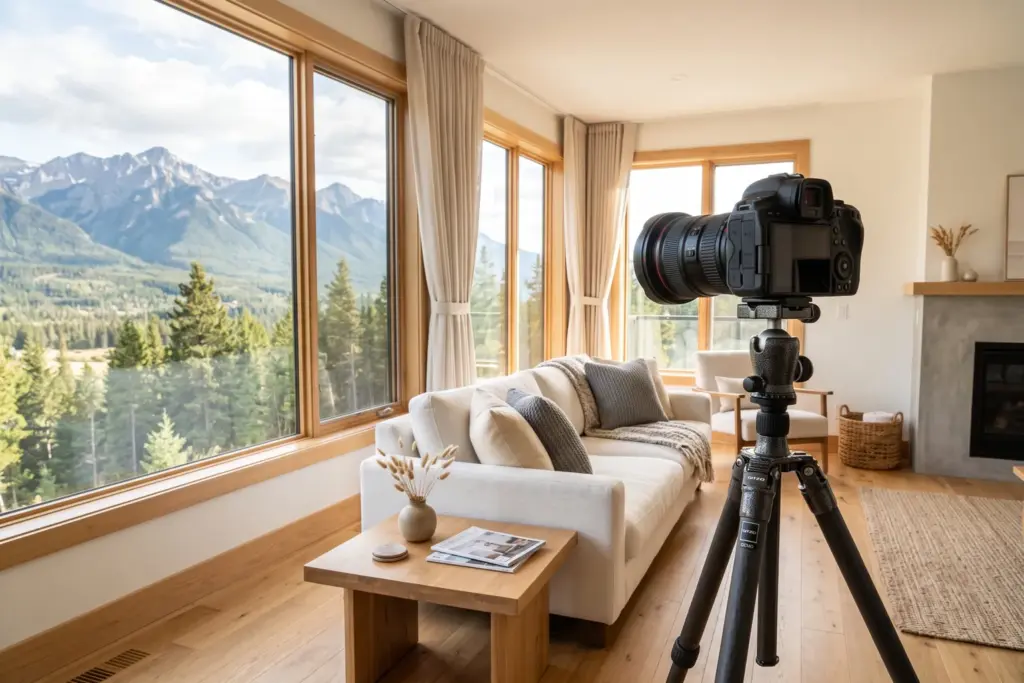
Key Takeaways
- Airbnb analyzed 14,700+ listings and found professional photos produce a 21% earnings increase and 19% higher booking rate on average.
- Your cover photo drives click-through rate from search results, which is one of the top ranking signals in Airbnb’s 2026 algorithm. Everything else is secondary.
- A $150-$500 photography investment returns approximately $3,500 more per year in added revenue, according to Carnegie Mellon University research.
- Shoot 40-60 photos, publish the best 20-30. The algorithm rewards listings with 20 or more high-quality images.
- VRBO requires a minimum of 6 photos and auto-rejects portrait-orientation shots. Airbnb has no hard minimum but rewards more high-quality images algorithmically.
Airbnb analyzed 14,700 listings and found professional photography produces a 21% increase in annual earnings and a 19% lift in bookings. Those are not projections. That is what actually happened when hosts upgraded their photos. If you are managing a property right now with mediocre images, you are leaving measurable money on the table.
This is a data guide for active STR hosts who want to close that gap. I read camera firmware changelogs for fun, so trust me when I say the tech angle here is less important than most hosts think. What matters is the sequence, the light, and the cover shot. Here is what the numbers actually show.
Why Listing Photos Are a Revenue Variable, Not a Style Choice
Most hosts treat photography as a listing quality issue. Better photos look more professional. That framing misses the real mechanism.
Photos are a performance variable with a measurable return because of how Airbnb’s search algorithm works in 2026. Click-through rate is one of the top ranking signals. Your cover photo is what drives that click. Before a guest reads your title, checks your price, or scans your reviews, they see your lead image. If it does not stop the scroll, nothing else gets the chance to convert them.
A Carnegie Mellon University dissertation tracking verified STR data found that listings with professional photos generated 8.9% more demand and approximately $3,500 more annual revenue on average. Real hosts, real results.
Airbnb’s own program data makes this more concrete: 85% of hosts who upgraded to professional photography recouped the cost within a single reservation. For most properties, that is one weekend booking.
The ROI math is straightforward. A $300 photography session that returns $3,500 annually is a 10-to-1 return in year one. In year two, the photos keep working. The cost does not repeat.
Photos also affect your average daily rate. Listings with higher-quality images achieve better ADR because they signal quality to guests comparing multiple properties at similar price points. When your photos look better than the competition, you capture the booking at a higher price. That is not a soft benefit. It is a rate positioning tool. The work you put into your pricing strategy compounds when your photos justify the rate you are charging.
The DIY Photography Framework
Professional photography is worth the cost for most properties. But if you are shooting your own listing, doing it right matters more than having expensive gear.
Equipment
Most recent smartphones shoot above Airbnb’s 1024×683 pixel minimum. The gap between smartphone and DSLR in real estate photography comes down to three things: wide angle, low-light performance, and depth-of-field control.
A clip-on wide-angle lens attachment ($30-$80) for your phone closes most of that gap for interiors. Rooms appear larger and more inviting. This is the highest-ROI gear upgrade available to DIY photographers.
If you want to step up, a Canon EOS R50 or Sony ZV-E10 with a wide-angle zoom lens ($700-$900 kit) produces near-professional results with practice. Either way, a tripod is not optional. A basic tripod ($30-$50) eliminates motion blur and inconsistent framing. Buy one before you buy anything else.
Light: The Single Biggest Variable
No amount of editing fixes bad light. The rule is simple: natural light wins.
Shoot during the day with blinds open. Turn off all artificial lights first, then bring them back selectively if a room needs warmth. The best time for interiors is mid-morning (8-11am) or mid-afternoon (2-4pm), when the sun is not hitting windows directly. Direct sunlight creates blown-out white rectangles where windows should be. Overcast days produce even, diffused light that is actually ideal for interiors.
For exterior shots, shoot during golden hour (30-60 minutes after sunrise or before sunset). The same house looks dramatically different in golden hour light versus noon. Twilight exterior shots (property lit from inside, soft sky behind) are becoming the standard cover photo format for premium listings. Going forward, AI tools will soon identify your property’s ideal shooting window based on its orientation and local weather data. That workflow is already being built by the major STR tech platforms.
Shot Sequence
Airbnb’s research shows guests scan listing images the same way they walk through a property. Start at the front and move logically through the space.
- Hero exterior shot (your cover photo). Frame from the street, capture the full facade, time it for golden hour.
- Living space wide shot. Largest common area from a corner or doorway at standing height.
- Primary bedroom. Guests decide based on where they sleep. Full-room shot plus one bedside detail if the room has something notable.
- Kitchen. Full view plus one counter detail. Visible appliances. A cutting board or bowl of fruit reads as host-ready.
- Outdoor amenity. Deck, patio, pool, fire pit. Styled furniture, shot when light is good. This is the second-highest click driver after the hero exterior.
- Remaining bedrooms. One shot each minimum.
- Bathrooms. Wide-angle, cleaned, staged with fresh towels.
- Unique features. Hot tub, game room, smart TV wall, interesting architecture. These are your differentiators.
- Neighborhood context. A nearby trail, beach access, or local landmark shot anchors guests in the destination.
Shoot 40-60 images total, then select the best 20-30 to publish. Going under 20 high-quality images leaves algorithmic visibility on the table. Going over 50 is fine for larger properties but provides diminishing returns for a standard 2-3 bedroom.
For a full walkthrough connecting photography to your broader listing strategy, our Airbnb setup guide covers this as part of the complete listing launch process.
When to Hire a Professional: The ROI Math
Professional STR photography costs $150-$500 in most markets. Premium photographers in urban areas or for larger properties run $375-$800 or more.
The math: if your property earns $30,000 annually, a 21% earnings increase represents $6,300 in added revenue. A $350 photography investment generating $6,300 in year one is not a close call. If your property earns $15,000, the same math produces $3,150 in added revenue against a $350 cost. Still a 9-to-1 return.
The only scenario where professional photography is not the right call: your existing photos are already genuinely professional quality, or your market runs at near-maximum occupancy regardless of photo quality. Most properties are not in that situation.
When hiring, look specifically for STR or real estate photography experience. Interior photography is a different skill than portrait or product photography. Ask for their STR portfolio. A photographer who shoots homes for real estate listings understands wide-angle framing, window handling, and staging in a way that a generalist photographer often does not.
The right time to hire is before your listing goes live, or immediately after a slow booking month when you are diagnosing what the bottleneck is. Run the StaySTRA Analyzer to benchmark your occupancy and ADR against comparable listings in your market. If your numbers are below market average despite competitive pricing, photos are the first variable to address.
Sponsored — OfferMarket
Buy Your First STR With Long-Term Rental Financing
Flexible, long-term financing for short-term rental buyers. Rates from 5.75%. Instant online quote, no credit pull.
Explore RTL Financing Options →Affiliate disclosure: StaySTRA may earn a referral fee.
Photo Editing Tools That Actually Work
Raw photos almost always need editing. Even professionals deliver edited finals. If you are shooting DIY, editing is not optional.
Adobe Lightroom Mobile (free tier) is the starting point for most hosts. The Auto Enhance function corrects exposure, color balance, and contrast on most interior shots automatically. The $11.99/month desktop version adds batch processing, so you set the edits once and apply them to every photo from a session.
Snapseed (free) handles perspective correction well. When walls appear to lean inward (a common interior photo problem), the Perspective tool straightens vertical lines in one step. For beginners, this is the easiest route to professional-looking results.
VSCO is useful for visual consistency. Applying the same filter across all 25 photos creates a cohesive look that reads as intentional. Guests view all photos in one session, and consistent color grading matters more than most hosts realize.
Autoenhance.ai is where this category is heading fast. AI-powered sky replacement, automatic window brightening, and batch enhancement are now accessible at the consumer level. Imagine soon: upload 40 raw photos, receive Airbnb-ready edits in minutes. That capability exists today and it is improving quickly. The next wave of STR listing tools will make manual editing optional for most hosts.
Three corrections every photo set needs: white balance (remove orange or blue color cast), exposure (brighten dark corners without blowing out windows), and vertical alignment (straighten walls that appear to lean). Those three adjustments alone separate acceptable photos from good ones.
Platform Requirements: Airbnb vs. VRBO
Both platforms have technical requirements. Violating them costs you distribution or visibility.
Airbnb Photo Requirements
- Minimum resolution: 1024 x 683 px
- Recommended upload size: 1920 x 1280 px (Airbnb compresses images to approximately 1440×960 on display; uploading at higher resolution produces sharper results after compression)
- Aspect ratio: 3:2 landscape preferred
- Max file size: 30 MB
- Accepted formats: JPEG, BMP, PNG
- No hard photo count minimum, but listings with 20+ quality photos perform measurably better algorithmically
Airbnb search results display one cover photo. The cover photo’s job is to stop the scroll. The gallery’s job is to answer every pre-booking question a guest might have. Treat these as two separate creative decisions. Your listing copy works alongside your photos, so review our Airbnb listing writing guide to make sure the full package is working together.
VRBO Photo Requirements
- Minimum photos: 6 required. Listings under 6 photos for 30+ consecutive days face suspension.
- Minimum resolution: 1024 x 683 px
- Recommended resolution: 3840 x 2160 px (VRBO supports higher resolution than Airbnb)
- Max file size: 20 MB
- Accepted formats: JPG, JPEG, PNG, GIF
- Portrait-orientation images are auto-rejected
- Black-and-white photos are prohibited
- No watermarks or logos permitted
VRBO allows photo captions, and most hosts ignore them. They do not affect algorithm ranking but they do affect conversion. “Back deck with gas grill and mountain views, seating for 8” tells guests exactly what they are getting. Use captions on every photo where context adds value.
If you dual-list on both platforms, shoot in landscape orientation at a resolution that satisfies VRBO’s higher standard. The same files work on Airbnb without modification.
Frequently Asked Questions
How many photos should an Airbnb listing have?
Airbnb does not enforce a hard minimum, but the algorithm rewards listings with 20 or more high-quality photos. For a standard 2-3 bedroom property, 20-30 photos covers all spaces thoroughly. Larger properties with significant outdoor amenities or multiple bedrooms can support 35-50 without diminishing returns. The practical workflow: shoot 40-60 photos, select the best 20-30 to publish.
Is professional photography worth it for a short-term rental?
For most active STR hosts, yes. Airbnb’s own data from 14,700+ listings shows professional photography produces a 21% earnings increase and a 19% higher booking rate. Photography costs $150-$500 in most markets. Carnegie Mellon University research found professionally photographed listings earn approximately $3,500 more per year on average. The cost is one-time. The return is ongoing.
What makes a good Airbnb cover photo?
The cover photo needs one thing: the click. Bright, wide-angle shots of the most visually appealing space or exterior perform best. Twilight exterior shots (property lit from inside, soft sky behind) are increasingly the standard for premium listings. Avoid cover photos that show a single room without context, any visible clutter, or vertical-orientation shots. If your click-through rate feels low, test a different cover photo before changing anything else in your listing.
What is the difference between Airbnb and VRBO photo requirements?
VRBO has stricter requirements: a minimum of 6 photos with suspension penalties for violations, portrait-orientation photos are auto-rejected, and black-and-white photos are prohibited. VRBO recommends higher upload resolution (3840×2160 px) and has a lower per-photo file size limit (20 MB vs. Airbnb’s 30 MB). Both platforms require a minimum resolution of 1024×683 pixels and prefer landscape orientation.
What editing app should STR hosts use for listing photos?
Adobe Lightroom Mobile (free) is the best starting point. It handles white balance, exposure, and color correction in one step with the Auto Enhance feature. Snapseed (free) is the easiest option for perspective correction on interior shots. VSCO makes it easy to apply a consistent look across your full gallery. AI tools like Autoenhance.ai now automate most corrections for hosts who want a faster workflow.
We do our best to keep our tech reviews accurate and up to date, but products evolve fast and we are only human. Always verify current features and pricing directly with vendors before purchasing.
Sponsored — OfferMarket
Buy Your First STR With Long-Term Rental Financing
Flexible, long-term financing for short-term rental buyers. Rates from 5.75%. Instant online quote, no credit pull.
Explore RTL Financing Options →Affiliate disclosure: StaySTRA may earn a referral fee.
Become a StaySTRA Insider
Join free — get our newsletter + 1 free property analysis/month.
No spam. Unsubscribe anytime. Free membership includes property analyses and market insights.