

Key Takeaways
- Remote STR self-management in 2026 runs on five connected layers: keyless entry, automated messaging, cleaning coordination, noise monitoring, and remote inspection. Build all five and you can manage from anywhere.
- Hosts who fully automate their operations save 15 or more hours per week and see up to 20% higher occupancy rates compared to manual workflows, per 2026 data from Hostaway and PriceLabs.
- A complete self-managed tech stack costs $1,200 to $2,400 per year. A property management company covering the same property charges $10,000 to $14,000. The tools pay for themselves in the first month.
- Your property management software is the hub. Smart locks, cleaning platforms, and noise monitors connect as spokes. A single booking trigger fires the whole chain without any action from you.
- AI adoption among STR operators jumped from 60% to 84% in one year. In 2026, the tools are finally talking to each other at a level that makes true remote self-management reliable at scale.
AI adoption among STR operators jumped from 60% to 84% in a single year. That number, from Hostaway’s 2026 industry data, is not just a software growth story. It means the tools matured fast enough that a critical mass of hosts are now running properties they rarely or never visit. The systems actually work.
Right now, with the World Cup filling STR calendars across Miami, Los Angeles, Houston, New York, and seven other U.S. host cities, a significant share of those hosts are operating at peak volume without being physically present. They are managing bookings, cleaners, access codes, and guest messages from their phones, from hundreds of miles away. Not through a property manager. Through a connected stack of tools that handles the operation automatically.
This is the guide to building that system. Not a product comparison. A systems map. From the moment a booking is confirmed to the moment a guest checks out, here is what tool handles each step and how those pieces pass information to each other. The goal is a replicable operations model you can apply to one property or five.
A Day in the Remote Host’s Life
When a booking is confirmed, a chain should start without you touching anything. Here is what that chain looks like when the system is built correctly.
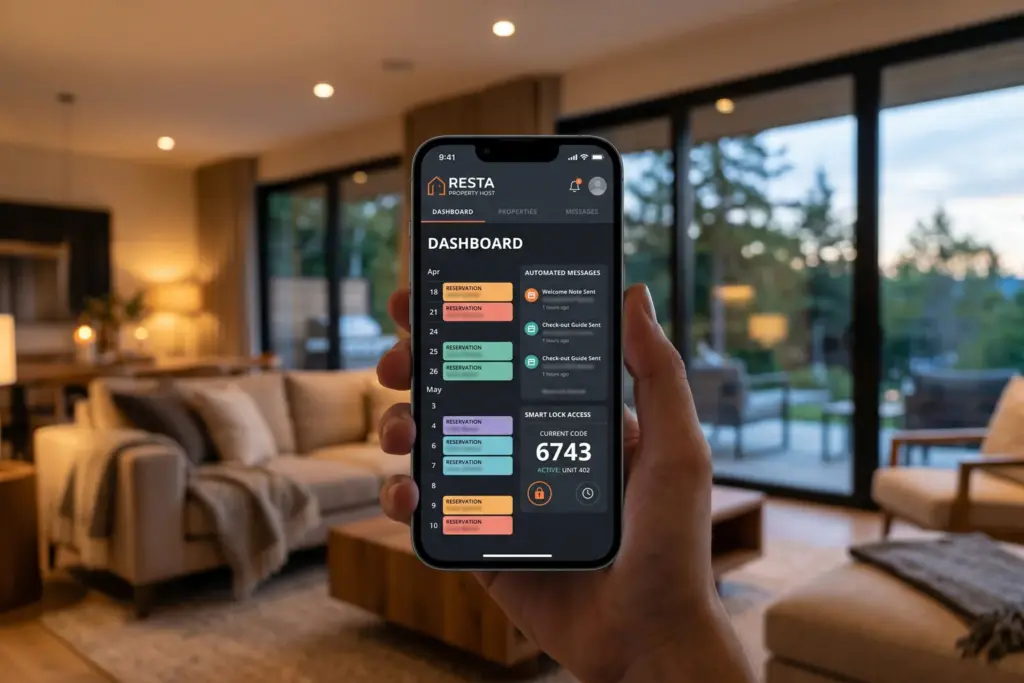
The booking arrives on Airbnb, Vrbo, or Booking.com. Your property management software picks it up instantly. It reads the check-in date, reads the checkout date, and fires a trigger. That single trigger does three things simultaneously: it generates a unique door code timed to the guest’s stay, it schedules a cleaning job for the checkout day, and it queues the first message in your automated guest sequence.
The guest receives a booking confirmation with check-in instructions. No action from you. Three days before arrival they get a follow-up with directions, parking, and local recommendations. On check-in day, one hour before arrival, the unique door code is delivered. The code works only during their stay. At checkout, it expires automatically.
During the stay, a noise monitor watches decibel levels around the clock. If a threshold is crossed, it sends an automated warning directly through Airbnb messaging to the current guests. If it escalates, it pushes an alert to you. Most of the time the automated warning handles it. You do not need to be awake or available.
After checkout, the cleaner already has the job on their calendar. They arrive, complete a photo-verified room-by-room checklist, and submit it from their phone. You review the photos from anywhere. The PMS sees the completed clean and marks the calendar open for the next guest. If there is damage, you document and file a claim. Then the review request fires automatically to the departing guest.
Seven major operational touchpoints. Zero required manual steps from you except reviewing post-clean photos and approving anything flagged for damage. That is what a working remote management system looks like in 2026.
The Five Operational Layers
Layer 1: Keyless Entry
There is no viable remote operation without smart locks. A key lockbox is not a solution. You cannot change the combination remotely between guests, and you cannot confirm whether a key was copied. Smart locks solve both problems at the hardware level.
The right lock generates a unique code per booking, synced directly from your property management software calendar. The Yale Assure Lock 2 Wi-Fi is the only lock with native Airbnb auto-code generation built in, meaning Airbnb itself creates and delivers the guest code without any manual step. The Schlage Encode Plus is the security pick for hosts who want ANSI Grade 1 durability. The August Wi-Fi 4th Gen retrofits over your existing deadbolt without requiring hardware replacement, useful when you cannot physically swap out a lock. For budget-conscious setups, the Wyze Auto-Lock Bolt v2 covers the basics at around $89.
The integration question matters more than brand preference. Hospitable integrates natively with Yale, Schlage, and August. Guesty connects through RemoteLock and SuiteOp. OwnerRez uses RemoteLock for Schlage and Hubitat for Yale and Kwikset. Before buying any hardware, verify the lock has a native integration path to your PMS. This single gap is where the access automation chain breaks most often. Our full 2026 smart lock guide covers each option with complete integration maps.
Layer 2: Automated Guest Messaging
Guest communication is almost entirely automatable in a well-built remote system. Booking confirmations, check-in instructions, mid-stay check-ins, checkout reminders, review requests: a good PMS handles all of it using time-based and event-based triggers.
Hospitable routes around 90% of messages for more than 20,000 hosts using it. One thing that surprises new remote hosts: Airbnb has no native auto-reply system for incoming guest messages. The platform schedules outbound messages but cannot respond to incoming questions automatically. Third-party tools handle that layer entirely.
The key design decision is trigger type. Time-based triggers (“send at 10am three days before check-in”) break when a booking changes dates. Event-based triggers (“send 72 hours before the check-in date on the reservation”) adapt automatically. Build your message sequence around events, not clock times. The full communication sequence structure is covered in our STR guest communication tools guide.
Layer 3: Cleaning Coordination
This is the highest-risk layer for remote hosts. A cleaner who does not show up after a checkout and before the next check-in is the most common operational failure point in remote STR management. The system needs to handle scheduling, confirmation, photo verification, and payment without you managing any of it manually.
Turno (formerly TurnoverBnB) is the cleaner marketplace approach. More than 25,000 vetted cleaners across the U.S., Canada, and Europe. When a guest books, Turno reads your calendar and auto-assigns a cleaning job to the checkout date. Cleaners complete photo-verified checklists room by room and submit photos before marking the job complete. Payment processes automatically. The marketplace feature means if your primary cleaner cancels, the platform can source a backup.
Breezeway goes deeper on workflow logic. Priority-based assignment, maintenance tracking alongside cleaning, and remote inspection via customizable checklists with photo documentation. The better choice when you already have a cleaning team and need coordination infrastructure rather than marketplace cleaner coverage.
The housekeeping software comparison covers both at length. Short version for remote hosts: Turno wins if you need cleaner coverage in a new market fast. Breezeway wins if you have a team and need systems around them.
Layer 4: Noise Monitoring
Noise complaints from neighbors are the fastest way to lose an STR permit. A noise monitor does not prevent problem guests. What it does is intervene before a complaint reaches a neighbor or a code enforcement officer, and it creates a documented record if one does.
Minut is the leading option in 2026. The M3 sensor combines noise monitoring, Bluetooth-based occupancy detection, temperature, humidity, motion, and cigarette and marijuana smoke detection. The Standard tier at $10/month syncs directly with Airbnb, meaning when decibel thresholds are crossed, Minut auto-sends a noise warning through Airbnb messaging to the current guests. No call from you required. The Pro tier at $15/month adds 30-plus PMS integrations. A $10/month Call Assist add-on dispatches a third party to call noisy guests when the automated warning is not enough.
NoiseAware is the focused alternative. Noise only, done well. Indoor sensor pricing starts at $15/month, with an optional outdoor sensor at $99. For hosts who want one thing to work reliably rather than a multi-function device, it delivers.
One thing to watch with either tool: they measure decibels, not context. A family cooking a late dinner can register similarly to a gathering that is actually a problem. Expect some false alerts and plan for a 60-second review before escalating. That is the real cost of remote noise oversight, and it is worth paying.
Layer 5: Remote Inspection
You are not walking the property between guests. That gap in visibility is manageable with the right systems in place.
Photo-verified cleaning checklists through Turno or Breezeway cover the most important inspection layer. The cleaner confirms condition, restocking, and any damage room by room with timestamped photos submitted before job completion. For single-property hosts, this is sufficient for day-to-day oversight.
For properties with pools, hot tubs, or high-value furnishings, external security cameras at entry points add a verification layer. A camera at the front door and driveway gives you occupancy confirmation and documents any exterior damage. Interior cameras are against platform policies and are illegal in most jurisdictions. They do not belong inside the property, ever.
Some remote hosts also maintain a local property contact, a neighbor, handyman, or nearby real estate contact, who can do one physical walkthrough per month. Low-tech, but it catches what no sensor or photo system catches: slow plumbing leaks, landscaping problems, or equipment showing wear before it fails during a guest stay.
Sponsored — OfferMarket
Buy Your First STR With Long-Term Rental Financing
Flexible, long-term financing for short-term rental buyers. Rates from 5.75%. Instant online quote, no credit pull.
Explore RTL Financing Options →Affiliate disclosure: StaySTRA may earn a referral fee.
How the Tools Talk to Each Other
I track integration release notes the way some people track sports scores. What actually changed in 2026 is not the existence of these integrations but their depth. Tools that previously required a third-party bridge like Zapier to connect are now exchanging data via direct API. That matters for remote hosts specifically, because every bridge you add is a failure point you cannot troubleshoot in person at 11pm before a check-in.
The PMS is the hub. Every other tool in the stack is a spoke. When the PMS receives a booking, it pushes the guest’s dates outward to every connected system. The smart lock generates a code for those dates. The cleaning platform schedules a turnover for checkout day. The guest messaging sequence queues. The noise monitor knows the property is occupied.
This is why the channel manager and PMS selection is the most consequential software decision a remote host makes. It is not just calendar sync across booking platforms. It is the automation trigger engine for the whole operation. A PMS with shallow integrations forces manual connection points between tools. A PMS with deep native APIs handles those connections automatically and monitors them continuously.
Hospitable and Guesty have the deepest native integration ecosystems among current PMS options. Hospitable’s native connections to Yale, Schlage, and August locks, plus its integrations with Turno and Minut, create a tight chain for single-property and small multi-property operators. Guesty’s enterprise workflow engine handles more complex task automation and is built for portfolios of five or more properties.
OwnerRez is worth noting as an exception. Strong channel management, trusted by experienced hosts for booking and rate management, but limited on the task automation side. It works well for remote hosts who handle guest communication personally or through a virtual assistant. It is not the right hub for a fully hands-off automation stack.
Before committing to any PMS, map every tool in your intended stack and check whether each connects via direct API or through a third-party bridge. Bridges work. But for remote hosts, direct API is always preferable, because when it breaks at midnight before a check-in, you are not there to fix it.
Building Your Remote Stack: Three Tiers
Entry Level (1 Property)
One property does not need enterprise complexity. It needs reliability. The goal is a stack that handles 95% of operations automatically at under $150 per month total.
- PMS and messaging: Hospitable ($25 to $30/month)
- Smart lock: Yale Assure Lock 2 Wi-Fi or August Wi-Fi 4th Gen ($200 to $250 one-time hardware)
- Cleaning coordination: Turno (free for hosts; cleaners are paid per job)
- Noise monitoring: Minut Standard ($10/month)
Total ongoing software cost: $35 to $40 per month after initial hardware. Annual run rate under $500 in software. A traditional property management company covering the same property charges 25% to 30% of gross revenue. For a property earning $40,000 per year, that is $10,000 to $12,000 in PM fees versus under $500 in self-managed software. The savings compound every year you keep the stack running.
Mid-Level (2 to 4 Properties)
At this scale, the gaps in a basic setup start to show. More turnovers mean more scheduling complexity. More bookings mean more incoming guest messages that need intelligent routing. You also need dynamic pricing at this tier because manually adjusting rates across multiple properties is a part-time job.
- PMS: Hospitable or OwnerRez (both handle 2 to 4 properties well, with better rate and channel controls than entry-level options)
- Channel management: Integrated in PMS, or standalone Beds24 at around $10/month for 60-plus channel coverage
- Smart locks: One per property, all synced to the same PMS for centralized code management
- Cleaning: Turno if you rely on marketplace coverage; Breezeway if you have a regular cleaning team
- Noise monitoring: Minut Pro ($15/month per property) for deeper PMS integration
- Dynamic pricing: PriceLabs or Wheelhouse ($9.99 to $19.99/month per property) for automated rate management
Total software cost at this tier runs $150 to $300 per month. Against PM fees of $30,000 to $42,000 per year across three properties earning $40,000 each, the self-managed stack represents a substantial long-term advantage.
Professional (5 or More Properties)
Five or more properties is where system reliability becomes non-negotiable. One integration failure, a PMS that drops a cleaning trigger or a lock that fails to generate a code, ripples across multiple guests at once. The professional tier is built for resilience, not just convenience.
- PMS: Guesty or Hostaway (enterprise-grade API ecosystems, dedicated onboarding, multi-property workflow automation)
- Property operations: Breezeway for coordinated cleaning, maintenance, and inspection workflows across all units
- Access management: RemoteLock or SuiteOp for centralized lock management across the portfolio
- Noise monitoring: Minut Pro (bulk pricing available at scale)
- Guest communications: Built into Guesty or Hostaway with AI-assisted response routing and 24/7 coverage
- Revenue management: PriceLabs (manages 500,000-plus units globally, deep API connections to enterprise PMS options)
At this scale, the conversation shifts from “how do I manage this from a distance” to “how do I build a local physical layer while keeping the automated digital layer running without me.” The tools handle the automated operations. A local handyman on retainer handles physical emergencies. That combination is the professional remote model for 2026 and the years ahead.
Sponsored — OfferMarket
Buy Your First STR With Long-Term Rental Financing
Flexible, long-term financing for short-term rental buyers. Rates from 5.75%. Instant online quote, no credit pull.
Explore RTL Financing Options →Affiliate disclosure: StaySTRA may earn a referral fee.
Before You Buy in a New Market
Remote management only works if the market supports it. Some markets have high cleaning costs, low cleaner availability, or regulations requiring owner presence for check-in. Others are operationally smooth because the STR ecosystem there is mature and professional. Knowing the operational overhead of a target market before you commit capital is the step most remote investors skip.
The StaySTRA Analyzer gives you revenue, occupancy, and market performance data across hundreds of markets. Run the numbers on any market you are evaluating before you look at a single listing.
Check market performance data with the StaySTRA Analyzer.
Frequently Asked Questions
Can you self-manage an STR if you live more than an hour away from the property?
Yes. The five-layer system (keyless entry, automated messaging, cleaning coordination, noise monitoring, remote inspection) handles the daily operation without your physical presence. The most important prerequisite is reliable cleaner coverage in the market where your property sits. If you have a trusted cleaner with backup options, everything else can run remotely through connected software tools.
What is the biggest failure point in remote STR management?
Cleaner no-shows are the number one operational failure for remote hosts. When a cleaner does not appear after a checkout and a new guest arrives to a dirty property, the review damage is severe and hard to recover from. Turno’s cleaner marketplace addresses this with backup coverage options. Single-cleaner setups with no backup plan are the most common place remote management systems break down in practice.
How much does a full remote STR management stack cost in 2026?
For a single property, expect $35 to $50 per month in ongoing software after one-time hardware investment. Annual total: $1,200 to $2,400. A traditional property management company charges 25% to 30% of gross revenue for comparable operational coverage. On a property earning $40,000 per year, that is $10,000 to $12,000 in PM fees versus under $500 in self-managed software. The economic case for self-management is strong for hosts willing to invest the time building the system once.
Which PMS is best for managing an Airbnb from a distance in 2026?
For single-property hosts starting out, Hospitable is the clear entry point. It handles messaging automation, connects natively to Yale, Schlage, and August locks, and integrates with Turno for cleaning coordination. For 2 to 4 properties, OwnerRez adds stronger direct booking and channel management tools. For 5 or more properties, Guesty and Hostaway offer enterprise-grade API ecosystems with deeper workflow automation and dedicated onboarding.
Do you need all five layers to manage an STR remotely?
You need at least the first three: keyless entry, automated messaging, and cleaning coordination. Without all three, guests will find gaps that show up in reviews. Noise monitoring is strongly recommended in markets with HOA rules or active permit enforcement. Remote inspection via photo-verified cleaning checklists is practically bundled with the cleaning layer anyway, so it is easier to include from the start than to add reactively after a problem surfaces.
We do our best to keep our tech reviews accurate and up to date, but products evolve fast and we are only human. Always verify current features and pricing directly with vendors before purchasing.
Become a StaySTRA Insider
Join free — get our newsletter + 1 free property analysis/month.
No spam. Unsubscribe anytime. Free membership includes property analyses and market insights.