

Key Takeaways
- Riverside County’s 45-day moratorium (Ordinance No. 449.256) halts all new short-term rental certificates in Thousand Palms and B Bar H Ranch, effective March 3 through approximately April 17, 2026.
- Existing STR permit holders are not affected. The freeze only blocks new certificate applications in these two unincorporated Coachella Valley communities.
- This is actually an extension of a moratorium first imposed in April 2025, meaning these areas have been closed to new STR operators for nearly a year.
- The broader Palm Springs area market has 6,018 active listings with a trailing 12-month occupancy rate of 60% and ADR of $463, per StaySTRA data.
- Riverside County is expected to bring permanent ordinance revisions before year-end, with proposed fee increases and stricter enforcement measures still under development.
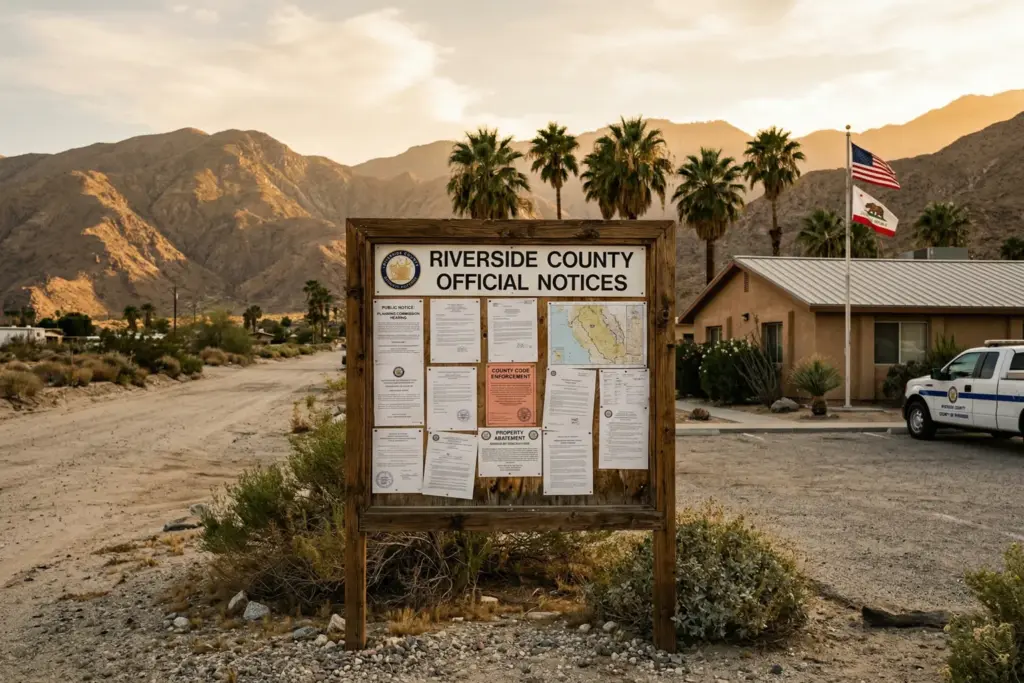
Riverside County’s Board of Supervisors voted 4-0 on March 3, 2026, to adopt Ordinance No. 449.256, an urgency interim ordinance that freezes all new short-term rental certificates in two unincorporated Coachella Valley communities: Thousand Palms and B Bar H Ranch. If you had a purchase contract pending in either area with plans to list on Airbnb, that plan just got a 45-day hold placed on it (at minimum).
The moratorium runs through approximately April 17, 2026. And if you are thinking “I’ll just wait it out,” you should know this is not the county’s first time pressing pause. The original moratorium was established in April 2025. The county has now extended it twice. That pattern matters.
What the Riverside County STR Moratorium Actually Freezes
Let me translate the ordinance language into something useful. The moratorium does exactly one thing: it stops the county from issuing new STR certificates in Thousand Palms and B Bar H Ranch. That is it. No new certificates means no new legal short-term rentals in those two communities.
Here is what the moratorium does not do:
- It does not revoke existing STR certificates. If you already hold a valid certificate in either area, you can continue operating.
- It does not affect any other unincorporated Riverside County community. The approximately 1,100 certificated STR properties across the rest of unincorporated Riverside County are unaffected.
- It does not apply to incorporated cities like Palm Springs, Cathedral City, Indio, La Quinta, or Desert Hot Springs. Those cities set their own STR rules.
The freeze is narrow in scope but significant in signal. Fifty-nine STR properties currently operate across the two affected communities. County staff flagged 35 properties in Thousand Palms and 27 in B Bar H Ranch for illegal (uncertificated) STR operations since 2022. That ratio of legal to illegal operators is part of what pushed the Board to act.
Why Riverside County Did This (It Was Not Sudden)
Picture this: you are a retiree living on a dirt road in East Thousand Palms. One night, 100 cars show up at the rental property next door for a party organized by a promoter who charged admission. The music runs past midnight. Code enforcement is unavailable after 10 p.m. You call the sheriff, but deputies have to prioritize calls. By morning, the cars are gone and nothing happened.
That is not a hypothetical. Multiple residents described exactly this scenario during a 90-minute hearing on February 10, 2026, where more than a dozen community members testified. One resident told the Board, “My life is a living hell. Nothing is being done.”
Board Chairman Manuel Perez put the enforcement gap in dollar terms: “When the promoters are making $50,000 on one party, the fines don’t really matter.” Current penalties range from $500 to $1,000 per violation. When the revenue from a single sponsored event dwarfs the maximum fine, the math does not work as a deterrent.
Supervisor Chuck Washington, who was absent for the March 3 vote, had previously expressed his own frustration at the February meeting: “How is it that we’ve gone through all these hearings and meetings, and we’ve arrived at the same place we were four years ago?”
The county’s Transportation and Land Management Agency (TLMA) and Code Enforcement officers are now using the moratorium window to assess conditions specific to Thousand Palms and B Bar H Ranch and to develop enforcement measures with, as officials put it, actual “teeth.”
The Coachella Festival Factor
The timing of this moratorium is not accidental. The Coachella Valley Music and Arts Festival draws hundreds of thousands of visitors to the region each April. The Board explicitly cited the upcoming festival as a consideration during the moratorium review period.
Unregulated and uncertificated rentals surge during Coachella season. The moratorium ensures no new certificates are issued in Thousand Palms and B Bar H Ranch before the festival hits, preventing a last-minute wave of applications from operators looking to capitalize on peak demand without going through the county’s (admittedly slow) compliance process.
What the Palm Springs Area STR Market Looks Like Right Now
StaySTRA data shows the broader Palm Springs market currently has 6,018 active short-term rental listings. The trailing 12-month average daily rate sits at $463, with a 60% occupancy rate generating average monthly revenue of $5,280 per property.
Seasonality is pronounced. March and April are peak months for the Coachella Valley. March 2025 performance hit an ADR of $525 with 88.2% occupancy, generating $8,249 in average monthly revenue. The low point comes during summer, when occupancy drops to around 40% and ADR settles near $423.
The affected unincorporated areas (Thousand Palms and B Bar H Ranch) represent a tiny fraction of this market. Fifty-nine properties across two communities, compared to more than 6,000 listings regionwide. But the moratorium’s significance is not about supply volume. It is about what it signals for regulatory direction.
Palm Springs Is Not Affected (But That Does Not Mean It Is Easy)
Palm Springs, as an incorporated city, sets its own short-term rental rules entirely independent of the county. The city already caps vacation rentals at 26 rental days per year for most properties, one of the strictest limits in California. If you are investing in Palm Springs proper, the county moratorium is not your concern. The city’s own restrictions are.
Other incorporated Coachella Valley cities (Cathedral City, Indio, La Quinta, Desert Hot Springs) each have their own permitting frameworks. None are affected by Ordinance 449.256. But the county’s posture tends to influence regional conversation, and investors should expect that tighter rules in unincorporated areas will keep the regulatory debate active across the valley.
California’s broader regulatory trajectory matters here too. SB 346, the Short-Term Rental Facilitator Act, already requires platforms like Airbnb and Vrbo to share host data with local jurisdictions. That state-level transparency framework makes it easier for counties like Riverside to identify and act against uncertificated operators.
What Happens on April 17 (Three Scenarios)
The moratorium expires approximately April 17, 2026. Based on the county’s track record, here are the realistic outcomes:
Scenario 1: Another extension. This is the most likely outcome. The county has already extended this moratorium twice (the original ran from April 2025). California Government Code Section 65858 allows interim ordinances to be extended for up to 22 months and 15 days total. The county has plenty of runway to keep extending if it chooses.
Scenario 2: Permanent ordinance revisions take effect. TLMA has been developing amendments to Ordinance 927 (the county’s primary STR regulatory framework, adopted October 2022). Proposed changes include an “urgent circumstance” provision for immediate nuisance abatement, denial of renewal certificates for operators with three violations in six months, increased application fees from $740 to $1,040, and annual renewal fees from $540 to $750. If these are ready, the moratorium could dissolve into a permanent tighter framework. County staff have indicated they expect to bring revisions before year-end.
Scenario 3: The moratorium lifts without replacement. Technically possible but unlikely given the political dynamics. Four supervisors voted for this moratorium. Community pressure is strong. Lifting it without new protections would be politically difficult.
What This Means If You Are an STR Investor
If you have an active purchase contract in Thousand Palms or B Bar H Ranch with STR plans, you need to talk to your attorney before closing. You will not be able to obtain a new STR certificate until the moratorium lifts, and there is no guarantee it will lift on April 17. Your closing timeline and the moratorium timeline may not align.
If you already hold a certificate in either area, nothing changes for you operationally. Your certificate remains valid. But watch the fee proposals. Application fees jumping from $740 to $1,040 (a 40.5% increase) and renewal fees from $540 to $750 (a 38.9% increase) will affect your operating costs when they take effect.
If you are looking at unincorporated Riverside County communities outside Thousand Palms and B Bar H Ranch, you are not directly affected. But the county’s enforcement review could lead to countywide changes to Ordinance 927. The moratorium is specific; the ordinance revision will likely be broader.
This article provides general information and should not be construed as legal advice. Consult a qualified attorney in your jurisdiction for advice specific to your situation.
The National Pattern
Riverside County is not operating in a vacuum. Unincorporated county areas have become ground zero for STR regulatory action across the country because they often lack the staffing and enforcement infrastructure that larger cities have.
The pattern repeats: residents complain, the county freezes new permits to buy time, enforcement catches up (or doesn’t), and eventually a permanent framework replaces the moratorium. We have seen this play out in markets experiencing occupancy declines, where oversupply meets tightening regulation.
For investors, the practical lesson is straightforward. Before committing capital to any unincorporated area, check the county’s regulatory status. Not the city. The county. Incorporated cities get the headlines, but unincorporated communities are where the surprise moratoriums happen.
We do our best to keep our regulatory guides accurate and up to date, but ordinances change and we are only human. Always verify current requirements directly with your local municipality before making business decisions.
Frequently Asked Questions
Does the Riverside County STR moratorium affect Palm Springs?
No. Palm Springs is an incorporated city with its own STR regulations, including a 26-day annual rental cap. The moratorium (Ordinance No. 449.256) only applies to unincorporated Riverside County communities, specifically Thousand Palms and B Bar H Ranch in the Coachella Valley.
Can I still operate my existing short-term rental in Thousand Palms during the moratorium?
Yes. The moratorium only freezes the issuance of new STR certificates. If you already hold a valid certificate, your operations are unaffected. The county has not revoked any existing permits as part of this action.
When does the Riverside County STR moratorium expire?
The current 45-day moratorium expires approximately April 17, 2026. However, this is already the second extension of a moratorium originally established in April 2025. The county can extend interim ordinances for up to 22 months and 15 days under California Government Code Section 65858.
What happens if I close on a property in Thousand Palms during the moratorium?
You can still purchase property, but you will not be able to obtain a new STR certificate until the moratorium is lifted or expires. This means you cannot legally operate a short-term rental on that property during the moratorium period. Consult a real estate attorney before closing if STR income is part of your investment thesis.
Will Riverside County make the STR restrictions permanent?
The county’s Transportation and Land Management Agency is developing permanent amendments to Ordinance 927, the primary STR regulatory framework. Proposed changes include higher fees, stricter violation thresholds, and faster nuisance abatement procedures. Staff have indicated these revisions are expected before the end of 2026.
Run the Numbers Before You Commit
If you are evaluating a short-term rental investment anywhere in the Coachella Valley or greater Palm Springs area, run the numbers through StaySTRA’s California STR calculator before you sign anything. The tool pulls real market data for occupancy, ADR, and projected revenue so you can see what a property would actually earn, not what a listing agent hopes it might.
For detailed market data on Palm Springs and the surrounding area, visit our California location pages.
Become a StaySTRA Insider
Join free — get our newsletter + 1 free property analysis/month.
No spam. Unsubscribe anytime. Free membership includes property analyses and market insights.