

Key Takeaways
- The Phoenix metro area has over 20,000 active short-term rental listings across Phoenix, Scottsdale, Tempe, and Chandler, with many hosts relying on that income for retirement or primary earnings.
- Arizona’s 2016 state preemption law (SB 1350) prevents cities from banning STRs, but HOA restrictions, rising insurance requirements, and permit complexity are creating real barriers for hosts.
- A new bill (HB 2429) passed the Arizona House in March 2026 and would impose occupancy limits and allow license suspensions, adding another layer of uncertainty for hosts planning around STR income.
- Phoenix requires a city permit and $500,000 in liability insurance; Scottsdale charges $250 per year for a license with the same insurance threshold.
- Hosts who built retirement or supplemental income plans around STR revenue are facing a market where the rules keep shifting beneath them.
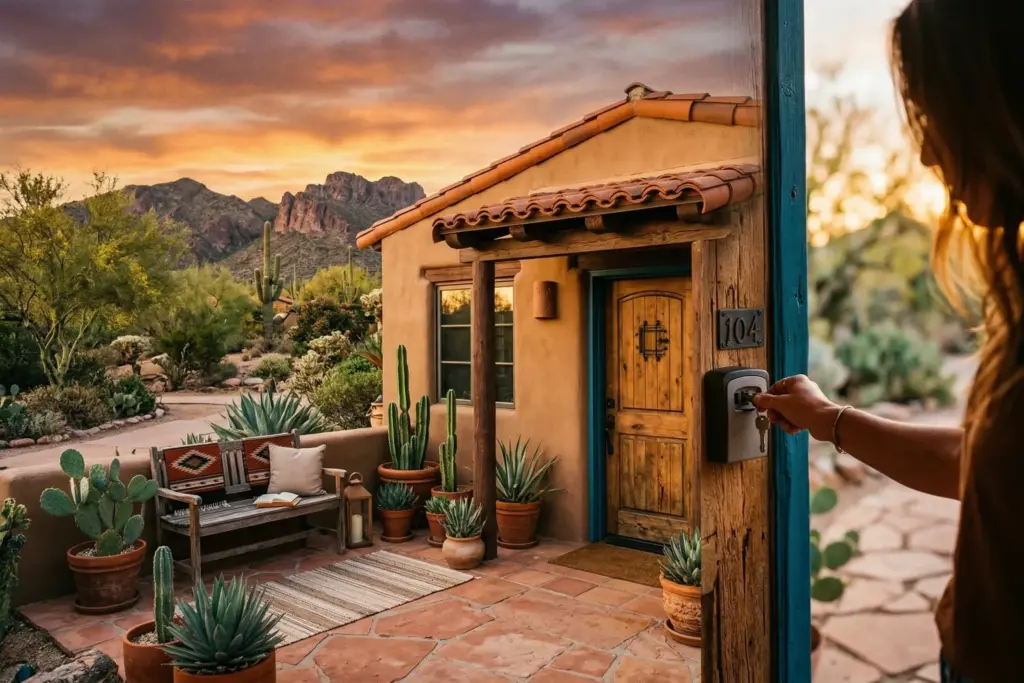
On a warm February evening in Scottsdale, the kind where the desert sky turns the color of burnt copper, a woman I’ll call Diana sat on the patio of a casita she’s owned for eleven years. She bought it as a snowbird retreat, a place to escape Wisconsin winters. Somewhere around 2018, she started listing it on Airbnb during the months she wasn’t using it. The income was good. Really good. By 2021, those rental checks had become the centerpiece of her retirement plan.
“It was never supposed to be a business,” she told me. “It was supposed to be a way to keep the house without draining my savings.”
Diana is not unique. Across the Phoenix metro, thousands of hosts built financial plans around short-term rental income. Some are retirees supplementing Social Security. Some are working people who turned a spare room into a lifeline after a layoff or a medical bill. Some are holding onto homes that have been in their families for decades, using STR revenue to cover property taxes and insurance that keep climbing.
Now, the ground beneath those plans is shifting. Not in one dramatic sweep, but in a dozen small ways that add up.
The Scale of What’s at Stake in the Phoenix Metro
The numbers paint a picture of a massive market. StaySTRA data shows Phoenix alone has 8,586 active short-term rental listings. Scottsdale, right next door, has 9,331. Add Tempe (roughly 1,480 listings) and Chandler (about 1,075), and you’re looking at more than 20,000 active STR properties in the metro area. This is one of the largest short-term rental markets in the country by listing count.
The revenue potential varies significantly across the metro. In Scottsdale, the last twelve months average daily rate sits at $297, with hosts averaging around $4,195 per month in revenue and a 68.4% occupancy rate. Phoenix proper shows a more modest picture: $182 ADR, 66.7% occupancy, and roughly $2,500 per month in average revenue. Chandler lands between the two at $194 ADR with 68.8% occupancy.
(Note: StaySTRA market data reflects the most recent available data from November 2025.)
Those averages, though, hide an enormous range. Peak season in Scottsdale, February and March, pushes ADR above $380 with occupancy clearing 80%. Summer months, when the thermometer regularly clears 110 degrees, drop occupancy to 50% or below and pull ADR down to the $140 range. A host who only looks at the annual average is missing the seasonal rollercoaster that defines this market.
Three Hosts, Three Plans, One Shifting Landscape
To understand what these regulatory and market changes mean in human terms, I spoke with hosts across the metro. Their names and some details are changed, but their situations are representative of patterns I heard again and again.
Diana: The Retirement Casita
Diana, the Scottsdale snowbird, is 68. Her casita earns around $3,800 per month during peak season and closer to $1,600 in summer. That averages out to something in the neighborhood of $2,800 per month across the year, which covers her property tax, insurance, HOA dues, and puts about $1,200 in her pocket. “That twelve hundred dollars is the difference between comfortable and tight,” she said.
When Scottsdale implemented its $250 annual license fee and the $500,000 liability insurance requirement, Diana’s costs went up by about $1,800 per year. Not ruinous, but she felt it. The insurance was the bigger hit. Her standard homeowners policy didn’t cover short-term guests, so she had to buy a specialized STR policy. “La diferencia entre lo que pagaba antes y lo que pago ahora,” she said, mixing languages the way she does when she’s frustrated. The difference between what I paid before and what I pay now.
Her HOA has been discussing STR restrictions for two years. Nothing has passed yet, but every quarterly meeting brings it up again. “I sit in those meetings with a knot in my stomach,” Diana said. “Half my neighbors love that I keep the place spotless and bring in quiet guests. The other half want all rentals gone.”
Marcus: The Side Hustle That Became a Lifeline
Let’s call him Marcus. He’s 44, lives in Tempe, and started renting out a detached casita behind his primary home in 2019. It was beer money at first. Then his employer laid off half the engineering team in 2023, and suddenly that casita income was paying his mortgage.
Marcus re-entered the workforce in 2024, but he kept the listing running. “Once you realize that little house in your backyard can generate $1,800 a month, you don’t just turn that off,” he said. He’s now used that income to build an emergency fund and start a college savings account for his daughter.
The permitting process is what frustrates Marcus most. Phoenix shifted from a simple registration to a full permit requirement in November 2023. He had to get the $500,000 liability insurance, send certified mail notifications to every property and HOA within 600 feet of his home, display his permit number in every listing ad, and keep a copy of the permit visible near his front entrance. “I counted seventeen steps,” he said. “For a casita behind my house.”
He pays the 12.57% transaction privilege tax on every booking. He files quarterly. He keeps meticulous records. “Hago todo bien,” he told me. I do everything right. “And still, every time the city council meets, I wonder if they’re going to make it harder.”
The Garcias: Keeping the Family Home
In Chandler, I met a couple I’ll call the Garcias. They inherited a three-bedroom ranch house from an uncle who passed in 2020. None of the siblings could afford to live in it, but no one wanted to sell it, either. It had been in the family since 1987. Familia, you know? Some things you don’t put on the market.
They listed it on Airbnb in early 2021. The $2,600 or so per month in average revenue covers the property tax, insurance, maintenance, and a small surplus that the siblings split four ways. “It’s not making anyone rich,” one of the Garcias told me. “It’s keeping the house in the family. That’s the whole point.”
Their biggest concern isn’t the city. It’s the HOA. Their neighborhood association amended its CC&Rs in 2024 to impose a 30-day minimum rental period, which would effectively kill their short-term rental operation. The Garcias are part of a group of homeowners challenging the amendment, arguing that Arizona’s state preemption law should override the HOA restriction. The legal landscape here is murky. Arizona law says HOAs can restrict STRs in their CC&Rs, even though cities can’t ban them outright. “How does that make sense?” one Garcia sibling asked me. “The state says the city can’t stop us, but our neighbor’s board can?”
The Regulatory Puzzle: State Protection, Local Pressure
That question cuts to the heart of what’s happening in Arizona. In 2016, the state legislature passed SB 1350, a preemption law that prevented cities from banning or capping short-term rentals. It was one of the most host-friendly pieces of legislation in the country. Cities could regulate health and safety (fire codes, sanitation, noise), but they couldn’t touch the fundamental right to rent your property short-term.
For hosts like Diana, Marcus, and the Garcias, that law was the foundation their plans rested on. Arizona was a safe state for STR investment. The government had their backs.
But the ground has been shifting. The state amended the law in 2022 to give cities more enforcement tools. Phoenix used that opening to create its permit system. Scottsdale built a licensing framework. And now, HB 2429, which passed the Arizona House on March 10, 2026, by a 36-19-4 vote, would go further.
The bill, currently pending in the state Senate, would impose occupancy limits of two people per bedroom plus two additional guests (children excluded). It would also allow local governments to suspend STR licenses after three violations within 24 months. The original version of the bill included provisions that would have let cities cap the number of STR licenses and control where rentals could operate. Those provisions were stripped before the vote, but the fact that they were introduced at all tells you where the conversation is heading.
“Every year, the rules get a little tighter,” Marcus told me. “Not enough to shut anyone down overnight, but enough to make you wonder where the line will be in five years.”
The HOA Factor: The Ban That Isn’t a Ban
For many Phoenix metro hosts, the most immediate threat isn’t the city or the state. It’s their homeowners association.
Arizona’s preemption law specifically carved out private agreements. HOAs can restrict or ban short-term rentals through their CC&Rs, and many have done exactly that. Some impose minimum stay requirements of 30 days. Others ban rentals of less than six months. A few have prohibited all rentals entirely.
The prevalence is hard to pin down with exact numbers, but every host I spoke with in the suburbs knew someone whose HOA had either passed or was considering STR restrictions. In communities across Chandler, Gilbert, and parts of Scottsdale, the HOA meeting has become the frontline of the STR debate.
Walking through a Chandler subdivision one afternoon, I passed a house with a lockbox on the door, clearly a rental, next to a home with a “Residents Not Rentals” sign in the window. Coexistencia dificil. A difficult coexistence.
The legal questions are real. Some attorneys argue that HOA amendments restricting STRs should require supermajority votes or face legal challenges under Arizona’s property rights protections. Others point out that CC&Rs are private contracts, and the state preemption law explicitly does not override them. For hosts caught in the middle, the legal uncertainty is its own cost, both financial and emotional.
Insurance and the Quiet Squeeze
Both Phoenix and Scottsdale require $500,000 in liability insurance for STR properties. That’s not a suggestion. No proof of insurance, no permit. No permit, no listing.
Standard homeowners policies don’t cover short-term rental activity. Hosts need specialized STR insurance or a commercial rider, and those policies have gotten more expensive. Basic STR coverage in the Phoenix metro runs $800 to $1,500 per year, but comprehensive policies that cover guest injuries, property damage, and lost income can run significantly higher. Several hosts told me their insurance costs had increased 20 to 30 percent over the past two years.
For a host like Diana, earning $2,800 per month in average revenue, an extra $400 to $600 per year in insurance premiums is meaningful. It’s one more line item chipping away at margins that were already tight during the summer months.
The 12.57% transaction privilege tax in Phoenix adds another layer. On a $5,000 booking, that’s $628.50 going to state and local government before the host pays their own income taxes, insurance, maintenance, and platform fees. “People see the nightly rate and think I’m making a fortune,” Marcus said. “They don’t see all the places the money goes before it reaches my pocket.”
What the Revenue Data Actually Shows
The StaySTRA data for Phoenix shows a market that’s still productive but increasingly squeezed. An average monthly revenue of $2,500 in Phoenix and $4,195 in Scottsdale sounds substantial until you subtract operating costs. Property tax, insurance, HOA dues, utilities, cleaning, maintenance, supplies, platform fees (typically 3% on Airbnb for hosts using the split-fee model), and the 12.57% TPT can easily consume 40 to 50 percent of gross revenue.
Hosts weighing whether the market still pencils can run their specific address in the StaySTRA analyzer to see projected revenue adjusted for current market conditions.
The seasonality makes planning especially tricky. A host who clears $1,500 in profit during a strong February might lose money in July. “You budget for twelve months,” Diana told me. “The good months have to carry the bad ones. When the good months get a little less good, the whole year tilts.”
That tilt is what worries hosts most. Not a sudden shutdown, but a gradual erosion. Higher insurance. New permit fees. HOA restrictions. Occupancy limits. Each one manageable on its own. Together, they reshape the math.
Where the Conversation Goes from Here
I left Phoenix with a feeling I’ve carried home from a lot of STR communities. Not despair, but unease. The people building their lives around this income aren’t speculators or corporations (though those exist in the market too). Many are ordinary people who found an opportunity and built around it responsibly.
The state preemption law gives Arizona hosts a legal floor that hosts in many other states don’t have. You cannot be banned from renting your property short-term. That’s real, and it matters. But the floor is lower than it used to be, and the walls are closing in from other directions: HOA amendments, insurance premiums, permit complexity, and a state legislature that’s actively discussing how much further to go.
Para los que construyeron planes alrededor de esta economia, for those who built plans around this economy, the question isn’t whether short-term rentals will survive in Phoenix. They will. The question is whether the margins will still be there for the individual host. The retiree with one casita. The working person whose spare room became a safety net. The family holding onto an inherited home because selling felt like giving up a piece of themselves.
That’s a question the data alone can’t answer. It lives in HOA meeting rooms and state senate chambers and insurance underwriters’ offices. And in the knot in Diana’s stomach every time the mail arrives.
We do our best to keep our content accurate and up to date, but things change and we are only human. Always verify details directly with local sources before making decisions.
Frequently Asked Questions
Can cities in Arizona ban short-term rentals?
No. Arizona’s SB 1350, passed in 2016, prevents cities from banning or capping short-term rentals. Cities can regulate health and safety aspects (fire codes, noise, sanitation) and require permits and registration, but they cannot prohibit STRs outright. However, HOAs can restrict or ban them through their CC&Rs.
What does Phoenix require to operate a short-term rental?
Phoenix requires a city-issued STR permit (upgraded from a registration requirement in November 2023), $500,000 in liability insurance, a valid Arizona Transaction Privilege Tax license, certified mail notification to all properties and HOAs within 600 feet, and display of the permit number in all listing advertisements. The combined TPT rate is 12.57%.
How much does a Scottsdale short-term rental license cost?
Scottsdale charges $250 per year per property for an STR license. Hosts also need $500,000 in liability insurance and must notify neighbors of their STR operation. The license must be renewed annually.
What is Arizona HB 2429 and how could it affect STR hosts?
HB 2429 passed the Arizona House on March 10, 2026, by a 36-19-4 vote and is now pending in the state Senate. If enacted, it would impose occupancy limits of two people per bedroom plus two additional guests (children excluded) and allow local governments to suspend STR licenses after three violations within 24 months.
Can my HOA ban short-term rentals even though the state protects them?
Yes. Arizona’s preemption law explicitly does not override private agreements. HOAs can restrict or ban short-term rentals through their CC&Rs, and many Phoenix metro HOAs have done so or are considering it. The legal landscape around HOA STR restrictions remains an active area of dispute among homeowners and attorneys.
Explore Phoenix STR Data
For a deeper look at Phoenix and Scottsdale short-term rental performance, including occupancy trends, revenue by property type, and neighborhood comparisons, visit the StaySTRA Phoenix market page or the StaySTRA Scottsdale market page. Hosts evaluating whether to enter the market or adjust their strategy can run their specific property in the Phoenix STR analyzer.
Become a StaySTRA Insider
Join free — get our newsletter + 1 free property analysis/month.
No spam. Unsubscribe anytime. Free membership includes property analyses and market insights.