

Key Takeaways
- Kearny, NJ expanded its existing short-term rental ban on March 13, 2026 to cover all residential properties, including multifamily buildings, less than three miles from MetLife Stadium.
- At least 75 New Jersey municipalities enforce short-term rental restrictions, with outright bans in towns like Kearny, West New York, Union City, Englewood, and Edgewater.
- MetLife Stadium will host eight 2026 FIFA World Cup matches including the Final, drawing over one million visitors to a corridor where many towns prohibit STRs entirely.
- Penalties for violating Kearny’s ordinance start at $750 per day and can include jail time, with escalating consequences for repeat offenders.
- Hosts operating in NJ should verify their municipality’s specific rules before listing, as there is no statewide law and regulations vary town by town.
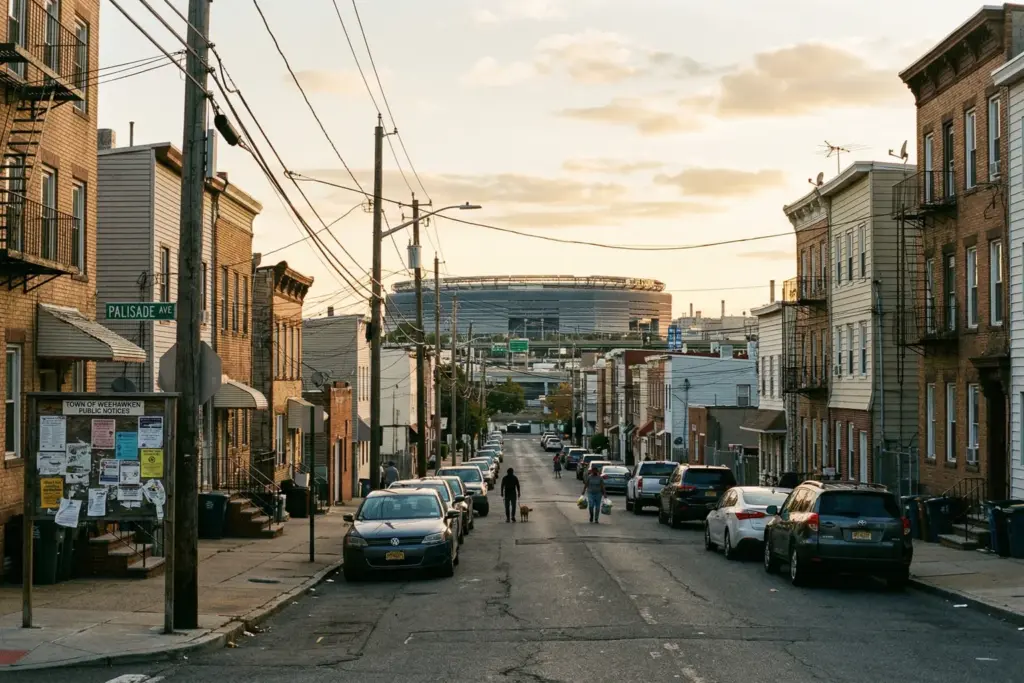
Kearny, New Jersey, a 40,000-person working-class suburb less than three miles from MetLife Stadium, voted on March 13, 2026 to ban short-term rentals in every type of residential property in town. The expansion closed the last remaining loophole in an ordinance that has been on the books since 2017. Multifamily buildings, two-family homes, and apartment complexes are now covered. The timing was not an accident.
“It causes such havoc in each individual neighborhood,” Mayor Carol Jean Doyle told the Hudson County View. “We had a big issue a couple of months ago, so the residents are quite concerned.”
The issue she is referencing is short-term rental activity surging in buildings like the Vermella development and the Lofts at Kearny, which were seeing 35 to 50 weekly listings on Airbnb and VRBO. Residents complained about noise, parking overflow, and strangers cycling through their hallways. The council decided to act before the World Cup turned that trickle into a flood.
MetLife Stadium will host eight FIFA World Cup matches this summer, including five group stage games, a Round of 32 match, a Round of 16 match, and the Final on July 19. Over one million soccer fans are expected to pass through the New York/New Jersey corridor between June 13 and July 19, 2026. That is a once-in-a-generation demand event for short-term rental operators in the area. And yet, some of the towns closest to the stadium are responding by tightening restrictions rather than relaxing them.
What the Kearny Ordinance Actually Does
The original 2017 ordinance prohibited short-term rentals (stays under 30 days) in single-family homes. Multifamily properties were not covered. Operators in apartment buildings and two-family homes technically operated in a gray area.
The March 2026 amendment eliminates that gray area entirely. Every residential dwelling in Kearny is now subject to the ban. The ordinance specifically targets properties that had become informal hotels, with the Vermella buildings singled out during council discussions.
The penalty structure is graduated and aggressive:
- First violation: Up to $750 per day until the violation is corrected, or up to 10 days in jail
- Second violation: Up to $1,200 per day, or up to 20 days in jail
- Third and subsequent violations: Up to $2,000 per day, or up to 30 days in jail
Enforcement works through complaints. Residents can report suspected STR activity by email or phone, and the town deploys building code officials, the health department, and law enforcement to investigate. The town has also stated it will notify platforms like Airbnb directly and pursue legal action against companies that continue to facilitate listings in violation of the ordinance.
Mayor Doyle framed the decision in blunt quality-of-life terms: “Can you imagine, you live next door, you have children, and you wake up to guitar playing, singing, laughing, and boisterous noise?”
Kearny Is Not Alone. The NJ Corridor Is Tightening.
Kearny’s expansion is part of a broader pattern across the New Jersey municipalities closest to MetLife Stadium. Data indicates that at least 75 New Jersey towns enforce some form of short-term rental restriction, and at least 10 of those fall within the ZIP codes Airbnb has been actively targeting with its $750 new-host incentive program.
Here is the current enforcement landscape in the MetLife Stadium corridor:
Towns with Complete or Near-Complete Bans
Kearny (Hudson County, less than 3 miles from MetLife): All residential STRs banned as of March 2026. Penalties up to $2,000/day plus jail time.
West New York (Hudson County): Prohibits short-term rentals outright. Located minutes from both MetLife Stadium and Manhattan.
Union City (Hudson County): Prohibits short-term rentals. Adjacent to West New York in the densely populated Hudson County corridor.
North Bergen (Hudson County): Approved a new ordinance in March 2026 limiting STRs to owner-occupied buildings with a 60-night annual cap. No more than two STR permits allowed per person or entity. Tenants are explicitly prohibited from operating short-term rentals.
Englewood (Bergen County): Complete ban on short-term rentals. Officials have warned they will pursue legal action against hosts and platforms that facilitate violations.
Edgewater (Bergen County): Bans STRs entirely. Officials describe the borough as an “urban bedroom community” that is incompatible with transient rental activity.
Towns with Restrictive Permitting
Jersey City (Hudson County): Not a ban, but the restrictions are substantial. Unhosted stays are capped at 60 nights per year. Rental arbitrage is prohibited. Hosts must carry $500,000 in liability insurance. Guests must be 21 or older. Annual permits are required for each unit.
Hoboken (Hudson County): Limits short-term rentals to owner-occupied properties in specific zoning districts. Investors and tenants cannot operate STRs.
Towns Where STRs Are Permitted (With Conditions)
Newark (Essex County): No blanket ban, but hosts must register annually with the city and obtain a Certificate of Habitability. Zoning compliance is required. Newark has been flagged as a likely beneficiary of World Cup demand spillover from NYC, where Local Law 18 has reduced Airbnb listings by roughly 90%.
Elizabeth (Union County): Allows licensed short-term rentals in designated zones. Mayor Christian Bollwage has described this approach as a “responsible middle ground.”
The Demand vs. Regulation Collision
The numbers tell a story of enormous missed opportunity for some towns and enormous potential risk for hosts who ignore the rules.
StaySTRA tracks 41 short-term rental markets across New Jersey. Our FIFA World Cup 2026 revenue analysis found that NYC’s Local Law 18 has pushed significant demand into the New Jersey corridor, particularly Jersey City and Newark. Hosts in NJ markets near MetLife are projected to earn substantially more during the tournament window than in any comparable period.
Airbnb is clearly betting on NJ demand. The company has rolled out a $750 incentive for new hosts in select New Jersey ZIP codes who complete a booking by July 31, 2026. But that incentive runs headfirst into the reality on the ground: many of those ZIP codes overlap with towns that ban STRs entirely.
This is the tension at the heart of the World Cup hosting story in New Jersey. The demand is real. The revenue potential is real. And for operators in towns like Kearny, West New York, or Englewood, the risk of fines, legal action, and even jail time is also very real.
Montclair, NJ has seen short-term rental rates climb 169% year over year according to market tracking data. The entire NJ corridor stands to benefit from the supply squeeze created by NYC’s restrictions. But municipalities are making a calculated choice: they would rather sacrifice that revenue than deal with the consequences of unrestricted short-term rental activity in residential neighborhoods.
Who Benefits and Who Loses
The accountability question here is straightforward, even if the answer is uncomfortable.
Who benefits from expanded bans? Long-term residents who do not want their neighbors replaced by rotating groups of World Cup tourists. Building owners who worry about liability and property damage in multifamily structures. Town councils that want to demonstrate responsiveness to constituent complaints.
Who loses? Homeowners who could earn thousands of dollars during a once-in-a-generation event. Small-scale operators who run legal, well-managed STRs and are being swept up in blanket restrictions designed to target bad actors. Visitors who will face inflated hotel prices in one of the most expensive metro areas in the country.
And then there are the platforms. Airbnb is simultaneously running new-host incentive programs in NJ ZIP codes where STRs are illegal. That is a disconnect that municipalities like Englewood have noticed, with officials explicitly warning they will pursue legal action against platforms that facilitate violations.
The broader pattern is clear. Cities near World Cup venues are not treating the tournament as a reason to loosen STR restrictions. If anything, the heightened scrutiny and media attention are providing political cover to expand enforcement and close loopholes. We saw this in NYC, where the city council flatly refused to suspend Local Law 18. We are seeing it now in Kearny and across Hudson County.
What Hosts in the NYC-Metro Area Should Do Right Now
If you operate or are considering operating a short-term rental anywhere in the New Jersey corridor near MetLife Stadium, here is what you need to know.
1. Verify your municipality’s specific rules. There is no statewide STR law in New Jersey. Everything is local. Check your town’s municipal code or contact the zoning office directly. Do not assume that because your neighboring town allows STRs, yours does too.
2. Do not rely on platform listings as proof of legality. Airbnb and VRBO will accept your listing even if your town bans short-term rentals. The platform’s new-host incentive program does not verify local compliance. If your town prohibits STRs and you list anyway, you bear the enforcement risk.
3. Understand the penalty exposure. In Kearny, fines start at $750 per day and escalate to $2,000 per day with potential jail time. Other towns have similar or more aggressive penalty structures. A week of World Cup bookings could generate a few thousand dollars in revenue and tens of thousands in fines.
4. Consider the 30-day workaround carefully. Most NJ STR bans define short-term rentals as stays under 30 days. Rentals of 30 days or longer generally fall outside these ordinances. Some operators are structuring month-long World Cup rentals to comply. This can work legally, but confirm with your municipality before assuming the threshold applies uniformly.
5. If you are in a permitted market, get compliant now. In towns like Newark and Elizabeth where STRs are allowed with permits, do not wait until June to register. Permit processing takes time, and enforcement agencies will be on high alert during the tournament.
6. Watch for additional restrictions. Kearny expanded its ban in March 2026. North Bergen passed its new restrictions the same month. Other Hudson County towns may follow before the tournament begins in June. Monitor your local council agendas.
We do our best to keep our reporting accurate and up to date, but situations evolve and we are only human. Always verify current details directly with local officials and sources before making decisions.
Frequently Asked Questions
Is my property covered by Kearny’s expanded short-term rental ban?
If your property is any type of residential dwelling in Kearny, including single-family homes, two-family homes, and multifamily apartment buildings, you cannot rent it for stays shorter than 30 days. The 2017 ordinance covered single-family homes; the March 2026 expansion closed the remaining gap for all other residential properties.
Can I appeal a short-term rental violation in Kearny?
The ordinance does not include a specific appeal process for citations. Violations are enforced through building code, health department, and law enforcement officials. If you receive a citation, you would need to consult with a local attorney about your options under New Jersey municipal law. The practical answer is that the town is actively enforcing and not signaling any flexibility.
What about towns neighboring Kearny? Do they allow short-term rentals?
Most do not, at least not without significant restrictions. West New York and Union City have outright bans. North Bergen limits STRs to owner-occupied buildings with a 60-night cap. Jersey City requires permits, $500,000 in liability insurance, and caps unhosted stays at 60 nights. Harrison and East Rutherford (where MetLife Stadium is located) should be verified directly with municipal offices, as regulations can change quickly in the lead-up to the World Cup.
What happens if I operate an illegal short-term rental during the World Cup?
In Kearny, first-time violators face fines up to $750 per day the violation continues, with potential jail time of up to 10 days. Second offenses escalate to $1,200 per day and 20 days. Third offenses reach $2,000 per day and 30 days. Other NJ towns with bans have similar enforcement tools. Englewood has specifically warned it will pursue legal action against both hosts and platforms during the World Cup period.
Where in New Jersey are short-term rentals still permitted near MetLife Stadium?
Newark allows STRs with annual registration and a Certificate of Habitability. Elizabeth permits licensed rentals in designated zones. Some smaller municipalities may not have addressed STRs in their municipal code, creating ambiguity. If you are looking for permitted markets, focus on towns with explicit permitting frameworks and get your paperwork in order well before June 2026.
Does a 30-day rental avoid these bans?
Generally, yes. Most NJ ordinances define short-term rentals as stays under 30 consecutive days. A month-long rental during the World Cup window (June 13 to July 19) would typically fall outside the restriction. However, confirm the specific threshold and any additional rules with your municipality, as definitions vary and some towns have begun exploring longer minimum-stay requirements.
The Bottom Line for NJ Hosts
The 2026 FIFA World Cup will bring unprecedented short-term rental demand to the New Jersey corridor around MetLife Stadium. The revenue potential is significant. But the regulatory environment is moving in the opposite direction from what many hosts expected.
Kearny’s decision to expand its ban less than three months before the tournament is a signal, not an anomaly. Multiple Hudson County towns have tightened restrictions in early 2026. The political calculus is clear: for many NJ municipalities, protecting residential neighborhoods from the disruption of unregulated short-term rentals outweighs the economic upside of World Cup tourism.
For operators, this means due diligence is not optional. Check your local rules. Get permitted where possible. And do not assume that the biggest STR demand event in a generation is an invitation to ignore the law.
For a deeper look at how NYC’s approach compares, read our analysis of New York City’s refusal to loosen Local Law 18 for the World Cup. For market-by-market revenue projections, see our FIFA World Cup 2026 STR revenue data.
Want to know how your market stacks up? Explore StaySTRA’s New Jersey market data covering 41 cities across the state.
Become a StaySTRA Insider
Join free — get our newsletter + 1 free property analysis/month.
No spam. Unsubscribe anytime. Free membership includes property analyses and market insights.
Sponsored — OfferMarket
Buy Your First STR With Long-Term Rental Financing
Flexible, long-term financing for short-term rental buyers. Rates from 5.75%. Instant online quote, no credit pull.
Explore RTL Financing Options →Affiliate disclosure: StaySTRA may earn a referral fee.