

Key Takeaways
- Long-tenured mountain town STR hosts in Telluride, Steamboat Springs, and Vail have built entire lifestyles around short term rental hosting, but the 2025-2026 ski season tested even the most experienced operators.
- Ski season (December through March) generates 60 to 65 percent of annual revenue for most Colorado mountain hosts, making shoulder season survival a defining skill.
- Regulatory shifts, lodging tax diversion ($256 million redirected across 39 Colorado communities since 2022), and platform fee increases are squeezing margins for hosts who once operated with comfortable cushion.
- The hosts who stay and thrive share common traits: deep community roots, diversified booking strategies, and a genuine love for the place that goes beyond the spreadsheet.
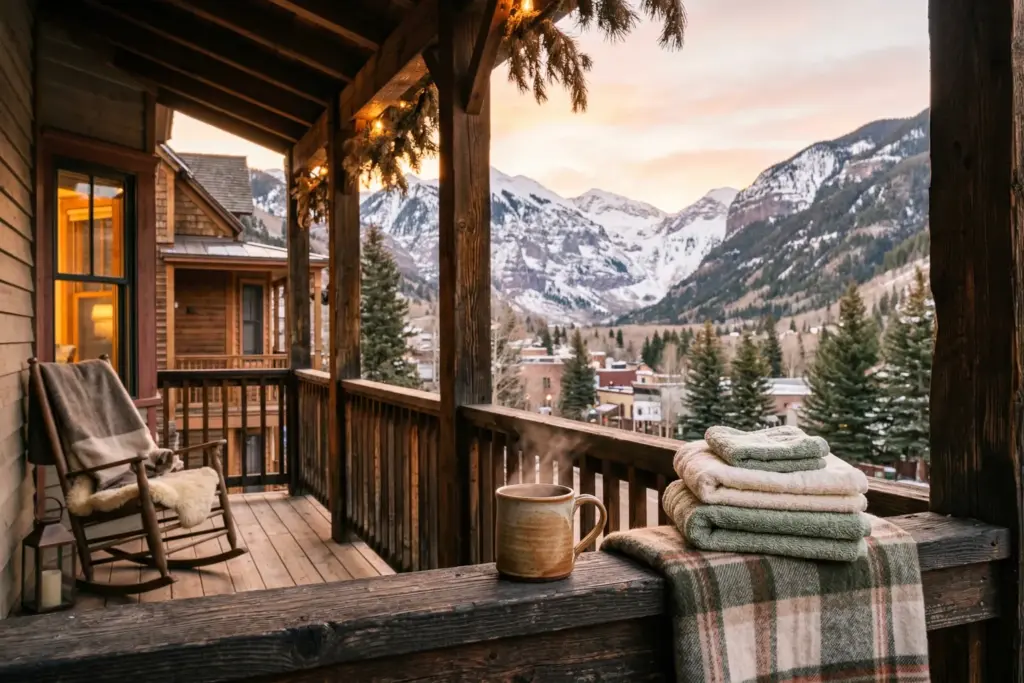
On a Tuesday morning in late March, the town of Telluride was still dark at 6:15 a.m. A woman we will call Sofia was already awake, coffee in hand, scrolling through her phone in the kitchen of a Victorian she has owned for eleven years. Two guests from Dallas were sleeping upstairs. A family from Chicago had just checked out the night before. Sofia’s cleaning crew was arriving in forty-five minutes, and the next guests, a couple celebrating their anniversary, would walk through the door by 3 p.m.
This is what short term rental hosting in a mountain town actually looks like. Not the glossy brochure version. Not the “passive income” pitch. The real thing, lived by the people who have built their days, their finances, and their communities around welcoming strangers into their homes at 8,750 feet.
I spent weeks talking with hosts across Telluride, Steamboat Springs, Vail, and Aspen for this story. Some have been doing this for over a decade. Others started five or six years ago and cannot imagine going back. Their names have been changed or composited for privacy, but their experiences are real. And what they told me paints a picture of a lifestyle that is equal parts rewarding, exhausting, and uncertain.
What Drew Them to the Mountains (and Kept Them There)
Let’s call him Marco. He moved to Steamboat Springs from Denver in 2014, originally to ski. He worked as a restaurant manager, saved money, and bought a two-bedroom condo near the base area in 2016. “I listed it on Airbnb because I needed help with the mortgage,” he told me. “Within two years, the rental income was covering everything, and I had moved into a smaller place down the road.”
Marco now manages three properties in Steamboat. He is a Superhost with over 400 reviews. He knows every plumber, every locksmith, and every housekeeper within a thirty-minute radius. His life revolves around the rhythm of the mountain: December through March is a sprint, summer brings a second wind, and the shoulder seasons are when he catches his breath, fixes what broke during peak, and wonders if this is the year he finally takes a real vacation.
His story is not unusual. Across Colorado’s mountain resort communities, a generation of hosts has built a working life around STR hosting that looks nothing like what the investment podcasts describe. These are not absentee owners running numbers from a laptop in Miami. They live in the towns they host in. They coach youth hockey, serve on planning commissions, and shop at the same grocery store as their neighbors.
“La montaña te escoge a ti,” Sofia told me with a laugh. The mountain chooses you. She came to Telluride in 2011 from Durango, where her parents had run a small motel for decades. Hospitality is in her blood, and the transition to STR hosting felt natural. “My parents taught me that every guest is a story. You treat them like family, and the reviews take care of themselves.”
The Seasonality Dance
If you host in a mountain town, your year has a shape that is unlike almost any other STR market in the country. StaySTRA data for Steamboat Springs shows that ski season accounts for roughly 62 percent of annual revenue. In Vail, that number is similar, with December through March generating about 62 percent of the year’s bookings. The peak month across most of these markets is February, when occupancy in Steamboat can hit 91 percent and average daily rates climb past $600.
Then comes the cliff.
By May, Steamboat occupancy drops to around 19 percent. Monthly revenue falls from nearly $12,000 in February to roughly $1,500. Vail’s shoulder season sees occupancy dip to about 50 percent, and smaller operators, the ones without a deep marketing playbook, sometimes go weeks without a single booking.
A host we will call David has run a four-bedroom chalet near Vail Village for nine years. He described the seasonality this way: “You make your year in about 100 days. The other 265 days, you are either preparing for those 100 days or recovering from them.”
Summer has become the second peak for savvy mountain hosts. Hiking, mountain biking, festivals, and fly fishing have turned June through August into a genuine revenue season. But it is still only about 20 to 25 percent of the annual total. The real gap is April to May and October to November, when the lifts are closed, the trails are muddy, and the town feels like it belongs only to the people who actually live there.
“Those shoulder weeks are when I remember why I love this place,” Marco told me. “No guests. No turnover texts at midnight. Just the river and the quiet. But you also watch your bank account and do the math.”
What the Numbers Look Like Up Close
The hosts I spoke with were remarkably transparent about their finances, and the numbers track closely with what StaySTRA’s market data shows.
In Telluride, the average daily rate sits at $663, the highest of any Colorado mountain market. But occupancy is just 37.5 percent, and the median annual revenue comes to about $62,379. Sofia confirmed that range. “People see the nightly rate and think we are printing money,” she said. “But after cleaning, maintenance, insurance, the license, and the lodging tax, you are looking at something much more modest.”
Steamboat offers a different equation. The ADR is lower ($392), but occupancy is significantly higher at 54.6 percent, producing roughly $54,648 in annual revenue across 3,747 active listings. Marco called it “the volume play.” You will not charge Telluride rates, but your calendar stays fuller.
Vail lands somewhere in between: $563 ADR, 47.1 percent occupancy, 3,377 listings. The guest profile skews affluent, with a median household income around $100,000, and stays average four to five nights during peak periods. David noted that his best months generate more than his old salary in Denver, but his worst months generate almost nothing.
For context on the broader Colorado mountain STR landscape, Jed Collins’ market-by-market guide to Colorado STR laws covers the regulatory framework that shapes what hosts can and cannot do across these towns.
What Keeps Mountain Hosts Up at Night
Every host I talked to mentioned regulations within the first five minutes. The anxiety is real, and it is not abstract.
In Telluride, the two-tier licensing system separates hosts into residential zone operators (capped at 29 rental days per year) and Classic License holders who can operate without day limits. That cap means a residential zone host in Telluride simply cannot build a full-time STR business. Sofia holds a Classic License, but she watches the political winds closely. “Every election, someone talks about tightening the rules. You never know if next year your license will still work the same way.”
Steamboat Springs implemented a three-zone overlay system: green zones allow unlimited STR units, yellow zones are capped, and red zones prohibit new permits entirely. Recent enforcement actions left some longtime operators feeling “blindsided,” according to local reporting from the Steamboat Pilot. The city council has agreed to revisit the policy, but the uncertainty lingers.
In Vail, voters rejected a proposed 6 percent STR excise tax by just 35 votes in November 2025. A proposed $1,200-per-bedroom housing fee remains on the table but has been delayed. “Thirty-five votes,” David repeated when I brought it up. “That is how close we were to a completely different business model.”
And then there is the tax diversion issue that affects hosts across all of these towns. Since 2022, thirty-nine Colorado communities have redirected $256 million in lodging tax revenue away from tourism marketing and toward housing, childcare, and infrastructure, enabled by House Bill 1117. The Colorado Sun reported that an additional $76.9 million is projected for 2026. Mountain hosts are paying record lodging taxes, and none of that money is going back into the tourism infrastructure that fills their calendars.
“We are funding the town’s housing plan,” Marco said, not with bitterness, but with the resignation of someone who has accepted the trade-off. “I get it. The town needs workforce housing. But it stings when occupancy drops and nobody is marketing Steamboat to the people who would book my place.”
The 2025-2026 Ski Season That Tested Everyone
This past winter was brutal. Colorado ski resort bookings fell across the board, with Telluride’s February occupancy dropping 19 points year over year (from 57 percent to 38 percent), Breckenridge falling 17 points, and even Vail seeing a 5 percent decline. Tourism officials in Steamboat described it as “the biggest anomaly year for visitation since the pandemic.”
Sofia called it “a season that reminded me this is not a guaranteed paycheck.” David used a different word: humbling. Marco, ever the pragmatist, said he saw it coming in his booking window data by October and adjusted his pricing early. “The hosts who held firm on their rates had empty calendars in January. I dropped mine 15 percent and stayed booked. Not ideal, but booked.”
The soft season has reinforced what long-tenured mountain hosts already knew: this lifestyle demands flexibility. The ones who survive bad winters are the ones who built cushion during good ones. “Yo siempre digo, hay que guardar para el invierno que no llega,” Sofia said. You always have to save for the winter that does not come.
The Guests They Remember
I asked every host the same question: tell me about a guest who stayed with you. The answers were immediate and vivid.
Sofia remembered a couple from New Mexico who came to Telluride for their 50th wedding anniversary. “They left a card on the kitchen counter that said, ‘This house felt like coming home.’ I still have it.”
Marco told me about a single father who brought his two kids to Steamboat for their first ski trip. “The youngest had never seen snow. He sent me a photo three months later of the kid wearing the same ski goggles at school. That is why I do this.”
David recalled a group of college friends who rented his Vail chalet every February for seven consecutive years. “They are part of the story of this house now. They know where the extra blankets are. They bring their own coffee. I have watched their kids grow up through booking messages.”
These are not transactional relationships. The best mountain hosts build something that looks more like extended family than a hotel operation. Bienvenidos a casa. Welcome home.
What Aspiring Mountain Hosts Should Know
If you are reading this and thinking about hosting in a mountain town, the people who have been doing it longest want you to know a few things.
First, live there. Every host I spoke with emphasized that the best mountain STR operators are the ones who are embedded in the community. “If you are managing from sea level, you are missing half the picture,” David said. “You need to know when the roads ice, which handyman actually answers the phone on a Saturday, and what your neighbors think about your guests’ parking.”
Second, understand the seasonality before you buy. The gap between February revenue and May revenue in Steamboat is more than $10,000 per month. If your mortgage depends on year-round occupancy, a mountain market may not be the right fit. (If you want the full data picture, start with the Telluride, Steamboat Springs, Aspen, and Vail market reports.)
Third, know the regulations cold. Licensing requirements, zone restrictions, day caps, lodging taxes. These vary by town and change often. A good starting point is the Colorado STR laws guide published here on StaySTRA.
And fourth, do it because you love the place. Not the spreadsheet, not the projected returns, but the place itself. The hosts who last in mountain towns are the ones who would live there even if they never listed a single night on Airbnb.
For stories of hosts who started from scratch and built their STR business step by step, check out From Skeptic to Superhost.
We do our best to keep our content accurate and up to date, but things change and we are only human. Always verify details directly with local sources before making decisions.
Frequently Asked Questions
How much do short term rental hosts make in Colorado mountain towns?
Annual revenue varies significantly by market. StaySTRA data shows Telluride hosts averaging about $62,379 per year at $663 ADR with 37.5 percent occupancy. Steamboat Springs averages $54,648 at $392 ADR with 54.6 percent occupancy. Vail falls between the two. These are gross figures before operating expenses, which typically run 25 to 40 percent of revenue.
What percentage of mountain STR revenue comes from ski season?
In most Colorado mountain markets, ski season (December through March) generates 60 to 65 percent of total annual revenue. Summer contributes about 20 to 25 percent, and the shoulder seasons (April to May and October to November) account for the remaining 15 percent or less. February is typically the single highest-revenue month.
What are the biggest challenges for mountain town STR hosts in 2026?
The three most-cited challenges are regulatory uncertainty (zone restrictions, day caps, and proposed new fees), lodging tax diversion ($256 million redirected across 39 Colorado communities since 2022), and a soft 2025-2026 ski season that reduced occupancy by 5 to 19 percentage points depending on the market.
Do you need to live in the mountain town to be a successful STR host?
Experienced mountain hosts overwhelmingly recommend living locally or having a trusted local partner. Mountain properties face unique challenges including extreme weather, rapid turnovers during peak season, and regulatory environments that change frequently. A required local contact person (within one hour response time in Vail, for example) is common across Colorado mountain towns.
How do mountain STR hosts manage the shoulder season revenue gap?
Common strategies include dropping rates significantly during April to May and October to November, targeting niche travelers (hunters, fall foliage seekers, remote workers), offering mid-week discounts, and using the downtime for property maintenance and upgrades. Some hosts also take personal vacations during shoulder season to avoid the temptation of chasing low-margin bookings.
Start Your Mountain Market Research
If you are exploring short term rental hosting in a mountain town, the first step is understanding the market you are considering. StaySTRA publishes detailed market data for Telluride, Steamboat Springs, Aspen, Vail, and dozens of other mountain markets.
For weekly insights on STR markets, host strategies, and the stories behind the data, join the StaySTRA community.
Become a StaySTRA Insider
Join free — get our newsletter + 1 free property analysis/month.
No spam. Unsubscribe anytime. Free membership includes property analyses and market insights.
Sponsored — OfferMarket
Buy Your First STR With Long-Term Rental Financing
Flexible, long-term financing for short-term rental buyers. Rates from 5.75%. Instant online quote, no credit pull.
Explore RTL Financing Options →Affiliate disclosure: StaySTRA may earn a referral fee.