

Key Takeaways
- Miami Beach and the City of Miami are separate jurisdictions with completely different STR rules. What is legal in one may be illegal in the other.
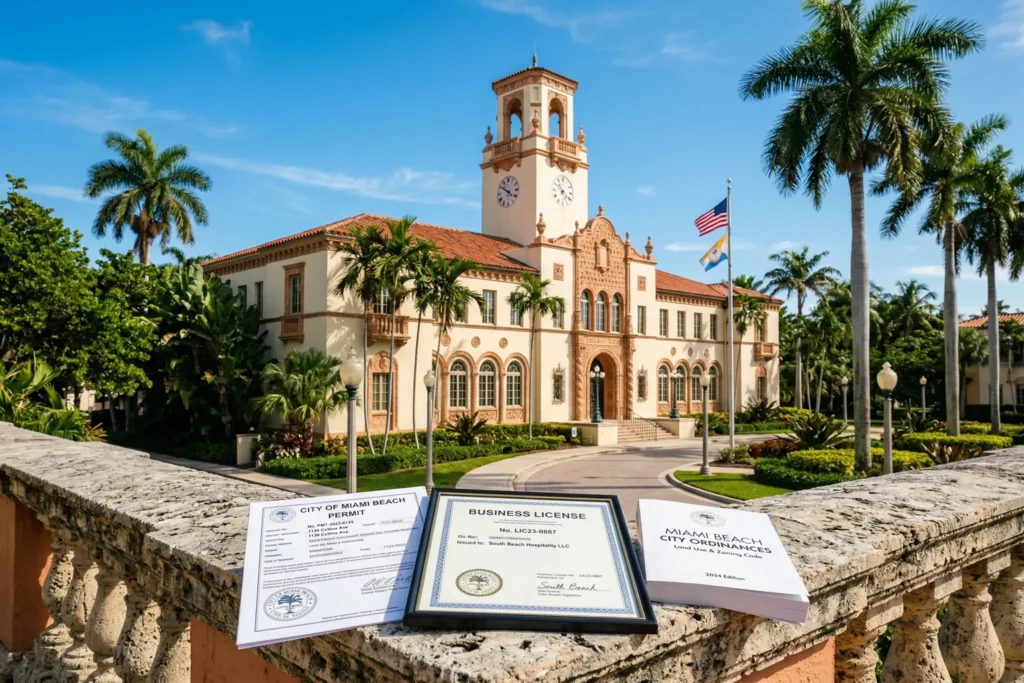
- Miami Beach requires four separate licenses or permits to operate legally, and fines for operating without authorization can reach $1,000 per day for a first offense and $5,000 per day for repeat violations under current enforceable state caps.
- Florida’s state preemption law (F.S. 509.032) bars cities from prohibiting vacation rentals or regulating their duration/frequency if enacted after June 1, 2011, but does not restrict local licensing, noise, parking, safety, or tax rules. Miami Beach’s restrictions predate that cutoff and remain fully enforceable.
- Hosts in Miami-Dade County must obtain a Certificate of Use from the county before listing on any platform, regardless of which city they are in.
- HOA and condo association rules are not preempted by state law. A building prohibition on short-term rentals is binding even when local zoning would otherwise permit one.
Picture this: You purchase a condo in Miami Beach with visions of Airbnb income dancing in your head. The location is perfect. The decor is impeccable. The listing goes live. Forty-eight hours later, you receive a notice from the City of Miami Beach informing you that the fine for your first offense is $20,000. Not $200. Not $2,000. Twenty thousand dollars.
I have reviewed more municipal codes than most people have read terms of service agreements, and the Miami metropolitan area is genuinely in a class by itself when it comes to short-term rental complexity. You are not dealing with one set of rules. You are dealing with at least four overlapping regulatory layers, two completely separate municipal governments, a county framework, and a state preemption law that is frequently misunderstood by hosts who assume it protects them from exactly the rules that are about to make their life difficult.
This guide is for hosts, prospective investors, and anyone who has ever looked at a Miami Beach condo listing and thought, “The numbers look great. What could go wrong?” Let us work through the answer systematically.
First: Miami and Miami Beach Are Not the Same Place
This distinction matters more here than almost anywhere else in Florida. The City of Miami and the City of Miami Beach are two entirely separate municipalities with their own city commissions, their own zoning codes, and their own enforcement regimes. Miami Beach is a barrier island connected to Miami by causeways. It is not a neighborhood of Miami. It is its own city.
Why does this matter? Because the STR rules are dramatically different. A regulatory approach that works in one jurisdiction will not simply transfer to the other. According to StaySTRA’s market data, Miami Beach has approximately 3,175 active short-term rental listings with an average daily rate of $199 and average monthly revenue of around $3,570. The City of Miami, by contrast, shows roughly 126 active listings with an ADR of $249 and average monthly revenue of $3,248. The gap in listing counts tells you something important: Miami Beach, despite being far smaller geographically, has a much larger STR market. It also has rules designed to contain it.
Florida State Preemption: What It Does and Does Not Do
Before diving into local rules, let us address the Florida preemption argument, because it comes up constantly and is regularly misapplied.
Florida Statute 509.032(7)(b) specifically bars local governments from (a) prohibiting vacation rentals outright and (b) regulating the duration or frequency of vacation rentals, unless those ordinances were already in place on or before June 1, 2011. Critically, the preemption does not prevent local governments from regulating licensing, noise, parking, safety, occupancy limits, or tax collection. The practical intent was to prevent a new wave of post-Airbnb prohibitions from sweeping through municipalities across the state, while still allowing reasonable operational regulation.
The June 1, 2011 grandfather clause is key: any local ordinance adopted on or before that date is exempt from the preemption entirely. This is precisely why Miami Beach can enforce its residential STR restrictions, including zone-based prohibitions and minimum stay requirements, that would otherwise conflict with the statute.
Here is the part hosts sometimes miss: Miami Beach’s residential short-term rental restrictions predate 2011. They are grandfathered under the statute and remain fully enforceable. The preemption does not rescue you from Miami Beach’s rules. A 2024 bill that would have expanded statewide standardization was vetoed, leaving the existing framework unchanged. As of March 2026, Miami Beach’s local authority over residential STRs is intact and actively exercised.
What the state preemption does accomplish is preventing cities that did not have STR restrictions before June 2011 from suddenly banning them altogether or limiting how often or how long guests can stay. Local governments without grandfathered ordinances can still regulate operational aspects including licensing, inspections, noise, parking, occupancy, safety, and tax collection. They just cannot prohibit the activity outright or restrict duration and frequency in markets where no pre-2011 restriction exists.
In addition to the preemption question, Florida requires all STR operators statewide to obtain a Vacation Rental Dwelling License from the Department of Business and Professional Regulation (DBPR) under Chapter 509, Florida Statutes. The annual fee is approximately $170, plus a $50 application fee. This is the baseline. Everything else is on top of it.
Miami-Dade County: The Layer Under Every Listing
Regardless of which city your property is in, Miami-Dade County imposes its own registration requirement on top of any city rules.
The county’s primary requirement is a Certificate of Use (CU). You must obtain one before listing your property on any short-term rental platform. The initial cost is approximately $136.17, covering the CU application, property inspection, and associated surcharges. Annual renewal runs approximately $136.17 as well, and a new inspection is required each year. The Miami-Dade County short-term vacation rental page outlines the current requirements and application process.
County operational requirements include maintaining a guest register with names and stay dates (retained for two years and available for county inspection), liability insurance coverage, and occupancy limits of two persons per bedroom plus two additional persons, with an absolute maximum of 12, excluding children under three. Hosts must also screen guests against the sexual offender registry. Pool safety features are required if children under six will be present. A 24/7 responsible party contact who can respond within one hour and is located within 30 minutes of the property is mandatory.
In Estate and Low Density Residential zoning areas, the property’s responsible party must reside on-site for more than six months annually. That requirement effectively limits those zones to owner-operators.
Operating without a CU carries escalating penalties: $100 for a first violation, $1,000 for a second violation within 24 months, and $2,500 for a third or subsequent violation. Unpaid fines can result in liens against the property.
The City of Miami: Zoning Drives Everything
The City of Miami operates under Miami 21, a transect-based zoning code. Short-term rental and lodging uses are permitted only in specific transect zones.
Without getting lost in the alphanumeric weeds: lodging is permitted by right in T4-L/O, T5-L/O, T6-L/O, CI-HD, and D1 zones. It requires a warrant in T4-R zones, and a special exception in T5-R and T6-R zones. Most standard residential areas do not permit non-owner-occupied STRs at all.
If your property is in a permissible zone, the City of Miami requires a Certificate of Use, a Business Tax Receipt, and building approval for lodging use (which may involve a change-of-use review). The fine for operating an illegal STR in the City of Miami can reach $20,000 per violation.
The practical upshot: if you are looking at a single-family home or apartment in a residential Miami neighborhood, verify zoning before you do anything else. The City of Miami’s Planning and Zoning department can confirm what your property’s transect zone permits.
Miami Beach: Where the Rules Get Serious
Miami Beach deserves its own extended discussion because it is where most of the high-profile enforcement actions occur and where the fines are genuinely life-altering in their magnitude.
Where STRs Are and Are Not Permitted
The short version: short-term rentals are prohibited in most of Miami Beach’s residential zoning districts. The prohibited zones include RM-1, RM-PRD, RM-PRD-2, RPS-1, RPS-2, CD-1, RO, RO-3, and TH. Single-family residential zones are also off-limits. In these areas, the minimum rental period is six months and one day. Not a typo. Six months and one day. Anything shorter is illegal regardless of how many licenses you hold.
Short-term rentals are permitted in commercial mixed-use (CMU) zones, higher-density residential zones (RM-2 and RM-3), the Entertainment District, and the North Beach Town Center area. North Beach carries its own additional wrinkle: a minimum seven-night stay applies for entire-home rentals, and the Certificate of Use application fee there is $1,000.
Before you do anything else, verify your specific property’s zoning district with Miami Beach’s Planning and Zoning department (305-673-7550). Do not assume that because your building advertises itself as “vacation-friendly” the underlying zoning supports short-term rentals. The gap between marketing and municipal code is exactly where $20,000 fines are born.
The Four-License Stack
If your property is in a permitted zone, operating legally in Miami Beach requires four separate credentials:
- Florida DBPR Vacation Rental Dwelling License (state level)
- Business Tax Receipt (BTR) from the City of Miami Beach
- Resort Tax Registration Certificate from Miami Beach
- Miami-Dade County Certificate of Use
The Miami Beach portion of this stack runs approximately $196.50 in fees (covering the BTR application, fire inspection fee, and resort tax application). The county CU adds roughly $136.17 for the initial application. And you need the DBPR license underneath all of that. The Miami Beach short-term rental requirements page provides current documentation requirements and contact numbers for pre-application verification.
You must also submit an Operational Management Plan to the city, addressing how you will handle noise and waste management. This is not a formality. It is a document the city will reference if complaints arise.
The Fine Structure
Miami Beach’s penalty schedule for operating without proper authorization is designed to make illegal operation economically catastrophic:
Miami Beach originally imposed fines of $20,000 for a first offense, $40,000 for a second, and $60,000 for a third. However, a Florida appellate court ruled in Nichols v. City of Miami Beach that these amounts exceed state statutory caps under Florida Statute 162.09. The current enforceable penalties are:
- First offense: up to $1,000 per day
- Repeat violations: up to $5,000 per day
Each violation increases by $20,000. One substantiated complaint can trigger license revocation. The city enforces proactively through data mining (scanning platforms for unlicensed listings) rather than relying solely on neighbor complaints. Guests can verify whether a property is properly permitted through the city’s Practice Safe Renting tool, and the city has worked with Airbnb and other platforms to delist properties that cannot produce valid permit numbers.
Enforcement proceedings where the city has documented platform listing history, permit check records, and complaint logs are not generally cases where hosts fare well on appeal. The evidentiary record Miami Beach accumulates tends to be thorough.
Taxes: The Multi-Layer Math
Every short-term rental booking in Miami Beach generates tax obligations at three levels. Florida state sales tax runs 6%. Miami-Dade County also levies a 1% discretionary sales surtax. Miami-Dade’s Convention Development Tax adds 3% at the county level (applicable throughout most of the county). The City of Miami Beach Resort Tax adds another 4% on all transient rentals of six months or less. Add those together and you are looking at approximately 14% in combined taxes (6% state + 1% discretionary surtax + 3% CDT + 4% resort tax).
Hosts must register a Resort Tax account with Miami Beach’s Finance Department and a separate tourist tax account with the county. These are different filings with different agencies on different schedules. Platforms like Airbnb and VRBO collect and remit certain taxes on hosts’ behalf in Florida, but you remain responsible for verifying that the correct amounts are being remitted and that your registration with each taxing authority is current. “The platform handles it” is not a defense that tends to satisfy tax collectors.
In the City of Miami outside Miami Beach, the city-level resort tax does not apply, but state and county taxes still do. Registration with the Florida Department of Revenue and the Miami-Dade Tax Collector is required regardless of which city you are in.
The HOA and Condo Layer
Florida’s state preemption law does not override condominium association declarations or HOA covenants. Full stop. This is the point where well-intentioned hosts make expensive mistakes.
Most Miami-area condominium associations prohibit short-term rentals outright, or impose minimum rental periods of 30, 90, or 180 days. Even if your property sits in a permissible zoning district and you have every required license, your condo association can independently prohibit the activity. Violating that prohibition exposes you to association fines (typically $100 to $1,000 or more per day), potential legal action, and in persistent cases, foreclosure proceedings.
If you are purchasing a Miami or Miami Beach condo with STR income in mind, read the full declaration, all amendments, and any current association rules before you close. Do not rely on a seller’s representation that rentals are allowed. Get written confirmation from the association management company specifying what rental durations are permitted. Miami-Dade County’s Certificate of Use application actually requires written HOA or condo association authorization, so the association check is not optional from a county compliance standpoint either.
Noise and Nuisance Enforcement
Even hosts operating in permitted zones with all four Miami Beach licenses in hand face ongoing compliance obligations around noise and nuisance. The Operational Management Plan requirement means the city expects hosts to have addressed guest behavior expectations before problems arise.
Noise complaints are among the most common triggers for code enforcement referrals in both Miami and Miami Beach. Violations can result in fines and license revocation. Post house rules prominently, provide a 24/7 contact number that someone actually answers, and respond to complaints promptly. One documented failure to address a noise issue can become part of the city’s enforcement file for your property.
The Compliance Checklist Before You List
If you are operating or considering a short-term rental in the Miami area, work through these steps before your listing goes live:
- Verify your property’s zoning district and confirm STRs are permitted at that classification
- Review your condo declaration or HOA governing documents for rental restrictions
- Obtain a Florida DBPR Vacation Rental Dwelling License
- Apply for a Miami-Dade County Certificate of Use (bring proof of DBPR license and insurance)
- If in Miami Beach: obtain a Business Tax Receipt and Resort Tax Registration Certificate from the city, and submit an Operational Management Plan
- If in City of Miami: obtain a Certificate of Use and Business Tax Receipt from the city
- Register with Miami Beach Finance Department for resort tax remittance (Miami Beach only)
- Register with Miami-Dade Tax Collector for the Convention Development Tax
- Register with the Florida Department of Revenue for state sales tax
- Display all license and permit numbers on every listing and within the property
- Establish a 24/7 local contact person who can respond to complaints within one hour
That is eleven steps before your first guest checks in. I mention this not to discourage anyone from entering the Miami STR market, but because treating any of these as optional tends to end in code enforcement proceedings that are expensive and largely avoidable.
This article provides general information and should not be construed as legal advice. Consult a qualified attorney in your jurisdiction for advice specific to your situation.
We do our best to keep our regulatory guides accurate and up to date, but ordinances change and we are only human. Always verify current requirements directly with your local municipality before making business decisions.
Frequently Asked Questions
Can I legally rent my Miami Beach condo on Airbnb?
It depends entirely on your property’s zoning district and your condo association’s governing documents. Short-term rentals are prohibited in most Miami Beach residential zones, where the minimum rental period is six months and one day. Even in permitted zones, your condo association may independently prohibit STRs. Verify your zoning classification with Miami Beach’s Planning and Zoning department before listing, and confirm rental permissions in writing with your association management company.
What is the fine for an illegal short-term rental in Miami Beach?
Miami Beach originally imposed fines of $20,000 for a first offense, $40,000 for a second, and $60,000 for a third. However, a Florida appellate court ruled in Nichols v. City of Miami Beach that these amounts exceeded state statutory caps under Florida Statute 162.09. The current enforceable penalties are up to $1,000 per day for a first offense and $5,000 per day for repeat violations. The city enforces proactively through platform data mining rather than waiting for neighbor complaints, and a single substantiated violation can also trigger license revocation.
Does Florida’s preemption law protect me from Miami Beach’s STR restrictions?
No. Florida Statute 509.032(7)(b) specifically bars local governments from prohibiting vacation rentals or regulating their duration and frequency, but only for ordinances enacted after June 1, 2011. Miami Beach’s residential rental restrictions predate that cutoff and are grandfathered as fully enforceable law. The preemption also does not prevent any city from regulating licensing, noise, parking, safety, occupancy, or tax collection. A broader preemption bill that would have expanded statewide uniformity was vetoed in 2024, leaving Miami Beach’s authority over residential STRs fully intact as of 2026.
How many permits do I need to operate a short-term rental in Miami Beach?
Four. You need a Florida DBPR Vacation Rental Dwelling License (state), a Business Tax Receipt from Miami Beach (city), a Resort Tax Registration Certificate from Miami Beach (city), and a Certificate of Use from Miami-Dade County. Each requires separate applications, fees, and in some cases inspections. Operating without any one of these exposes you to the city’s $20,000 starting fine.
What taxes do short-term rental hosts in Miami Beach owe?
Hosts in Miami Beach owe Florida state sales tax (6%), Miami-Dade’s 1% discretionary sales surtax, Miami-Dade’s Convention Development Tax (3%), and Miami Beach’s Resort Tax (4%), for a combined rate of approximately 14%. All three require separate registration with different agencies: the Florida Department of Revenue, the Miami-Dade Tax Collector, and Miami Beach’s Finance Department respectively. Platforms may remit some taxes on your behalf, but verifying correct remittance and maintaining your own registrations remains your responsibility.
Run the Numbers for Miami Beach
Curious what a compliant short-term rental in Miami Beach could realistically earn? Our free Miami Beach Airbnb Calculator pulls real market data so you can estimate revenue, occupancy rates, and expenses before you commit. For a deeper look at the Miami Beach STR market including active rental counts, average daily rates, and neighborhood-level data, check out our Miami Beach market profile.
Evaluating the City of Miami instead? Our Miami Airbnb Calculator and Miami market profile offer current data for that market as well.
Stay in the Loop
STR regulations change. Tax rates shift. New ordinances pop up with little warning. Join the StaySTRA Insider newsletter and we will keep you updated on the regulatory changes that matter to Florida hosts.
Become a StaySTRA Insider
Join free — get our newsletter + 1 free property analysis/month.
No spam. Unsubscribe anytime. Free membership includes property analyses and market insights.