

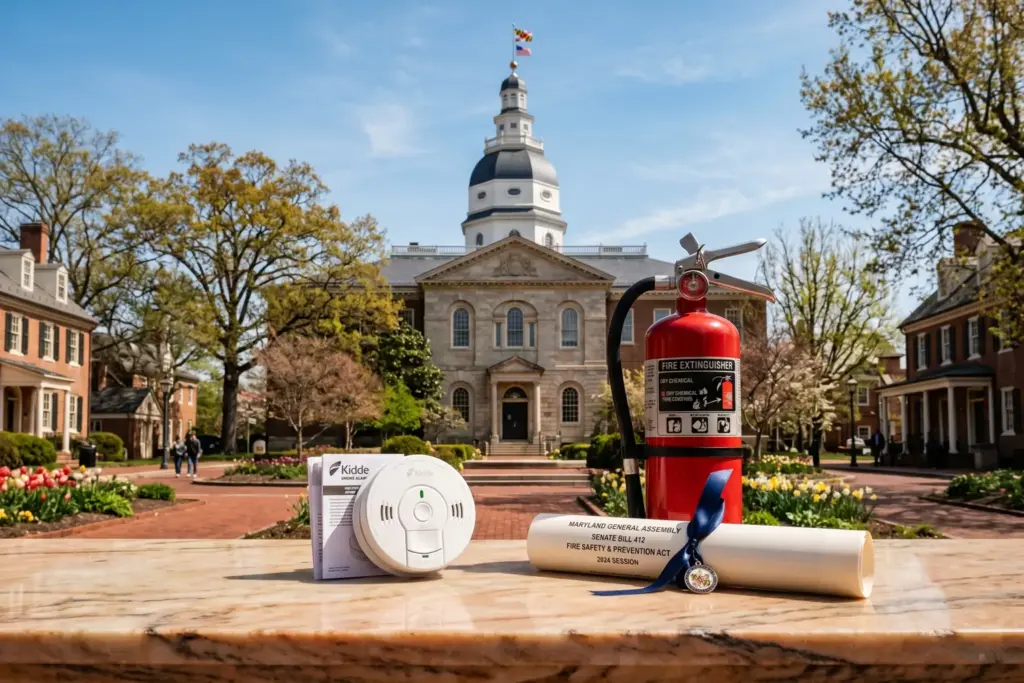
Key Takeaways
- Maryland’s Jillian and Lindsay Wiener Short-Term Rental Safety Act (HB 1221/SB 624), signed into law on April 14, 2026, makes Maryland the first state in the nation to mandate baseline fire safety equipment in all short-term rentals.
- Every STR in Maryland must have working smoke alarms, carbon monoxide detectors, fire extinguishers, posted evacuation diagrams, and emergency contact information by October 1, 2026.
- By July 1, 2028, every Maryland county and Baltimore City must establish annual inspection requirements for all STR units in their jurisdiction.
- The law covers any property rented for fewer than 30 consecutive days, including single-family homes, condos, apartments, and co-ops.
- Noncompliance is a misdemeanor under Maryland law.
On August 3, 2022, at roughly 3:30 in the morning, a fire broke out in a vacation rental in Noyac, on Long Island. Jillian Wiener, 21, and Lindsay Wiener, 19, were asleep on the second floor. Their parents woke to the sound of shattering glass and screamed for their children to get out. The parents escaped. Their brother jumped from a second-story window. Jillian and Lindsay never made it out.
The rental had been advertised online as having smoke and carbon monoxide detectors. None of them functioned. Investigators later documented dozens of code violations at the property, including disconnected smoke detectors, overloaded electrical circuits, and an outdoor kitchen built without permits. The property owners, Peter and Pamela Miller, eventually pleaded guilty to criminally negligent homicide and reckless endangerment, respectively.
The Wiener sisters grew up in Potomac, Maryland, in Montgomery County. Their mother, Alisa Wiener, took their story to the Maryland General Assembly. On April 14, 2026, Governor Wes Moore signed the Jillian and Lindsay Wiener Short-Term Rental Safety Act into law, making Maryland the first state in the nation to mandate baseline fire safety equipment in every short-term rental within its borders. “We’re telling every family that has ever lost someone and turned their grief into action,” Moore said at the signing ceremony, “that your courage changes lives and your courage saves lives.”
I have spent the past week reviewing the full text of HB 1221 and its cross-filed companion, SB 624. Here is what the law actually requires, who it covers, and what compliance looks like before summer.
What Every Maryland STR Must Have by October 1, 2026
The law takes effect October 1, 2026. By that date, every short-term rental unit in Maryland must include all of the following:
- Working smoke alarms that comply with NFPA 72 standards (the national fire alarm code, for those of you who do not keep fire safety codes on your nightstand)
- Carbon monoxide detectors in working condition
- At least one fire extinguisher readily accessible to guests
- An evacuation diagram posted in the unit showing routes to all exits
- Emergency telephone numbers posted in a visible location
Hosts are also responsible for replacing smoke alarms and carbon monoxide detectors when they reach the end of their useful life or malfunction. This is not a “set it and forget it” standard. You are on the hook for ongoing maintenance.
Who Is Covered
The statute defines a “short-term rental unit” as any dwelling offered for rental for fewer than 30 consecutive days. That includes:
- Single-family homes
- Multi-family homes
- Apartments
- Condominiums
- Co-ops
If you list a property on Airbnb, Vrbo, Booking.com, or any other platform for stays under 30 days in Maryland, this law applies to you. There is no carve-out for owner-occupied properties. There is no grandfathering clause for existing listings. If you rent it short-term in Maryland, the safety requirements apply. Period.
This is a broader net than most people assume. Picture this: you own a condo in Ocean City that you rent out for a few summer weekends through Vrbo. You have been doing it for a decade without anyone asking about your smoke detector compliance. As of October 1, you need interconnected, NFPA-compliant smoke alarms, CO detectors, a fire extinguisher, an evacuation diagram, and posted emergency contacts. The vacation rental you have been treating as a side hustle just became subject to a statewide safety inspection framework.
This article provides general information and should not be construed as legal advice. Consult a qualified attorney in your jurisdiction for advice specific to your situation.
The Inspection Mandate: July 1, 2028
The equipment requirements take effect in October 2026. But the law’s second phase is arguably more consequential for long-term compliance.
By July 1, 2028, every county in Maryland and Baltimore City must enact local laws or regulations requiring annual inspections of all short-term rental units within their jurisdiction. Counties must also report certain information to the State Fire Marshal.
This is not a suggestion. The statute directs every county government in Maryland to build an inspection apparatus from scratch (yes, another layer of bureaucracy, but one that might actually save lives). The practical effect is that by mid-2028, every STR host in Maryland will face an annual safety inspection, the scope and mechanics of which will vary by county.
For hosts, this means two distinct compliance deadlines: get your equipment right by October 2026, and prepare for annual inspections starting no later than July 2028.
Sponsored — OfferMarket
Buy Your First STR With Long-Term Rental Financing
Flexible, long-term financing for short-term rental buyers. Rates from 5.75%. Instant online quote, no credit pull.
Explore RTL Financing Options →Affiliate disclosure: StaySTRA may earn a referral fee.
What Happens If You Do Not Comply
Noncompliance with the equipment requirements is a misdemeanor under Maryland law. Beyond criminal liability, the practical risk is equally significant. Booking platforms are increasingly requiring proof of safety compliance before allowing listings to go live. If Maryland begins enforcing this law through platform-level verification (which the statute contemplates by requiring platforms to collect compliance documentation), noncompliant hosts could lose their ability to list entirely.
If your STR permit gets denied or revoked because of safety compliance failures, the appeals process becomes significantly harder when the violation involves life-safety equipment. A missing permit renewal fee is fixable. Missing smoke detectors in a state with a named safety law is a different conversation.
How to Get Compliant Before Summer
Summer rental season in Maryland’s coastal and bay markets starts in late May. That is roughly five weeks away. The law does not technically take effect until October 1, but there are three reasons to comply now rather than waiting.
First, liability. If something happens in your rental before October and you do not have working safety equipment, a plaintiff’s attorney will absolutely cite HB 1221 as evidence of the standard you should have been meeting. The law’s existence creates an expectations floor even before the enforcement date.
Second, insurance. Carriers are watching this law. STR-specific policies from providers already require baseline safety equipment. Maryland’s law gives them a statutory hook to deny claims on noncompliant properties.
Third, it is the right thing to do. The equipment list in HB 1221 is not expensive or complicated. Here is a realistic compliance checklist:
- Smoke alarms: Install interconnected alarms on every level and in every sleeping area. Budget $30 to $50 per unit for quality 10-year sealed battery models.
- CO detectors: One per level, near sleeping areas. Budget $25 to $40 each.
- Fire extinguisher: One multipurpose ABC extinguisher, mounted in a visible, accessible location (the kitchen is the obvious choice). Budget $25 to $60.
- Evacuation diagram: Create a simple floor plan showing all exits, post it in a frame near the entry. A local print shop can laminate one for under $10.
- Emergency contacts: Post local fire department, police, and poison control numbers alongside your own contact information.
Total cost for a typical two-bedroom rental: under $300. That is less than one night’s revenue in most Maryland beach markets.
What This Means Nationally
Maryland’s approach is a different animal entirely from the STR safety regulations that have emerged in cities like Pittsburgh and Birmingham. Those ordinances were reactive responses to specific incidents (a shooting, a fire) and focused on party-house enforcement: noise limits, occupancy caps, nuisance provisions. They were about controlling behavior.
Maryland’s law is about baseline infrastructure. It does not regulate noise, parties, or guest behavior. It says: every short-term rental in this state must have the same minimum safety equipment that hotels have always been required to maintain. That is a completely different legislative philosophy, and it is one that translates cleanly across state lines.
No other state has enacted a comparable statewide STR safety baseline as of this writing. But the bipartisan support behind HB 1221 (it cleared the Senate unanimously and passed the House by a wide margin) suggests this model has political legs. States with large vacation rental markets and recent safety incidents will be watching Maryland’s implementation closely.
For investors evaluating new markets, safety compliance is becoming table stakes. If you are considering a Maryland STR investment, factor compliance costs into your DSCR loan analysis from the beginning.
Maryland STR Markets by the Numbers
StaySTRA data shows Maryland’s three primary STR markets represent over 11,000 active listings that will all be subject to HB 1221:
- Ocean City: 7,954 active listings with a $348 average daily rate and 76% occupancy. This is Maryland’s STR heavyweight, drawing 8 million visitors annually. The vast majority of these listings are 2- and 3-bedroom units in a market that runs hot from Memorial Day through Labor Day.
- Baltimore: 2,208 active listings at $163 ADR and 68% occupancy. A more urban, year-round market with lower price points but steady demand driven by 8.7 million annual visitors.
- Annapolis: 990 active listings at $390 ADR and 57% occupancy. The smallest of the three but the highest-priced, serving the Chesapeake Bay sailing and government crowd.
The compliance burden falls disproportionately on Ocean City, where nearly 8,000 units need to meet the new standard. Many of those are investor-owned condos managed remotely. If you own one, now is the time to confirm your property manager has a compliance plan in place.
Run your own numbers for any Maryland market using the StaySTRA Analyzer.
We do our best to keep our regulatory guides accurate and up to date, but ordinances change and we are only human. Always verify current requirements directly with your local municipality before making business decisions.
Frequently Asked Questions
Does this law apply to my Maryland Airbnb?
Yes. If you rent any property in Maryland for fewer than 30 consecutive days, you are subject to the Jillian and Lindsay Wiener Short-Term Rental Safety Act. This includes listings on Airbnb, Vrbo, Booking.com, or any other platform. The law covers single-family homes, condos, apartments, and co-ops with no owner-occupied exemption.
What is the deadline for the annual inspection requirement?
The equipment requirements (smoke alarms, CO detectors, fire extinguishers, evacuation diagrams, emergency contacts) take effect October 1, 2026. The annual inspection mandate has a separate deadline: every Maryland county and Baltimore City must establish inspection requirements by July 1, 2028. The specific inspection process will vary by county.
Do I need a fire extinguisher in every room?
No. The law requires at least one fire extinguisher readily accessible to occupants. A single multipurpose ABC extinguisher mounted in a visible location (typically the kitchen) satisfies the requirement. However, for multi-level properties, placing one per floor is both a best practice and likely to become a county-level inspection expectation.
What if my county does not have an STR inspection program yet?
The equipment requirements apply statewide starting October 1, 2026, regardless of whether your county has built its inspection framework. You must have the required safety equipment in place by that date. Counties have until July 1, 2028, to establish inspection programs, but your compliance obligation begins on the effective date of the law.
Is Maryland the only state with a law like this?
Yes. As of April 2026, Maryland is the first and only state to enact a statewide baseline safety equipment mandate for short-term rentals. Other states may follow, but no comparable legislation has been enacted elsewhere.
Sponsored — OfferMarket
Buy Your First STR With Long-Term Rental Financing
Flexible, long-term financing for short-term rental buyers. Rates from 5.75%. Instant online quote, no credit pull.
Explore RTL Financing Options →Affiliate disclosure: StaySTRA may earn a referral fee.
If you are evaluating Maryland properties or checking whether your current rental meets the new standard, start with the StaySTRA Analyzer to pull market-specific data for any Maryland zip code.
Become a StaySTRA Insider
Join free — get our newsletter + 1 free property analysis/month.
No spam. Unsubscribe anytime. Free membership includes property analyses and market insights.